From the free course AP Microeconomics on Lykke
1.2 Resource Allocation and Economic Systems** `[MKT]`
Key concepts: Scarcity · Resource allocation · Economic systems · Factors of production · Non-rival resources · Incentives and constraints · Market prices · Market demand curves
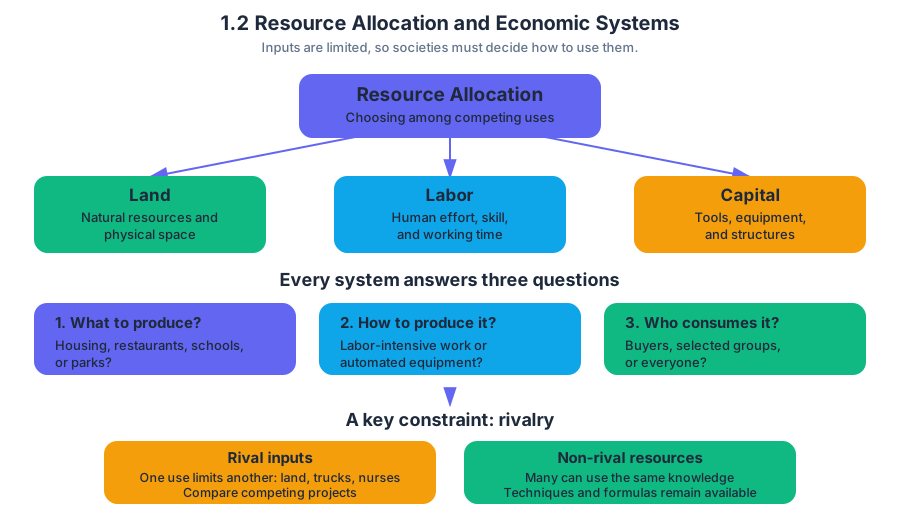
A society must answer three linked questions whenever it directs inputs toward production: what goods and services to produce, how to produce them, and who consumes them.
1.2 Resource Allocation and Economic Systems** [MKT]
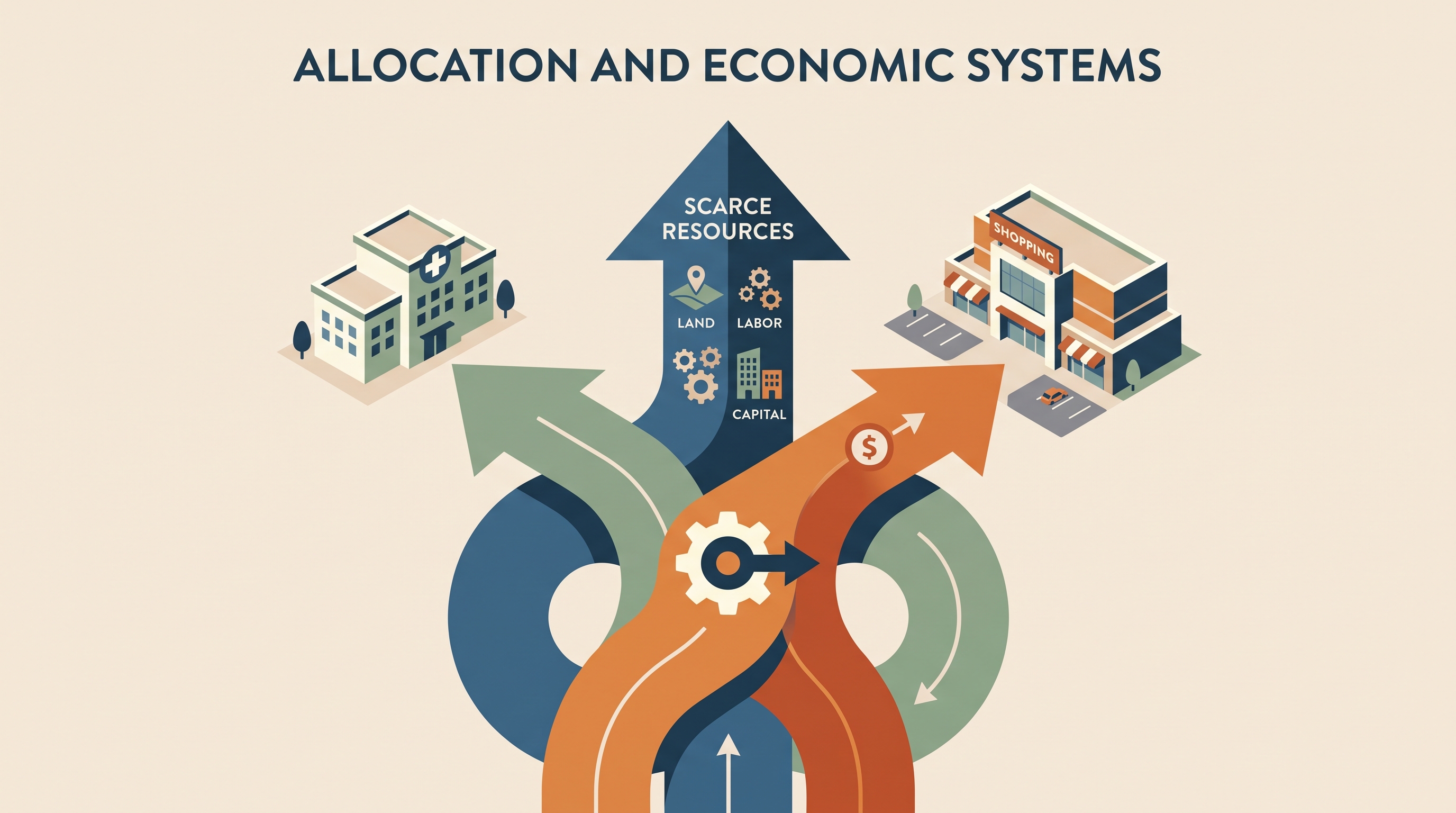
A society must answer three linked questions whenever it directs inputs toward production: what goods and services to produce, how to produce them, and who consumes them. The answers determine whether a city uses a valuable waterfront for apartments, a public park, a factory, or some combination—and whether those decisions are made through prices, government direction, custom, or a mixture of systems.
The allocation problem
Resource allocation is the process of deciding how available resources are assigned among competing uses. The relevant resources include the factors of production: land (natural resources and physical space), labor (human effort), and capital (produced tools, equipment, and structures used to make other goods and services).
| Allocation question | Example for a city |
|---|---|
| What to produce? | More housing, restaurants, schools, or parks? |
| How to produce it? | With labor-intensive construction or automated equipment? |
| Who consumes it? | Whoever can pay, whoever is selected by public rules, or everyone through shared access? |
Allocation depends especially on whether an input is rival: one person’s use prevents, or reduces, another person’s use of that same unit. A construction site, delivery truck, nurse’s working time, and parcel of land are rival inputs. Assigning them to one project means they cannot simultaneously serve competing projects, so decision-makers must compare uses and respond to constraints.
Some resources are non-rival, meaning one person’s use does not substantially reduce another person’s ability to use them. Established knowledge—such as a production technique or a mathematical formula—can often be used by many firms at once. A firm may still need scarce labor, computers, or legal access to apply that knowledge, but the knowledge itself does not become unavailable merely because another firm uses it.
Economic systems shape allocation
An economic system is the set of rules and institutions a society uses to organize production and consumption. Because systems assign decision-making authority differently, they produce different answers to the three allocation questions.
- A market economy relies primarily on decentralized decisions by households and firms. Prices communicate information about relative scarcity and guide resources toward uses for which buyers are willing to pay.
- A command economy relies primarily on government decisions. Public authorities determine production targets, methods, and distribution rules.
- A mixed economy combines markets with government action. Prices allocate many resources, while laws, taxes, subsidies, public production, or regulation alter particular outcomes.
No system eliminates constraints. A market economy may allocate housing toward high-income buyers rather than toward families with the greatest need. A command system may direct resources toward a public priority but lack accurate information about consumers’ changing preferences. The important economic question is not whether choices occur—they must—but who makes them and what incentives guide them.
Incentives and constraints
An incentive is a reward or penalty that changes the benefit or cost of an action. A higher wage can encourage workers to enter an occupation; a profit opportunity can encourage firms to produce a good; a tax can discourage an activity; and a subsidy can encourage it. A constraint is a limit on the actions available, such as income, time, technology, laws, or the quantity of land and labor.
Worked example — a neighborhood bakery: A bakery has one oven, a fixed number of workers, and limited flour. It must decide whether to produce bread, pastries, or both (what); whether to use more workers or specialized equipment (how); and which customers receive the output if demand exceeds production capacity (who). If the price of pastries rises, the potential profit creates an incentive to shift resources toward pastries—but the oven and staff remain constraints.
The bakery’s decision is also connected to consumers. The market demand curve is derived by adding the quantities demanded by all individual buyers at each possible price. If one buyer demands $2$ loaves at a price of $4$, a second demands $3$, and a third demands $1$, market quantity demanded at $4 is:
$$ Q_D^{market}=2+3+1=6\text{ loaves} $$
As prices change, the summed quantities show how the market communicates collective willingness to purchase. Sellers then use the resulting price signals, together with production costs and available inputs, to help allocate scarce resources.
Misconception check
Misconception: “A market economy means the government has no role.” A market economy uses prices and private decisions as its primary allocation mechanism, but a mixed economy may also use taxes, regulations, public goods, and other policies. Misconception: “Knowledge is always scarce because resources are scarce.” Knowledge can be non-rival even when the labor, equipment, and time required to create or apply it are rival and scarce.
Retrieval check
A town can use a vacant lot for a clinic or a shopping center. Identify the allocation question involved, name one rival factor of production that constrains the choice, and explain how a higher expected profit from shopping-center construction could change the town’s allocation decision. Then state why the town’s market demand curve cannot be found by looking at only one buyer’s demand.
Source Materials
- AP Microeconomics Course and Exam Description
- AP Microeconomics Course and Exam Description Clarifications and Corrections
- AP Microeconomics Course Overview
- AP Microeconomics Course at a Glance
- AP Microeconomics Course at a Glance Poster
- AP Microeconomics
- AP Microeconomics
- AP Microeconomics Sample Syllabus 1