From the free course AP Microeconomics on Lykke
4.2 Monopoly** `[PRD]`
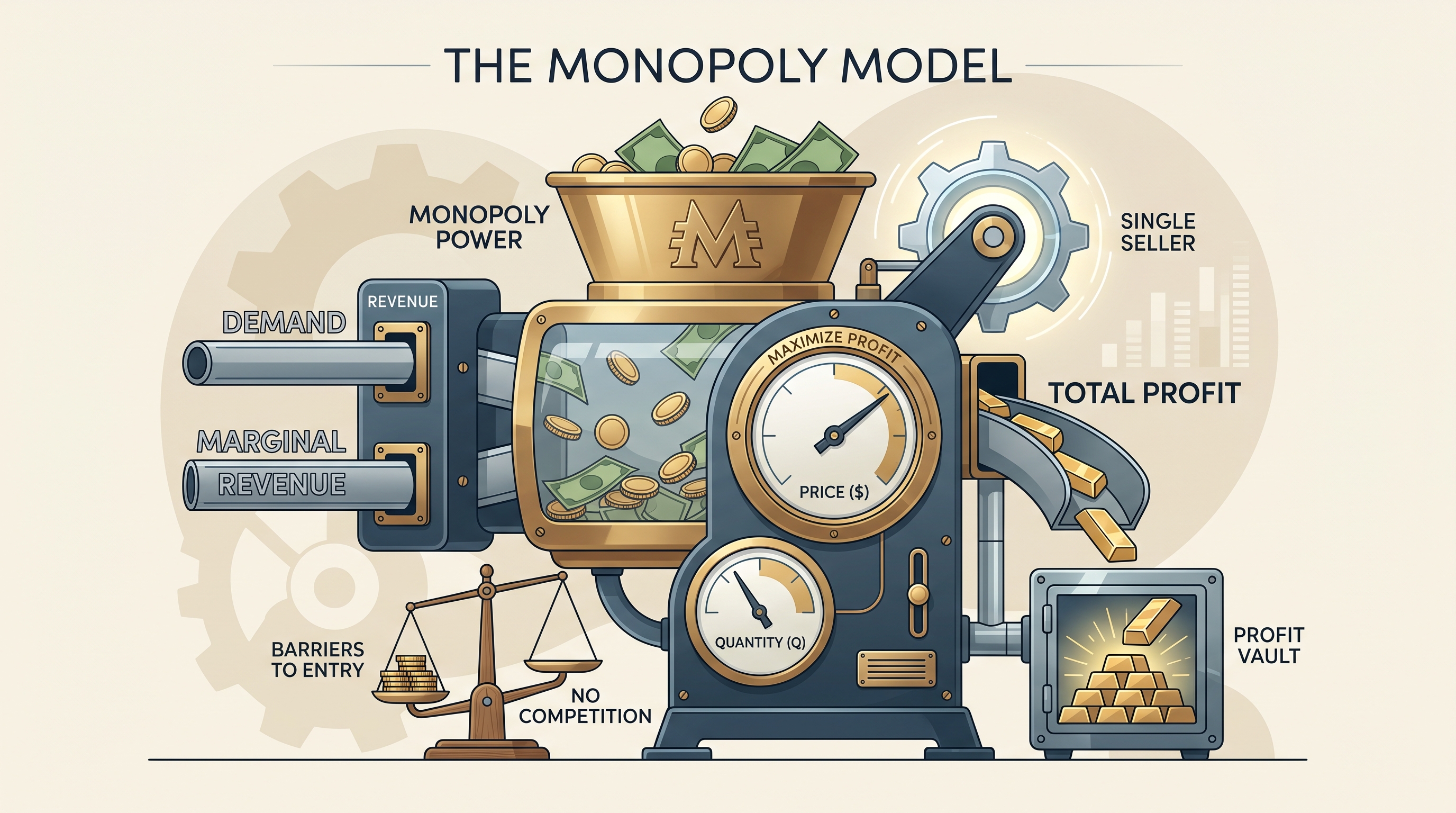
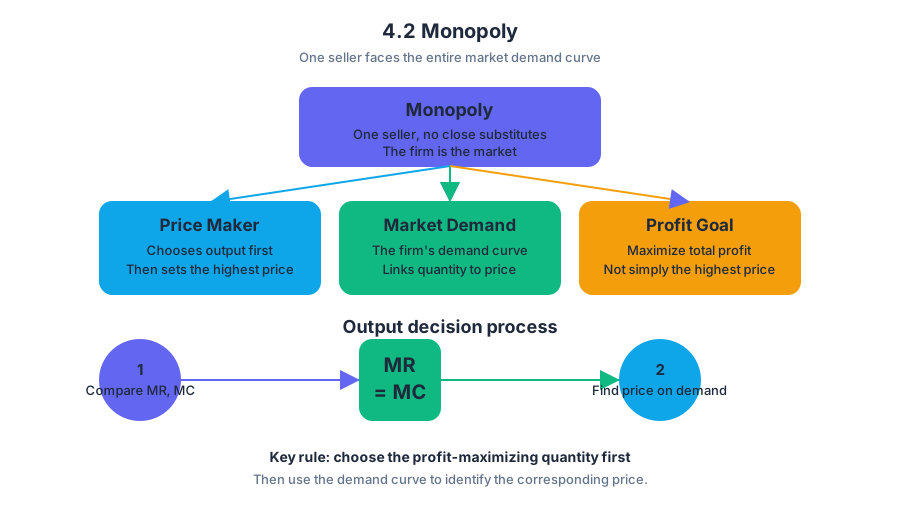
A monopoly exists when one firm is the only seller of a product with no close substitutes. Because the firm faces the market demand curve, it is a price maker: it chooses an output level and then charges the highest price consumers will pay for that quantity.
4.2 Monopoly** [PRD]
A monopoly exists when one firm is the only seller of a product with no close substitutes. Because the firm faces the market demand curve, it is a price maker: it chooses an output level and then charges the highest price consumers will pay for that quantity.
The crucial question is not “What price should the monopolist charge first?” It is: Which quantity maximizes profit? The monopolist chooses output where marginal revenue equals marginal cost, $MR = MC$, and then uses the demand curve to find the corresponding price.
Why a monopoly can exist
A monopoly survives because barriers to entry prevent other firms from entering the market. Important barriers include:
- Legal barriers, such as patents, licenses, or exclusive government franchises.
- Control of a key resource, such as the only viable source of a mineral.
- Economies of scale, when one large firm can produce at a lower average cost than several smaller firms. This can create a natural monopoly, often associated with infrastructure such as water distribution networks.
A monopoly may therefore have economic profit in the long run. In perfect competition, positive economic profit attracts entry, shifting market supply and reducing profit. Monopoly barriers block that entry, so the firm’s economic profit is not automatically eliminated.
The monopolist’s demand and marginal revenue
A monopolist’s demand curve is downward sloping. To sell one additional unit, the firm generally must lower the price not only on that unit but also on the units it was already selling. Consequently, marginal revenue lies below demand for every positive quantity.
For example, suppose market demand is
$$ P = 80-Q $$
Then total revenue is
$$ TR=P \times Q=(80-Q)Q=80Q-Q^2 $$
and marginal revenue is
$$ MR=80-2Q $$
The $MR$ curve has twice the slope of the linear demand curve and lies below it.
Profit maximization: from quantity to price
Suppose the monopolist’s marginal cost is
$$ MC=20+Q $$
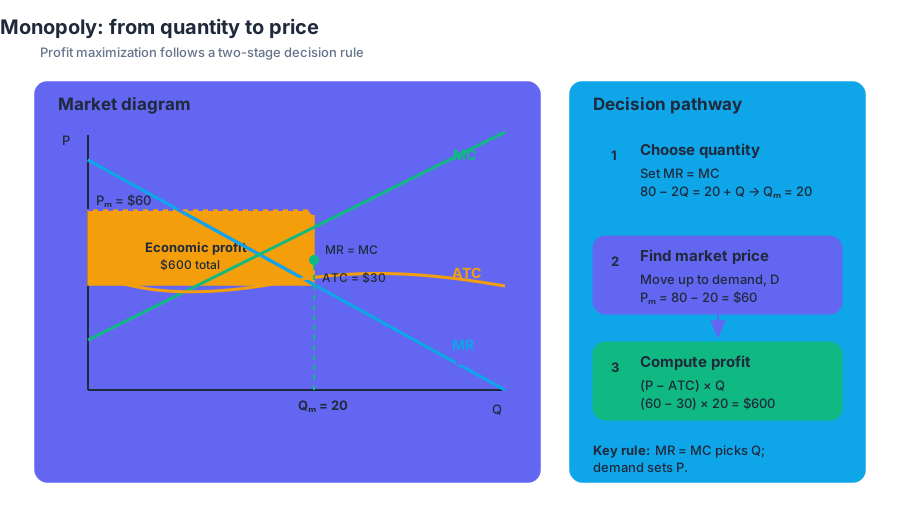
Set marginal revenue equal to marginal cost:
$$ 80-2Q=20+Q $$
$$ 60=3Q $$
$$ Q_M=20 $$
The profit-maximizing quantity is therefore $20$ units. To find the price, move vertically from $Q_M$ to the demand curve—not the $MR$ curve:
$$ P_M=80-20=$60 $$
If average total cost at $Q_M$ is $$30$, economic profit is
$$ \pi=(P_M-ATC)\times Q_M $$
$$ \pi=(60-30)(20)=$600 $$
The graph should show $D$, $MR$, $MC$, and $ATC$; $MR=MC$ determines quantity, demand determines price, and the vertical distance between price and average total cost determines profit per unit.
Key rule: A monopolist chooses $Q_M$ where $MR=MC$, then charges $P_M$ from the demand curve at that quantity.
Monopoly versus the socially efficient outcome
The socially efficient quantity occurs where consumers’ marginal benefit equals producers’ marginal cost. On a market graph, marginal benefit is represented by demand, so the efficient output $Q_S$ satisfies
$$ D=MC $$
For the numerical example:
$$ 80-Q=20+Q $$
$$ Q_S=30 $$
Thus,
$$ Q_M=20<Q_S=30 $$
The monopoly produces too little output and charges a higher price than the socially efficient outcome.
The lost gains from trades that would have benefited both buyers and sellers create deadweight loss. In the example, the deadweight loss is the triangular area between demand and marginal cost from $Q_M$ to $Q_S$:
$$ DWL=\frac{1}{2}(30-20)(60-40)=$100 $$
A monopoly can also create allocative inefficiency because price exceeds marginal cost:
$$ P_M>MC $$
At $Q_M$, the price is $$60$ while marginal cost is $$40$.
Profit, loss, and shutdown
A monopoly can earn economic profit when $P>ATC$, break even when $P=ATC$, or incur an economic loss when $P<ATC$. In the short run, it may continue operating despite a loss if price covers average variable cost:
$$ P\geq AVC $$
It shuts down in the short run when
$$ P<AVC $$
because producing would not cover the costs that vary with output.
Misconception check: A monopoly does not charge the highest imaginable price. Charging an excessively high price may reduce quantity demanded and total revenue. The profit-maximizing price is the price on demand at the output where $MR=MC$.
AP reasoning and retrieval check
This topic uses Skill Category 1: Principles and Models, especially Skill 1.A: Define economic principles and models, when identifying monopoly, barriers to entry, profit, and deadweight loss. It uses Skill Category 2: Interpretation to read a monopoly graph and infer price, quantity, profit, or loss; Skill Category 3: Manipulation to calculate $TR$, $MR$, profit, and efficient output; and Skill Category 4: Graphing and Visuals, including Skill 4.B, to construct and label the monopoly model accurately.
Retrieval check: A monopolist faces $D: P=100-Q$ and $MC=20+Q$. Find $MR$, $Q_M$, and $P_M$.
$$ MR=100-2Q $$
$$ 100-2Q=20+Q \Rightarrow Q_M=\frac{80}{3} $$
$$ P_M=100-\frac{80}{3}=\frac{220}{3} $$
The essential sequence is: derive $MR$ → set $MR=MC$ → find $Q_M$ → return to demand for $P_M$.
Source Materials
- AP Microeconomics Course and Exam Description
- AP Microeconomics Course and Exam Description Clarifications and Corrections
- AP Microeconomics Course Overview
- AP Microeconomics Course at a Glance
- AP Microeconomics Course at a Glance Poster
- AP Microeconomics
- AP Microeconomics
- AP Microeconomics Sample Syllabus 1