From the free course AP Microeconomics on Lykke
5.4 Monopsonistic Markets** `[PRD]`
Key concepts: Monopsonistic markets · Intervention in different markets
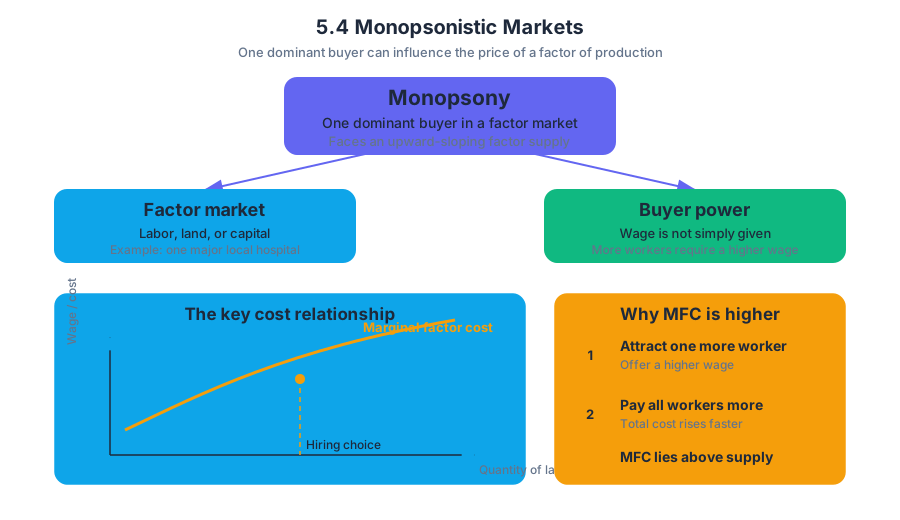
A monopsony exists when a single buyer has substantial control over the purchase of a factor of production, such as labor. A town with one major hospital hiring nurses, or one factory employing most local workers, may be able to influence the wage rather than accept a market wage as given.
5.4 Monopsonistic Markets** [PRD]
A monopsony exists when a single buyer has substantial control over the purchase of a factor of production, such as labor. A town with one major hospital hiring nurses, or one factory employing most local workers, may be able to influence the wage rather than accept a market wage as given.
Monopsony: a factor market with one dominant buyer that faces an upward-sloping supply curve for the factor.
The key asymmetry is simple: a competitive firm hires at the market wage, but a monopsonist must often offer a higher wage to attract additional workers. Because raising the wage may increase the payment to all workers, the marginal factor cost—the additional cost of hiring one more unit of the factor—lies above the factor supply curve.
The monopsony outcome
Suppose a firm faces these relationships in a labor market:
$$w_S = 10 + L$$
$$MFC = 10 + 2L$$
$$MRP_L = 50 - L$$
Here, $L$ is the number of workers, $w_S$ is the wage required to attract labor, and $MRP_L$ is the marginal revenue product of labor: the additional revenue generated by one more worker.
The monopsonist chooses employment where the marginal factor cost equals the marginal revenue product:
$$MFC = MRP_L$$
$$10 + 2L = 50 - L$$
$$3L = 40$$
$$L_M = 13.33$$
After choosing $L_M$, the firm moves down to the labor-supply curve to find the wage it pays:
$$w_M = 10 + 13.33 = $23.33$$
The monopsony therefore hires about $13.33$ workers at $$23.33$ per worker. It does not read the wage from the $MFC$ curve; the $MFC$ curve determines employment, while the supply curve determines the wage.
For comparison, a competitive labor market reaches equilibrium where labor supply equals labor demand, or here where $w_S = MRP_L$:
$$10 + L = 50 - L$$
$$L_C = 20,\qquad w_C = $30$$
The monopsony produces a lower wage and lower employment than the competitive outcome:
| Market structure | Employment | Wage |
|---|---|---|
| Competitive labor market | $20$ | $$30$ |
| Monopsony | $13.33$ | $$23.33$ |
This is a market failure because the monopsony restricts factor employment below the socially efficient level. At employment levels between $13.33$ and $20$, the worker’s contribution to revenue exceeds the cost of the wage required to employ that worker, but the monopsonist does not hire because doing so would raise its factor costs.
Government intervention in a monopsonistic labor market
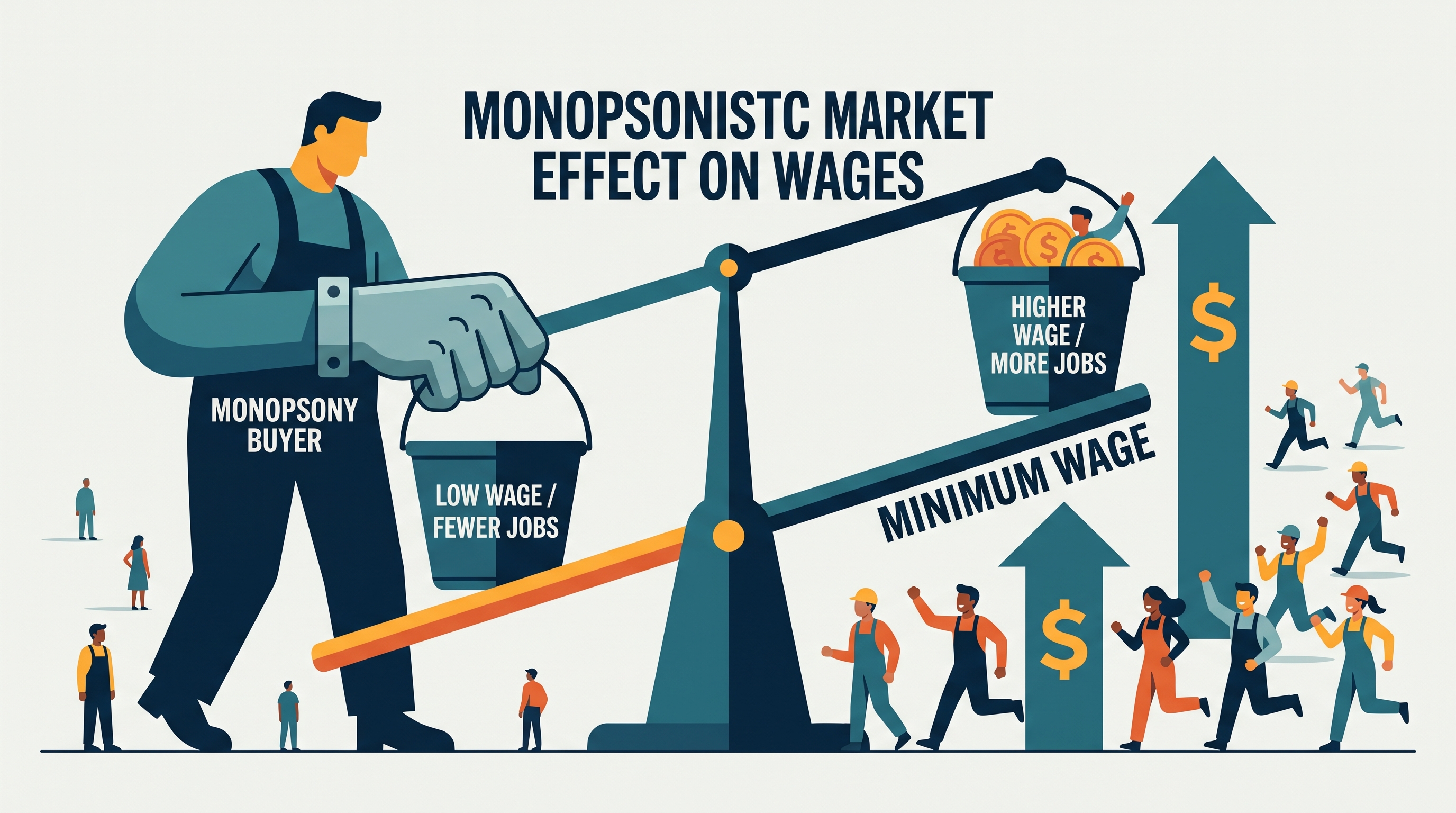
A government may impose a minimum wage, a legal wage floor below which workers cannot be paid. In a competitive labor market, a binding minimum wage usually creates a surplus of labor—more workers want jobs than firms want to hire. In a monopsony, however, a carefully chosen minimum wage can increase both the wage and employment.
Consider a minimum wage of $$25$, which lies above the monopsony wage of $$23.33$ but below the competitive wage of $$30$. At $$25$, the labor supply equation gives:
$$25 = 10 + L$$
$$L = 15$$
The firm can hire $15$ workers at $$25$. Because the wage floor prevents the firm from lowering pay below $$25$, employment rises from $13.33$ to $15$, while the wage rises from $$23.33$ to $$25$.
A minimum wage of exactly $$30$ is the competitive-wage intervention in this example. It produces the competitive outcome: $20$ workers are employed at $$30$. A floor above $$30$ would begin to create the familiar excess supply of labor, because workers would want to supply more labor than the firm wishes to hire at that wage.
Reading intervention across markets
The effect of government intervention depends on the market structure, not merely on the policy’s label. A price floor in a competitive product market can create a surplus, while a wage floor in a monopsonistic factor market can correct underemployment. The same apparent intervention can therefore have different outcomes depending on which side of the market possesses power.
Use this decision path when interpreting a graph:
- Identify whether the controlled market is a product market or a factor market.
- Identify whether the relevant buyer or seller has market power.
- Compare the intervention with the unregulated equilibrium price or wage.
- Determine the quantity actually traded—not merely the quantity demanded or supplied.
- Check for surplus, shortage, or improved efficiency.
AP skills and common misconception
This topic most directly uses Skill Category 1: Principles and Models, especially 1.A Define economic principles and models and 1.B Explain economic principles and models; Skill Category 2: Interpretation, especially 2.B Explain economic outcomes; Skill Category 3: Manipulation, especially 3.B Determine the effect of economic changes; and Skill Category 4: Graphing and Visuals, especially 4.A Draw correctly labeled graphs and 4.C Explain economic outcomes using graphs. On an exam, these skills may appear through a monopsony graph, a numerical intervention, or a written explanation of employment and wage changes.
Misconception check — “Every minimum wage causes unemployment.” That statement is too broad. In a competitive labor market, a binding wage floor above equilibrium can cause unemployment. In a monopsony, a minimum wage between the monopsony wage and the competitive wage can raise employment by limiting the buyer’s wage-setting power.
Retrieval check: In the numerical example, what happens when the minimum wage rises from $$25$ to $$30$? The wage rises to $$30$ and employment rises to the competitive level of $20$. Why would a wage floor above $$30$ produce a different result? Because it exceeds the competitive wage and creates excess labor supply.
Source Materials
- AP Microeconomics Course and Exam Description
- AP Microeconomics Course and Exam Description Clarifications and Corrections
- AP Microeconomics Course Overview
- AP Microeconomics Course at a Glance
- AP Microeconomics Course at a Glance Poster
- AP Microeconomics
- AP Microeconomics
- AP Microeconomics Sample Syllabus 1