From the free course AP Microeconomics on Lykke
1.1 Scarcity** `[MKT]`
Key concepts: Scarcity · Incentives and constraints · Mutually beneficial terms of trade · Utility · Profit-maximizing strategy · Strategic decision-making
A community can want unlimited clean water, leisure, food, shelter, and entertainment, but it cannot command unlimited time, money, labor, or materials. Scarcity exists because human wants exceed the resources available to satisfy them.
1.1 Scarcity** [MKT]
A community can want unlimited clean water, leisure, food, shelter, and entertainment, but it cannot command unlimited time, money, labor, or materials. Scarcity exists because human wants exceed the resources available to satisfy them. Every choice therefore has a cost: selecting one use of a resource means giving up another.
Investigative question: When resources are limited, how do incentives, constraints, and trade help people and firms make choices?
Scarcity forces choices
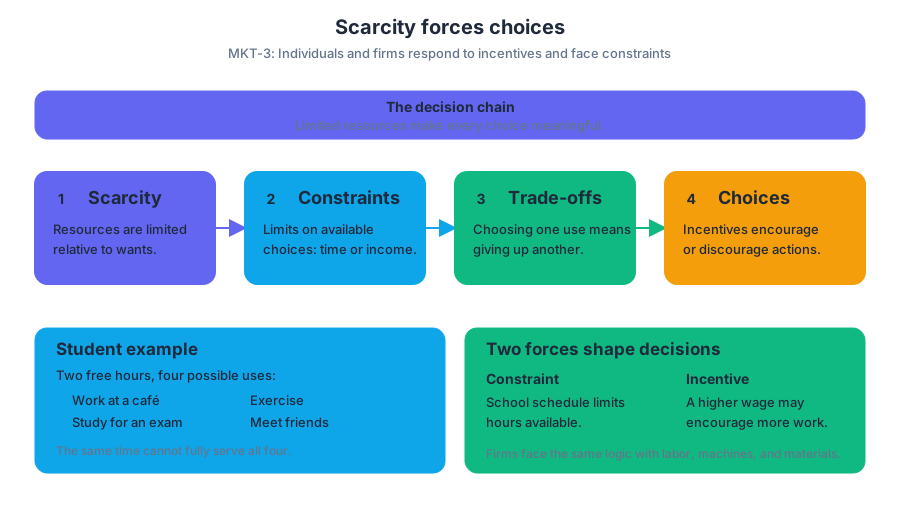
A student with two free hours might work at a café, study for an exam, exercise, or meet friends. The student cannot fully choose all four uses of the same two hours. A constraint is a limitation on available choices, such as time, income, technology, information, or productive capacity. An incentive is something that encourages or discourages an action, such as a wage, a price, a reward, a penalty, or an expected profit.
The important point in MKT-3: Individuals and firms respond to incentives and face constraints is that choices arise from the interaction of both forces. A higher wage may encourage a person to work more, but a demanding school schedule may limit how many hours are actually available. A firm may want to produce more, but limited machinery, workers, or materials constrain its output.
A useful decision chain is:
$$ \text{Scarcity} \longrightarrow \text{Constraints} \longrightarrow \text{Trade-offs} \longrightarrow \text{Choices shaped by incentives} $$
Misconception check — “Scarcity means a good is rare.” Scarcity does not require physical rarity. Even abundant goods can be scarce if obtaining, storing, or distributing them requires limited resources. Air is generally not scarce for breathing, but clean air in a polluted city may be scarce because its quality is limited relative to demand.
Mutually beneficial terms of trade
Scarcity does not mean every person must produce everything independently. Trade allows people or firms to exchange goods, services, or resources. Mutually beneficial terms of trade are exchange conditions under which both parties become better off than they would have been without the exchange.
Suppose Maya can bake bread efficiently but dislikes repairing bicycles, while Luis repairs bicycles efficiently but has little time for baking. Maya gives Luis bread, and Luis repairs Maya’s bicycle. If each person values what they receive more than what they give up, both gain—even though no new physical resources appeared. Trade improves the allocation of existing scarce resources by allowing specialization and exchange.
The exchange must be voluntary and acceptable to both sides. If Maya would accept at least one bicycle repair for two loaves of bread, while Luis would provide that repair for no more than three loaves, any agreed exchange between those amounts can benefit both participants.
Utility: measuring benefit from consumption
Utility is the benefit or satisfaction a consumer receives from consuming a good or service. Utility is not necessarily measured in dollars; economists use it as a way to represent how strongly a consumer values different options.
For example, a hungry customer may receive high utility from the first sandwich but less additional utility from a second sandwich. The customer still faces an income constraint, so the choice depends on both the satisfaction available from each purchase and the prices of the goods. Utility explains the benefit side of a consumer decision; scarcity explains why the consumer cannot simply purchase every desirable option.
Worked example: Field Cruiser
Field Cruiser is deciding how to improve its vehicle. Its scarce development budget can be directed toward greater Power or another feature. The firm compares the expected additional revenue or cost savings from each strategy with the resources required to implement it.
When the available incentives, expected benefits, and production constraints are evaluated together, Field Cruiser’s most profitable strategy is to improve Power. The conclusion is not that Power is universally the best feature. It is the best strategy under Field Cruiser’s particular constraints and expected returns.
This is a simple example of strategic decision-making: choosing an action after considering how scarce resources, expected payoffs, and constraints interact. A profit-maximizing firm selects the strategy expected to produce the greatest economic profit, not necessarily the strategy with the greatest sales, popularity, or physical output.
AP skill connection
This topic most directly uses Skill Category 1: Principles and Models, especially 1.A Define economic principles and models and 1.B Explain economic principles and models; Skill Category 2: Interpretation, including 2.A Identify economic concepts, principles, and models and 2.B Explain economic outcomes; and Skill Category 3: Manipulation, including 3.A Determine outcomes of specific economic situations. On an exam, these skills may appear through a short scenario, a comparison of incentives and constraints, or a request to identify the firm’s most profitable strategy.
Retrieval check: A worker receives a higher wage but cannot work additional hours because of a fixed school schedule. Which force limits the worker’s response: an incentive or a constraint? Why can a voluntary exchange make both parties better off?

Source Materials
- AP Microeconomics Course and Exam Description
- AP Microeconomics Course and Exam Description Clarifications and Corrections
- AP Microeconomics Course Overview
- AP Microeconomics Course at a Glance
- AP Microeconomics Course at a Glance Poster
- AP Microeconomics
- AP Microeconomics
- AP Microeconomics Sample Syllabus 1
- equal to $15, greater than $15, or less than $15? Explain using numbers.
- AP Microeconomics-AP Students-College Board
- AP/College Microeconomics-Khan Academy
- AP Microeconomics Exam Questions-AP Central-College Board