From the free course AP Microeconomics on Lykke
1.4 Comparative Advantage and Trade** `[MKT]`
Key concepts: Absolute advantage · Comparative advantage · Opportunity cost · Specialization in production · Production possibilities curve (PPC) · Gains from trade · Terms of trade · Scarcity · Consumption possibilities beyond the PPC · Mutually beneficial trade
A producer can benefit from trade even when another producer is better at making everything. The key question is not “Who can produce more?” but “Who gives up less to produce this good?”
1.4 Comparative Advantage and Trade** [MKT]
A producer can benefit from trade even when another producer is better at making everything. The key question is not “Who can produce more?” but “Who gives up less to produce this good?”
Scarcity creates the reason to specialize
Resources are scarce: time, labor, land, tools, and materials have competing uses. When a producer uses those resources to make one good, the producer gives up some amount of another good. That forgone alternative is the opportunity cost of the choice.
Specialization directs scarce resources toward the use with the lowest opportunity cost. Trade then allows producers to exchange part of their specialized output for other goods, mitigating the consequences of scarcity.
Absolute advantage versus comparative advantage
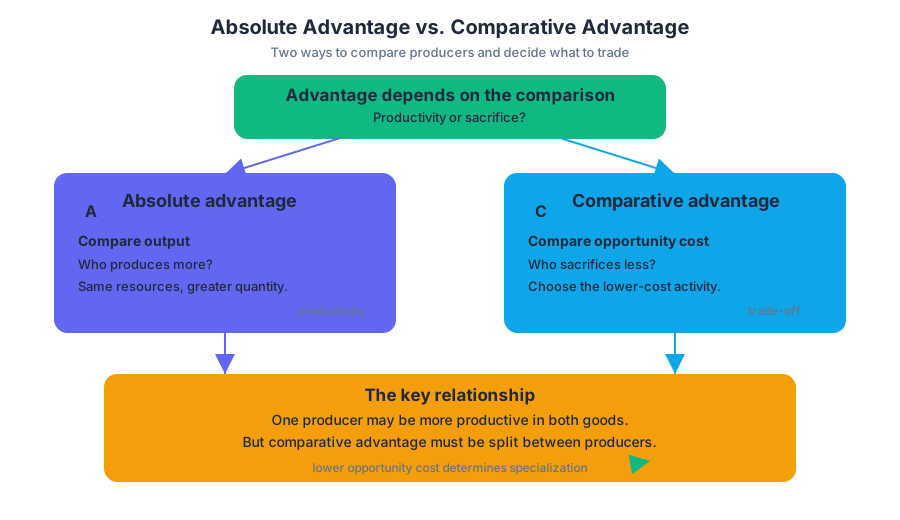
Absolute advantage means producing a greater quantity of a good or service than another producer with the same quantity of resources. It is a comparison of productivity.
MKT-2.A.1: Absolute advantage describes a situation in which an individual, business, or country can produce more of a good or service than any other producer with the same quantity of resources.
Comparative advantage means producing a good or service at a lower opportunity cost than another producer. It is a comparison of what must be sacrificed.
MKT-2.A.2: Comparative advantage describes a situation in which an individual, business, or country can produce a good or service at a lower opportunity cost than another producer.
A producer may have an absolute advantage in both goods, but cannot have a comparative advantage in both goods. If one producer has the lower opportunity cost of producing one good, the other producer must have the lower opportunity cost of producing the other good.
Worked example: finding comparative advantage
Suppose Blair and Casey each have the same resources. In one production period, Blair can produce either $16$ baskets of fruit or $6$ shirts. Casey can produce either $12$ baskets of fruit or $4$ shirts.
Blair has the absolute advantage in both goods because Blair can produce more fruit and more shirts. But opportunity costs determine comparative advantage:
$$ \text{Blair's opportunity cost of 1 shirt}
\frac{16\text{ baskets of fruit}}{6\text{ shirts}}
\frac{8}{3}\text{ baskets of fruit} $$
$$ \text{Casey's opportunity cost of 1 shirt}
\frac{12\text{ baskets of fruit}}{4\text{ shirts}}
3\text{ baskets of fruit} $$
Because Blair gives up fewer baskets of fruit per shirt, Blair has the comparative advantage in shirts. Casey therefore has the comparative advantage in fruit: Casey gives up fewer shirts per basket of fruit.
To analyze a trade problem, calculate each producer’s opportunity costs, identify comparative advantage, and test whether the proposed terms of trade fall between those costs.
Specialization and gains from trade
Specialization in production occurs when each producer concentrates resources on the good for which that producer has comparative advantage. Blair specializes in shirts, while Casey specializes in fruit. Their combined production can exceed the combined production possible when each produces both goods independently.
Terms of trade are the rate at which one good exchanges for another. For trade to benefit both parties, the exchange rate must lie between their opportunity costs.
For one shirt, Blair requires at least $\frac{8}{3}$ baskets of fruit to avoid losing from trade, while Casey will pay up to $3$ baskets of fruit because producing one shirt costs Casey $3$ baskets. Therefore, mutually beneficial terms of trade for one shirt fall in the interval
$$ \frac{8}{3} < \text{terms of trade} < 3. $$
At a rate of $1$ shirt for $\frac{17}{6}$ baskets of fruit, Blair receives more fruit than Blair’s internal opportunity cost, and Casey pays less fruit than Casey’s internal opportunity cost. Both producers gain.
Why consumption can move beyond the PPC
A production possibilities curve shows what a producer can produce using available resources and technology. Trade does not necessarily move the producer’s own PPC; instead, it allows the producer to consume a combination that would have been unattainable through isolated production.
For example, if Blair specializes in shirts, produces $6$ shirts, and trades for $\frac{16}{3}$ baskets of fruit, Blair may consume a bundle containing $2$ shirts and $\frac{16}{3}$ baskets of fruit after trading away $4$ shirts. Measured against Blair’s fruit-only maximum of $16$ baskets and shirt maximum of $6$ shirts, the bundle’s normalized resource use is
$$ \frac{16/3}{16}+\frac{2}{6}
\frac{1}{3}+\frac{1}{3}
\frac{2}{3}, $$
which is feasible. If the intended bundle instead uses Blair’s relevant trade conversion of $\frac{16}{3}$ fruit units against a six-unit fruit scale, its normalized calculation is
$$ \frac{16/3}{6}+\frac{2}{6}
\frac{8}{9}+\frac{1}{3}
\frac{11}{9}>1. $$
That second representation places Blair’s consumption bundle beyond the original PPC: Blair could not reach it without trade. The economic conclusion is the important one—specialization based on comparative advantage and mutually beneficial exchange expands consumption possibilities.
MKT-2.B.1: Production specialization according to comparative advantage, not absolute advantage, results in exchange opportunities that lead to consumption possibilities beyond the PPC.
MKT-2.B.2: Comparative advantage and opportunity costs determine the terms of trade for exchange under which mutually beneficial trade can occur.
Misconception check
Misconception: “The producer with absolute advantage should produce both goods.” Absolute advantage identifies who can produce more, but comparative advantage identifies who sacrifices less. Producing according to absolute advantage alone can waste the gains created by different opportunity costs.
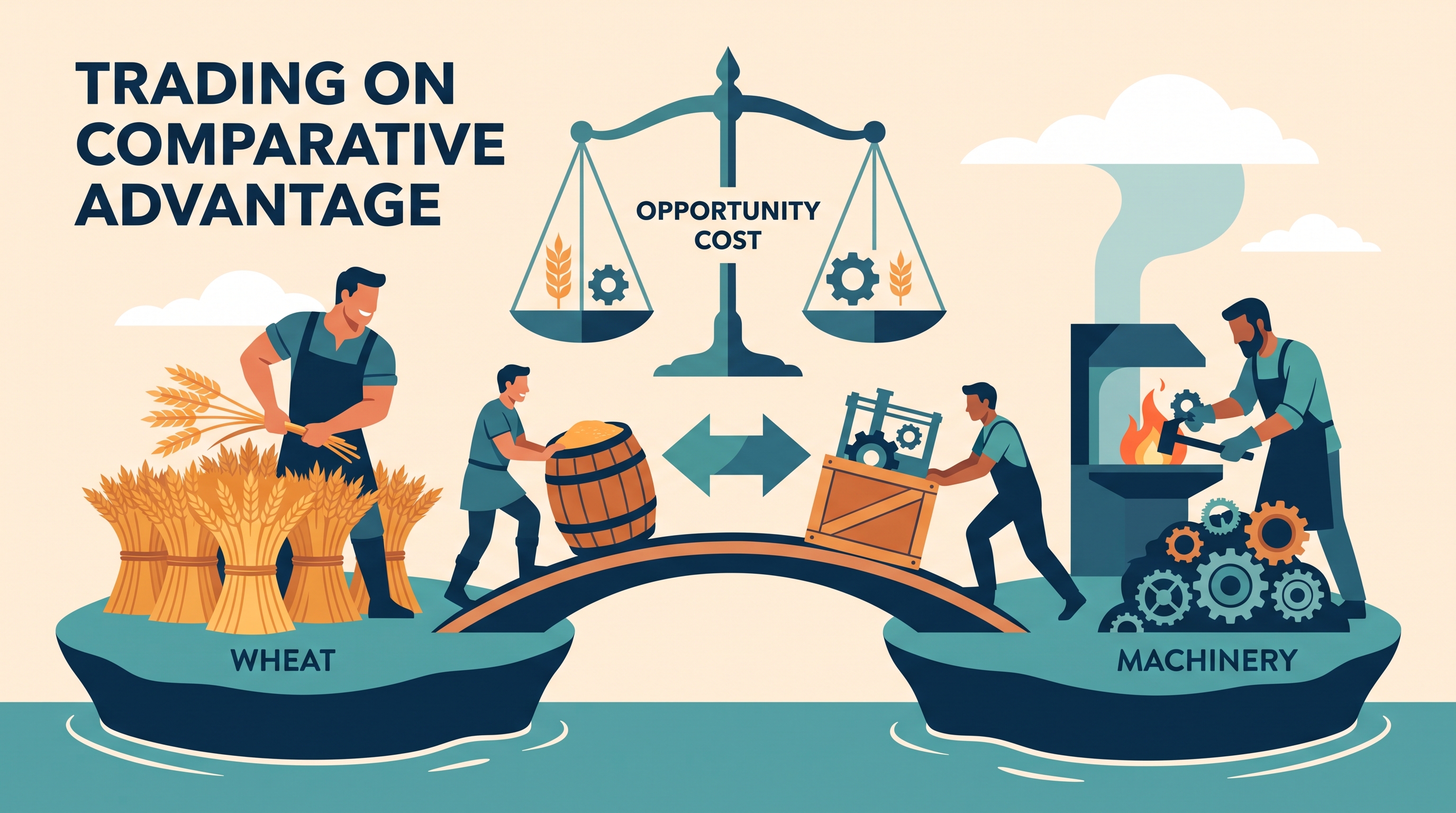
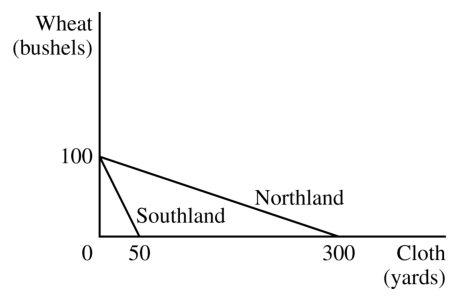
Retrieval check: If one country has a lower opportunity cost of producing wheat and another has a lower opportunity cost of producing machines, which country should specialize in wheat? What must be true of the terms of trade for both countries to gain?
Source Materials
- AP Microeconomics Course and Exam Description
- AP Microeconomics Course and Exam Description Clarifications and Corrections
- AP Microeconomics Course Overview
- AP Microeconomics Course at a Glance
- AP Microeconomics Course at a Glance Poster
- AP Microeconomics
- AP Microeconomics
- AP Microeconomics Sample Syllabus 1
- Based on your experience at the AP® Reading with student responses, what advice would you offer teachers to help them improve the student performance on the exam? Comparative advantage is a core conce
- (a) Which country has a comparative advantage in producing wheat? Explain using numbers.