From the free course AP Microeconomics on Lykke
2.5 Other Elasticities** `[MKT]`
Key concepts: Confusing a player’s best response with a Nash equilibrium · Failing to compare a firm’s profits conditional on the other firm’s strategy · Failing to identify both Nash equilibria in a payoff matrix · Misreading payoff inequalities when determining the preferred strategy · Confusing the strategy labels Unique, Typical, Gold, and Silver · Failing to distinguish each firm’s profit from the other firm’s profit · Misinterpreting reported changes in fuel prices or fuel-related amounts for Nice Ride and Field Cruiser
A firm’s best strategy can change when its rival changes strategy, so a payoff matrix must be read conditionally, not by searching for the largest number.
2.5 Other Elasticities** [MKT]
A firm’s best strategy can change when its rival changes strategy, so a payoff matrix must be read conditionally, not by searching for the largest number. The central question is: given what the other firm does, which action gives this firm the higher payoff?
Best responses: compare within the rival’s choice
A best response is the strategy that produces the greatest payoff given the other firm’s strategy. It is not necessarily the strategy with the largest payoff anywhere in the matrix.
For Tony’s Trinkets and Bitaly’s Bracelets, write each cell as $(\text{Tony payoff},\text{Bitaly payoff})$:
| Bitaly: Gold | Bitaly: Silver | |
|---|---|---|
| Tony: Unique | $(18,21)$ | $(20,19)$ |
| Tony: Typical | $(17,7)$ | $(21,16)$ |
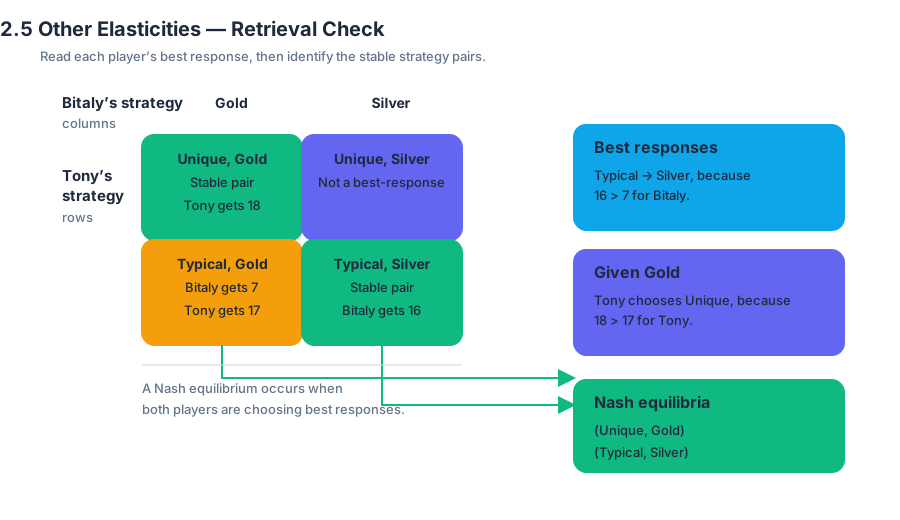
Suppose Bitaly chooses Silver. Tony compares only the Silver column: Unique gives Tony $20$, while Typical gives Tony $21$. Because $21>20$, Tony’s best response is Typical, not Unique.
Now hold Tony’s choice fixed and analyze Bitaly. If Tony chooses Unique, Bitaly compares $21$ from Gold with $19$ from Silver. Since $21>19$, Bitaly prefers Gold. If Tony chooses Typical, Bitaly compares $7$ from Gold with $16$ from Silver. Since $16>7$, Bitaly prefers Silver.
Reading rule: Tony compares the first number in each relevant row or column; Bitaly compares the second number. Never compare a firm’s payoff with the other firm’s payoff.
Dominant strategies are stronger than best responses
A dominant strategy gives a firm a higher payoff regardless of what the other firm chooses. Bitaly does not have a dominant strategy: Gold is better when Tony chooses Unique, but Silver is better when Tony chooses Typical.
The conditional logic is:
$$ \begin{array}{c} \text{Tony chooses Unique} \Rightarrow \text{Bitaly chooses Gold because }21>19\[4pt] \text{Tony chooses Typical} \Rightarrow \text{Bitaly chooses Silver because }16>7 \end{array} $$
The labels Unique, Typical, Gold, and Silver are strategy names, not payoff categories. “Unique” and “Typical” belong to Tony’s Trinkets; “Gold” and “Silver” belong to Bitaly’s Bracelets. A common mistake is to treat “Gold” as automatically better than “Silver” or to choose “Unique” because it sounds more valuable. The numbers, conditional on the rival’s action, determine the best response.
Nash equilibrium requires mutual best responses
A Nash equilibrium is an outcome in which both firms are choosing best responses to each other. Neither firm would increase its own payoff by changing strategies alone.
The first equilibrium is:
$$ (\text{Tony: Unique},\text{Bitaly: Gold}) $$
At $(\text{Unique},\text{Gold})$, Tony receives $18$. If Bitaly remains with Gold, Tony compares $18$ from Unique with $17$ from Typical, so Tony stays with Unique. Bitaly receives $21$; if Tony remains with Unique, Bitaly compares $21$ from Gold with $19$ from Silver, so Bitaly stays with Gold. Both choices are mutual best responses.
The second equilibrium is:
$$ (\text{Tony: Typical},\text{Bitaly: Silver}) $$
At $(\text{Typical},\text{Silver})$, Tony receives $21$ and would receive only $20$ by switching to Unique. Bitaly receives $16$ and would receive only $7$ by switching to Gold. Therefore, both firms again prefer to remain where they are.
Examiner’s warning: Naming only one equilibrium is incomplete. Part C requires identifying both Nash equilibria: $(\text{Unique},\text{Gold})$ and $(\text{Typical},\text{Silver})$.
Why fuel-related dollar amounts cannot be compared mechanically
The Nice Ride and Field Cruiser example reports fuel-price-related dollar amounts of $30$ million for Nice Ride and $40$ million for Field Cruiser. These figures are changes associated with fuel prices; they are not automatically the firms’ prices, profits, or total costs. Their effect depends on whether the change raises or lowers each firm’s fuel cost and therefore its payoff.
If a fuel-price increase raises Nice Ride’s operating cost by $30$ million, Nice Ride’s relevant payoff falls by $30$ million, holding other factors constant. If the same kind of increase raises Field Cruiser’s cost by $40$ million, Field Cruiser’s payoff falls by $40$ million. A fuel-price decrease would reverse those directions by lowering cost and raising payoff.
The correct procedure is therefore:
- Identify whether the amount is a change in cost, a change in profit, or another stated quantity.
- Determine the direction: does the fuel change increase or decrease the firm’s payoff?
- Insert the adjusted payoff into the appropriate cell.
- Compare each firm’s payoffs conditional on the other firm’s strategy.
- Mark an outcome as a Nash equilibrium only when both firms are best responding.
Retrieval check
If Tony chooses Typical, which strategy does Bitaly prefer, and why? If Bitaly chooses Gold, which Tony strategy is best using the matrix above? Finally, name both Nash equilibria.
Answer: Bitaly prefers Silver because $16>7$. Given Gold, Tony prefers Unique because $18>17$. The two Nash equilibria are $(\text{Unique},\text{Gold})$ and $(\text{Typical},\text{Silver})$.

Source Materials
- AP Microeconomics Course and Exam Description
- AP Microeconomics Course and Exam Description Clarifications and Corrections
- AP Microeconomics Course Overview
- AP Microeconomics Course at a Glance
- AP Microeconomics Course at a Glance Poster
- AP Microeconomics
- AP Microeconomics
- AP Microeconomics Sample Syllabus 1
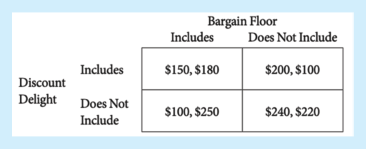
- (a) If Discount Delight does not include the shoes in its sale but Bargain Floor includes them, what will Bargain Floor’s profit be?
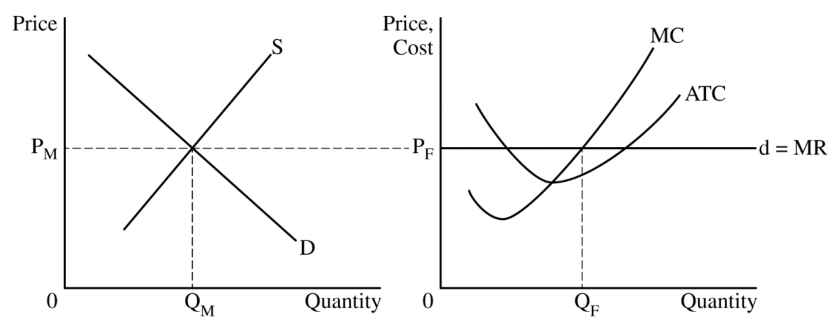
- For the fifth point, the firm’s graph must show the area representing positive economic
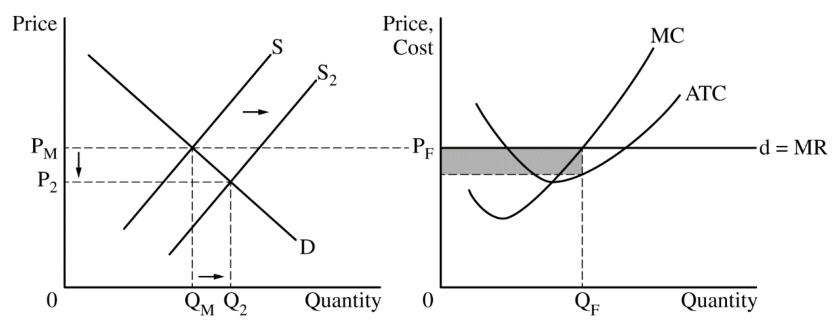
- (ii) On the firm’s graph from part (a), show a lower price, labeled P*, extended from the new
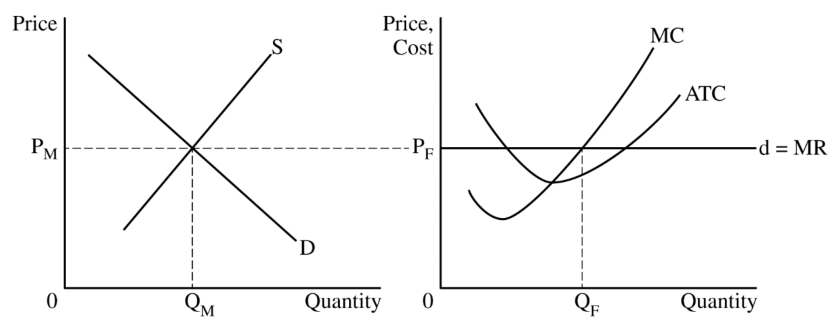
- For the fifth point, the firm’s graph must show the area representing positive economic