From the free course AP Microeconomics on Lykke
6.1 Socially Efficient and Inefficient Market Outcomes** `[POL]`
Key concepts: Social efficiency · Perfectly competitive market equilibrium · Marginal benefit and marginal cost · Private costs and benefits · Market inefficiency · Deadweight loss · Externalities · Non-efficient quantity · Market structures and imperfect competition · Cost-benefit analysis
A market is socially efficient when it produces the quantity that maximizes total economic surplus: the value consumers place on the last unit equals the full cost of producing it.
6.1 Socially Efficient and Inefficient Market Outcomes** [POL]
A market is socially efficient when it produces the quantity that maximizes total economic surplus: the value consumers place on the last unit equals the full cost of producing it. In symbols, the efficient quantity occurs where:
$$MSB = MSC$$
Here, $MSB$ is marginal social benefit, the total benefit to society from one additional unit, and $MSC$ is marginal social cost, the total cost to society of producing that unit.
Investigative question: When does a market’s private equilibrium also produce the best outcome for society—and when does it quietly produce too much or too little?
The efficient quantity
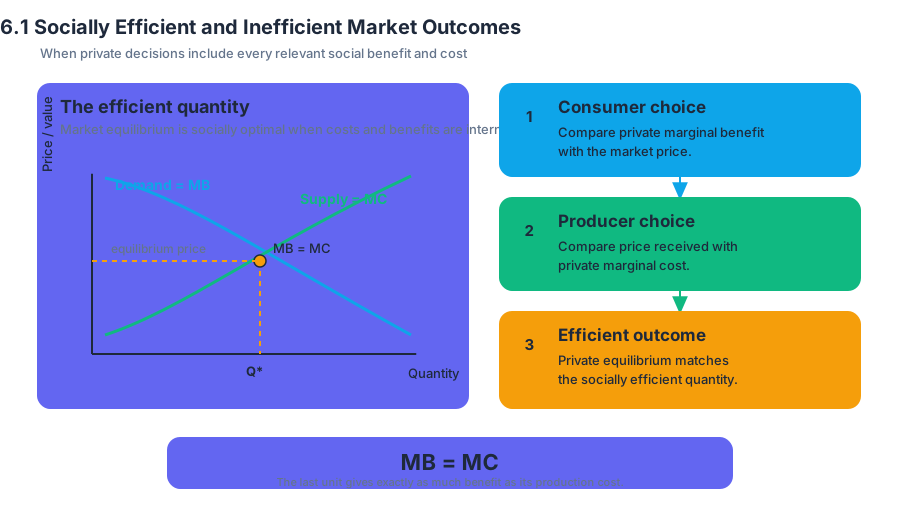
For a product with no unaccounted-for costs or benefits, the market demand curve represents marginal benefit and the market supply curve represents marginal cost. The equilibrium quantity, where demand intersects supply, is therefore socially optimal because the last unit purchased provides exactly as much benefit as the cost of producing it.
A consumer compares the private marginal benefit of one more unit with its price. A producer compares the price received with its private marginal cost, the additional cost paid by the producer to make one more unit. In a perfectly competitive market, rational consumers and firms make decisions that lead toward:
$$MB = MC$$
When all social benefits and costs are internalized—meaning they are included in the decisions of market participants—private equilibrium matches the socially efficient outcome.
Why perfect competition can be efficient
Imagine a competitive market for bicycle repairs. At the equilibrium price, customers willing to pay at least the cost of providing a repair receive the service, while customers who value it less than its cost do not. Because each transaction creates at least as much benefit as cost, total surplus is maximized.
This result depends on the market being perfectly competitive and on private incentives reflecting the full social consequences of production and consumption. Perfect competition alone does not guarantee efficiency if an outside cost or benefit is missing from the market decision.
| Decision-maker | Marginal comparison | Private decision |
|---|---|---|
| Consumer | Private marginal benefit versus price | Purchase if benefit is at least the price |
| Firm | Price or private marginal revenue versus private marginal cost | Produce if revenue covers the additional cost |
| Society | Marginal social benefit versus marginal social cost | Produce until $MSB = MSC$ |
When equilibrium becomes inefficient
A market can reach an equilibrium that is rational for each participant but inefficient for society. Market inefficiency occurs when the market produces a quantity different from the socially optimal quantity. Essential Knowledge POL-2.C.1 identifies several causes: monopoly, oligopoly, monopolistic competition, negative and positive externalities in production or consumption, asymmetric information, and insufficient production of public goods.
Market power is one major cause. A monopolist restricts output because its private profit-maximizing decision occurs where marginal revenue equals marginal cost, $MR = MC$, rather than where the market’s marginal benefit equals marginal cost. The resulting quantity is below the socially efficient quantity, creating lost gains from trades that would have benefited both sides.
Externalities create another possibility: the private marginal cost or benefit differs from the social marginal cost or benefit. For example, if production imposes an unpriced cost on others, private firms may produce more than the socially efficient quantity. If production creates an unpriced benefit for others, the market may produce less than the socially efficient quantity. The detailed policy tools for these cases depend on identifying which social cost or benefit is missing.
Deadweight loss: the cost of the wrong quantity
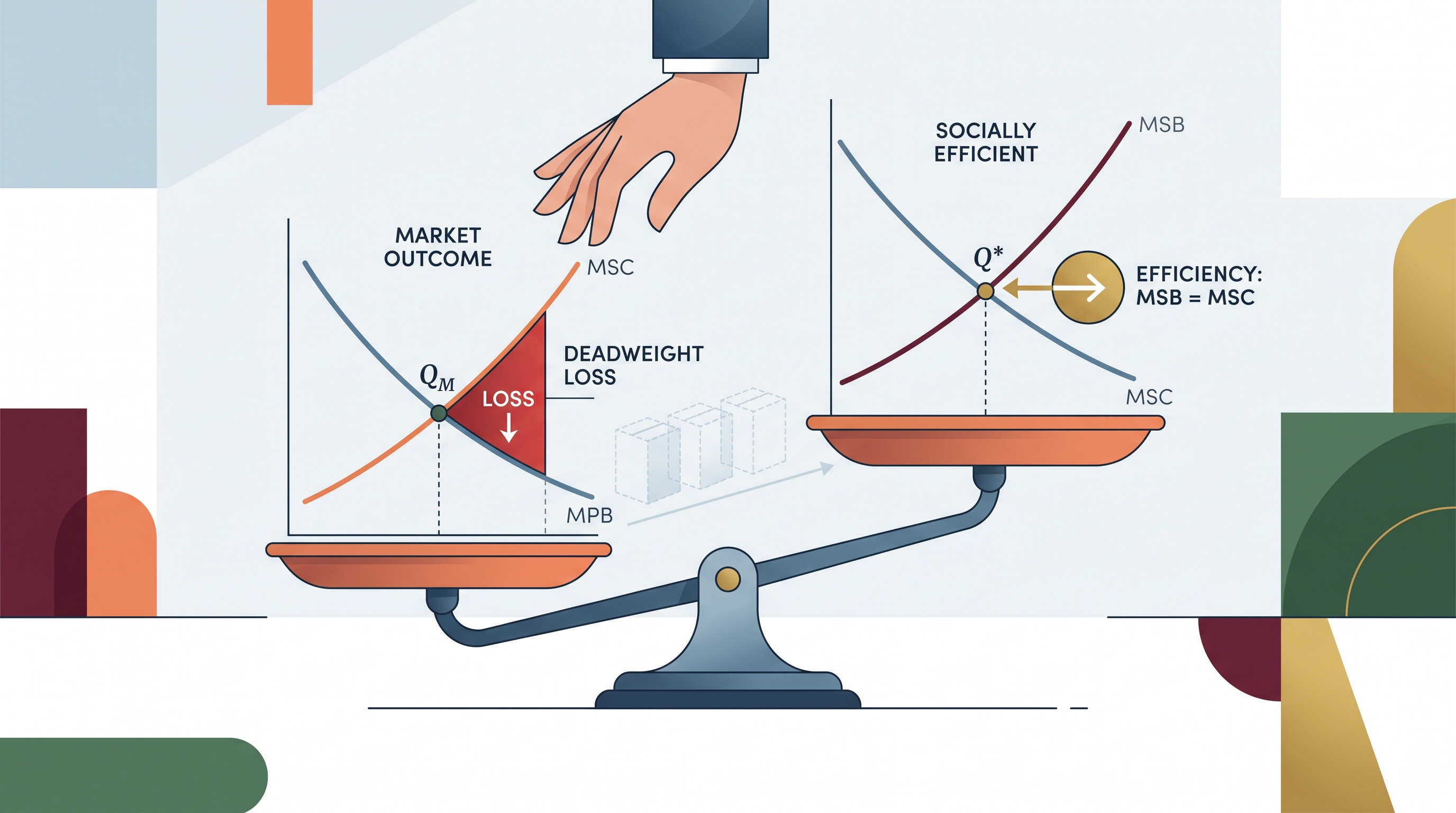
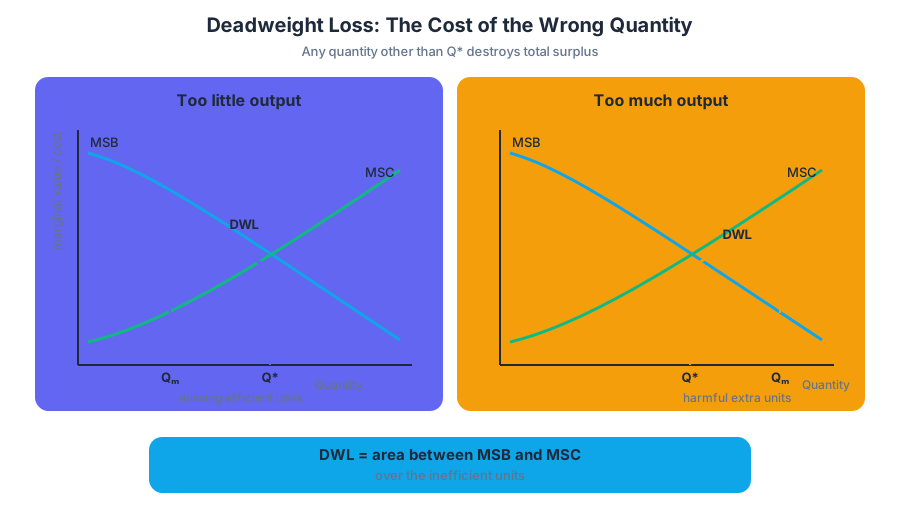
Deadweight loss is the reduction in total surplus caused by producing a non-efficient quantity. Essential Knowledge POL-2.C.2 states that any quantity other than the socially efficient quantity creates deadweight loss—not only a quantity that is too small.
Suppose the socially efficient quantity is $Q^$, but a market produces only $Q_M$, where $Q_M < Q^$. The units between $Q_M$ and $Q^*$ are not produced even though each has a marginal social benefit greater than its marginal social cost. The triangular area between the $MSB$ and $MSC$ curves over that range is the deadweight loss.
$$DWL = \text{area between } MSB \text{ and } MSC \text{ from } Q_M \text{ to } Q^*$$
If the market produces too much, the same logic applies in reverse: the additional units cost society more than they are worth. Deadweight loss is again the area between the relevant marginal-benefit and marginal-cost curves over the inefficient units.
Policy and cost-benefit analysis
Learning Objective POL-2.B asks why rational private actions can generate socially undesirable outcomes. Essential Knowledge POL-2.B.1 recognizes that agents may exploit market power, while POL-2.B.2 emphasizes that agents optimize using private marginal benefits and private marginal costs. Their choices can be individually rational yet collectively inefficient.
Policymakers use cost-benefit analysis—a comparison of the expected benefits and costs of an action—to evaluate policies that might reduce deadweight loss. Essential Knowledge POL-2.B.3 connects this analysis to policy selection, and POL-2.B.4 states the goal: design policies that move private incentives toward the condition $MSB = MSC$.
Skills and reasoning in this topic
This topic activates Skill 1.A: Define economic principles and models when identifying social efficiency, marginal social benefit, marginal social cost, and deadweight loss. It uses Skill 2.A: Explain economic outcomes when connecting market structure or private incentives to an inefficient quantity, Skill 3.A: Determine the effect of economic actions when predicting how a policy changes output or surplus, and Skill 4.A: Create representations of economic models when drawing and labeling equilibrium quantity, socially optimal quantity, and deadweight loss on a graph.
Misconception check
Misconception: “Every market equilibrium is efficient.” Equilibrium only means that quantity demanded equals quantity supplied under the existing incentives. Efficiency requires that those incentives capture all relevant social benefits and costs and that the resulting quantity satisfies $MSB = MSC$.
Retrieval check
A competitive market produces $Q_M$ units, while the socially efficient quantity is $Q^* > Q_M$. State the condition that identifies $Q^*$ and identify the graph area representing the deadweight loss.
Answer: $Q^$ occurs where $MSB = MSC$. The deadweight loss is the area between the $MSB$ and $MSC$ curves from $Q_M$ to $Q^$, representing mutually beneficial units that were not produced.
Source Materials
- AP Microeconomics Course and Exam Description
- AP Microeconomics Course and Exam Description Clarifications and Corrections
- AP Microeconomics Course Overview
- AP Microeconomics Course at a Glance
- AP Microeconomics Course at a Glance Poster
- AP Microeconomics
- AP Microeconomics
- AP Microeconomics Sample Syllabus 1
- • The negative externality causes the marginal social cost to be greater than the marginal social benefit (MSC > MSB) at the market equilibrium.
- • The negative externality causes the marginal social cost to be greater than the marginal social benefit (MSC > MSB) at the market equilibrium.
- AP Microeconomics-AP Students-College Board
- AP/College Microeconomics-Khan Academy