From the free course AP Microeconomics on Lykke
AP Practice 1
Key concepts: Scarcity and choice · Marginal analysis · Costs and benefits of decisions · Utility from consuming additional units · Graphical economic models · Interpreting economic graphs · Evidence-based reasoning · Credibility of sources and drawing conclusions · AP course access and readiness · AP Classroom activation and Progress Checks
A scarce resource cannot satisfy every possible use, so every choice carries an opportunity cost: the value of the next-best alternative given up. The central question in this practice set is therefore simple but powerful: should the additional benefit of one more unit exceed the additional cost of obtaining it?
AP Practice 1
A scarce resource cannot satisfy every possible use, so every choice carries an opportunity cost: the value of the next-best alternative given up. The central question in this practice set is therefore simple but powerful: should the additional benefit of one more unit exceed the additional cost of obtaining it?
This set practices one current exam task type: multiple-choice questions. The questions are original and unofficial, but they use the reasoning demanded by AP Microeconomics: principles and models, interpretation, manipulation, and graphing and visuals.
A visual decision rule
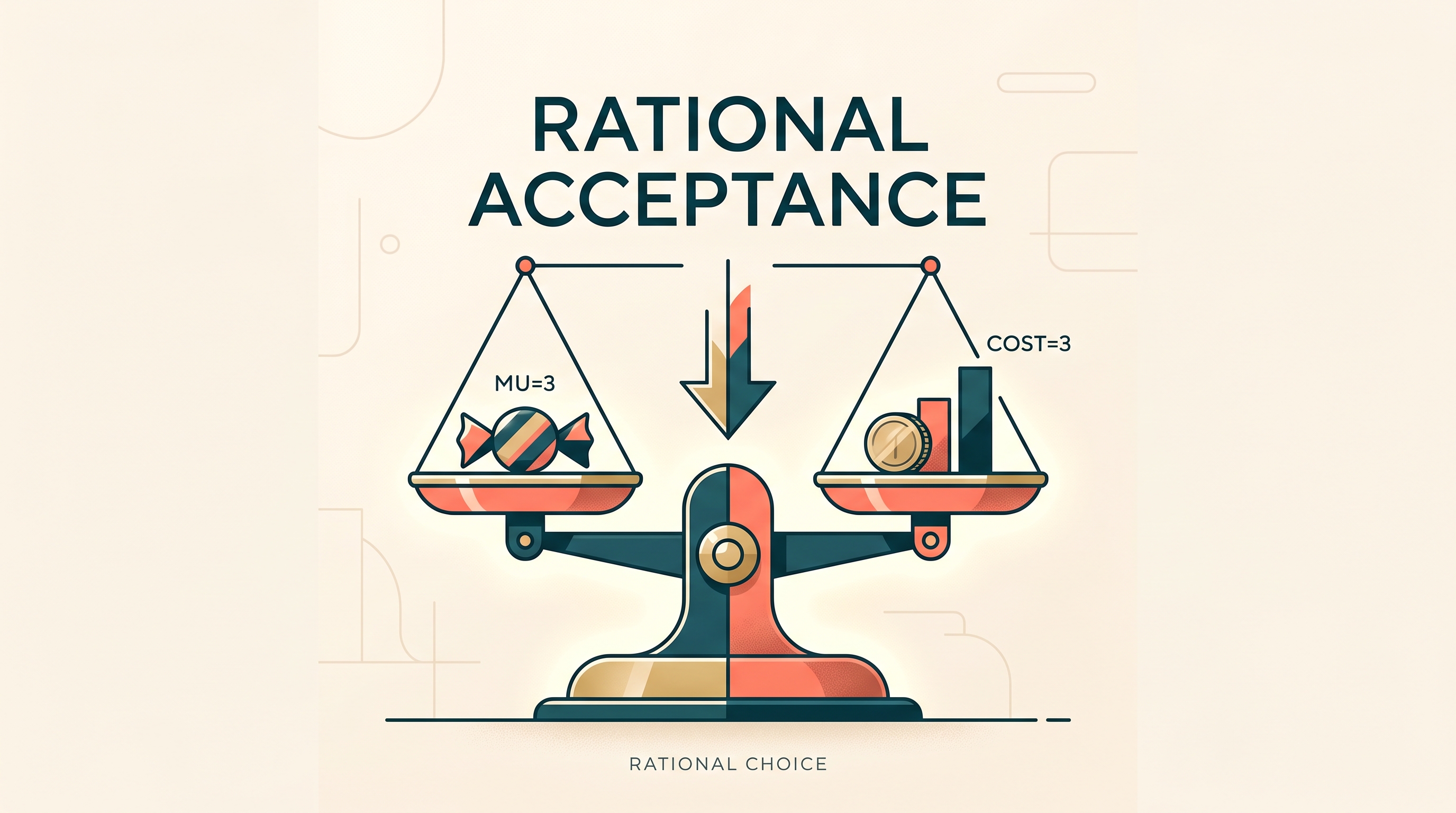
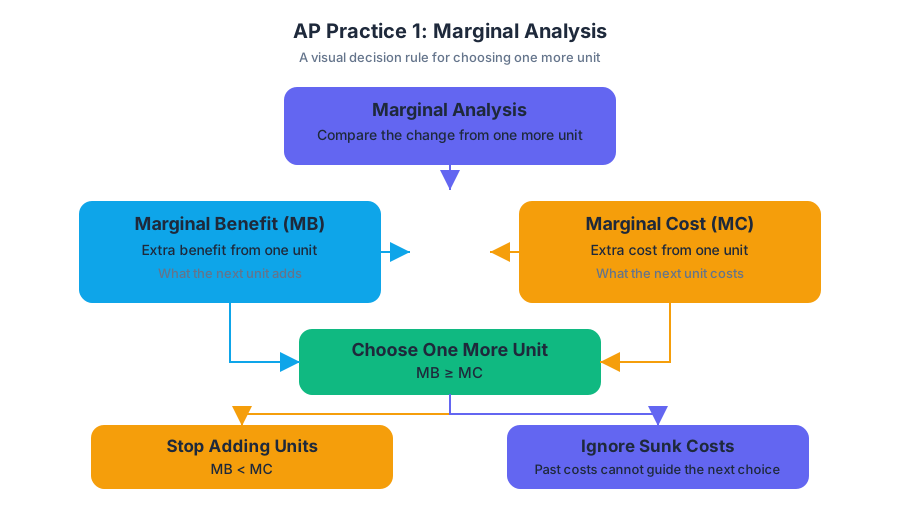
Marginal analysis compares the change caused by one additional unit. A rational decision-maker chooses another unit when marginal benefit is at least as large as marginal cost, and stops when the next unit’s marginal cost exceeds its marginal benefit.
$$ \text{Choose one more unit if } MB \geq MC $$
$$ \text{Stop adding units when } MB < MC $$
The rule concerns additional costs and benefits, not totals already incurred. A cost that cannot be recovered is a sunk cost; it may matter for measuring total cost, but it should not determine whether one more unit is worthwhile.
Question 1 — Marginal utility
A student records the utility from each additional piece of candy on a scale from $1$ to $10$:
| Piece consumed | Utility from that piece |
|---|---|
| $1$ | $9$ |
| $2$ | $7$ |
| $3$ | $5$ |
| $4$ | $2$ |
| $5$ | $-1$ |
Each piece costs the student $4$ in equivalent value. How many pieces should the student consume?
A. $1$
B. $2$
C. $3$
D. $4$
E. $5$
Answer: C. $3$ pieces.
The first three pieces provide marginal utility of $9$, $7$, and $5$, each greater than the marginal cost of $4$. The fourth piece provides marginal utility of $2$, which is less than $4$, so consumption stops at three pieces.
The pattern illustrates diminishing marginal utility: as consumption increases, the additional satisfaction from another unit generally falls. It does not mean total utility must fall. Total utility can continue rising while marginal utility is positive, even if each additional increase is smaller.
Misconception check: “Diminishing marginal utility means the consumer dislikes every later unit.”
Correction: Later units may still add utility; they simply add less than earlier units.
Question 2 — Total costs and benefits
A student is considering a college degree. The estimated total benefits are $240{,}000$, including higher lifetime earnings and personal opportunities. The estimated total costs are $175{,}000$, including tuition, books, transportation, and earnings forgone while studying. Which conclusion follows from a cost-benefit analysis?
A. The degree should be rejected because tuition is a direct monetary cost.
B. The degree should be accepted because its total benefits exceed its total costs.
C. The degree should be rejected because opportunity cost cannot be measured.
D. The degree should be accepted only if every individual year has positive marginal benefit.
E. No conclusion is possible because benefits cannot be compared with costs.
Answer: B. The net benefit is
$$ \text{Net benefit} = \text{Total benefit} - \text{Total cost} $$
$$ \text{Net benefit} = $240{,}000-$175{,}000=$65{,}000 $$
Because estimated total benefits exceed estimated total costs, the decision has a positive net benefit under the stated assumptions.
This conclusion is conditional, not automatic. A careful analyst should investigate whether the estimates are credible, identify assumptions, and draw an independent conclusion from evidence. Nonmonetary benefits and costs may be difficult to measure, but difficulty of measurement does not make them irrelevant.
Question 3 — Interpreting a graphical model
A graph has quantity of study time on the horizontal axis and total examination performance benefit on the vertical axis. The benefit curve rises rapidly at first and then becomes flatter. A separate horizontal line represents the total cost of study time. The curves intersect at $4$ hours and again at $8$ hours; between those points, total benefit is greater than total cost.
Which statement is most accurate?
A. Studying for $6$ hours produces the largest possible total cost.
B. Studying for $6$ hours produces a positive net benefit.
C. Studying for $8$ hours must be better than studying for $6$ hours.
D. The marginal benefit of study time must increase between $4$ and $8$ hours.
E. The student should study zero hours because scarcity makes all choices costly.
Answer: B. At $6$ hours, the total-benefit curve lies above the total-cost line, so total benefits exceed total costs and net benefit is positive. The intersections identify break-even quantities; they do not by themselves identify the quantity that maximizes net benefit.
A correctly constructed economic graph needs clearly labeled axes, readable curves, and relevant intersection points. Interpretation then requires translating the visual relationship into words: above means greater on the vertical measure, while a flatter benefit curve signals a smaller marginal increase.
Timing, scoring logic, and error review
Allow about $5$–$6$ minutes for these three questions. For each item, first identify whether the task requires marginal comparison, total cost-benefit comparison, or graphical interpretation. Then eliminate answers that confuse total and marginal values, ignore opportunity cost, or make claims unsupported by the graph.
For AP-aligned reasoning, a fully defensible choice should show:
- Skill Category 1: Principles and Models — identify scarcity, marginal utility, opportunity cost, or cost-benefit analysis.
- Skill Category 2: Interpretation — connect the principle to the student’s specific decision or graph.
- Skill Category 3: Manipulation — calculate net benefit or compare marginal values.
- Skill Category 4: Graphing and Visuals — read axes, curves, intersections, and relative positions accurately.
After checking answers, record the type of error rather than merely the question number: marginal-versus-total confusion, omitted opportunity cost, incorrect inequality, or graph-reading error. Rework the missed item without looking at the explanation, then explain aloud why each incorrect option fails.
Retrieval check
If a fourth candy provides marginal utility of $3$ and has marginal cost of $3$, should a rational consumer accept it? Yes, under the stated rule, because $MB=MC$; the consumer is indifferent at the margin. A fifth candy with marginal utility of $1$ should be rejected because $MB<MC$.

Source Materials
- AP Microeconomics Course and Exam Description
- AP Microeconomics Course and Exam Description Clarifications and Corrections
- AP Microeconomics Course Overview
- AP Microeconomics Course at a Glance
- AP Microeconomics Course at a Glance Poster
- AP Microeconomics
- AP Microeconomics
- AP Microeconomics Sample Syllabus 1
- Based on your experience at the AP® Reading with student responses, what advice would you offer teachers to help them improve the student performance on the exam?
- Based on your experience at the AP® Reading with student responses, what advice would you offer teachers to help them improve the student performance on the exam? The perfect competition model and its
- Based on your experience at the AP® Reading with student responses, what advice would you offer teachers to help them improve student performance on the exam?
- Based on your experience at the AP® Reading with student responses, what advice would you offer teachers to help them improve student performance on the exam?