From the free course AP Microeconomics on Lykke
1.5 Cost-Benefit Analysis** `[CBA]`
Key concepts: Cost-benefit analysis · Total benefits and total costs · Total net benefits · Marginal benefit and marginal cost · Rational economic decision-making · Profit maximization · Allocative efficiency · Market equilibrium · Deadweight loss · Per-unit subsidies and market inefficiency
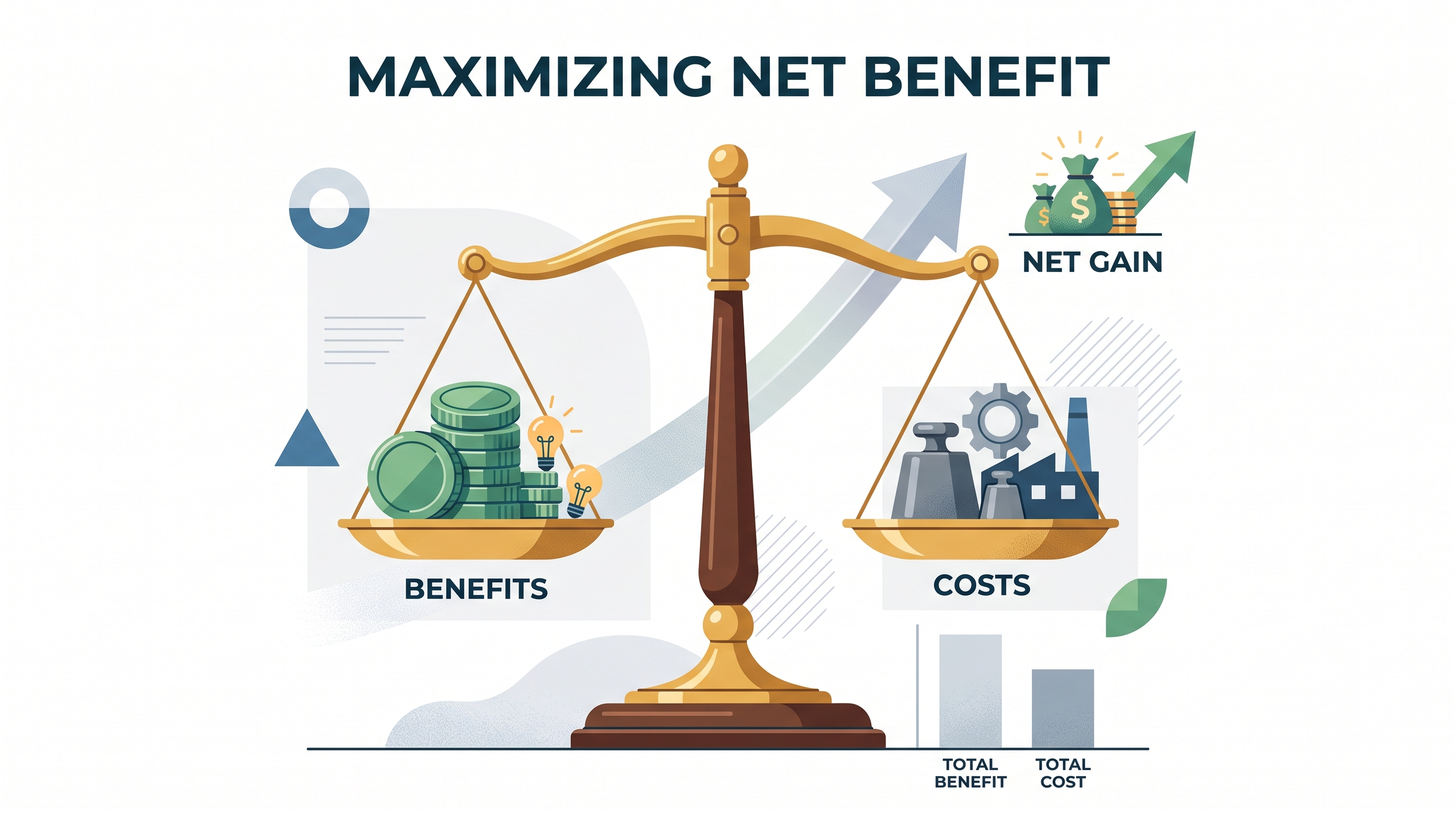
A rational decision is not necessarily the decision with the greatest total benefit; it is the decision with the greatest total net benefit after every economic cost is counted.
1.5 Cost-Benefit Analysis** [CBA]
A rational decision is not necessarily the decision with the greatest total benefit; it is the decision with the greatest total net benefit after every economic cost is counted. That means including both the money paid and the opportunity cost of what must be given up.
From benefits and costs to the optimal choice
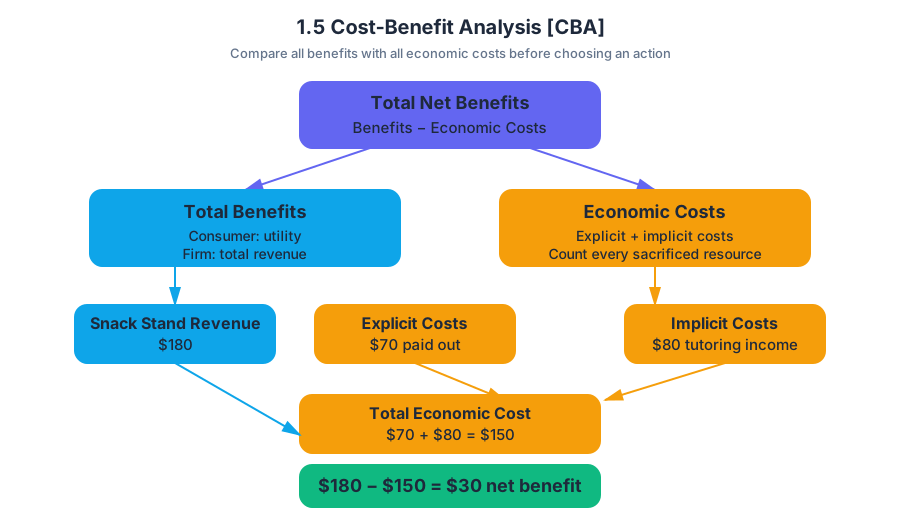
Cost-benefit analysis compares the total benefits of an action with its total economic costs. For a consumer, total benefit is commonly measured as utility; for a firm, it is commonly measured as total revenue. Economic cost includes explicit costs, such as wages or rent actually paid, and implicit costs, such as the income the owner sacrifices by using personal time or money in the business.
CBA-1.A.1: Total net benefits equal total benefits minus total economic costs, including both explicit and implicit costs.
The central calculation is:
$$ \text{Total Net Benefits}=\text{Total Benefits}-\text{Total Economic Costs} $$
Suppose a student is deciding whether to spend Saturday operating a snack stand. The stand earns $180$ in revenue. The student pays $70$ for ingredients and permits, but gives up $80$ that could have been earned at a tutoring job. Total economic cost is therefore $150$, not merely the $70$ paid out of pocket:
$$ \text{Total Economic Costs}=$70+$80=$150 $$
$$ \text{Total Net Benefits}=$180-$150=$30 $$
If the student instead attends a free concert, the decision may not be naturally divisible into one-unit increments. In that case, comparing total benefits and total costs is more useful than comparing marginal values. Under CBA-1.B.1, total net benefits are maximized at the optimal choice.
Marginal analysis: choosing the next unit
Some decisions can be separated into increments: one more hour worked, one more backpack produced, or one more unit sold. The marginal benefit is the additional benefit from one more unit; the marginal cost is the additional economic cost of that unit.
CBA-1.B.2: Rational economic agents compare marginal benefit and marginal cost when deciding whether and how much of an activity to pursue.
The decision rule is:
$$ \text{Pursue another unit if } MB \geq MC $$
Continue expanding an activity while marginal benefit exceeds marginal cost. Stop at the quantity where the next unit would add no more benefit than cost. When marginal benefit is decreasing and marginal cost is increasing, total net benefits are maximized generally where:
$$ MB=MC $$
Misconception check — “The best choice has the highest total benefit.” Not necessarily. A larger activity can generate more total benefit but also much larger total cost. The correct comparison is total benefit versus total economic cost, or—when the decision is divisible—marginal benefit versus marginal cost.
Firms: profit maximization
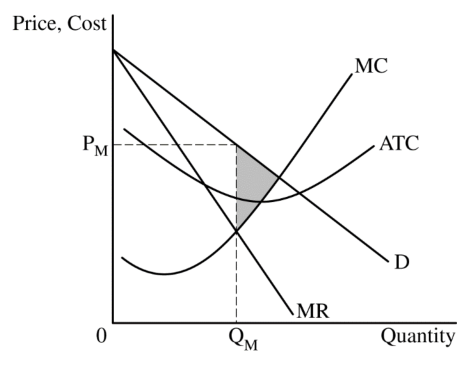
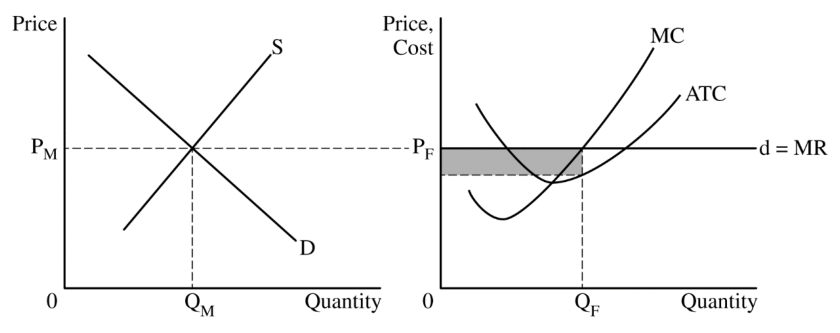
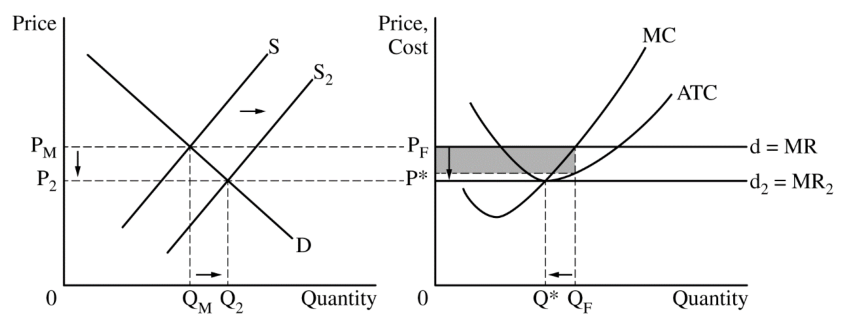
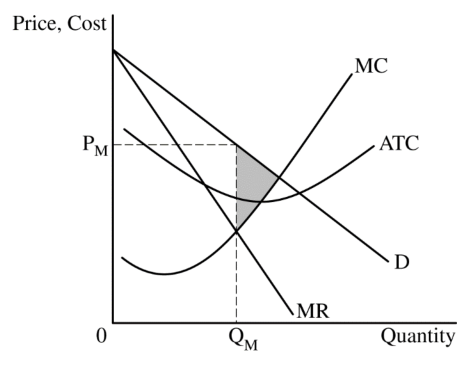
For a firm, the relevant benefit from selling one additional unit is marginal revenue—the change in total revenue from that unit. The firm maximizes economic profit by producing the quantity where marginal revenue equals marginal cost:
$$ MR=MC $$
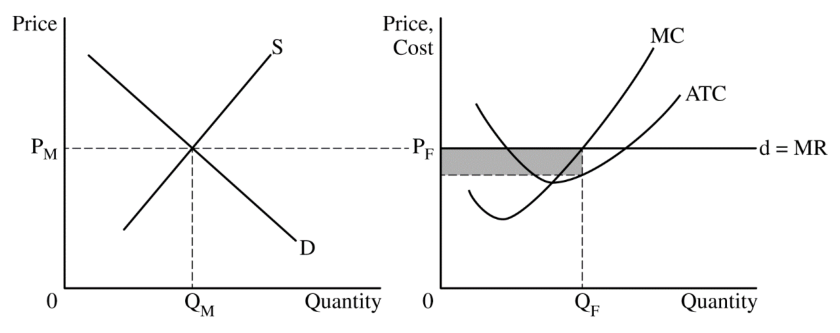
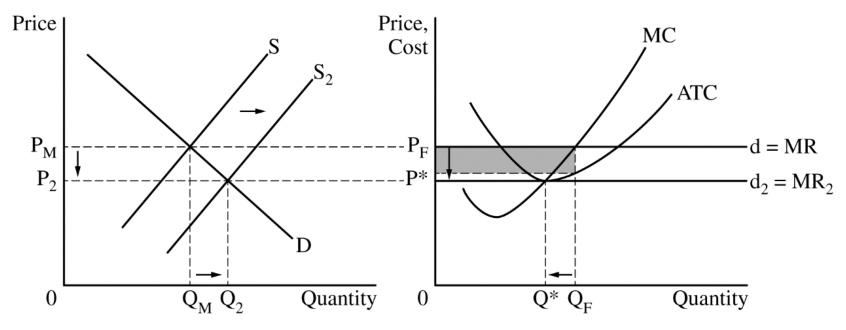
In perfect competition, the firm is a price taker, so the price received for every additional unit is constant. Therefore:
$$ MR=P $$
For a firm with market power, marginal revenue is generally below the demand curve because selling additional output requires lowering the price. The firm first finds its output where $MR=MC$, then uses the demand curve to determine the price consumers will pay. This distinction matters: choosing the highest possible price does not generally maximize profit.
Cost calculations that reveal the decision
Two calculations frequently appear in cost-benefit problems:
$$ AFC=\frac{\text{Total Fixed Cost}}{\text{Quantity of Output}} $$
If total fixed cost is $$90$ and output is $30$ units:
$$ AFC=\frac{$90}{30}=$3 $$
Marginal cost measures the change in variable cost caused by a change in output:
$$ MC=\frac{\Delta TVC}{\Delta Q} $$
If total variable cost rises by $$6$ when output increases by one unit, marginal cost is $$6$. Fixed cost does not change when output changes in the short run, so it does not determine marginal cost.
Market efficiency, deadweight loss, and corrective policy
In a market graph, the demand curve can represent marginal benefit and the supply curve can represent marginal cost. The competitive equilibrium is allocatively efficient when the equilibrium quantity is where marginal benefit equals marginal cost.
If equilibrium output is $20$ backpacks but the allocatively efficient output is only $16$, the market is overproducing. The units between $16$ and $20$ cost more to produce than they are worth to buyers. The lost total surplus is deadweight loss, shown as the area between the marginal-benefit and marginal-cost curves over that excess-output range.
Misconception check — “A subsidy always fixes deadweight loss.” The correct policy depends on the direction of the inefficiency. With equilibrium quantity $20$ and efficient quantity $16$, a per-unit tax, not a subsidy, must reduce the private incentive to produce. If the marginal external cost is $$10$ per backpack at the efficient quantity, a $$10$ per-unit tax shifts private marginal cost upward by that wedge and can align private incentives with social cost.
Conversely, if equilibrium output is below the efficient quantity—for example, $16$ backpacks instead of $20$ because production creates a $$10$ marginal external benefit—a $$10$ per-unit subsidy shifts the private marginal-benefit incentive upward. It encourages the additional production whose social benefit exceeds its private benefit, eliminating the deadweight loss when the wedge is correctly measured.
Retrieval check: A firm’s total revenue is $$500$, explicit costs are $$300$, and implicit costs are $$120$. Its economic profit is $$80$. If the next unit adds $$14$ of revenue and $$11$ of cost, should the firm produce it? Yes: the additional unit raises total net benefits by $$3$, because $MB$ or $MR$ exceeds $MC$.
Source Materials
- AP Microeconomics Course and Exam Description
- AP Microeconomics Course and Exam Description Clarifications and Corrections
- AP Microeconomics Course Overview
- AP Microeconomics Course at a Glance
- AP Microeconomics Course at a Glance Poster
- AP Microeconomics
- AP Microeconomics
- AP Microeconomics Sample Syllabus 1
- Total for part (a) 5 points
- Total for part (b)
- Total for part (c) 2 points
- Total for part (a) 5 points