From the free course AP Microeconomics on Lykke
AP Practice 3
A price change does not automatically tell you whether a seller’s total revenue rises or falls; the decisive question is how strongly buyers respond. This practice task focuses on numerical analysis: calculating price elasticity of demand, interpreting its meaning, and connecting the result to total revenue.
Task focus: numerical analysis using Skill 3: Manipulation, especially Skill 3.C, and interpretation supported by Skill 2: Interpretation. When a graph is required, use Skill 4: Graphing and Visuals, including accurate labels under Skill 4.A.
Original practice prompt
A neighborhood bakery sells boxes of specialty pastries. The bakery records the following results:
| Situation | Price per box | Quantity demanded |
|---|---|---|
| Before a price change | $8 | $500$ boxes |
| After a price change | $10 | $440$ boxes |
Answer each part using the information above.
(a) Calculate the percentage change in price and the percentage change in quantity demanded using the midpoint method.
(b) Calculate the price elasticity of demand for the bakery’s pastry boxes. State whether demand is elastic, inelastic, or unit elastic.
(c) Calculate the bakery’s total revenue before and after the price change. Did total revenue increase or decrease?
(d) Explain how the elasticity result predicts the change in total revenue.
Worked reasoning
Part (a): Calculate the percentage changes
The midpoint method uses the average of the original and new values as the denominator. This avoids choosing one endpoint as the reference point.
$$ %\Delta P= \frac{P_2-P_1}{(P_2+P_1)/2}\times 100 $$
$$ %\Delta P= \frac{10-8}{(10+8)/2}\times 100
\frac{2}{9}\times 100 \approx 22.2% $$
Quantity demanded falls from $500$ boxes to $440$ boxes:
$$ %\Delta Q_d= \frac{440-500}{(440+500)/2}\times 100 $$
$$ %\Delta Q_d= \frac{-60}{470}\times 100 \approx -12.8% $$
The negative sign matters economically: the higher price caused quantity demanded to decrease. When calculating elasticity, economists commonly use the absolute value because the law of demand normally makes price elasticity of demand negative.
Part (b): Calculate and classify elasticity
Price elasticity of demand measures the responsiveness of quantity demanded to a change in price:
$$ E_d= \left| \frac{%\Delta Q_d}{%\Delta P} \right| $$
$$ E_d= \left| \frac{-12.8%}{22.2%} \right| \approx 0.58 $$
Because $E_d<1$, demand is inelastic. Quantity demanded changes proportionally less than price. A price increase of about $22.2%$ produces a quantity decrease of only about $12.8%$.
Examiner-rewarded conclusion: The numerical calculation must be followed by the classification. Writing only “$0.58$” does not fully communicate the economic meaning.
Part (c): Calculate total revenue
Total revenue is the money received by the seller:
$$ TR=P\times Q $$
Before the price change:
$$ TR_1=$8\times 500=$4{,}000 $$
After the price change:
$$ TR_2=$10\times 440=$4{,}400 $$
Total revenue increases by:
$$ $4{,}400-$4{,}000=$400 $$
The bakery’s total revenue rises even though it sells fewer boxes.
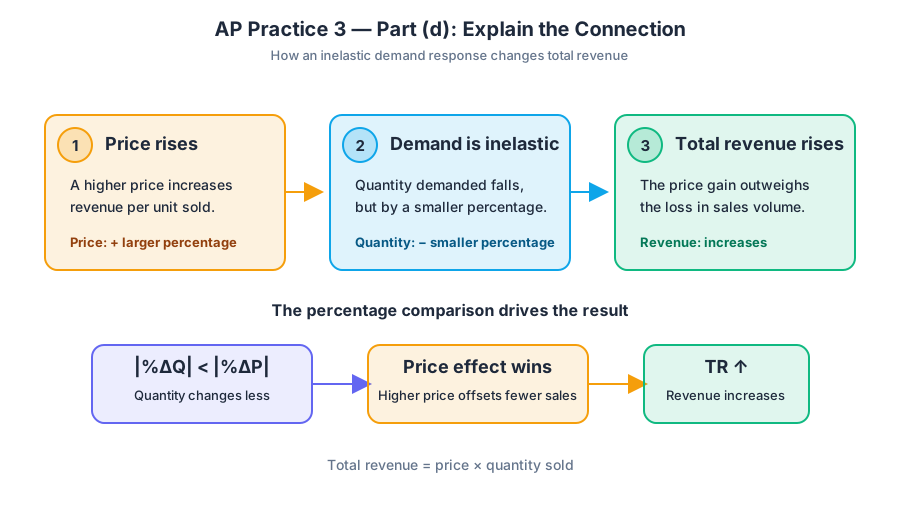
Part (d): Explain the connection
Demand is inelastic, so the percentage decrease in quantity demanded is smaller than the percentage increase in price. The higher price therefore more than offsets the loss of sales volume, causing total revenue to increase.
What the response must show
| Required move | Strong response |
|---|---|
| Numerical manipulation | Correctly computes both midpoint percentage changes |
| Classification | Identifies $E_d\approx 0.58$ as inelastic |
| Revenue calculation | Uses $TR=P\times Q$ for both situations |
| Economic explanation | Connects inelastic demand to increased total revenue |
| Interpretation | Explains what the number means, not merely what it equals |
This is Skill 3: Manipulation because the situation requires calculations that determine an economic outcome. It also uses Skill 2: Interpretation because the numerical result must be translated into an explanation about buyer responsiveness and seller revenue.
Misconception check
Named misconception: “A price increase always lowers total revenue.”
A price increase lowers quantity demanded, but it does not necessarily lower total revenue. With inelastic demand, quantity falls by a smaller percentage than price rises, so total revenue increases. With elastic demand, quantity falls by a larger percentage, so total revenue decreases.
Another common error is reversing the elasticity ratio. Price elasticity of demand is the responsiveness of quantity demanded to price, so quantity’s percentage change belongs in the numerator:
Timing and error review
For a short numerical-analysis response, aim to complete the calculation and explanation in approximately 8–10 minutes. Reserve the final minute to check signs, midpoint denominators, units, arithmetic, and whether every numerical answer has an accompanying economic interpretation.
Afterward, classify the error rather than merely marking the answer wrong:
- Setup error: the formula or numerator/denominator was incorrect.
- Arithmetic error: the correct method produced an incorrect number.
- Classification error: the value was not compared with $1$ correctly.
- Reasoning error: the calculation was correct, but the revenue explanation was missing or contradicted the elasticity result.
Retrieval check: If the bakery’s demand had instead been elastic, with $E_d>1$, what would you predict about total revenue after the same price increase? Explain your prediction in one sentence using percentage changes, not just the words “elastic” or “inelastic.”

Source Materials
- AP Microeconomics Course and Exam Description
- AP Microeconomics Course and Exam Description Clarifications and Corrections
- AP Microeconomics Course Overview
- AP Microeconomics Course at a Glance
- AP Microeconomics Course at a Glance Poster
- AP Microeconomics
- AP Microeconomics
- AP Microeconomics Sample Syllabus 1
- AP Microeconomics-AP Students-College Board
- AP/College Microeconomics-Khan Academy
- AP Microeconomics Exam Questions-AP Central-College Board
- AP Microeconomics Practice FRQ Questions-ReviewEcon