From the free course AP Microeconomics on Lykke
1.6 Marginal Analysis and Consumer Choice** `[CBA]`
Key concepts: Consumer constraints and choice · Marginal analysis · Marginal benefit · Marginal cost · Marginal utility · Rational consumer decision-making · Optimal decisions under constraints · Allocation of consumption across goods and services · Fixed costs and sunk costs · Fixed benefits from past choices
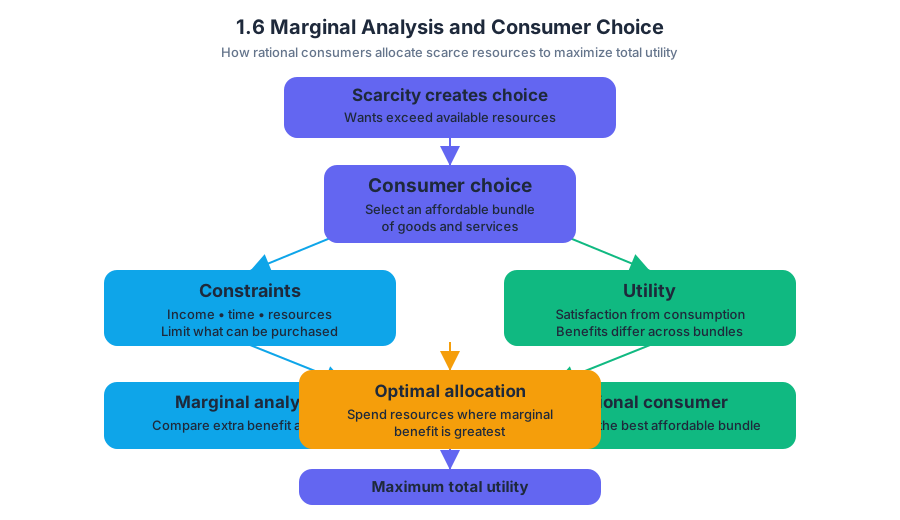
Every consumer has more wants than available income, time, or resources can satisfy, so consumer choice is the problem of selecting the combination of goods and services that provides the greatest benefit within a constraint.
1.6 Marginal Analysis and Consumer Choice** [CBA]
Every consumer has more wants than available income, time, or resources can satisfy, so consumer choice is the problem of selecting the combination of goods and services that provides the greatest benefit within a constraint.
Consumer choice is the allocation of limited resources among goods and services to maximize total utility.
Utility means the satisfaction or benefit a consumer receives from consumption. In the rational-consumer model, people are assumed to choose the affordable combination that maximizes their total utility, as required by CBA-2.A.1, CBA-2.A.2, and CBA-2.A.3.
Consumer constraints and marginal utility
A budget constraint limits the bundles a consumer can purchase. If a student has income of $$8$, apples cost $$1$ each, and sandwiches cost $$2$ each, then every affordable bundle must satisfy
$$ 1A+2S\leq 8. $$
The consumer cannot simply choose the bundle with the highest possible utility; the bundle must also be affordable.
Marginal utility is the additional utility obtained from consuming one more unit of a good or service. Consumers commonly experience diminishing marginal utility: as more units are consumed, each additional unit usually adds less satisfaction than the preceding unit.
| Unit consumed | Marginal utility of sandwiches | Marginal utility per dollar | Marginal utility of apples | Marginal utility per dollar |
|---|---|---|---|---|
| $1$ | $14$ | $14/2=7$ | $9$ | $9/1=9$ |
| $2$ | $10$ | $10/2=5$ | $7$ | $7/1=7$ |
| $3$ | $6$ | $6/2=3$ | $5$ | $5/1=5$ |
| $4$ | $2$ | $2/2=1$ | $3$ | $3/1=3$ |
The relevant comparison is not marginal utility alone but marginal utility per dollar:
$$ \frac{MU_S}{P_S} \qquad\text{and}\qquad \frac{MU_A}{P_A}. $$
With $$8$, the consumer selects the highest available marginal utility per dollar while respecting the budget. The resulting bundle is $2$ sandwiches and $4$ apples, costing
$$ 2($2)+4($1)=$8. $$
Its total utility is
$$ (14+10)+(9+7+5+3)=48\text{ utils}. $$
The consumer does not buy the third sandwich because its marginal utility per dollar is only $3$, while the fourth apple provides the same ratio for just $$1$ and allows the budget to be used fully. In a continuous-choice model, utility is maximized when the marginal utility per dollar is equal across goods:
$$ \frac{MU_S}{P_S}=\frac{MU_A}{P_A}. $$
For indivisible units, the practical rule is to compare the available ratios and choose the best affordable sequence; exact equality need not occur.
Marginal analysis: the next unit
Marginal analysis compares the additional benefit of increasing an activity with the additional cost of that increase. It focuses on changes at the margin—the next unit—not on total or average values.
Suppose an additional hour of concert streaming costs $$6$, while the marginal benefits of successive hours are $$11$, $$8$, $$5$, and $$2$.
The consumer should purchase the first hour because $$11\geq$6$, the second because $$8\geq$6$, and stop before the fourth because $$2<$6$. The optimal discrete choice is therefore $3$ hours. The rule is:
Consume each unit whose marginal benefit is at least marginal cost; stop when the next unit’s marginal benefit is less than marginal cost.
The statement $MB=MC$ describes an exact equality or a continuous-choice optimum. It should not be forced onto a discrete table when no unit has exactly equal marginal benefit and marginal cost. At the optimum, total net benefits are maximized, consistent with CBA-1.B.1, while CBA-1.B.2 reminds us that some decisions require total benefits and total costs rather than unit-by-unit comparisons.
What marginal analysis ignores
The current decision depends on the additional benefit and additional cost of the next unit. A fixed cost—including a sunk cost, a cost already paid and unrecoverable—does not change the current marginal comparison. Likewise, a fixed benefit already determined by past choices does not affect whether the next unit should be consumed. The consumer should not let “I already paid for it” substitute for comparing the benefit of consuming one more unit with its current cost.
Misconception check
Misconception: “A consumer should choose the good with the greatest marginal utility.”
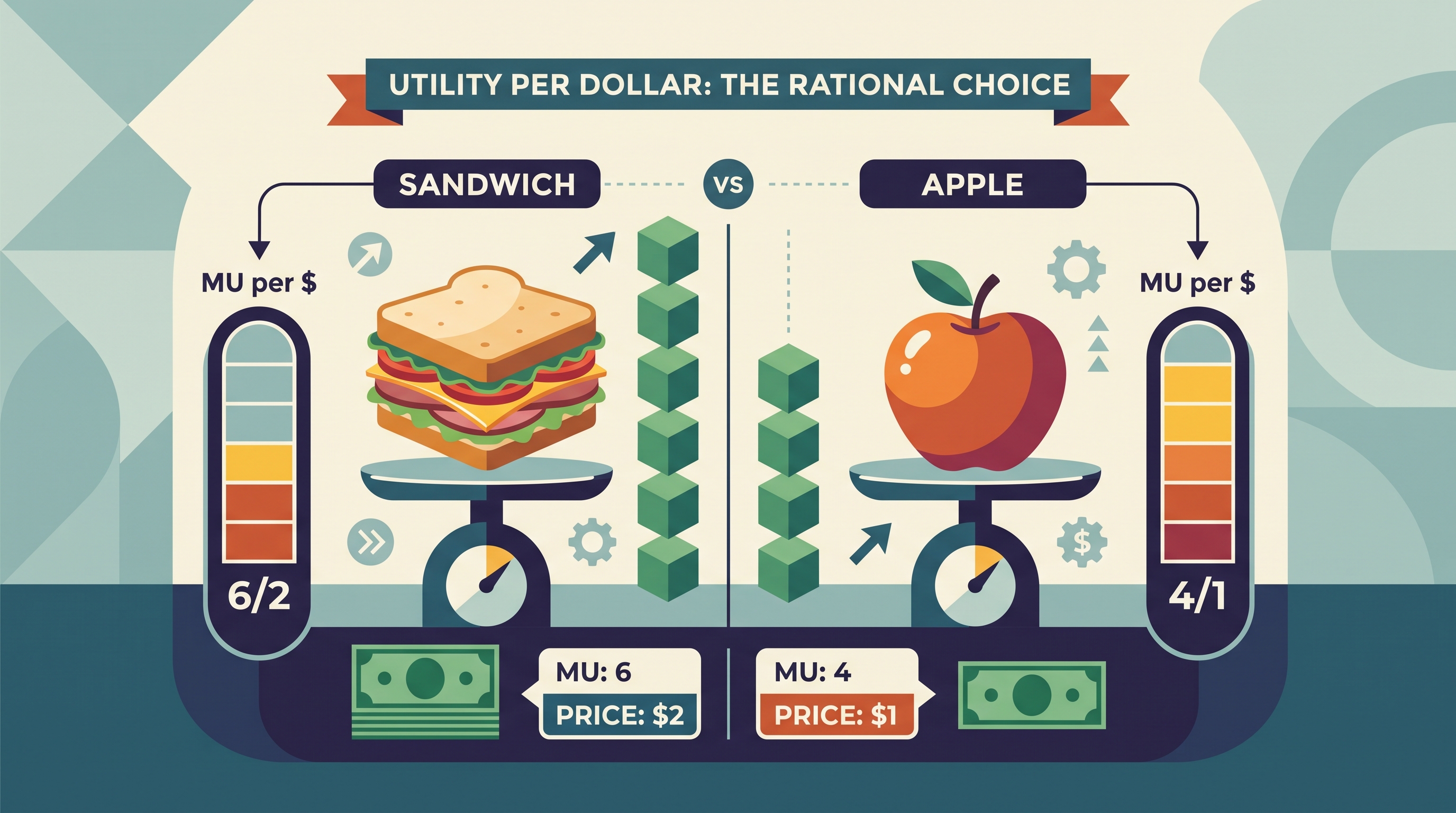
Correction: The consumer should compare marginal utility per dollar, because prices differ. A good with lower marginal utility can be the better choice if it delivers more utility for each dollar spent.
Retrieval check: If the next sandwich provides $6$ units of utility and costs $$2$, while the next apple provides $4$ units and costs $$1$, which has the greater marginal utility per dollar, and what constraint must still be checked before choosing it?


Source Materials
- AP Microeconomics Course and Exam Description
- AP Microeconomics Course and Exam Description Clarifications and Corrections
- AP Microeconomics Course Overview
- AP Microeconomics Course at a Glance
- AP Microeconomics Course at a Glance Poster
- AP Microeconomics
- AP Microeconomics
- AP Microeconomics Sample Syllabus 1
- Figure — Sample Responses Q1 - Set 1 (p. 2)
- Figure — Sample Responses Q1 - Set 1 (p. 2)
- Figure — Sample Responses Q1 - Set 1 (p. 3)
- Figure — Sample Responses Q1 - Set 1 (p. 4)