From the free course AP Microeconomics on Lykke
2.1 Demand** `[MKT]`
Key concepts: Consumer demand · Determinants of demand · Graphical representation of demand · Willingness to pay · Changes in consumer demand
A consumer’s demand is the quantity of a good or service the consumer is both willing and able to buy at each possible price during a given time period.
2.1 Demand** [MKT]
A consumer’s demand is the quantity of a good or service the consumer is both willing and able to buy at each possible price during a given time period. The key question is not merely “How much does someone want?” but “How much would that person actually choose to buy at this price?”
Willingness to pay: the foundation of demand
Willingness to pay is the highest price a consumer is prepared to pay for one unit of a good. If Maya would pay up to $12 for a concert ticket, her willingness to pay for that ticket is $12. At a price of $9, she buys it because the price is below her willingness to pay; at $14, she does not.
Suppose four students value a smoothie as follows:
| Consumer | Willingness to pay |
|---|---|
| Ana | $10 |
| Ben | $8 |
| Chen | $6 |
| Dev | $4 |
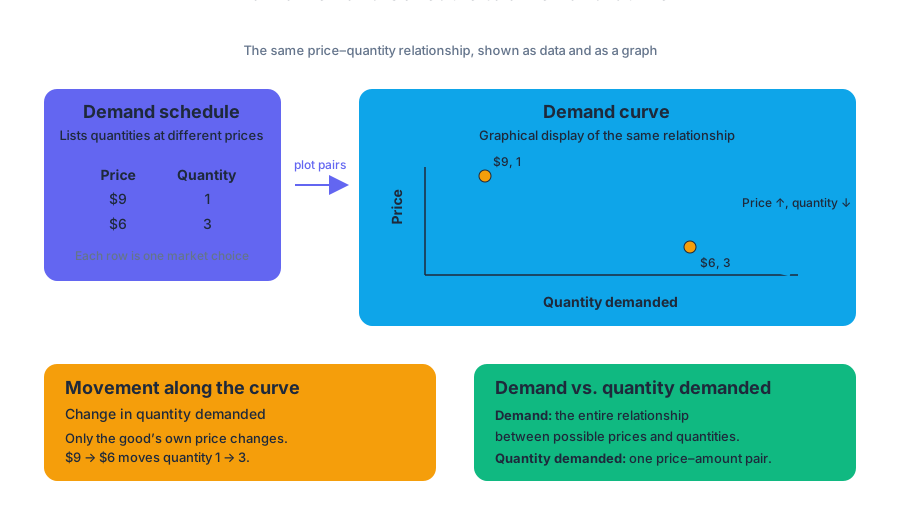
At a price of $9, only Ana buys, so quantity demanded is $1. At a price of $6, Ana, Ben, and Chen buy, so quantity demanded is $3. At a price of $4, all four buy, so quantity demanded is $4. A lower price makes more purchases worthwhile, producing the law of demand: holding other determinants constant, price and quantity demanded move in opposite directions.
From a demand schedule to a demand curve
A demand schedule lists the quantity consumers will buy at different prices. A demand curve displays the same relationship graphically: price is placed on the vertical axis, and quantity demanded is placed on the horizontal axis. The downward slope represents the inverse relationship between price and quantity demanded.
A movement from one point to another on the same demand curve is a change in quantity demanded. It is caused only by a change in the good’s own price. For example, if the price of smoothies falls from $9 to $6, the market moves down along the existing demand curve from quantity demanded $1$ to quantity demanded $3$.
Demand is the entire relationship between possible prices and the quantities consumers are willing and able to buy. Quantity demanded is one specific amount at one specific price.
Determinants that shift demand
A change in demand occurs when a determinant other than the good’s own price changes. The entire demand curve shifts because consumers now want to buy a different quantity at every price.
Important determinants include:
- Income: For a normal good, higher income increases demand and shifts the curve right. For an inferior good, higher income decreases demand and shifts the curve left.
- Tastes and preferences: A successful health report praising smoothies can increase demand for smoothies.
- Prices of related goods: If tea and coffee are substitutes, a higher coffee price can increase demand for tea. If smoothies and protein powder are complements, a higher protein-powder price can decrease demand for smoothies.
- Expectations: If consumers expect concert-ticket prices to rise next month, current demand may increase.
- Number of buyers: More consumers in the market increase market demand.
Worked application: A city announces that its popular smoothie ingredient has major health benefits. At every smoothie price, more consumers now want smoothies. This is a change in a determinant—tastes—not a change in the smoothie’s own price. Therefore, demand increases and the demand curve shifts right, from $D_1$ to $D_2$.
By contrast, if the smoothie price itself rises, consumers move upward along the same curve. Calling that a “rightward shift in demand” is the price-versus-demand-shift misconception: a price change changes quantity demanded, while a nonprice determinant changes demand.
AP reasoning in action
The learning objective MKT-3.B asks you to explain, using graphs when appropriate, how buyers respond to changes in incentives and constraints. Essential knowledge MKT-3.B.1 specifies that changes in the determinants of consumer demand can cause the demand curve to shift.
To apply this reasoning, use a three-step chain:
- Identify the determinant that changed.
- Decide whether buyers want more or less at every price.
- Shift the entire demand curve right for an increase or left for a decrease.
This combines Skill Category 1: Principles and Models, especially applying an economic model; Skill Category 2: Interpretation, especially interpreting a graph or scenario; and Skill Category 4: Graphing and Visuals, especially showing a correctly labeled demand shift. The graph is evidence of the explanation, not a substitute for naming the determinant and its effect.
Misconception check and retrieval
Misconception check: “If consumers buy fewer movie tickets, demand decreased.” Not necessarily. If ticket prices increased, quantity demanded decreased—a movement along the demand curve. Demand decreased only if a determinant such as income, preferences, expectations, or the price of a related good changed.
Retrieval check: The price of streaming subscriptions falls, and consumers buy more subscriptions. Is this a change in demand or quantity demanded? Now suppose a new competitor makes consumers prefer a different service at every price. What happens to the original service’s demand curve? The answers are: quantity demanded increases in the first case; demand decreases and the curve shifts left in the second.

Source Materials
- AP Microeconomics Course and Exam Description
- AP Microeconomics Course and Exam Description Clarifications and Corrections
- AP Microeconomics Course Overview
- AP Microeconomics Course at a Glance
- AP Microeconomics Course at a Glance Poster
- AP Microeconomics
- AP Microeconomics
- AP Microeconomics Sample Syllabus 1
- AP Microeconomics-AP Students-College Board
- AP/College Microeconomics-Khan Academy
- AP Microeconomics Exam Questions-AP Central-College Board
- AP Microeconomics Practice FRQ Questions-ReviewEcon