From the free course World History Volume 1 on Lykke
9.1 Africa’s Geography and Climate
By the end of this section the student can: Describe the way geography and climate shaped Africa’s ancient societies; Discuss the various Neolithic and hunter-gatherer societies in early Africa
9.1 Africa’s Geography and Climate
Africa’s ancient societies developed across one of Earth’s most environmentally varied continents. More than $11$ million square miles in area, Africa contains deserts, grasslands, tropical rainforests, temperate regions, highlands, and even glaciers. The central historical question is therefore not simply why civilizations arose, but how different environments made different ways of living possible.
Geography means the physical features of a place—its landforms, rivers, soils, and location—while climate means its long-term patterns of temperature and precipitation. Together, they influenced where people could find water, grow food, hunt animals, move across the landscape, and preserve records of the past. A reliable river could support dense settlement and monumental construction; a dry grassland could favor mobile herding; a rainforest could provide abundant life while making overland travel and large-scale farming more difficult.
Geography did not mechanically determine African history. It created opportunities and constraints to which human communities responded in different ways.
Geographic Diversity on the African Continent
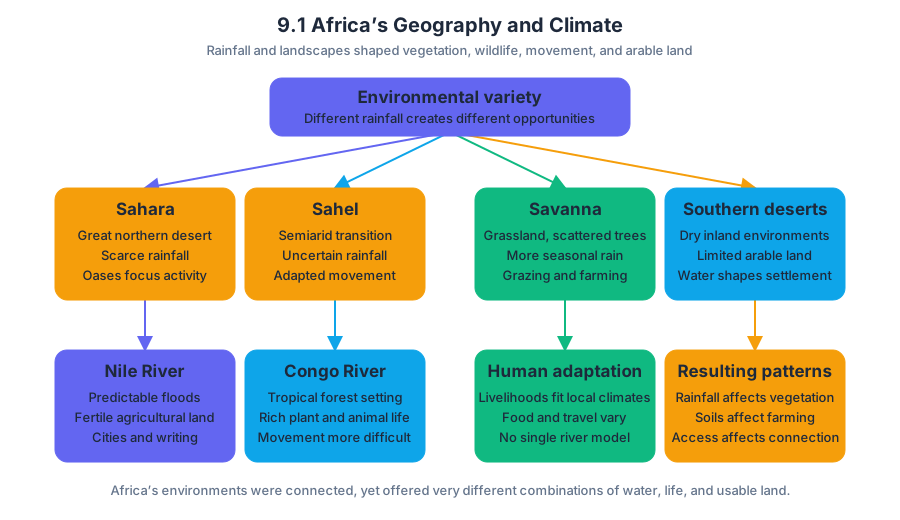
Africa’s size and position help explain its environmental diversity. The continent stretches across the equator and includes both northern and southern temperate zones. Its landscapes range from the great northern desert to equatorial forests and southern deserts. These environments were not isolated from one another, but they offered very different combinations of rainfall, vegetation, wildlife, and arable land.
The Nile River illustrates how a river can organize human life. Its predictable flood patterns replenished agricultural land and helped Egyptian civilization flourish for centuries. Readily available food supported large populations, cities, and grand architecture. Egypt also developed hieroglyphs, a writing system that left permanent records of important moments in its history. The Nile was therefore more than a source of water: it was an agricultural schedule, a transportation route, and a foundation for political and cultural development.
The Congo River created a sharply different setting. It flows through a tropical region dominated in many places by dense forests. Such forests supported rich plant and animal life, but they did not produce the same conditions as the open floodplain of the Nile. Dense vegetation could make movement and communication more difficult, while local communities developed livelihoods suited to forest environments. The contrast between the Nile and Congo regions demonstrates why “river civilization” is not a single model: rivers matter through their surrounding climate, vegetation, soils, and patterns of accessibility.
North of the equatorial forests lay several important ecological belts. The Sahara was the great northern desert, an immense region where scarce rainfall limited farming and concentrated human activity around oases and other sources of water. South of the Sahara was the Sahel, a semiarid transition zone between desert and wetter grasslands. Because the Sahel received more moisture than the Sahara but less than the savannas farther south, it supported forms of life and movement adapted to uncertain rainfall.
The savanna consisted largely of grasslands with scattered trees. Compared with the Sahara, savannas offered more rainfall, pasture, wildlife, and land suitable for cultivation. Their resources could support settled farming communities, hunting societies, and pastoralists—people who depend substantially on herding domesticated animals. Yet savannas were not uniformly fertile. Seasonal rainfall meant that communities had to plan around changing water and food availability.
The woodland savanna formed another belt between the great northern desert and the equatorial rainforest. It contained tall grasses interrupted by scattered trees and corridors of gallery forest along streams and rivers. It usually received rainfall during approximately nine months of the year. This combination of grassland, trees, and waterways created a varied environment in which people could hunt, gather, cultivate plants, and move between resource zones.
The Serengeti provides a vivid example of how African environments supported extraordinary animal life. More than a million wildebeest move across the region during their annual migration, one of the most impressive animal movements on Earth. Such migrations mattered to human communities because wildlife was not merely scenery: it represented a major source of food, materials, and knowledge about seasonal landscapes.
Southern Africa included the Kalahari Desert, a semiarid sandy savanna covering approximately $350{,}000$ square miles. Sometimes described as the southern African equivalent of the Sahel, it stretches south from present-day Namibia into South Africa’s Northern Cape Province and extends into the interior of the South African veld, or grassland. Although called a desert, the Kalahari is not simply empty wasteland; its semiarid savanna supported human communities adapted to limited and uneven water supplies.
Environmental Constraints and Historical Evidence
Africa’s environments influenced not only how people lived but also what evidence survived about their lives. Stone, bone, pottery, and rock art can endure for thousands of years, while oral traditions preserve knowledge through performance and memory. In some forest regions, however, humid conditions can damage or destroy organic materials. This helps explain why the historical record is uneven: the absence of written documents does not mean the absence of complex societies or meaningful history.
The rock art of the Cederberg Caves in South Africa offers evidence of human engagement with the natural world. One image depicts twenty San men interacting with six elephants. The scene reveals that people observed, represented, and interpreted animals central to their environment. It also reminds us that early African history must be reconstructed through more than monumental buildings or writing.
Types of Ancient African Societies
Before the domestication of plants and animals, prehistoric African life was often organized around hunter-gatherer societies. Hunter-gatherers survive by hunting prey and gathering fruits, vegetables, and other wild foods. Some also exchange game for crops grown by other communities. This way of life required detailed knowledge of animal behavior, plant seasons, water sources, and the changing conditions of particular landscapes.
Hunter-gathering should not be confused with aimless wandering. Mobility was usually a practical response to the distribution of resources. When animals migrated, plants ripened, or water sources changed, communities could move to take advantage of them. In regions with more predictable resources, people could remain in one place for longer periods. Thus, the boundary between “mobile” and “settled” societies was not always absolute.
Some early African communities practiced forms of pastoralism, moving with herds in search of pasture and water. Arid and semiarid regions could be difficult places for intensive agriculture but useful for herding animals. Mobility allowed pastoralists to respond to seasonal conditions, although it also exposed them to drought and competition over scarce water and grazing land.
Other communities lived in more settled agricultural societies, especially where rainfall, fertile soils, or river systems made cultivation dependable. Settled life could produce larger populations and more permanent villages. Over time, food production supported specialization, population growth, and more complex political organization. The Nile Valley demonstrates this process dramatically, but the environmental conditions that supported settlement varied widely across the continent.
The term Neolithic refers broadly to the period associated with new stone technologies, food production, and more settled communities. In Africa, Neolithic societies did not all look alike. Some combined cultivation with hunting and gathering; others relied on herding; still others remained strongly mobile. “Neolithic” therefore identifies broad changes in subsistence and technology, not a single African lifestyle.
The major misconception to avoid is that Africa had one environment and consequently one ancient history. In reality, African societies formed a mosaic. Nile farmers, Sahelian herders, savanna hunters, rainforest communities, and Kalahari foragers adapted to different combinations of water, vegetation, animals, and climate. Their political institutions, technologies, settlement patterns, and historical memories developed accordingly.
This environmental mosaic also explains why early African history cannot be reduced to the societies that left the largest monuments or written records. Egypt’s hieroglyphs provide unusually visible evidence because the Nile supported urban civilization and durable record keeping. Other regions preserved their histories through archaeological remains, rock art, and oral traditions. To understand ancient Africa, historians must connect these forms of evidence to the environments in which communities lived.
The relationship between environment and society also prepares the ground for later developments in Africa. Farming, ironworking, and migration would not spread across an empty or uniform landscape; they would interact with deserts, forests, grasslands, rivers, and existing communities. Geography shaped the routes and possibilities of those changes without dictating a single outcome.
Content adapted from OpenStax World History, Volume 1: to 1500 by Ann Kordas et al., licensed CC BY 4.0.
Source Materials
Study World History Volume 1 on Lykke
This course page is free to open: signed out, you can read its first two sections, and signing in, on any plan, opens the rest. The free Lykke Chrome extension syncs your own Canvas courses, so ChatGPT, Claude and Muse can answer from your classes and deadlines. It only reads Canvas.
Add the free extensionSign in to open every sectionAll sections of World History Volume 1 · Browse more course pages