From the free course World History Volume 1 on Lykke
4.2 Egypt’s New Kingdom
Key concepts: The Hyksos and the end of Egypt’s Second Intermediate Period · The New Kingdom’s chronology and expansion · Ahmose I’s reconquest of Egypt, Nubia, and Palestine · Egyptian imperial power and influence in the Near East · Amun-Re and the relationship between religion and kingship · Hatshepsut’s rule as a female pharaoh · Amenhotep III’s prosperous reign · Akhenaten’s religious transformation · Egypt’s interactions with neighboring peoples through immigration and trade · Monumental temples and solar-alignment engineering
By the end of this section the student can: Explain the causes and consequences of the Hyksos invasion; Analyze the successes and failures of key New Kingdom pharaohs; Discuss Egypt’s interaction with its neighbors via immigration and trade; Identify the political and religious innovations of Egypt’s New Kingdom
4.2 Egypt’s New Kingdom
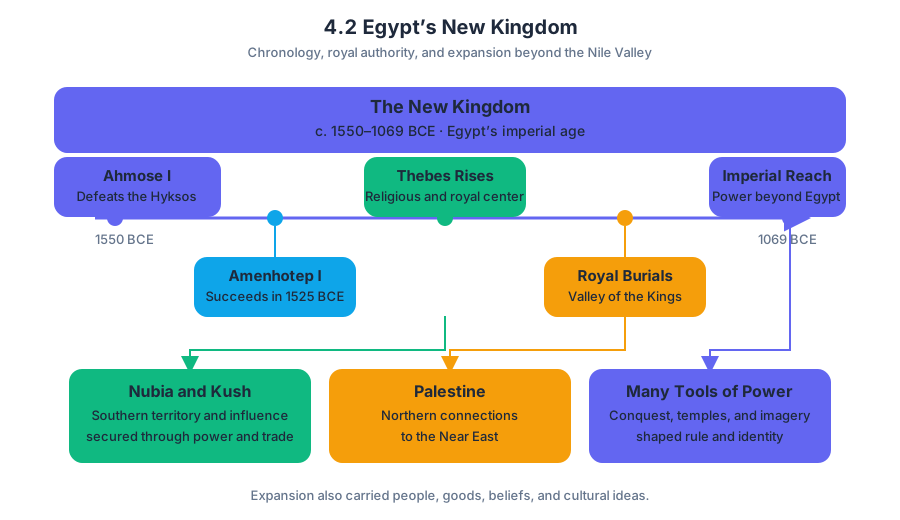
Egypt’s New Kingdom, lasting approximately $1550$–$1069$ BCE, was built from military recovery but sustained through the close relationship among empire, religion, and royal representation. Its pharaohs ruled not only a reunited Egypt but also territories and peoples beyond the Nile Valley, making the period a pinnacle of Egyptian power and influence in the Near East.
The Hyksos and the End of the Second Intermediate Period
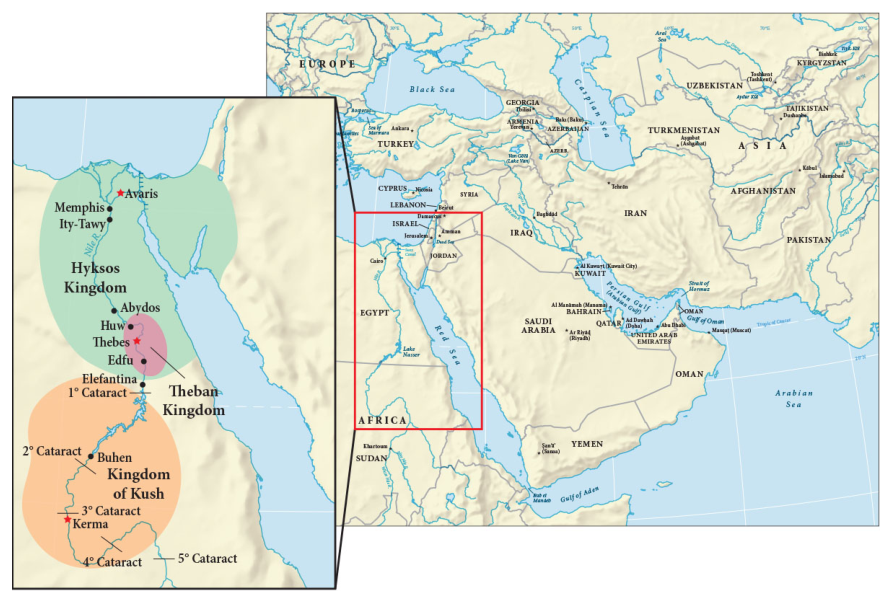
Around $1650$ BCE, recently arrived Canaanite peoples known as the Hyksos challenged the Egyptian princes who still ruled parts of the Nile Valley during the Second Intermediate Period. The Hyksos established a kingdom in Egypt and made Avaris, in the eastern Nile Delta, their capital. Their presence created a divided political landscape: Egyptian rulers, especially those based at Thebes in Upper Egypt, confronted a foreign dynasty controlling much of Lower Egypt.
The conflict did not end with a single easy victory. Theban rulers launched multiple unsuccessful attacks before they were able to move onto the offensive, capture large portions of Hyksos territory, and carry the war to the edges of Avaris. This pattern matters because it shows that Egyptian reunification was a process of sustained military effort rather than an automatic restoration of older political unity.
By approximately $1540$ BCE, Pharaoh Ahmose I had broken the defenses around Avaris, destroyed the Hyksos kingdom, and reasserted Egyptian power in Lower Egypt. He then directed Egyptian forces south toward Kush and east toward Palestine. These campaigns extended Egyptian control beyond the traditional heartland and inaugurated the period called the New Kingdom.
Key insight: The New Kingdom emerged from a successful reconquest. Its later imperial strength was therefore connected to the memory and political practice of defending Egypt against external challengers.
A common misconception is that the Hyksos episode simply represents an invasion followed by the restoration of an unchanged Egypt. The political result was more significant: the Theban victory reunited the country while also encouraging a more outward-looking monarchy. Egyptian rulers now treated control of neighboring regions as part of the security and greatness of the state.
The New Kingdom’s Chronology and Expansion
The New Kingdom lasted approximately $1550$–$1069$ BCE. Its beginning is conventionally associated with Ahmose I’s destruction of the Hyksos kingdom and the reestablishment of Egyptian authority in Lower Egypt. Its significance lies not only in its length but in the scale of Egyptian influence: the state projected power into Nubia, including Kush, and into Palestine, connecting Egypt more directly to the political world of the Near East.
After Ahmose I died in $1525$ BCE, his son Amenhotep I succeeded him. Amenhotep I and later New Kingdom pharaohs strengthened the institutions and religious foundations of royal authority. Thebes became especially important as the state’s religious capital and the favored royal burial place developed in the area commonly called the Valley of the Kings.
The New Kingdom’s rulers used conquest, building projects, religious patronage, and royal imagery together. Military expansion brought territory and influence; temples displayed the pharaoh’s relationship with the gods; and monumental architecture made political power visible. Egypt’s relations with neighboring peoples were not limited to warfare. They also involved immigration, trade, and the movement of cultural and religious ideas.
Imperial Power and Influence in the Near East
Egyptian expansion into Nubia and Palestine created an imperial zone in which military power and cultural exchange operated together. Egypt interacted with surrounding peoples through territorial expansion, but also through the movement of merchants, immigrants, religious concepts, and artistic practices. These connections made the New Kingdom a participant in a wider Near Eastern political and cultural environment rather than an isolated Nile Valley kingdom.
Imperial power was expressed materially through monumental construction. New Kingdom pharaohs commissioned temples, palaces, mortuary monuments, and statues that associated the king with divine order and national prosperity. The scale of these projects required substantial organization and resources, while their religious setting presented royal power as more than ordinary political authority.
Amenhotep III, known as “the Magnificent,” illustrates the connection between prosperity, peace, and monumental kingship. His nearly forty-year reign in the fourteenth century BCE was especially prosperous and marked by extended peace. During it, Egyptians constructed numerous monuments, including a sumptuous palace at Thebes, the Serapeum at Saqqara, temples to many gods, Amenhotep’s large mortuary temple, and many statues of the pharaoh himself.
These monuments did not merely celebrate an individual ruler’s personality. They communicated that the pharaoh stood at the center of Egypt’s political and religious order. The repeated representation of the king, alongside temples dedicated to the gods, made imperial authority visible to subjects and to neighboring peoples who encountered Egyptian wealth and artistic power.
Amun-Re and the Relationship between Religion and Kingship
Religion was central to New Kingdom government because the pharaoh’s authority was understood through relationships with the gods. Amenhotep I’s patron god was Amun, a deity especially associated with Thebes. Amun’s importance merged with reverence for Re, the patron god of the Egyptian monarchy, producing the combined deity Amun-Re.
Amun-Re joined the religious importance of Thebes with the solar and monarchic authority associated with Re, creating a powerful divine focus for New Kingdom kingship.
Amenhotep I and his successors built temples and other major public works in honor of Amun-Re, particularly the great Temple of Amun at Karnak. Such construction linked political resources to religious devotion. The state supported the god’s temple, while the god’s prestige reinforced the pharaoh’s legitimacy as Egypt’s ruler.
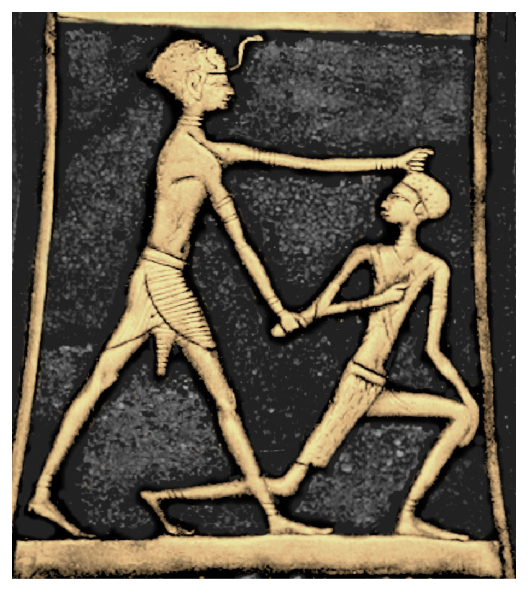
The relationship between religion and kingship could also change dramatically. The New Kingdom included major religious and political changes associated with rulers such as Akhenaten. Visual evidence from his reign presents the sun disk Aton extending life-giving rays toward Akhenaten and his family, while the royal family appears as the exclusive intermediary between the deity and the Egyptian people. The associated artistic style is more intimate and naturalistic than the rigidly idealized conventions of earlier royal representation.
Akhenaten’s reign therefore demonstrates that religion was not a decorative addition to monarchy. Control over divine worship could reshape royal identity, artistic practice, and the political position of the king’s family. At the same time, the prominence of Amun-Re and the great temples at Thebes shows how deeply established religious institutions supported the wider New Kingdom order.
Hatshepsut’s Rule as a Female Pharaoh
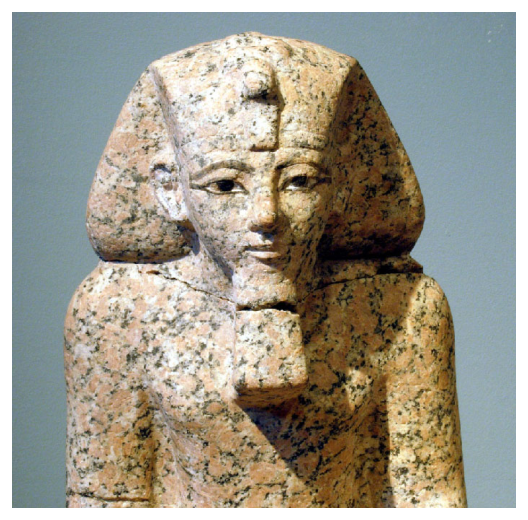
Hatshepsut ruled Egypt as pharaoh, making her an important example of how Egyptian kingship could accommodate a woman while preserving the symbolic expectations of the office. Egyptian pharaohs were traditionally represented as male, so Hatshepsut appeared in art with traditionally masculine features.
Her representation should not be mistaken for evidence that her rule was simply ignored or that Egyptian political identity had no room for women. Rather, the imagery shows how strongly the office of pharaoh was tied to a masculine symbolic role. Hatshepsut’s official representation adapted her appearance to the established visual language of kingship, presenting her as the ruler required by Egyptian political and religious tradition.
Key distinction: Hatshepsut was female, but the office she occupied was symbolically represented as male. Her images reveal the difference between a ruler’s biological identity and the formal visual language of pharaonic authority.
New Kingdom Governance and Historical Significance
The New Kingdom’s distinctive strength came from the combination of three forms of power. Imperial expansion placed Nubia and Palestine within Egypt’s sphere of control and increased interaction with the Near East. Religious authority connected the pharaoh to Amun-Re and supported enormous temple-building programs. Royal representation—from Hatshepsut’s masculine imagery to Amenhotep III’s statues and Akhenaten’s innovative family scenes—made claims about who could rule and how rulers related to the divine visible in stone and relief.
The period’s history therefore cannot be reduced to military conquest. Egypt’s greatness depended on the ability of rulers to turn victory into durable authority: authority over territory, over religious institutions, and over the images through which kingship was understood. Immigration, trade, warfare, and cultural exchange connected Egypt to its neighbors, while temples and monuments translated those connections into a distinctly Egyptian vision of empire.
Content adapted from OpenStax World History, Volume 1: to 1500 by Ann Kordas et al., licensed CC BY 4.0.
Source Materials
Study World History Volume 1 on Lykke
This course page is free to open: signed out, you can read its first two sections, and signing in, on any plan, opens the rest. The free Lykke Chrome extension syncs your own Canvas courses, so ChatGPT, Claude and Muse can answer from your classes and deadlines. It only reads Canvas.
Add the free extensionSign in to open every sectionAll sections of World History Volume 1 · Browse more course pages