From the free course World History Volume 1 on Lykke
5.2 The Steppes
Key concepts: Eurasian Steppe · Western and eastern halves of the steppe · Geographic extent from the Caspian Sea to the Pacific Ocean · Steppe climate · Steppe vegetation · Pasturing livestock · Limits of settled agriculture
By the end of this section the student can: Discuss the role climate played in the ancient history of the steppes; Describe the daily life of people who lived in the region of the steppes; Analyze the relationship between the people of the steppes and nearby civilizations
5.2 The Steppes
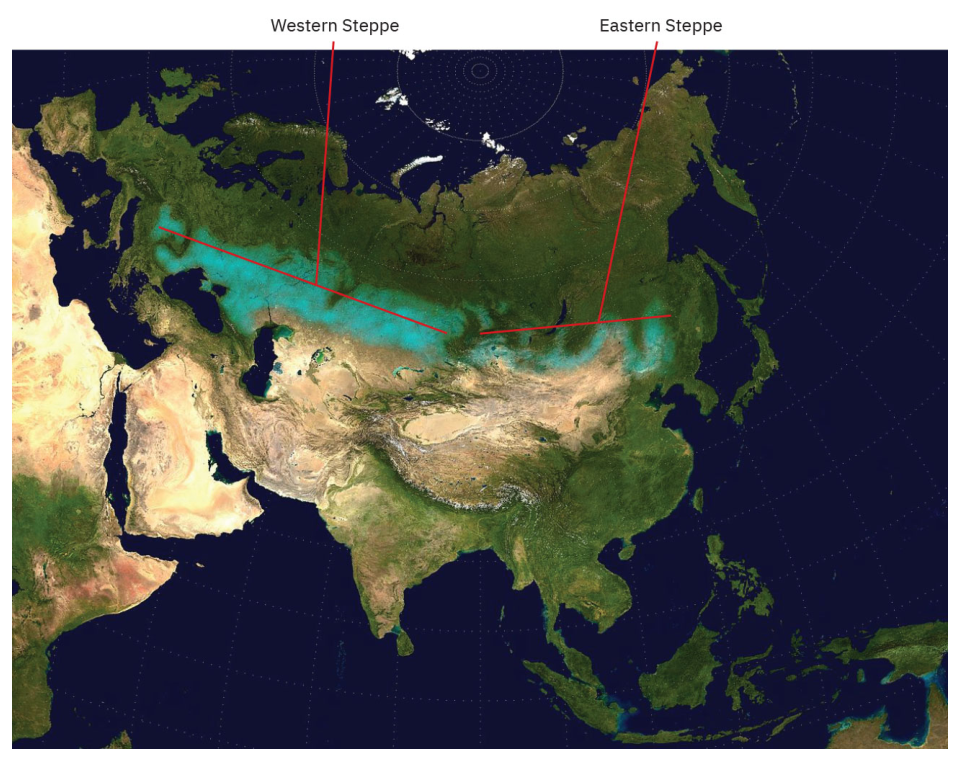
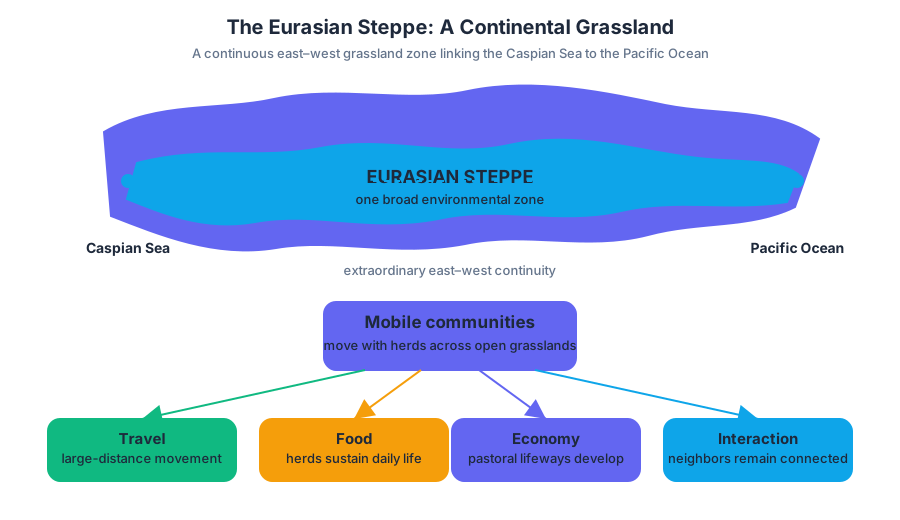
The Eurasian Steppe is a vast belt of grassland that stretches from the Caspian Sea in the west to the Pacific Ocean in the east. Its geography encouraged a distinctive way of life: instead of planting crops in permanent fields, many communities moved with herds of horses, sheep, goats, cattle, and camels in search of seasonal pasture. The steppe was therefore neither an empty wilderness nor a failed agricultural zone. It was a productive environment for pastoral nomads and a major historical corridor connecting China, Central Asia, eastern Europe, and the Middle East.
The word steppe describes a largely treeless grassland. The Eurasian Steppe had two broad regions. The western steppe extended from the lands north of the Black Sea and Caspian Sea toward Central Asia. The eastern steppe continued across Mongolia and northern China to the Pacific Ocean. Although these areas were separated by enormous distances, their open terrain allowed peoples, animals, technologies, languages, and military practices to move across the continent.
Climate shaped nearly every part of steppe history. Rainfall was generally too limited and unpredictable to support intensive agriculture across much of the region, but it was sufficient in many places to sustain grasses. Winters could be bitterly cold, while summers were often hot and dry. A community that remained in one location too long could exhaust the nearby pasture; a community that moved at the wrong time might lose animals to drought, cold, or a lack of fodder. Mobility was therefore not simply a cultural preference. It was an effective response to the environmental conditions of the grasslands.
The steppe’s ecological logic can be summarized as a cycle: pasture supported herds, herds supported people, and people moved to prevent pasture from being depleted. Pastoralism is an economy based primarily on raising and managing domesticated animals. Pastoralists consumed animal products such as meat, milk, and cheese, and they used hides, wool, hair, and sinew for clothing, shelter, tools, and trade. They also exchanged livestock products for grain, metal goods, textiles, ceramics, and luxury objects produced by settled societies.
The Nomadic Culture of the Steppes
Nomads are people who move periodically rather than living permanently in one settlement. Steppe nomads were more precisely pastoral nomads, because their movement followed the needs of domesticated animals. Their routes were not random wandering. Families and larger communities usually understood the location of water, the timing of seasonal grasses, and the dangers of particular landscapes. Movement might take place between summer and winter pastures, or in response to drought, political pressure, warfare, and changes in the size of a herd.
Daily life revolved around the animals. Horses provided transportation, allowed herders to supervise widely dispersed animals, and later became essential to mounted warfare. Sheep and goats supplied meat, milk, wool, and hides. Cattle provided food, leather, and traction, while camels were especially valuable in the dry regions of Central Asia because they could travel long distances with limited water. The composition of a herd depended on the local environment, and families often maintained several kinds of animals so that they were not dependent on a single species.
Portable housing made seasonal movement possible. Steppe peoples used tents and other temporary structures that could be dismantled, transported, and reassembled. A mobile household could carry its shelter, tools, clothing, and food-processing equipment with the family and herd. This mobility distinguished pastoral societies from agricultural communities whose houses, storage buildings, irrigation systems, and fields tied them to a particular place.
The contrast between nomadic and settled life should not be exaggerated. Steppe peoples were not isolated from farming societies, and they did not necessarily reject agriculture or urban life. Many communities combined herding with limited cultivation, hunting, fishing, and trade. Nomads also visited markets and settlements, sometimes peacefully and sometimes under military pressure. Their economies depended partly on exchange with people who produced grain, metalwork, and manufactured goods in larger quantities.
The horse was especially important because it transformed the scale and speed of movement. Mounted herders could monitor animals across broad territories, travel rapidly between pastures, and communicate over long distances. Horse riding also gave steppe warriors a major military advantage. Skilled mounted archers could attack from a distance, retreat quickly, and return before a slower infantry army could respond. Weapons such as the composite bow, made from several materials and designed for power in a compact form, were well suited to mounted combat.
A common misconception portrays nomads as people without social organization, political institutions, or cultural traditions. In reality, steppe societies developed intricate systems of kinship, leadership, ritual, diplomacy, and warfare. Their mobility made centralized administration difficult, but it did not make political authority impossible. Leaders built influence by distributing livestock, organizing protection, controlling trade, rewarding followers, and directing military campaigns.
Archaeological evidence reveals that steppe peoples created impressive artistic and technological traditions. Burial mounds, often called kurgans, contain weapons, horse equipment, jewelry, textiles, and other objects that indicate social distinctions and long-distance connections. Animal-style art, characterized by dynamic representations of animals such as deer, felines, birds of prey, and horses, appears across parts of the steppe. These artifacts show that pastoral communities participated in broad cultural networks rather than existing outside the history of civilization.
The evidence must nevertheless be interpreted carefully. Written accounts were usually produced by settled neighbors, including Greek, Persian, Chinese, and Roman observers, who sometimes described steppe peoples as violent or uncivilized. Archaeology offers another perspective, but graves and elite objects do not reveal every aspect of ordinary life. Historians therefore compare written testimony with settlement remains, animal bones, tools, weapons, burial practices, and environmental evidence. The result is a more complicated picture: steppe communities could raid, trade, migrate, negotiate, and build states.
Tribes, Confederations, and Settled Neighbors
Steppe political organization often began with the tribe, a community connected by kinship, shared ancestry, allegiance, or common political leadership. Tribes could be divided into clans and extended families, but the boundaries were flexible. In times of crisis or opportunity, several tribes might unite in a confederation, a larger alliance under a powerful leader. Confederations could expand rapidly when a leader offered military success, access to pasture, protection, or wealth gained through trade and conquest.
The political strength of a confederation depended on maintaining loyalty among groups that retained their own leaders and identities. A successful ruler had to distribute captured goods, negotiate among allied chiefs, and coordinate armies across enormous distances. Confederations could therefore be powerful without resembling the centralized bureaucratic states of Egypt, Persia, or China. They might also dissolve when a leader died, when rival factions competed for power, or when drought and military defeat weakened the alliance.
Among the best-known western steppe peoples were the Scythians, who flourished from approximately the eighth to the third century BCE in the region north of the Black Sea and across parts of Central Asia. Greek historian Herodotus described Scythian customs, warfare, religious practices, and relations with neighboring peoples. His account is valuable but must be read critically: he wrote from the perspective of a Greek observer, and some of his stories may combine direct information with inherited tales or exaggeration.
Herodotus famously described the Scythians as mobile horse-using peoples who depended on their herds and possessed no permanent cities in the Greek sense. He also recorded the failed invasion of Scythia by the Persian king Darius, usually dated to about $513$ BCE. The Scythians avoided offering Darius the decisive battle he wanted. Instead, they withdrew across the open landscape, disrupted Persian supplies, and used their knowledge of the environment to make the campaign difficult. The episode illustrates how a mobile society could defend itself against a larger imperial army by refusing to fight on the invader’s terms.
Scythian burial mounds provide evidence that complements Herodotus. Archaeologists have found richly furnished graves containing weapons, horse gear, ornaments, and objects showing connections with Greek colonies and other settled regions. These discoveries demonstrate that Scythian society included wealthy elites and specialized craftspeople. They also reveal sustained interaction between steppe communities and the cities around the Black Sea, including trade as well as conflict.
Farther east, the Xiongnu formed one of the most important steppe confederations of the late first millennium BCE. Under leaders such as Modu Chanyu, who came to power around $209$ BCE, the Xiongnu united multiple groups across the eastern steppe. Their power brought them into repeated conflict and negotiation with the Han dynasty of China. The Han court attempted to protect its northern frontier, secure trade routes, and prevent Xiongnu raids, while Xiongnu leaders sought horses, grain, luxury goods, and political recognition.
Relations between the Xiongnu and Han were not simply a story of Chinese civilization confronting barbarism. They included warfare, diplomacy, marriage alliances, tribute, trade, and shifting treaties. The Han expanded military power and built or strengthened defensive walls and frontier settlements, but it also sent gifts and negotiated with Xiongnu rulers. From the Xiongnu perspective, these exchanges could represent political acknowledgment and a source of wealth rather than passive submission.
The relationship between steppe peoples and settled neighbors was therefore reciprocal, even when it was unequal or violent. Agricultural states provided grain, textiles, metalwork, and manufactured goods that pastoralists wanted or needed. Nomads supplied horses, animal products, military services, and access to routes across the grasslands. They could also threaten settled populations through raids or invasions, particularly when political fragmentation, ecological stress, or competition for resources increased pressure on the steppe.
Historians disagree about how to explain this relationship. Older accounts often treated nomadic invasions as destructive attacks from outside civilization. More recent interpretations emphasize that nomads were active participants in regional economies and political systems. The steppe was not a blank space separating civilizations; it was a zone of interaction that linked them. Its peoples sometimes destroyed states, sometimes served them, and sometimes created empires of their own.
The central historical lesson is that climate and geography shaped possibilities without mechanically determining events. Grasslands encouraged mobility and livestock raising, but human choices transformed those conditions into political power, artistic traditions, trade networks, and military systems. Tribes and confederations connected the western and eastern halves of the Eurasian Steppe to neighboring civilizations, making the region one of the most important arenas of ancient world history.
Content adapted from OpenStax World History, Volume 1: to 1500 by Ann Kordas et al., licensed CC BY 4.0.
Source Materials
Study World History Volume 1 on Lykke
This course page is free to open: signed out, you can read its first two sections, and signing in, on any plan, opens the rest. The free Lykke Chrome extension syncs your own Canvas courses, so ChatGPT, Claude and Muse can answer from your classes and deadlines. It only reads Canvas.
Add the free extensionSign in to open every sectionAll sections of World History Volume 1 · Browse more course pages