From the free course World History Volume 1 on Lykke
6.3 The Hellenistic Era
Key concepts: Alexander the Great and the rise of Macedonian power · The Hellenistic Era · Alexander’s conquest of the Persian Empire · Spread of Greek culture throughout the Mediterranean and Near East · Formation and shifting borders of Hellenistic kingdoms · The Seleucid Empire · The Greco-Bactrian Kingdom · Continuing Greek influence in Bactria · Popularization of mystery religions and philosophies · Hellenistic cultural and political interactions with Rome
By the end of this section the student can: Explain the events that led to the rise of Alexander the Great; Analyze Alexander the Great’s successes as a military and political leader; Discuss the role that Alexander the Great’s conquests played in spreading Greek culture
6.3 The Hellenistic Era
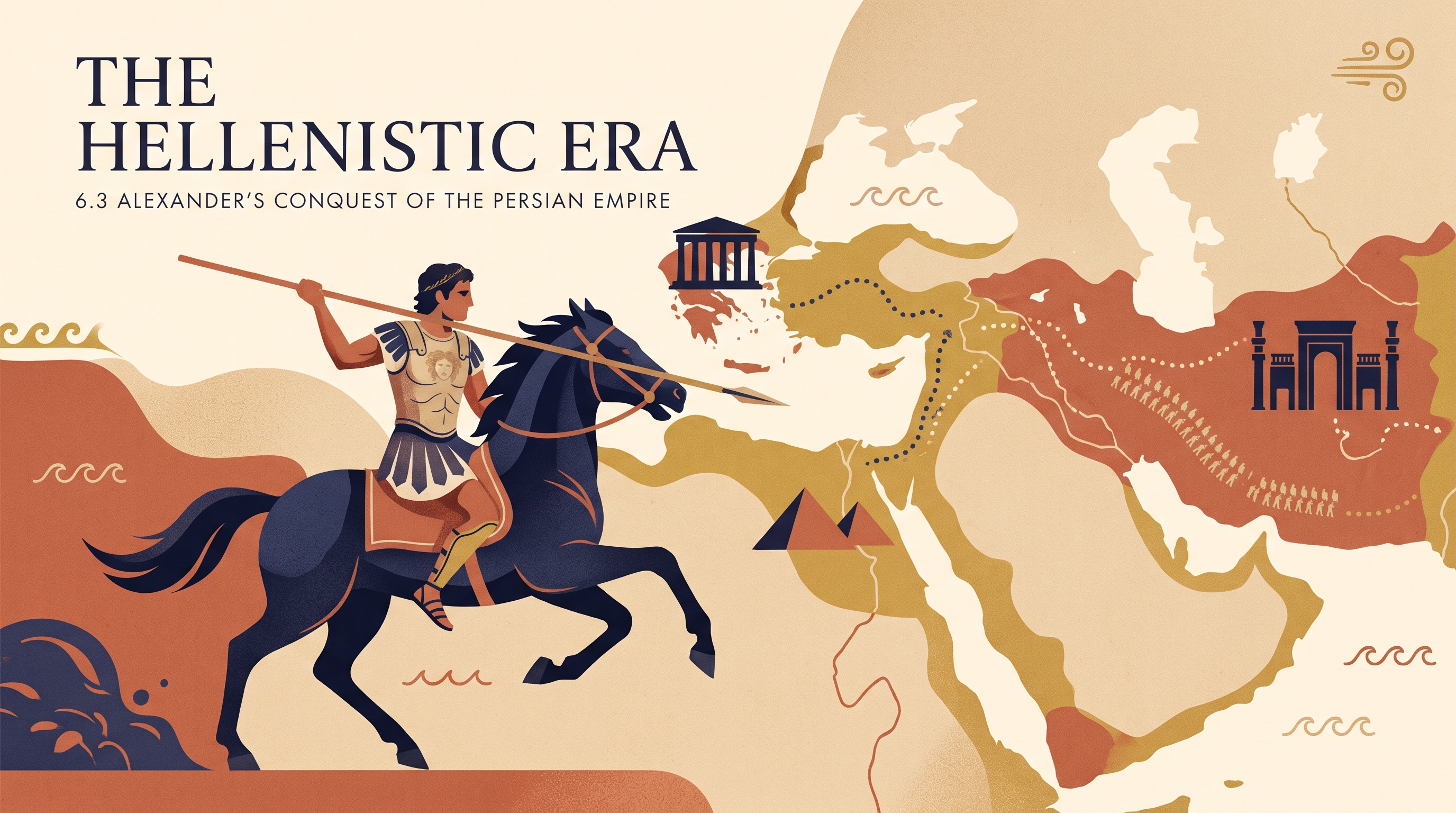
Alexander the Great’s conquest of the Persian Empire transformed the eastern Mediterranean and Near East into a connected political and cultural world. The conquest did not create a single stable empire for long: after Alexander’s death, conflicts over territory and spoils reordered the former Persian Empire, producing several rival kingdoms whose borders shifted repeatedly.
Alexander the Great and the Rise of Macedonian Power
Macedon lay north of the Greek city-states, occupying territory in and around modern Greece and northern Macedonia. The Macedonians did not speak Greek, but they had adopted Greek culture during the Archaic period. Their royal family claimed descent from Heracles, the mythical Greek hero. This claim connected Macedonian kingship to the heroic traditions that Greek communities regarded as part of their shared cultural inheritance.
The decisive figure in Macedon’s rise was Philip II, who ruled from $359$ to $336$ BCE. Philip transformed Macedon from a kingdom on the margins of the Greek world into a major military power. His success created the political and military foundation for the conquests of his son, Alexander.
Philip’s achievement mattered because Macedonian power changed the balance among the Greek states. The Classical period in Greece ended when Greece lost its freedom to the Kingdom of Macedon. Alexander inherited this strengthened kingdom and used it as the base for an unprecedented campaign against the Persian Empire.
Alexander became king in $336$ BCE and rapidly demonstrated both military ambition and political skill. His leadership must be understood as the foundation of the Hellenistic Era: without Macedon’s transformation under Philip and Alexander’s ability to command a large multinational army, Greek culture would not have spread so widely across the Mediterranean and Near East.
Alexander’s Conquest of the Persian Empire
Alexander’s campaign carried Macedonian power from Greece into the territories of the Persian Empire. The famous Alexander Mosaic, discovered in a Roman house at Pompeii, portrays the Macedonian king during the Battle of Issus in $333$ BCE. Although the mosaic was made in the first century CE—centuries after Alexander’s lifetime—it shows how later Romans remembered and admired him.
The mosaic presents Alexander riding his horse, Bucephalus, into battle. He wears armor decorated with a gorgoneion, or image of Medusa’s head, and thrusts a spear toward his opponents. The image is not a contemporary battlefield photograph; it is a later artistic portrayal that turned Alexander into a heroic symbol of military courage and conquest.
Alexander’s victories brought the Persian Empire under Macedonian control and opened routes through Egypt, the Near East, and Central Asia. His conquests connected regions that had previously been governed within the Persian imperial system but were now reorganized around Macedonian kingship and Greek-speaking elites.
The conquest also raised difficult questions about Alexander’s conduct. One important controversy concerns the burning of Persepolis in $330$ BCE, the Persian ceremonial capital. Ancient historians offered different accounts of the event. Quintus Curtius Rufus and Plutarch associated the destruction with Thaïs, while Arrian of Nicomedia provided a different interpretation. The disagreement reminds historians that ancient narratives were shaped by political judgments, moral criticism, and the authors’ distance from the events they described.
Alexander’s campaigns were therefore both military operations and political acts of reordering. Conquest created access to wealth, land, and spoils, but disputes over their distribution intensified after Alexander’s death. His empire did not remain unified; competing commanders fought over its territories and divided the former Persian imperial space among themselves.
The Hellenistic Era
The Hellenistic Era was the period following Alexander’s death when Greek culture spread across the Mediterranean and Near East. The term does not mean that everyone in these regions became Greek or that local traditions disappeared. Rather, it describes a world in which Greek language, artistic forms, political institutions, philosophical ideas, and religious practices circulated widely and interacted with older local cultures.
The Hellenistic Era was the period after Alexander’s conquests in which Greek culture spread throughout the Mediterranean and Near East, especially through the kingdoms established by his successors.
Alexander’s conquests created the conditions for this cultural expansion, but the process continued through cities, royal courts, armies, merchants, and settlers. Greek influence reached far beyond Macedon and the Greek mainland. It became especially visible in areas that had been incorporated into the kingdoms formed after Alexander’s death.
A common misconception is that Hellenization simply replaced local cultures with Greek culture. The Hellenistic world was instead marked by interaction. Greek influence continued in Bactria even after the Greco-Bactrian Kingdom separated from the Seleucid Empire, yet that influence existed within a region with its own peoples, political traditions, and cultural history.
Hellenistic Kingdoms and Shifting Borders
Alexander’s empire fragmented after his death. His former commanders competed for power, and their struggles produced kingdoms that changed in size and political allegiance. The Hellenistic kingdoms should therefore be understood as unstable successor states rather than as permanent political units with fixed frontiers.
The map associated with the period offers a snapshot of the region around $263$ BCE. It captures one moment in a history of shifting borders. Kingdoms expanded, contracted, broke apart, and fought over strategic cities and territories. A map of $263$ BCE is consequently not a permanent picture of the Hellenistic world but a frame taken from a rapidly changing political landscape.
This instability resulted from the political consequences of Alexander’s conquests. His commanders inherited the wealth and territory of the Persian Empire, but no uncontested successor inherited Alexander’s authority. Conflicts over spoils and imperial possessions reordered the region and established several competing royal dynasties.
The Greco-Bactrian Kingdom illustrates this process. It broke away from the Seleucid Empire in the third century BCE. Separation from Seleucid rule did not end Greek influence in Bactria. Instead, Greek cultural forms continued there after political independence, demonstrating that political control and cultural influence did not always follow the same borders.
The Seleucid Empire
The Seleucid Empire was one of the major Hellenistic kingdoms formed from the territories conquered by Alexander. It occupied a large area of the former Persian Empire and became a principal center for the continuation of Macedonian and Greek political influence in the Near East and Central Asia.
The Seleucid realm was difficult to govern because it stretched across diverse regions and peoples. Its borders shifted as rulers confronted rival Hellenistic kingdoms, local resistance, and breakaway territories. The emergence of the Greco-Bactrian Kingdom in the third century BCE shows that the Seleucid Empire could lose control of distant provinces while Greek cultural influence remained.
The Seleucid example reveals the central tension of the Hellenistic world: conquest created broad connections, but political unity remained fragile. Greek culture could travel across imperial boundaries even when military authority could not.
Hellenistic Culture, Religion, and Philosophy
The spread of Greek culture affected more than royal administration and military organization. Mystery religions and philosophies became increasingly popular during the Hellenistic Era. These traditions offered people ways to understand the uncertainties of a world shaped by conquest, migration, political instability, and cultural contact.
Mystery religions were religious traditions associated with initiation and special knowledge or ritual participation. Their popularity reflected the religious creativity of the Hellenistic world. They flourished alongside older civic and local religious practices rather than simply erasing them.
Philosophy also developed in public settings. Zeno, the founder of Stoicism, taught his students in the Stoa Poikile, or “Painted Porch,” in the Athenian agora. The location mattered: philosophical teaching occurred in a shared urban space where people gathered, conducted business, and participated in civic life.
The Hellenistic cultural world thus combined movement and continuity. Greek ideas traveled through the cities and kingdoms created by Alexander’s conquests, while local religious traditions and regional identities continued to shape how people interpreted those ideas.
Rome, Mithridates, and the Enduring Hellenistic World
The Hellenistic kingdoms did not exist in isolation. Their history included ongoing conflicts involving Rome and Mithridates. These struggles demonstrate that the Hellenistic world remained politically important even as new powers entered Mediterranean affairs.
Rome’s expanding influence increasingly affected the eastern Mediterranean. Conflict with Mithridates formed part of the larger pattern of competition among Rome, Hellenistic kingdoms, and regional rulers. The Hellenistic era therefore did not end because Greek culture suddenly disappeared. Its political landscapes were gradually incorporated into an expanding Roman world.
Greek cultural influence continued as these cities and kingdoms became incorporated into the Roman Empire. Roman admiration for Alexander, visible in the first-century CE mosaic found at Pompeii, shows how Roman society claimed and commemorated the Greek and Hellenistic past.
The central historical pattern is therefore not a simple replacement of Greece by Rome. Alexander’s conquest created a broad Hellenistic world; successor kingdoms gave that world shifting political forms; Greek culture interacted with local traditions; and Rome later absorbed many of its cities and cultural practices. The Hellenistic Era was defined by this combination of conquest, fragmentation, cultural exchange, and continuity.
Content adapted from OpenStax World History, Volume 1: to 1500 by Ann Kordas et al., licensed CC BY 4.0.
Source Materials
Study World History Volume 1 on Lykke
This course page is free to open: signed out, you can read its first two sections, and signing in, on any plan, opens the rest. The free Lykke Chrome extension syncs your own Canvas courses, so ChatGPT, Claude and Muse can answer from your classes and deadlines. It only reads Canvas.
Add the free extensionSign in to open every sectionAll sections of World History Volume 1 · Browse more course pages