From the free course World History Volume 1 on Lykke
2.2 People in the Paleolithic Age
Key concepts: Small cooperative hunter-gatherer groups · Bands made up of related families · Group sizes of roughly 40–60 people · Foraging for wild plants and other foods · Hunting wild game · Use of rudimentary hunting tools · Adaptation to scarce local resources · The San as an ethnographic parallel for prehistoric lifeways
By the end of this section the student can: Explain how the environment shaped the way people lived in the Paleolithic Age; Describe the day-to-day life of people in the Paleolithic Age; Discuss Paleolithic Age peoples and their likely attitudes toward the environment, gender, religion, and social hierarchy
2.2 People in the Paleolithic Age
A group of forty people could already strain the food supply of a single area. That simple fact helps explain why Paleolithic communities generally remained small, cooperative, and flexible rather than growing indefinitely in one place. Their survival depended on how many wild plants, animals, insects, nuts, and other foods the surrounding environment could provide.
Life in the Paleolithic Age
The Paleolithic Age, or Old Stone Age, was characterized by communities that lived from resources available in the wild. Rather than producing food through agriculture, people obtained what they needed by foraging, meaning the collection of wild plant and animal foods, and by hunting. Because these resources were scattered and could be depleted, social organization had to match environmental limits.
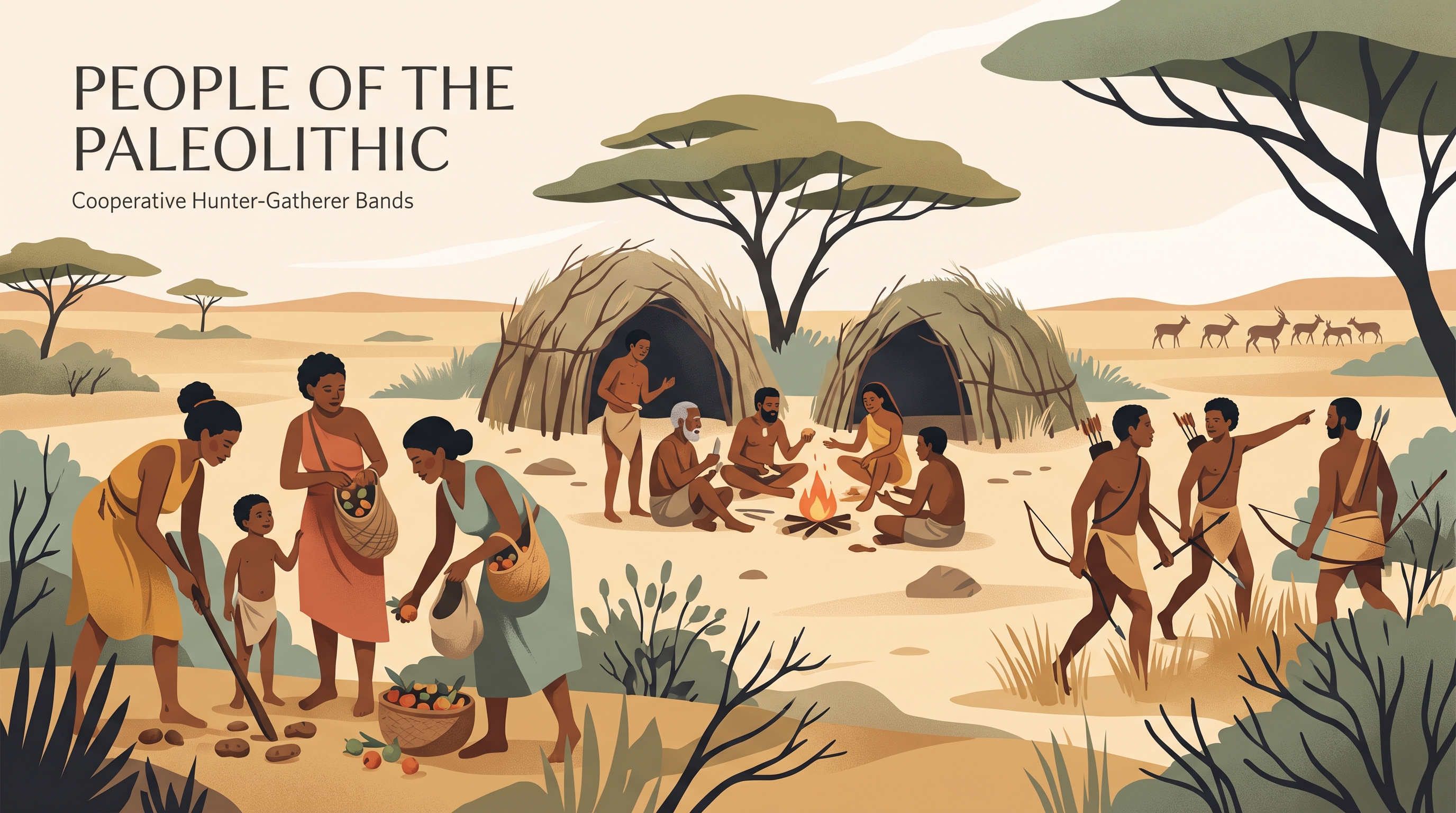
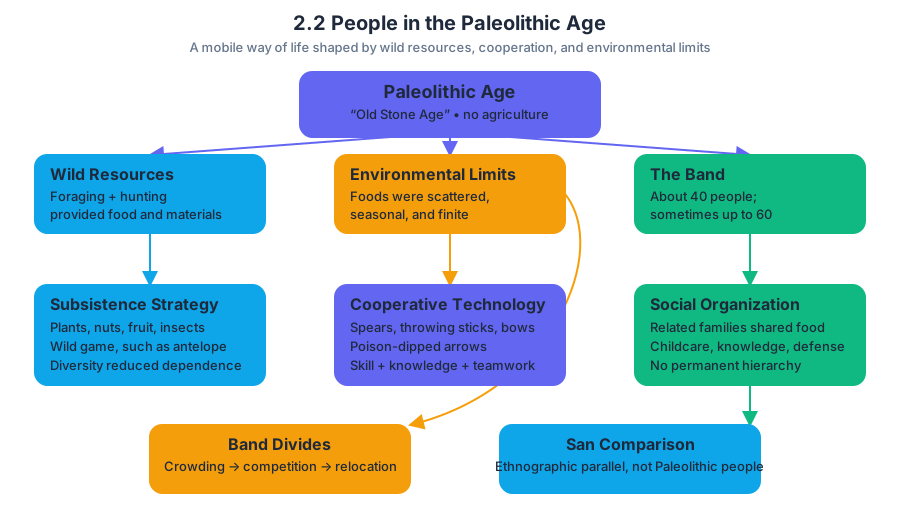
The basic social unit was a band: a small cooperative group made up primarily of related families. A band might include about forty people, although groups could reach as many as sixty when several related families lived and traveled together. These numbers were not arbitrary. A larger population required more food, water, and living space, and the resources of a particular area might not support it.
When a group became too large, its members would struggle to survive on the scarce resources of the region. Cooperation would also become more difficult as more people competed for the same supplies. The practical solution was for the group to divide: some members would move to another area with different resources, forming a smaller social unit capable of supporting itself. In this way, environmental scarcity directly influenced the size and structure of Paleolithic communities.
This organization should not be mistaken for isolation. A band consisted of several related families, so cooperation operated both within families and across them. Members could share knowledge about food sources, participate in hunts, care for children, and respond collectively to danger. Their survival depended less on one individual’s ability to produce everything alone than on the coordinated efforts of the group.
Foraging supplied much of the everyday diet. People searched for the particular foods their environment offered, including wild vegetables, nuts, fruit, and insects. Foraging required detailed knowledge of seasonal availability and local landscapes: a community had to recognize edible plants, locate them, and understand where different foods could be found. The importance of this knowledge also meant that survival depended on accumulated experience shared among members of the band.
Hunting supplemented foraging with animal protein and other useful resources. Paleolithic hunters pursued wild game, or undomesticated animals, including antelope. Hunting was dangerous and uncertain, so it worked as a cooperative activity rather than a guaranteed daily source of food. The combination of gathering and hunting allowed a band to make use of several kinds of resources instead of relying on only one.
Hunting depended on rudimentary tools. These included throwing spears, which extended a hunter’s reach and allowed an attack from some distance. Other hunting tools used by the San included throwing sticks, small bows, and arrows dipped in poison. Such equipment was technically simple compared with later weapons, but it could make hunting more effective and helped small groups obtain game in challenging environments.
The phrase rudimentary hunting tools does not mean useless or random tools. It describes equipment that was relatively basic in construction but carefully adapted to particular tasks. A throwing spear, for example, converted the force of the hunter’s arm into a weapon that could strike an animal without requiring close physical contact. The value of these tools lay in how they worked together with cooperation, environmental knowledge, and practiced skill.
Diverse Paleolithic Peoples
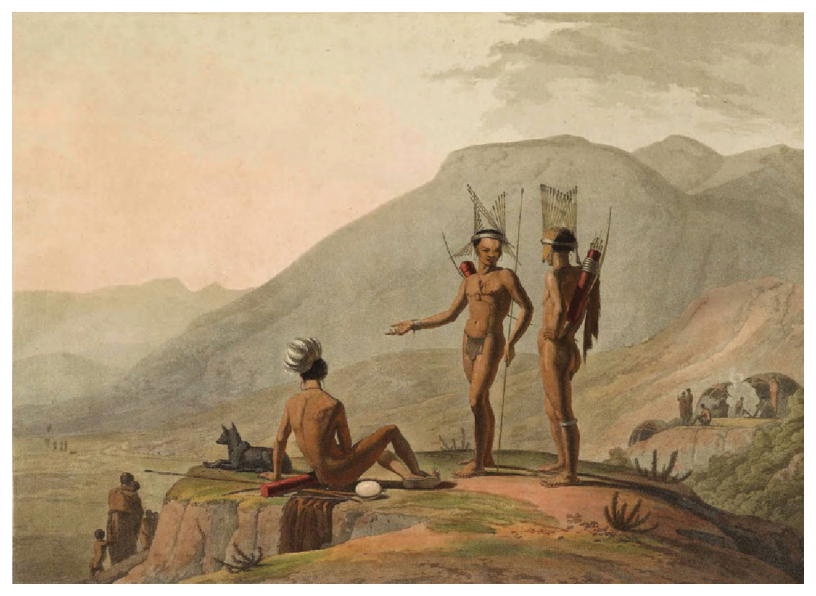
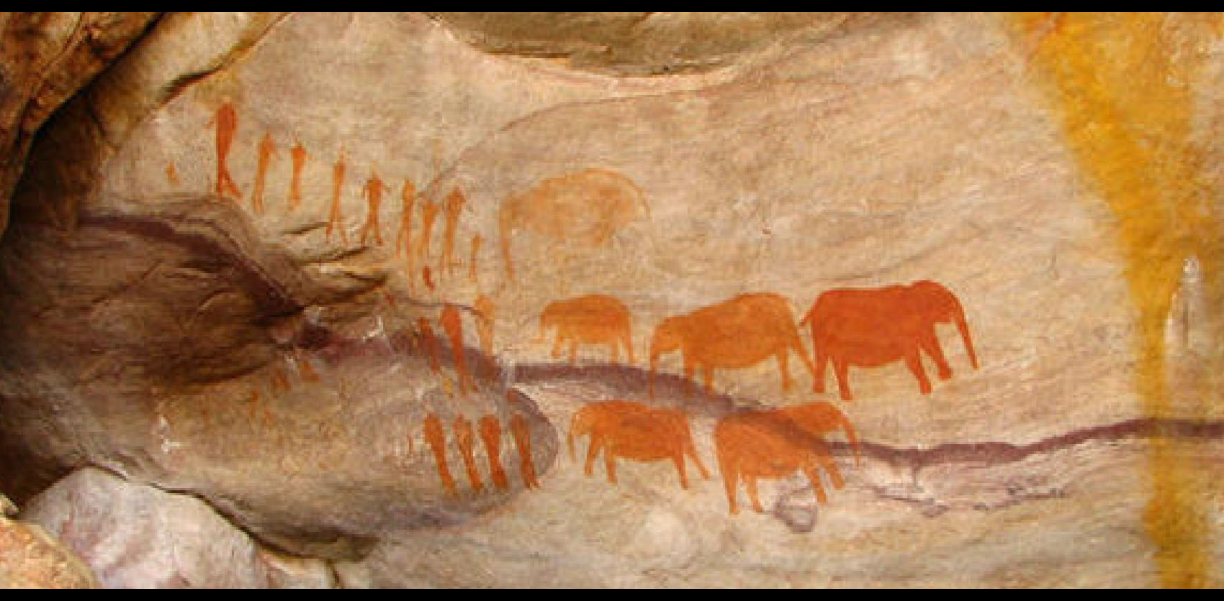
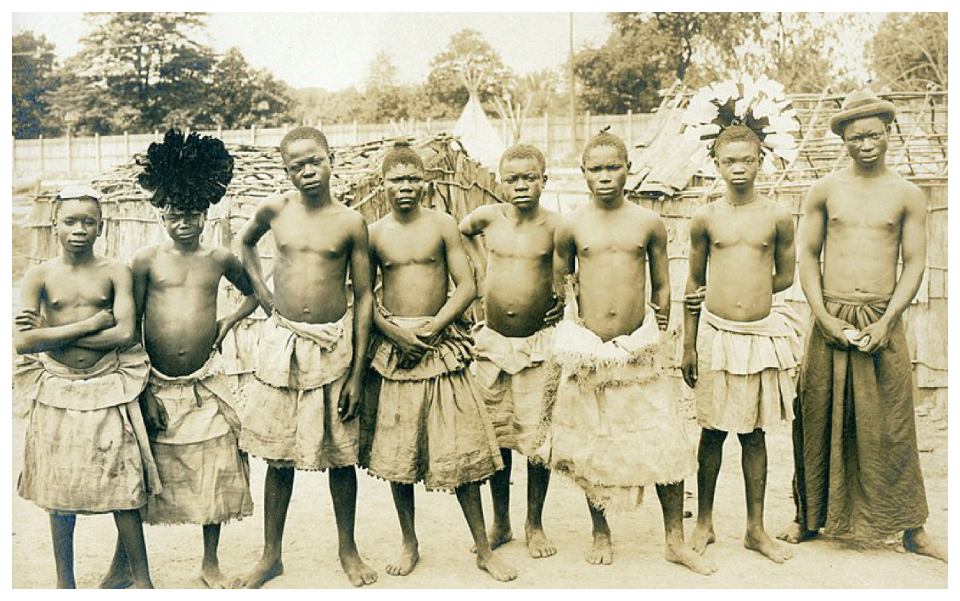
The San of southern Africa provide an important historical and ethnographic parallel for understanding how prehistoric humans may have lived. Ethnography is the study of people and their ways of life through close observation and description. The San are not identical to Paleolithic communities, but their continued experience as hunter-gatherers offers evidence for imagining how small cooperative groups could organize survival without agriculture or large political institutions.
The San traditionally survive by foraging for wild vegetables, nuts, fruit, and insects. They also hunt wild game such as antelope, using tools including throwing sticks, spears, and small bows that shoot poison-dipped arrows. This combination of gathering and hunting illustrates the broad subsistence pattern associated with Paleolithic bands: people draw on several sources of food because no single resource can be counted on to meet every need.
The San live in relatively small groups that include members of several related families. Their communities are largely leaderless, meaning that no permanent central authority normally commands the group. In particular situations, however, respected hunters or older men might exercise some authority. This arrangement shows that cooperation did not require a rigid hierarchy. Knowledge, age, experience, and hunting ability could earn respect without producing a formal ruling class.
The San therefore help historians and anthropologists connect several features of Paleolithic life: small population size, family relationships, shared subsistence, hunting skill, basic tools, and cooperation in difficult environments. The comparison must remain cautious because the San are modern people with their own history and culture, not living fossils from the Paleolithic Age. Their way of life nevertheless demonstrates how a human community can organize food production, social relationships, and authority around foraging and hunting.
Resource Scarcity and Band Organization
The central relationship is practical: scarce local resources limited group size, and those limits encouraged bands to remain small enough for cooperation and survival. Family ties made coordinated work possible, while foraging, hunting, and rudimentary tools allowed the group to use a varied but finite supply of wild foods.
Content adapted from OpenStax World History, Volume 1: to 1500 by Ann Kordas et al., licensed CC BY 4.0.
Source Materials
Study World History Volume 1 on Lykke
This course page is free to open: signed out, you can read its first two sections, and signing in, on any plan, opens the rest. The free Lykke Chrome extension syncs your own Canvas courses, so ChatGPT, Claude and Muse can answer from your classes and deadlines. It only reads Canvas.
Add the free extensionSign in to open every sectionAll sections of World History Volume 1 · Browse more course pages