From the free course World History Volume 1 on Lykke
1.2 Primary Sources
By the end of this section the student can: Identify different types of primary sources; Analyze primary sources in a historical context; Interpret primary sources effectively
1.2 Primary Sources
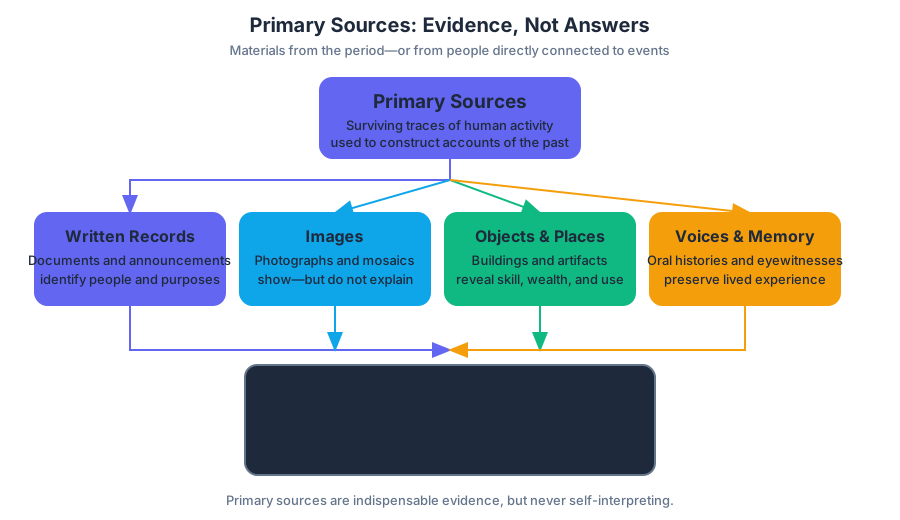
A magazine cover, a mosaic, a government announcement, and an eyewitness account can all become evidence of the past—but none automatically tells the whole truth. Primary sources are materials produced in the historical period being studied or by people directly connected to the events. They include written documents, images, oral histories, buildings, artifacts, and other surviving traces of human activity. Historians use them to construct accounts of the past, while asking what each source reveals, what it conceals, and why it was created.
The central challenge is that the past does not arrive with its own explanation attached. A photograph may show what someone looked like, but not why the person was there. A building may display wealth and technical skill, but not necessarily the experiences of the laborers who constructed it. A written account may offer valuable detail while also reflecting the author’s assumptions, interests, and intended audience. Primary sources therefore require both attention and skepticism: they are indispensable evidence, but they are never self-interpreting.
Learning to Evaluate Documents and Images
Human beings have deliberately created records and preserved memories because they considered the past worth remembering. Oral histories, prehistoric cave paintings, and archaeological artifacts can all provide valuable evidence, especially for societies that left few written records. For historians, however, written language often offers greater clarity for building narratives of the past. A text can identify people, actions, places, and purposes in ways that an image or object may not.
Consider a modern magazine featuring a rock or pop star on its cover, dressed for performance in a vivid or provocative style. Five hundred years from now, that image might lead historians to make several guesses about the society that produced it. They might infer something about entertainment, fashion, celebrity, or gender expectations. Yet the photograph alone leaves many questions unanswered. Was the person a singer, actor, politician, or model? Was the clothing typical, theatrical, or deliberately unusual? Was the image meant to inform, advertise, shock, or attract buyers?
A caption such as “Pop star rising to the top of the charts” would provide substantially more information. The words identify the person’s profession and suggest that the image concerns success in popular music. The caption also changes how viewers interpret the clothing and pose: what might otherwise look like an ordinary portrait becomes part of a story about fame and achievement. The example demonstrates why historians combine visual evidence with textual evidence whenever possible.
Key principle: An artifact can show that something existed, but context helps explain what it meant.
Context means the surrounding circumstances that give a source meaning. For a document or image, context may include the political situation, social expectations, religious beliefs, economic conditions, and major events of the time. Without context, even accurate observations can produce misleading conclusions. A modern image of a performer, for example, cannot be interpreted responsibly without knowing something about mass media, celebrity culture, popular music, and the commercial purpose of magazines.
Written sources also require a critical eye. The existence of text does not make a source automatically objective or truthful. “Fake news” is not a new phenomenon; what has changed in the modern era is the speed at which false or misleading claims can circulate. Earlier authors could also exaggerate, omit information, repeat rumors, or shape their accounts to serve political and personal purposes. Historians must therefore ask not only what does this source say? but also why was it written, and how reliable is it for this particular question?
Images as Historical Evidence
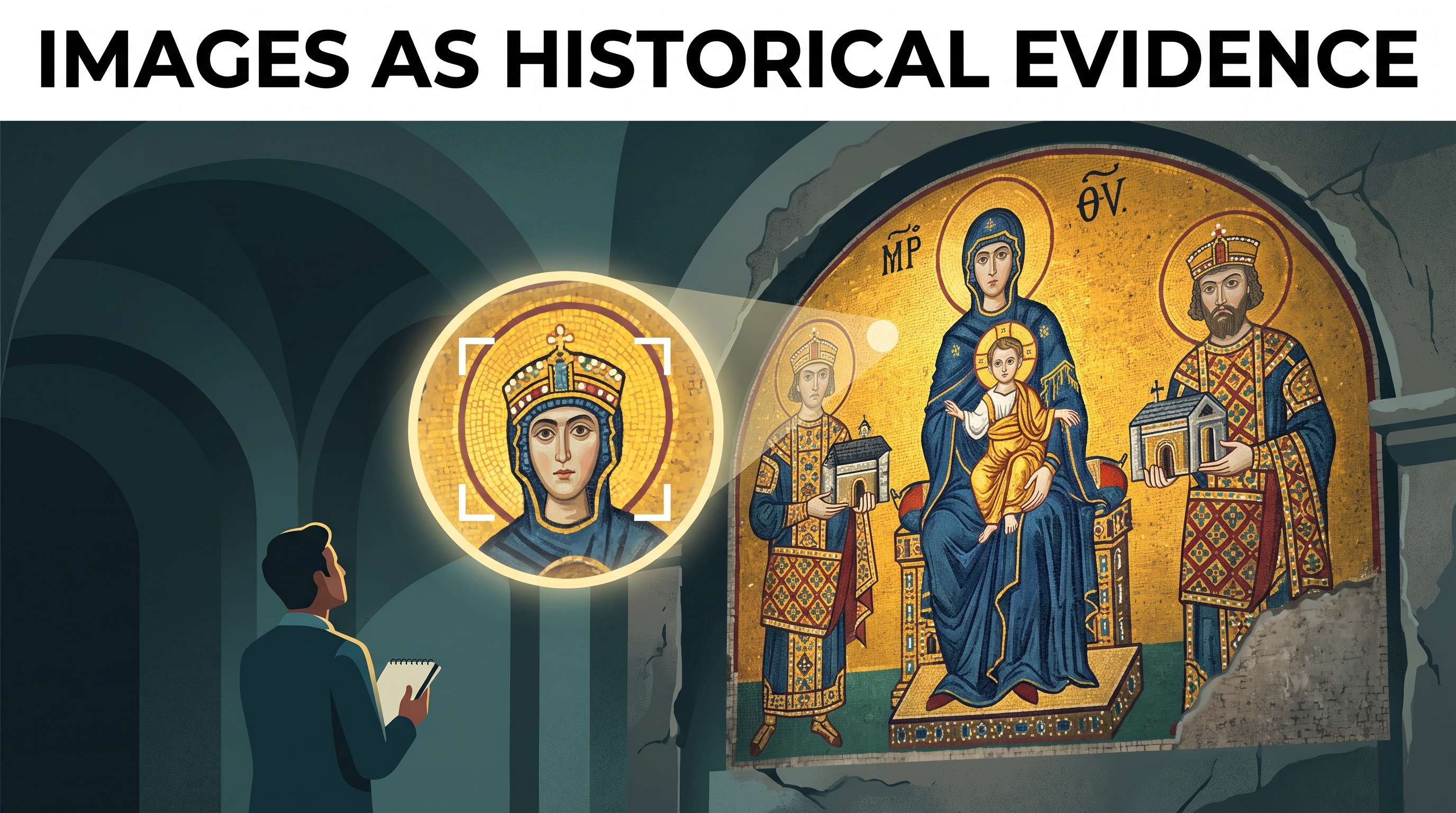
Images communicate through choices about subject, arrangement, scale, color, clothing, gesture, and emphasis. These choices can reveal what a society valued or wanted others to believe. The interior of Hagia Sophia, for example, preserves evidence of Greek Christian religious culture through its iconography. Halos identify holy figures, while the lavish use of gold in a tenth-century mosaic of Mary, the child Jesus, and the emperors Justinian and Constantine communicates sanctity, imperial authority, and wealth.
The mosaic does not merely decorate the building. It presents a relationship between religious holiness and imperial power. The placement of emperors alongside sacred figures suggests that political rule was represented within a Christian visual world. At the same time, the image cannot answer every question about Byzantine society. It does not reveal how ordinary worshippers understood the mosaic, how artisans experienced their work, or whether all inhabitants of the empire shared the values displayed in the imperial image. Its evidence is powerful precisely when historians define what it can—and cannot—show.
Architecture provides another kind of visual source. Hagia Sophia’s scale, construction, durability, and interior decoration reveal the resources and technical abilities available to the society that built it. The survival of the structure allows historians to study materials, engineering, religious design, and imperial patronage. Yet buildings, like written texts, reflect the priorities of those who commissioned them more directly than the experiences of everyone who lived around them.
Textual Sources: The Importance of Language
Language gives historians access to meanings that images alone may leave uncertain. A written statement can identify an event, name an intended enemy, describe losses, or announce a government’s position. One example is the announcement concerning the Japanese attack on the Hawaiian Islands. It states that the attack caused severe damage to American naval and military forces, reports the loss of many American lives, mentions American ships torpedoed between San Francisco and Honolulu, and adds that Japan had launched an attack against Malaya.
The wording matters. The announcement does not simply list events; it frames them for its audience. Expressions such as “I regret to tell you” establish an official and solemn tone, while the emphasis on damage, deaths, and attacks presents the situation as a national emergency. A historian can use the document to study the event itself, but also the government’s effort to communicate danger and mobilize public understanding.
Translation creates an additional problem. Historians may work with documents written in languages they do not speak, or with translations that select one English equivalent among several possible meanings. A translated text can make evidence accessible, but it may also smooth out ambiguity, cultural references, or emotional force. Language is therefore not a transparent window onto the past. It is part of the evidence that must itself be examined.
Reading a text historically means examining both its information and its language: what the author reports, the words chosen to report it, and the response those words were designed to produce.
Evaluating Author, Audience, Intent, and Context
A primary source should be evaluated through four closely connected questions: Who created it? For whom was it created? Why was it created? What circumstances shaped it? These questions help historians identify evidence that may otherwise remain hidden. The author’s background can reveal education, social position, political commitments, religious beliefs, or personal interests. The audience can explain why the author emphasized certain facts or used a particular tone. The author’s intent may have been to persuade, justify, warn, celebrate, record, instruct, or entertain.
Some answers are obvious. An official announcement is likely directed toward a public audience and may aim to inform citizens or justify government action. An imperial mosaic may have been intended to express religious devotion while also presenting rulers as legitimate and powerful. Other motives are less visible. An author may omit damaging information, portray opponents harshly, or present personal choices as unavoidable. Careful inspection can reveal motivations that the source never states directly.
Audience is especially important because the same event can be represented differently for different groups. A ruler’s inscription may praise conquest, while the conquered population remembers violence and loss. A military report may emphasize strategic success, while a civilian account focuses on suffering. Neither perspective should be accepted uncritically, but each can provide evidence about the experiences and priorities of the people who produced it.
Dueling Voices: The Spanish Arrival in the Aztec Capital
The Spanish arrival in the Aztec capital illustrates why historians compare accounts rather than relying on a single voice. An account from the Aztec perspective describes warriors guarding the Eagle Gate after the Spanish had killed the king of Nauhtla, Cohualpopocatzin, by wounding him with arrows and burning him alive. The warriors were then told to dress the figure of Huitzilopochtli—the god of sun and war—in sacred ornaments and paper clothing. They left their posts to perform this religious duty, and celebrations began with songs.
The account then describes a sudden massacre. On the second day of the festival, the unarmed dancers and singers were attacked without warning. The Spanish soldiers struck the musicians first, cutting their hands and faces, and continued killing singers, spectators, and people performing ordinary tasks such as carrying water, bringing fodder for horses, grinding meal, sweeping, or standing watch. The detailed listing of victims makes the violence concrete: the passage emphasizes that the attack reached beyond combatants to religious participants and workers.
This account is valuable because it preserves the experience and interpretation of people subjected to the attack. It also requires evaluation. Historians must ask who recorded the account, when it was recorded, what earlier testimony it may reflect, and how the language presents the Spanish and the Aztec participants. The passage’s emotional force is part of its historical significance, but emotional force does not remove the need for corroboration and contextual analysis.
The phrase dueling voices captures a central historical problem: different communities can describe the same encounter from sharply different positions. Comparing those voices does not mean treating every claim as equally accurate or deciding that truth is impossible. It means testing accounts against one another and against other evidence, while recognizing that the historical record is shaped by unequal power. Some groups had greater access to writing, official record keeping, or institutions capable of preserving their version of events.
Primary-source analysis therefore combines empathy with discipline. Historians should take seriously what a source says about the world of its creator, but they should not confuse a source’s perspective with the entire past. A document may be accurate about one experience and incomplete about another. An image may reveal a society’s ideals without proving that those ideals governed everyday life. The most responsible interpretation identifies the source’s evidence, limits, purpose, and relationship to other surviving voices.
Content adapted from OpenStax World History, Volume 1: to 1500 by Ann Kordas et al., licensed CC BY 4.0.
Source Materials
Study World History Volume 1 on Lykke
This course page is free to open: signed out, you can read its first two sections, and signing in, on any plan, opens the rest. The free Lykke Chrome extension syncs your own Canvas courses, so ChatGPT, Claude and Muse can answer from your classes and deadlines. It only reads Canvas.
Add the free extensionSign in to open every sectionAll sections of World History Volume 1 · Browse more course pages