From the free course World History Volume 1 on Lykke
5.3 Korea, Japan, and Southeast Asia
Key concepts: Korean Three Kingdoms and the spread of Chinese writing · Queen Seondeok and female rule in Korea · Cultural exchange and migration between Korea and Japan · Jōmon hunter-gatherer society · Yayoi agricultural communities · The emergence of centralized political power in Yamato Japan · Queen Himiko and the loose confederation of Japanese states · Geography and cultural diversity of Southeast Asia · India’s centrality to ancient Southeast Asian exchange · Port-opening, pious legitimacy, and economic prosperity in Southeast Asian states
By the end of this section the student can: Discuss how geography and climate change influenced the early history of Korea, Japan, and
5.3 Korea, Japan, and Southeast Asia
Korea, Japan, and Southeast Asia developed through a constant tension between local adaptation and connections with larger cultural worlds. Writing, migration, farming, trade, and political authority did not spread as a single package: communities borrowed particular practices, reshaped them, and used them for their own purposes.
Ancient Korea: Writing, Mobility, and Political Culture
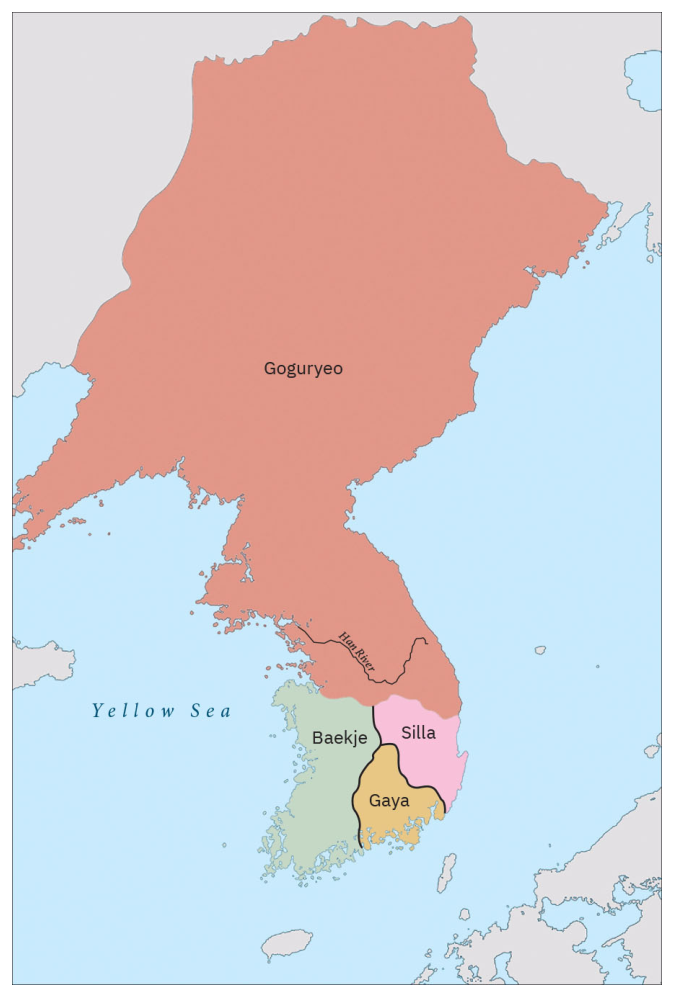
During Korea’s Three Kingdoms era, the Chinese writing system spread across the peninsula. Writing was more than a method for recording speech. It created access to forms of learning associated with Confucian texts and Buddhist sutras, the teachings attributed to the Buddha. Literacy therefore became a rare and valuable skill with political consequences.
People excluded from aristocratic families could use knowledge of Chinese writing to seek appointments as scribes. In a society where high office was closely connected to hereditary status, the ability to read and write offered a limited but important route into government service. Writing did not erase aristocratic privilege, but it created a new basis for advancement alongside birth.
Writing became a political resource: it allowed some people outside the aristocracy to pursue official appointments through literacy, even though elite families continued to dominate Korean courts.
Chinese cultural knowledge also shaped courtly life. Studying Confucian works and Buddhist scriptures required literacy, while knowledge of Chinese culture could support a career at court. Poetry became a favorite pastime of Korean royalty, and the ability to compose an elegant verse came to signify nobility. In this setting, writing served both practical and symbolic purposes: it helped administer courts and also marked refinement and status.
Korean societies did not simply copy every practice they encountered. The passage describing Mahan, for example, notes that clothing and hairstyles resembled styles associated with the Xianbei of the Inner Asian steppes, even though Mahan society was organized around farming rather than a horse-based nomadic lifestyle. This illustrates selective cultural borrowing: a community could adopt visible styles while maintaining a different economy and social pattern.
Korea was also connected to Japan through movement across the sea. Koreans traveled to Japan as traders and fishers, while others arrived as migrants and permanent settlers. These travelers carried skills, customs, and cultural knowledge across the water. Migration therefore linked the histories of Korea and Japan not only through diplomatic contact but through the ordinary movement of people who worked, settled, and formed communities.
Queen Seondeok and the Possibilities of Female Rule
Queen Seondeok’s reign marked an unprecedented period of female rule in Korea. Her authority mattered because it demonstrated that a woman could occupy the highest political position and helped establish a precedent for later queens of Silla. Jindeok and Jinseong later inherited the throne, making Seondeok’s reign part of a broader history of female succession.
Women already held forms of influence in ancient Korea. Royal princesses could wield power, and affluent women often served as advisors and regents. Seondeok’s reign nevertheless represented a significant expansion of what female political authority could look like. The distinction is important: women’s influence existed before her, but her queenship made direct rule by a woman especially visible and consequential.
Her reign also contributed to artistic developments that later became distinctively Korean traditions. Korean artisans learned from China how to produce celadon, a type of ceramic known for its lustrous green glaze. The technique came through cultural exchange, but its later development in Korea shows again that borrowing did not mean permanent dependence. Imported knowledge could become part of a locally recognizable artistic tradition.
Cultural exchange often begins with imitation but does not end there. A technique learned from abroad can be transformed through local craftsmanship into an art form associated with a particular society.
Queen Seondeok therefore connects political and cultural history. Her rule opened space for future queens, while the artistic changes associated with her era contributed to traditions that later audiences recognized as Korean. Female authority and artistic production were not isolated developments; both show how Korean society adapted outside influences within its own political and cultural setting.
Ancient Japan: Jōmon Communities
Historic Japan is commonly divided into two broad eras: the Jōmon era, associated primarily with hunter-gatherers from approximately $14{,}500$ to $300$ BCE, and the Yayoi era, associated with agricultural communities that emerged afterward and dominated the period from about $300$ BCE to $300$ CE. The division is useful, but it should not suggest that either population possessed a modern concept of being “Japanese.” The people of these eras left their imprint on the main islands through migration, settlement, and changing ways of using the landscape.
The Jōmon period is known primarily through archaeological evidence, meaning material remains such as tools, dwellings, ceramics, and other objects rather than a written historical record. Jōmon communities included hunters and produced pottery. One artifact dates approximately to $3500$–$2500$ BCE, providing evidence of both technical skill and the importance of ceramic production in these communities.
The pottery matters because it makes the Jōmon past visible even where written testimony is absent. Archaeologists can examine objects to reconstruct patterns of production and settlement, but the evidence does not provide the same kind of political narrative as a court chronicle. For Jōmon Japan, material culture is therefore central: pottery and settlement remains offer a way to study communities that left no records describing themselves in their own words.
Jōmon societies also occupied varied environments. The later history of the islands involved fertile plains, mountainous forests, numerous ocean bays, and rivers. These landscapes shaped how communities moved, settled, gathered resources, and eventually practiced agriculture. Japan’s geography did not produce one uniform way of life; it supported different adaptations across the islands.
The Yayoi and the Growth of Political Power
The Yayoi emerged after the Jōmon and became agriculturalists. They inhabited Japan’s fertile plains as well as mountainous forests, bays, and rivers. Agriculture changed the possibilities of settlement because communities could organize their lives around cultivated land and more permanent occupations. Yet the transition was not simply a replacement of one population by another: migration, settlement, and the development of new practices all contributed to the formation of societies on the main islands.
Agricultural communities could support larger and more settled populations than many mobile hunting groups, but farming alone did not immediately create a centralized state. Political authority developed gradually as communities organized territory, resources, and relationships among local leaders. The emergence of agriculture thus created conditions for political concentration without making centralization automatic.
Records associated with Queen Himiko indicate that political power was becoming increasingly concentrated. Himiko was connected to a loose confederation of states, suggesting that Japan still consisted of multiple political communities rather than one fully unified kingdom. At the same time, the confederation’s relationship to her shows that authority could extend across territories held by separate states.
This concentration of power helps explain the emergence of Yamato Japan. The Yamato polity represented a movement toward centralized political authority over communities that had previously remained more loosely connected. The process was gradual: local states and regional identities continued to matter, but political power increasingly gathered around a central ruling house.
Centralization is a process, not an instant event. Himiko’s confederation shows political coordination among separate states; Yamato Japan shows the longer-term development of more concentrated authority.
The relationship among agriculture, migration, and state formation is especially important. Agricultural communities settled productive landscapes, while migration connected different populations and transmitted practices. As settlements became more deeply tied to land and regional resources, leaders gained stronger reasons and greater opportunities to organize authority over territories. Political centralization therefore emerged from the interaction of economic life, population movement, and the management of local communities—not from a single invention or one moment of conquest.
Southeast Asia: Diverse Landscapes and Wider Connections
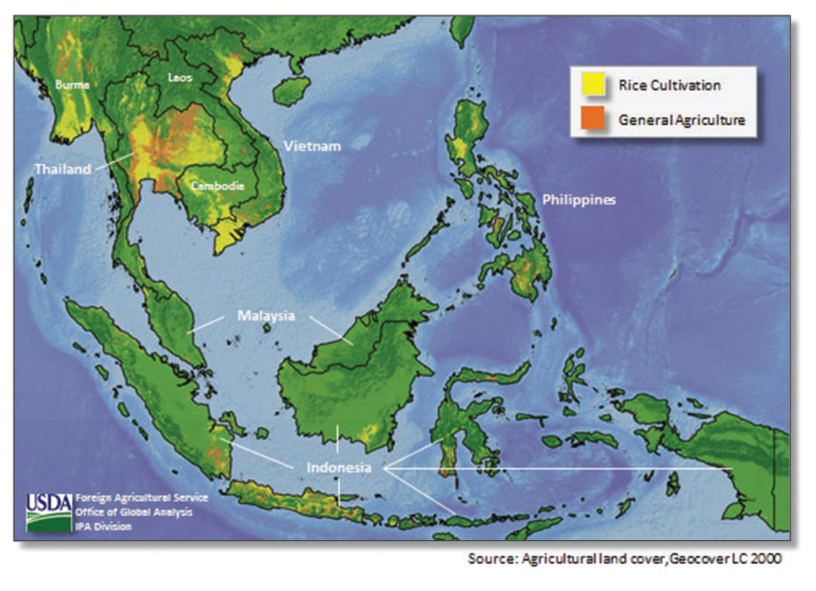
Southeast Asia contained varied topographies and climates. Its mountains, plains, rivers, islands, and coastal zones produced different patterns of settlement and political development. The region should not be treated as a single cultural unit. Its societies differed from one another, yet they also shared historical and cultural features created through movement, trade, religion, and contact with neighboring regions.
Ancient Southeast Asian states often gained political legitimacy by presenting their rulers as pious examples for their subjects. Legitimacy means the belief that a ruler has the right to govern. In these states, religiously appropriate conduct helped support that right. Rulers were not legitimized solely through military power or inheritance; they also presented themselves as models of piety whose behavior justified obedience.
These states also prospered economically by opening their ports to the wider world. Port cities connected local producers and rulers to merchants traveling through maritime networks. A port was therefore more than a point where ships arrived: it was a political and economic strategy. By welcoming exchange, states could benefit from commerce and position themselves within wider regional connections.
India stood at the center of many of Southeast Asia’s ancient political, economic, and cultural connections. Indian goods were objects of desire, while Indian religious and artistic traditions inspired local societies. India also offered ideas useful for state-building and served as a bridge to the wider Eurasian world. These connections operated through trade, religion, and art rather than through a simple one-way process of conquest.
The broader pattern linking Korea, Japan, and Southeast Asia is therefore not uniform “influence” but adaptation through networks. Chinese writing could give some Koreans access to court appointments; Korean migrants could settle in Japan; agricultural communities could support increasingly concentrated political power; and Southeast Asian rulers could use ports and piety to strengthen states connected to India and the wider world. Exchange supplied possibilities, but local societies decided how those possibilities would be used.
Content adapted from OpenStax World History, Volume 1: to 1500 by Ann Kordas et al., licensed CC BY 4.0.
Source Materials
Study World History Volume 1 on Lykke
This course page is free to open: signed out, you can read its first two sections, and signing in, on any plan, opens the rest. The free Lykke Chrome extension syncs your own Canvas courses, so ChatGPT, Claude and Muse can answer from your classes and deadlines. It only reads Canvas.
Add the free extensionSign in to open every sectionAll sections of World History Volume 1 · Browse more course pages