From the free course World History Volume 1 on Lykke
5.1 Ancient China
Key concepts: Neolithic settlements in ancient China · The Yellow and Yangtze River regions · Agriculture, foraging, and food resources · Matrilineal Neolithic Chinese communities · The Yellow River’s environmental impact · The Erlitou culture and debate over the Xia dynasty · The Shang dynasty and Bronze Age civilization · Ancestor worship and ritual bronze vessels · Oracle bones and Shang divination · Logographic Chinese writing and elite literacy
By the end of this section the student can: Discuss the early dynasties of ancient China; Analyze the impact of the Warring States Period on ancient Chinese politics and culture; Explain the connections between ancient Chinese philosophy and its political and social context
5.1 Ancient China
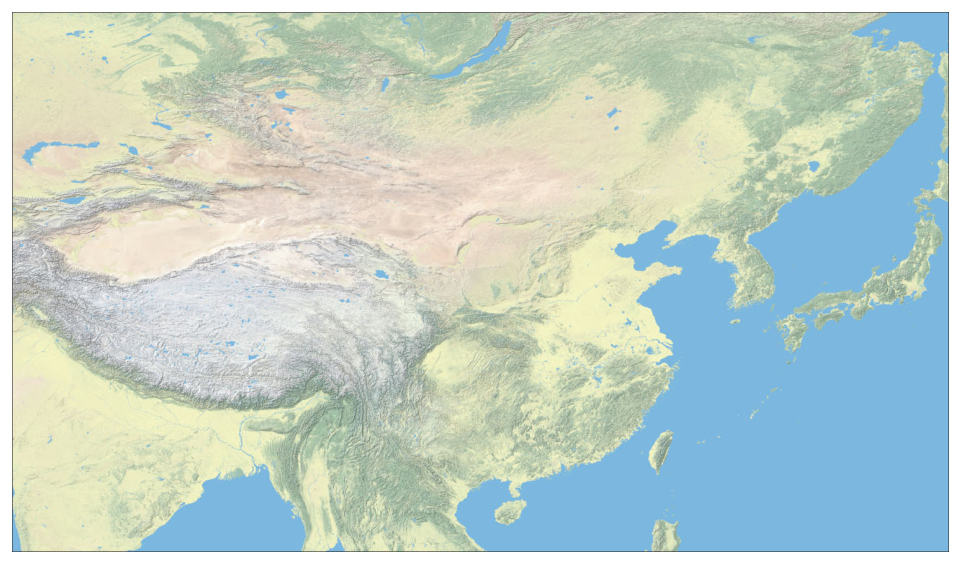
China’s earliest complex societies grew along two great river systems—the Yellow River in the north and the Yangtze River in the south—but they did not emerge from a single, uniform landscape or culture. Farming villages, ritual centers, bronze-working elites, written records, competing states, and political philosophies developed over thousands of years before the Qin rulers first unified much of China in 221 BCE.
Key idea: Ancient Chinese history is not simply a story of dynasties replacing one another. It is also the history of changing relationships among environment, agriculture, kinship, ritual authority, warfare, technology, and political thought.
The chronological sequence developed in this section moves from Neolithic communities to the debated Xia dynasty, the historically documented Shang dynasty, the long Zhou dynasty, the violent Warring States era, and finally Qin unification. Evidence becomes more abundant over time, but historians must still distinguish between archaeological evidence, later historical traditions, and the claims made by rulers seeking to justify their power.
Prehistoric China
Agriculture and settled life developed in several parts of ancient China rather than appearing at one single site. The Yellow River region in northern China supported communities that cultivated crops suited to a relatively dry climate, especially millet. The Yangtze River region farther south had warmer and wetter conditions that favored rice cultivation. Rivers provided water, fertile soil, fish, and transportation, but they could also destroy settlements through flooding and change course unpredictably.
The earliest farming communities combined cultivation with hunting, fishing, gathering, and the domestication of animals. Agriculture did not immediately replace foraging. People continued to draw on wild plants and animals because farming was labor-intensive and harvests could fail. The mixed food economy of these communities helped them survive seasonal variation and environmental uncertainty.
Neolithic, meaning “New Stone Age,” communities in ancient China produced pottery, polished stone tools, woven textiles, and increasingly permanent houses. Archaeological sites show that some settlements were organized into planned neighborhoods, storage areas, burial grounds, and communal spaces. These discoveries reveal social cooperation, but they do not automatically prove the existence of kings or centralized states.
The Yellow River, known in Chinese as the Huang He, was both a foundation of northern civilization and a persistent danger. Its heavy deposits of fine yellow sediment, called loess, made the surrounding soil highly fertile. At the same time, the river’s sediment could raise its bed, causing floods that destroyed fields and settlements. The environmental problem was therefore double-edged: the same process that enriched farmland could also make human habitation hazardous.
Later Chinese traditions remembered flood control as a defining achievement of early rulers. The legendary figure Yu, often called the Great Yu, was said to have controlled the floods through massive public works and to have founded the Xia dynasty. The story presents political authority as a reward for solving a collective environmental crisis. It also helped establish a long-standing Chinese ideal: a legitimate ruler should protect society from disorder, including the disorder caused by nature.
Archaeology offers a more complicated picture of early social organization. Some Neolithic communities appear to have been relatively egalitarian, while others show differences in houses, burials, tools, and access to valuable goods. Evidence from some sites has led scholars to argue that certain Neolithic communities may have been matrilineal, meaning that descent and inheritance were traced through the mother’s line. This does not necessarily mean that women ruled politically or that men lacked authority. It indicates instead that family identity and property may have been organized through maternal kinship.
The distinction between matrilineal and matriarchal is important. Matrilineal describes descent through the mother’s family; matriarchal describes a social system in which women hold dominant political authority. The archaeological evidence discussed for Neolithic China supports arguments about kinship patterns more readily than it supports the claim that these societies were governed by women.
One especially important archaeological development was the Erlitou culture, located in the Yellow River basin and generally dated to approximately $1900$–$1500$ BCE. Erlitou settlements included large structures, workshops, elite burials, bronze objects, and evidence of social ranking. The culture’s bronze vessels and ritual practices resemble those later associated with the Shang dynasty.
Historians disagree about whether Erlitou represents the Xia dynasty described in later Chinese texts. Some scholars identify Erlitou with the Xia because its dates, location, and level of political organization broadly fit traditional accounts. Others remain cautious because no Erlitou site has been found with documents written by the Xia themselves. References to the Xia come from records composed centuries after the supposed dynasty ended. The Xia may have been a historical kingdom remembered through later tradition, but the evidence does not allow historians to treat that identification as certain.
Early Dynastic China
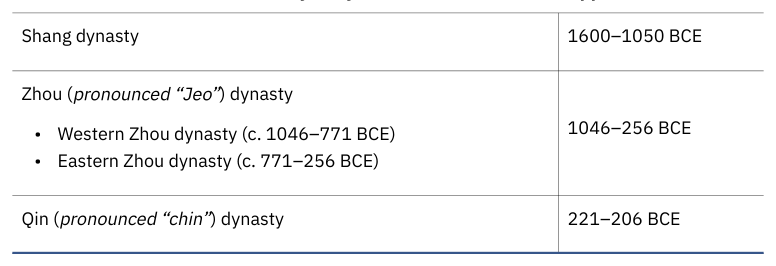
The Shang dynasty is the first Chinese dynasty for which historians possess solid written and archaeological evidence. It flourished during China’s Bronze Age, generally from approximately $1600$ to $1046$ BCE. The Shang created a socially stratified civilization whose political authority rested on royal power, warfare, ancestor worship, ritual performance, and control of bronze production.
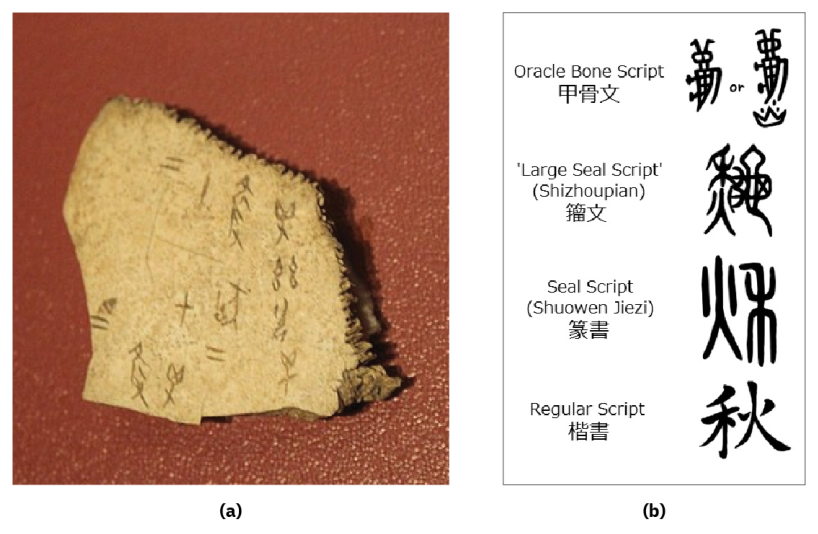
For many years, scholars treated the Shang as possibly legendary, much as they debated the Xia. That changed in the late nineteenth century, when scholars encountered old turtle shells inscribed with Chinese characters in a medicine shop. These objects, together with inscribed animal bones, became known as oracle bones. They were not merely religious artifacts: they were written records from the Shang period and provide direct evidence for the dynasty’s kings, concerns, rituals, and political activities.
Shang diviners carved questions onto turtle shells or animal bones and then applied heat until the material cracked. They interpreted the patterns as responses from spirits or ancestors. Questions concerned matters such as the success of an impending harvest, the outcome of a military campaign, the health of the king, or the arrival of an heir. The inscriptions sometimes recorded both the question and the later result, allowing historians to connect religious practice with administration and royal decision-making.
Shang kings used ancestor worship to present themselves as the necessary intermediaries between the living community and the spirit world. The king was not simply a political ruler. He performed rituals, consulted ancestors, sought divine approval, and maintained relationships with powerful supernatural forces. Religion therefore formed the institutional backbone of Shang society rather than existing as a separate private sphere.
Bronze vessels were central to this system. Shang elites used them in ceremonies involving offerings to ancestors and other spirits. Bronze production required mining, specialized labor, technical knowledge, and control over workshops, so bronze objects displayed both religious status and economic power. The ability to command bronze production helped distinguish the royal and aristocratic classes from the wider population.
Shang society was aristocratic and militaristic. Kings rewarded vassals with land, captives, and shares of plunder, while warfare expanded royal authority and reinforced elite loyalty. Captives taken in war could be enslaved by the Shang warrior elite or sacrificed in ritual ceremonies. Royal hunts for deer, bears, tigers, and elephants also trained aristocratic warriors and displayed their ability to control both people and the natural world.
The Shang capital shifted over time, and the late Shang center at Anyang has yielded especially important evidence. Excavations there have uncovered royal tombs, bronze vessels, weapons, chariots, and oracle bones. These remains show a society in which political power, military force, religious authority, and wealth were concentrated in the hands of the king and a hereditary elite.
The Zhou Dynasty
The Zhou dynasty defeated the Shang around $1046$ BCE and ruled for more than eight centuries, until $256$ BCE. Historians commonly divide Zhou rule into the Western Zhou, from approximately $1046$ to $771$ BCE, and the Eastern Zhou, from $770$ to $256$ BCE. The Eastern Zhou period included the Spring and Autumn era and the later Warring States era.
The Zhou justified its conquest through the Mandate of Heaven, the belief that Heaven granted political authority to a morally worthy ruler. Unlike a permanent divine right, the Mandate could be withdrawn. A king who governed unjustly, failed to protect the people, or allowed disorder could lose Heaven’s support. Natural disasters and political catastrophe could therefore be interpreted as signs that a dynasty had become illegitimate.
Mandate of Heaven: Heaven authorizes a ruler to govern, but that authorization depends on effective and moral rule. Rebellion against a corrupt dynasty can therefore be presented as the restoration of rightful order rather than simple treason.
The Zhou used this doctrine to explain the Shang conquest. Zhou rulers claimed that the Shang had become immoral and oppressive, so Heaven transferred its mandate to the Zhou. This argument became one of the most influential political ideas in Chinese history because it explained both why dynasties ruled and why dynasties could fall.
Zhou political organization depended on relationships among the royal house, aristocratic families, and local rulers. The king granted territories to relatives and allied elites, who governed local communities, collected resources, and supplied military support. These arrangements helped the Zhou control a large territory, but over time local lords accumulated power and became increasingly independent.
During the Zhou period, iron tools and weapons became increasingly important, agricultural production expanded, and population growth intensified competition for land and labor. Improvements in farming supported larger states and armies, but they also increased the stakes of political conflict. The decentralized political order that had once helped the Zhou govern a broad territory eventually contributed to fragmentation.
The Zhou period also provided the social and political setting for major Chinese philosophical traditions. As warfare, political instability, and social change challenged older assumptions about authority, thinkers asked how order could be restored. Confucianism emphasized ethical conduct, education, proper relationships, and responsible government. Daoist thought questioned excessive intervention and valued harmony with the Dao, the underlying way or pattern of nature. Legalism argued that stable government required strict laws, clear punishments, and strong centralized authority.
These philosophies were not abstract systems detached from history. They were responses to a world in which inherited aristocratic authority was weakening, states were competing for survival, and rulers needed new methods of administration. Their different answers—moral example, alignment with the natural order, or coercive law—reflected the political crises of the late Zhou period.
The Warring States Era and Qin Unification
The Warring States era, conventionally dated from $475$ to $221$ BCE, was marked by sustained conflict among powerful states that had emerged from the weakening Zhou order. The principal competitors included Qin, Chu, Qi, Yan, Han, Zhao, and Wei. Warfare was no longer limited to aristocratic raids. States mobilized large armies, used infantry and cavalry, built defensive walls, and reorganized taxation and administration to sustain prolonged campaigns.
The era brought destruction and insecurity, but it also encouraged administrative and technological change. Rulers sought direct control over land, labor, taxation, and military service. Bureaucratic officials increasingly replaced hereditary nobles in important functions. Iron tools and weapons, improved agricultural methods, and large irrigation and defensive projects strengthened the states that could organize them most effectively.
The political crisis sharpened debates among Confucian, Daoist, and Legalist thinkers. Confucian thinkers argued that rulers should cultivate virtue and govern through moral example, while people should fulfill obligations within relationships such as ruler and subject, parent and child, and elder and younger. Daoist thinkers criticized ambition and coercion, stressing simplicity and harmony. Legalists rejected reliance on personal virtue and instead promoted strict laws, standardized administration, rewards, and punishments.
Qin adopted especially effective Legalist methods. Its rulers centralized authority, weakened rival aristocrats, divided territory into administrative units governed by officials, standardized laws, and organized taxation and military service. Qin’s location in the western part of the Zhou world had sometimes been regarded as peripheral, but political and military reforms transformed it into the strongest competing state.
In $221$ BCE, Qin conquered the remaining rival states and established the first unified imperial dynasty. Its ruler took the title Qin Shi Huangdi, meaning the First Emperor of Qin. The unification created a centralized state on a scale that earlier dynasties had not achieved. Qin officials standardized weights and measures, currency, and aspects of writing, making it easier for the government to administer diverse regions.
The Qin government also undertook major construction projects, including roads, defensive walls, canals, and the massive tomb complex associated with the First Emperor. These projects required enormous amounts of labor and demonstrated the state’s organizational power, but they imposed severe burdens on peasants and conscripted workers. Qin rule was therefore both an administrative achievement and a coercive regime.
Qin political thought favored strict control, and the government punished opposition harshly. Later historians, especially those influenced by Confucian ideals, portrayed the Qin as cruel and oppressive. That criticism should not erase the dynasty’s accomplishments: Qin unification established political institutions, territorial concepts, and administrative practices that shaped later imperial China. Yet the dynasty’s severity also limited its durability. The Qin collapsed shortly after the First Emperor’s death, in $206$ BCE, and was replaced by the Han dynasty.
Historical significance: The Warring States era produced both political fragmentation and the ideas that could overcome it. Qin victory ended the era of competing states, while the philosophical debates of the period continued to shape Chinese views of government, society, morality, and human behavior.
Content adapted from OpenStax World History, Volume 1: to 1500 by Ann Kordas et al., licensed CC BY 4.0.
Source Materials
Study World History Volume 1 on Lykke
This course page is free to open: signed out, you can read its first two sections, and signing in, on any plan, opens the rest. The free Lykke Chrome extension syncs your own Canvas courses, so ChatGPT, Claude and Muse can answer from your classes and deadlines. It only reads Canvas.
Add the free extensionSign in to open every sectionAll sections of World History Volume 1 · Browse more course pages