From the free course World History Volume 1 on Lykke
7.5 The Regions of Rome
Key concepts: Rome’s conquest and unification of Italy · Roman expansion into the Mediterranean · Rome’s wars with Carthage for control of the Mediterranean · Roman colonies as defensive outposts in conquered territories · Roman roads linking Rome to its colonies and enabling rapid military movement · The social and military effects of large plantations worked by enslaved foreigners · The Gracchi brothers’ concerns about small farmers and proposals to reform Roman government · Senatorial resistance to reforms and accusations of corruption · Augustus’s control of frontier provinces and command of the Roman army · Imperial succession and continued expansion under early Roman emperors, including the conquest of Britain
By the end of this section the student can: Identify the regions of the Roman Empire and the way they related to the center of power; Describe the various peoples who made up the Roman Empire
7.5 The Regions of Rome
Rome did not become a Mediterranean superpower by conquering territory and then simply leaving it alone. It built a system in which colonies guarded newly conquered lands, roads moved armies rapidly, former enemies supplied troops, and Roman language and culture spread through connected communities. The central question is therefore not only how far Rome expanded, but how it organized, defended, and governed the regions it brought under its control.
The Conquest and Unification of Italy
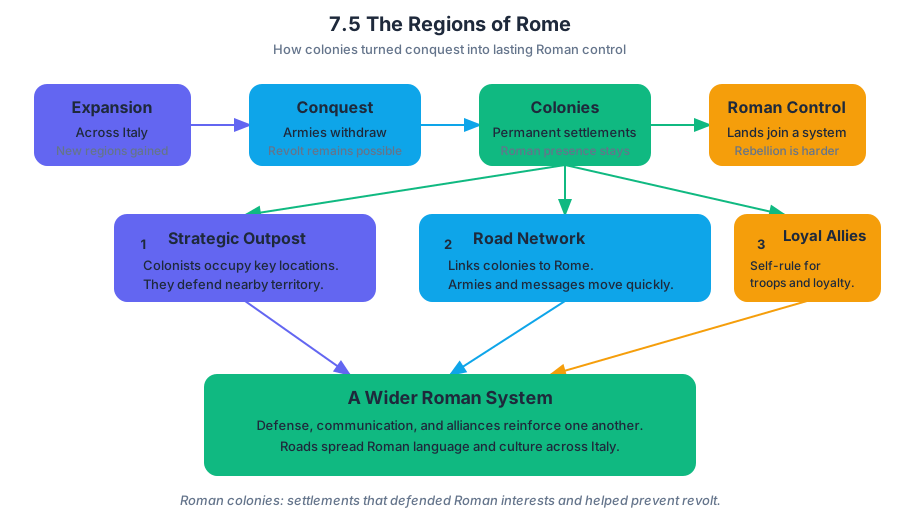
Rome’s first major expansion carried it across the Italian peninsula. Conquest created a problem familiar to every expanding state: newly defeated peoples might revolt as soon as Roman armies withdrew. Rome’s successful response was to place permanent settlements, or colonies, in recently conquered territories. These colonies served as the first line of defense if a region rebelled against Rome. Their inhabitants helped anchor Roman authority where military victory alone might have been temporary.
A Roman colony was therefore more than a settlement for farmers. It was also a strategic outpost. Colonists occupied important locations, maintained a Roman presence, and helped protect nearby territory. By distributing Roman communities across Italy, Rome made rebellion more difficult and transformed conquered lands into parts of a wider political system.
Roads made this system effective. Rome constructed well-built roads connecting the capital to its colonies, allowing armies to reach rebellious regions quickly. A distant colony was useful only if Rome could reinforce it; the road network solved that problem by linking local defense to the military power of the capital. These roads also encouraged movement, communication, and cultural exchange. Over time, the language and culture of Rome spread throughout Italy and, later, across the empire.
Rome also used former enemies in a flexible way. Some communities that had fought Rome were transformed into loyal allies. They could retain a degree of self-government as long as they respected Rome’s other alliances and supplied troops when required. This arrangement reduced the need for Rome to govern every community directly. It also turned conquest into a source of military strength: the peoples Rome defeated could eventually help defend and enlarge Roman power.
Roman colonies were settlements established in recently conquered lands to defend Roman interests, maintain a local Roman presence, and help prevent revolt.
Expansion into the Mediterranean
After expanding across Italy, Rome increasingly encountered neighboring kingdoms and other powers beyond the peninsula. Its second-century BCE expansion reflected both ambition and response: Rome expanded its territory, but it also reacted to threats from kingdoms near its borders. Each new conflict could make further expansion appear necessary, because a secure frontier seemed to require control over the regions beyond it.
The most important Mediterranean struggle was Rome’s conflict with Carthage. Rome and Carthage fought for control of the Mediterranean, a contest that was simultaneously military, economic, and strategic. Control of the sea and its surrounding lands meant access to trade routes, ports, agricultural regions, and strategically valuable positions. Rome’s victory over Carthage helped transform it from an Italian power into a Mediterranean empire.
The Roman pattern of expansion combined several tools: military force defeated resistance; colonies secured conquered areas; roads connected those areas to Rome; and alliances recruited local communities into the Roman military system. This combination explains why Roman expansion was more durable than a series of isolated battlefield victories. Rome built connections that made its control visible and practical in everyday life.
Plantations, Enslavement, and the Pressure on Roman Society
Mediterranean conquest brought wealth and captives into Roman society, but the gains were distributed unevenly. Large plantations worked by enslaved foreigners expanded across the conquered territories. These plantations displaced Roman farmers, who found it increasingly difficult to compete with estates using enslaved labor. The result was not merely an economic change. It altered the social structure of the republic and raised questions about the future strength of Rome’s army.
Roman military power depended heavily on citizen soldiers. If independent farmers lost their land, fewer citizens remained in the social position traditionally associated with military service. The success of conquest could therefore weaken the class of people who had helped make conquest possible. Rome’s expansion produced wealth and territory, but it also destabilized the agricultural society on which republican military expectations rested.
This development helps correct a common misconception: Roman expansion did not benefit all Romans equally. Conquest enriched powerful landowners and supplied enslaved labor, while many ordinary farmers faced displacement. The empire’s external growth could intensify internal conflict, linking the history of Roman provinces to struggles over land, citizenship, political power, and military service within Rome itself.
Gaius Gracchus and Conflict over Reform
The political consequences of these social changes appeared in the reform efforts associated with the Gracchi. Gaius Gracchus proposed a new court system that could try senators for corruption. The proposal challenged the Senate’s control over political accountability because senators themselves had often occupied positions of authority and influence. A court capable of judging them threatened an important source of elite power.
The Senate responded with extreme opposition in $121$ BCE. The conflict demonstrated how difficult it was to reform the Roman political system when reforms threatened the privileges of the governing elite. Political disagreements that might have been settled through ordinary debate instead became confrontations over who had the authority to define justice, control courts, and direct the state.
Gaius Gracchus’s proposed court system also reveals why Roman expansion created domestic political problems. Provincial administration generated opportunities for wealth and corruption, while the Senate remained central to governing Rome’s growing territories. The larger Rome became, the more important provincial justice became—and the more powerful the officials who administered the provinces could become. Reformers therefore challenged not only individual abuses but the political structure that allowed elite authority to escape effective control.
From Republic to Imperial Command
The tensions created by conquest, wealth, land displacement, and political conflict eventually contributed to the transformation of Roman government. Under the emerging imperial system, the Senate appointed Augustus proconsul, meaning a governor with authority over provinces, including Rome’s frontier provinces. This appointment gave Augustus effective command of the Roman army.
Proconsul means a provincial governor with formal authority over a territory. In Augustus’s case, control of the frontier provinces also meant effective control of the Roman army.
The arrangement mattered because military command was the foundation of authority in a vast empire. The Senate could preserve the appearance of republican institutions, but Augustus’s command over the frontier provinces placed the empire’s armed strength under his direction. Rome’s political geography thus shaped its constitutional change: governing distant and potentially dangerous frontiers required military coordination, and military coordination strengthened the position of one central ruler.
The imperial system also introduced a new danger. Hereditary inheritance could transfer power to a ruler who was incompetent or unable to govern effectively. Under a republic, political authority was formally connected to offices and institutions, even though elite families dominated those institutions. Under an imperial system, the identity and abilities of the successor became especially important. A stable ruler might preserve the empire, while a poor successor could create fear and disorder.
Tiberius illustrates this risk. After becoming emperor, he later grew increasingly paranoid. His behavior shows why imperial inheritance was not automatically a solution to Rome’s political conflicts. Concentrating authority could make government more decisive, but it also meant that the weaknesses of one ruler could affect the entire imperial system.
Britain and the Outer Regions of the Empire
Rome’s expansion continued under the early emperors. Britain, corresponding roughly to modern England and Wales, was added to the Roman Empire. Its inclusion demonstrates the geographic reach of Roman power: the empire extended beyond the Mediterranean heartland into frontier regions that required military occupation, roads, administrative organization, and continuing defense.
Britain also makes the meaning of “Roman expansion” concrete. Incorporation into the empire did not mean that every local community became identical to Rome. Rather, Rome established authority through military power and administrative connections, while the broader imperial system spread Roman language and culture unevenly. As in Italy, the empire depended on linking distant regions to central power and maintaining enough military strength to respond when frontier communities resisted.
The regions of Rome were therefore held together by a combination of force and infrastructure. Colonies guarded conquered lands, roads enabled rapid military movement, and allied communities supplied troops. At the same time, conquest generated internal tensions through slavery, plantation agriculture, the displacement of farmers, and struggles over corruption and political accountability. Rome’s territorial success created the conditions for its imperial power, but it also produced the social and political pressures that made Roman government increasingly dependent on centralized military authority.
The most important pattern is a cycle: conquest created new territories; new territories required colonies, roads, alliances, and armies; those institutions expanded Roman power; and the wealth and labor extracted from expansion transformed Roman society. The empire’s strength and its vulnerabilities grew from the same process. Rome became powerful because it could connect many regions to a single military and political system, but that system also made land inequality, elite corruption, succession, and the character of individual rulers matters of imperial importance.
Content adapted from OpenStax World History, Volume 1: to 1500 by Ann Kordas et al., licensed CC BY 4.0.

Source Materials
Study World History Volume 1 on Lykke
This course page is free to open: signed out, you can read its first two sections, and signing in, on any plan, opens the rest. The free Lykke Chrome extension syncs your own Canvas courses, so ChatGPT, Claude and Muse can answer from your classes and deadlines. It only reads Canvas.
Add the free extensionSign in to open every sectionAll sections of World History Volume 1 · Browse more course pages