From the free course World History Volume 1 on Lykke
3.4 The Indus Valley Civilization
Key concepts: Indus Valley Civilization · Indus River Valley settlements · Harappa and Mohenjo-Daro · Bronze Age urbanization · Archaeological discovery and excavation · Geographical extent of Indus sites · Mohenjo-Daro’s material culture · Indus Valley religious and artistic traditions · Indus Valley decline and collapse · Ancient urban planning and monumental architecture
By the end of this section the student can: Analyze the growth, development, and decline of the Indus valley culture; Describe the cities of Mohenjo-Daro and Harappa; Identify key themes in Indus valley religion and culture
3.4 The Indus Valley Civilization
A civilization can leave behind enormous cities, carefully planned streets, monumental buildings, and finely made objects while leaving no readable account of its own rulers. That is the central historical challenge of the Indus Valley Civilization, an early civilization that developed in settlements along the fertile Indus River Valley more than fifteen hundred miles east of Mesopotamia. Its cities reveal sophisticated urban life, but because scholars cannot yet fully interpret the civilization’s writing, archaeology provides the primary evidence for reconstructing its history.
The Indus Valley and the Growth of Civilization
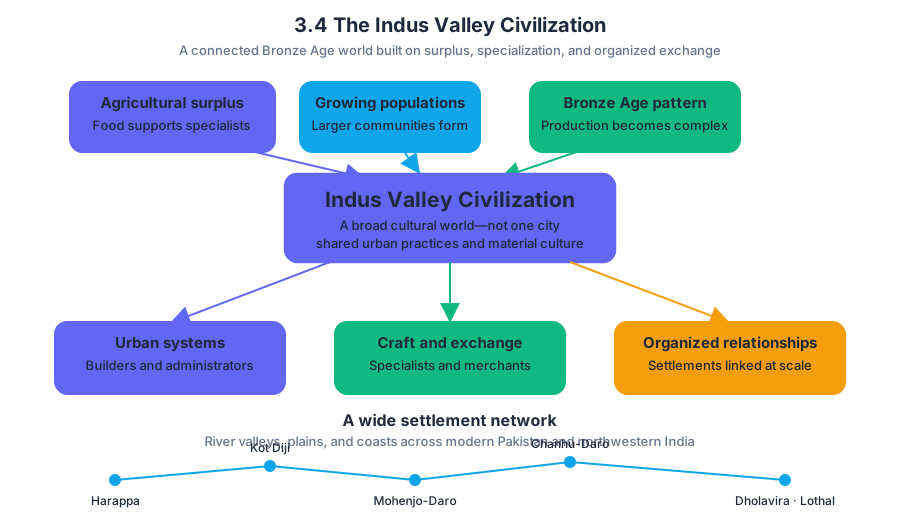
The Indus River Valley offered conditions favorable to settled communities. Beginning around $2800$ BCE, the region entered a new developmental phase marked by significant growth. Settlements expanded, populations increased, and communities developed increasingly complex systems of production and organization. This process formed part of the broader Bronze Age pattern in which agricultural communities generated surpluses that could support craft specialists, administrators, builders, merchants, and religious authorities.
The phrase Indus Valley Civilization refers not to one city but to a broad cultural world connected by shared urban practices, material culture, and settlement patterns. The civilization extended across thousands of square miles in areas corresponding largely to modern-day Pakistan and northwestern India. Its sites were distributed across river valleys, plains, and coastal regions, meaning that the civilization depended on networks linking communities separated by considerable distances.
The geographical extent of the Indus world is visible in the distribution of its major sites. These include Mohenjo-Daro, Dholavira, Lothal, Kot Diji, and Chanhu-Daro, as well as Harappa itself. Their separation from one another suggests that Indus society required more than isolated village production. Coordinating construction, craft manufacture, exchange, and perhaps political authority across such a large area demanded durable institutions and organized relationships among settlements.
Archaeological Discovery and the Importance of Harappa
Modern scholars became aware of the Indus Valley Civilization comparatively late. British excavations revealed Harappa in the early nineteenth century, opening the way to the recognition of a previously unknown Bronze Age civilization. Archaeological excavation—the systematic recovery and interpretation of buildings, tools, pottery, burials, sculptures, seals, and other remains—became essential because the civilization’s surviving written signs have not provided historians with a fully readable historical narrative.
Harappa is one of the civilization’s two most important archaeological sites. Located near the Ravi River in present-day Pakistan, it gave its name to the term Harappan civilization, which scholars also use for the wider Indus cultural complex. The site demonstrates that the Indus world included substantial urban centers rather than only agricultural villages. Its remains provide evidence for specialized craftsmanship, trade, public organization, and the material inequalities associated with urban society.
Mohenjo-Daro is the other major site for studying the civilization. Its remains demonstrate the scale, monumental architecture, and urban layout of Indus cities. Archaeologists have identified organized streets, elevated areas, large structures, and carefully arranged urban spaces. The city’s design indicates planning on a scale that required substantial labor and coordination. Rather than growing randomly, Mohenjo-Daro was constructed according to an urban order that shaped movement, building, and public life.
The archaeological record is especially valuable because it allows historians to connect individual objects with broader social systems. A drainage arrangement, a standardized artifact, a large public structure, or a finely made bronze object is not merely an isolated curiosity. Together, such remains show that Indus cities possessed technical knowledge, craft specialization, and administrative practices capable of sustaining dense populations.
Urbanization in the Bronze Age
Urbanization means the growth of towns and cities accompanied by new forms of economic, social, and political organization. In the Indus Valley, urbanization brought together people who performed different kinds of work. Farmers produced food; artisans shaped metal, stone, pottery, and ornaments; builders raised monumental structures; and other workers transported goods or maintained urban systems. The city therefore functioned as both a physical settlement and a system of organized interdependence.
Mohenjo-Daro makes this transformation particularly visible. Its monumental architecture and planned layout show that Indus urbanism involved collective projects extending beyond the household. The city’s construction required the acquisition of materials, the mobilization of labor, and decisions about how buildings and public spaces should be arranged. These features support the conclusion that the civilization possessed sophisticated forms of administration, even though the precise identities of its rulers and officials remain uncertain.
The wide distribution of Indus sites also points to economic connections among cities and smaller settlements. Lothal, Dholavira, Kot Diji, and Chanhu-Daro were not simply duplicates of Harappa or Mohenjo-Daro; each occupied a particular regional setting within the larger civilization. Taken together, the sites show how Bronze Age urbanization could operate through a network of settlements rather than through one isolated capital.
Material Culture and the Mohenjo-Daro Dancer
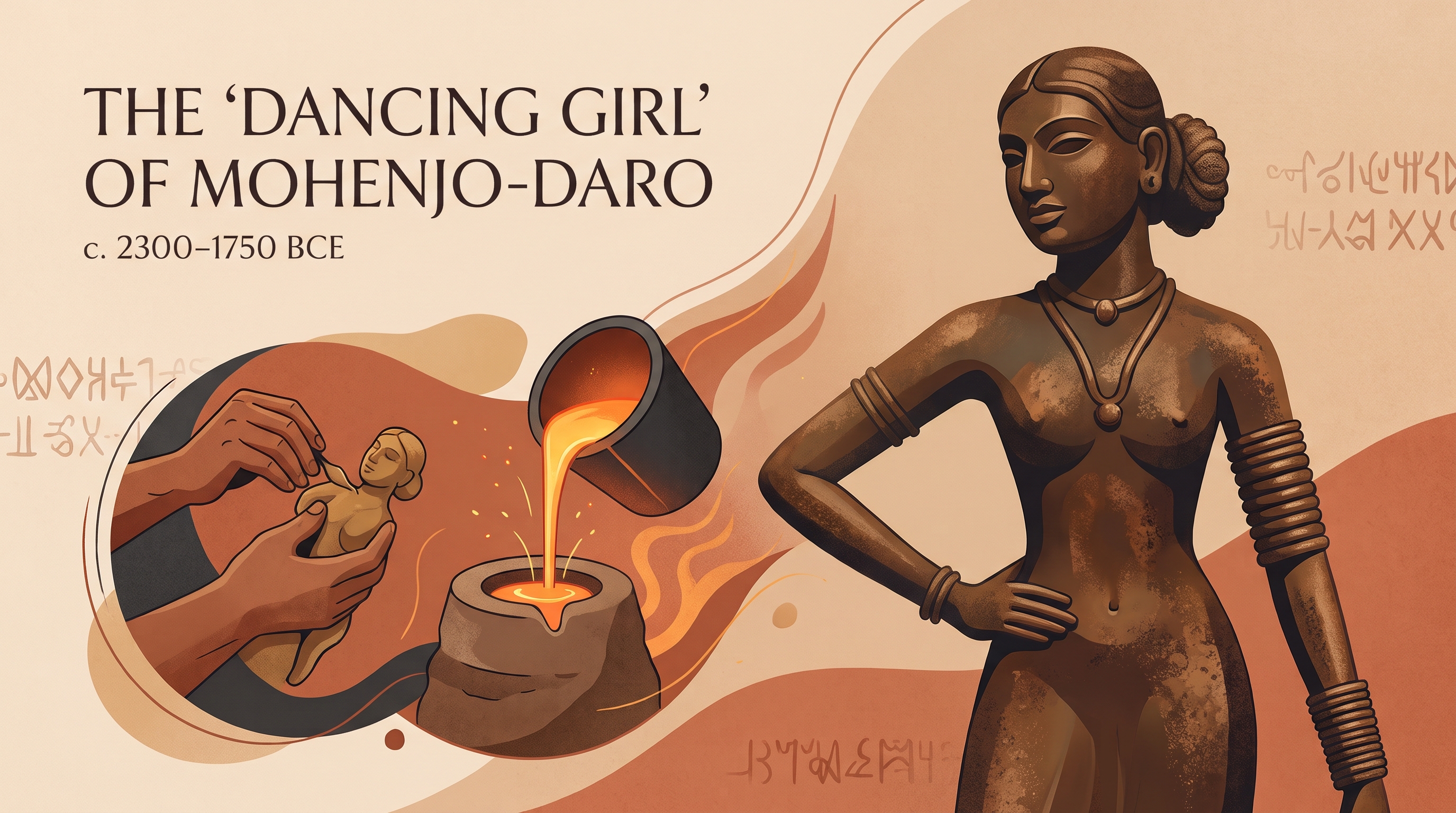
Material culture—the physical objects people make, use, and leave behind—offers some of the clearest evidence for Indus artistic and technological achievement. One famous example is the Mohenjo-Daro Dancer, a bronze statue approximately four inches tall and dated to about $2300$–$1750$ BCE. Although small, the figure provides a vivid connection to the people who lived in the city and to the skills of its metalworkers.
The statue demonstrates the use of advanced bronze-casting techniques, including the lost-wax method. This process allowed artisans to create a wax model, encase it in a material that could form a mold, remove the wax through heating, and pour molten metal into the resulting space. The finished bronze preserves the intended shape in durable form. The technical sophistication of the object indicates that Indus craftspeople possessed specialized knowledge of metallurgy and controlled the labor and materials required to produce it.
The figure is conventionally identified as a dancer, although that interpretation remains an inference from its pose rather than a statement preserved in an Indus written explanation. Its posture suggests movement and performance. If the figure does represent a dancer, it may indicate that music and dance formed part of social or religious rituals. Its jewelry and bangles may also suggest ideas about adornment, status, gender, or ceremonial display. These interpretations are useful, but they must remain connected to the limits of archaeological evidence: the statue shows what an artisan represented, not exactly how every Indus person understood the image.
Religion, Symbols, and Interpretation
Indus religious life is difficult to reconstruct because the evidence consists largely of images, seals, figurines, buildings, and other artifacts rather than readable religious texts. Some seals depict figures, animals, and symbolic scenes that scholars have interpreted as possible religious imagery. One commonly discussed seal portrays a seated figure associated by some interpreters with a figure later connected to Pashupati or Shiva. The comparison can suggest possible cultural continuity, but it does not prove that the Indus figure was the same deity worshiped in later Hindu traditions.
This uncertainty illustrates a broader principle of archaeological interpretation. An image may preserve a religious symbol, but its meaning depends on context: where it was found, how it was used, whether similar images appear elsewhere, and what other evidence survives. The Indus civilization’s material remains allow historians to identify patterns in artistic representation and ritual possibility, but they do not justify confident claims about every belief or ceremony.
The Decline of the Civilization
By around $1500$ BCE, the Indus Valley civilization’s social and political systems had broken down, and its sophisticated urban culture had collapsed. The causes remain uncertain. One possible explanation is an attack on Mohenjo-Daro around $1500$ BCE, which could have contributed to the city’s destruction or disruption. Yet an attack alone has not been established as the complete explanation. Environmental change, economic disruption, political breakdown, or several causes acting together may also have contributed. The evidence therefore supports a distinction between an observed outcome—the decline of urban civilization—and hypotheses about why it happened.
Why the Indus Valley Civilization Matters
The Indus Valley Civilization matters because it demonstrates that early urban civilization developed in South Asia through its own distinctive combination of river-valley settlement, long-distance connections, skilled craftsmanship, monumental construction, and planned cities. Harappa and Mohenjo-Daro make the scale of that achievement visible, while artifacts such as the Mohenjo-Daro Dancer bring individual artistic choices into view. Studied together, the cities and objects show how archaeology can recover the structure of a complex society even when its political history and written language remain only partly understood.
Content adapted from OpenStax World History, Volume 1: to 1500 by Ann Kordas et al., licensed CC BY 4.0.
Source Materials
Study World History Volume 1 on Lykke
This course page is free to open: signed out, you can read its first two sections, and signing in, on any plan, opens the rest. The free Lykke Chrome extension syncs your own Canvas courses, so ChatGPT, Claude and Muse can answer from your classes and deadlines. It only reads Canvas.
Add the free extensionSign in to open every sectionAll sections of World History Volume 1 · Browse more course pages