From the free course World History Volume 1 on Lykke
3.1 Early Civilizations
Key concepts: Characteristics of early civilizations · River-valley settlement and agriculture · Urbanization and population growth · Occupational specialization and interdependence · Social stratification · Political and religious authority · Trade and peaceful relations between communities · Sumerian technological developments · Origins of writing and record-keeping · Hammurabi’s Code and early legal systems
By the end of this section the student can: Discuss the attributes of early civilizations; Analyze the way human relationships changed with the development of urban areas
3.1 Early Civilizations
Large rivers made civilization possible not because water automatically created cities, but because controlled water and productive farmland could support food surpluses, dense settlements, specialized workers, and powerful institutions.
Characteristics of Early Civilizations
Before cities appeared, many human communities lived by hunting, gathering, herding, or small-scale farming. Families often produced most of what they needed themselves. Wealth differences between families were limited, and community leaders commonly depended on consensus. Warriors and religious leaders helped maintain order, while peaceful relations and trade with neighboring groups supported stability.
Civilization describes a society in which relatively large numbers of people live in a concentrated settlement, produce surpluses, and organize exchange, labor, authority, and social relationships through increasingly complex institutions.
The transition to civilization was gradual. Agriculture and permanent settlements began in some regions around $10{,}000$–$8{,}000$ BCE, but the earliest urban civilizations emerged much later, roughly in the fourth millennium BCE. This distinction matters: farming villages were not automatically cities, and cities were not simply larger villages. Urban life required new arrangements for distributing food, organizing labor, managing conflict, and legitimizing authority.
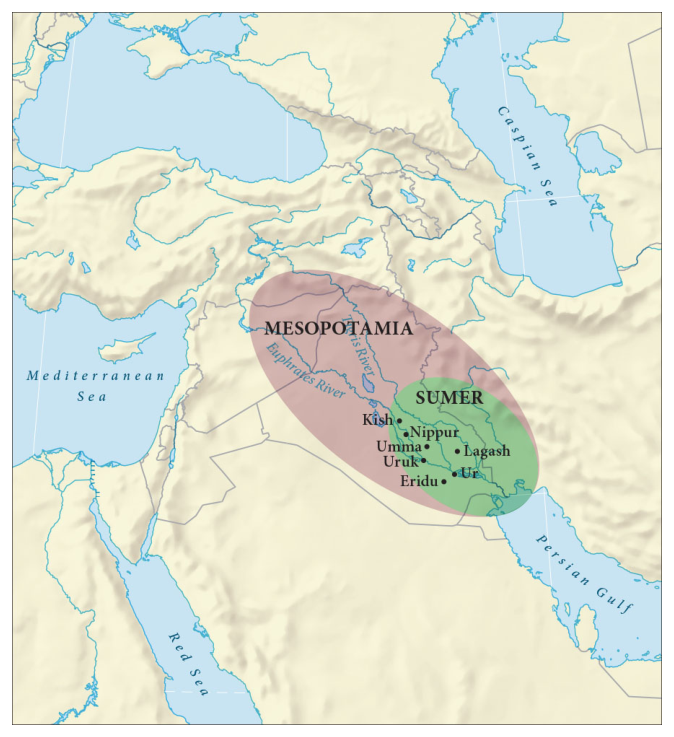
Early civilizations generally arose in fertile regions near large rivers. Important early centers developed in the Fertile Crescent, the Nile Valley, the Indus Valley, and China, while complex societies also emerged independently in places such as modern Mexico and Peru. Rivers supplied water for crops, supported transportation, and deposited fertile soil, but they also demanded cooperation. Communities had to coordinate planting, irrigation, storage, and protection from floods or droughts.
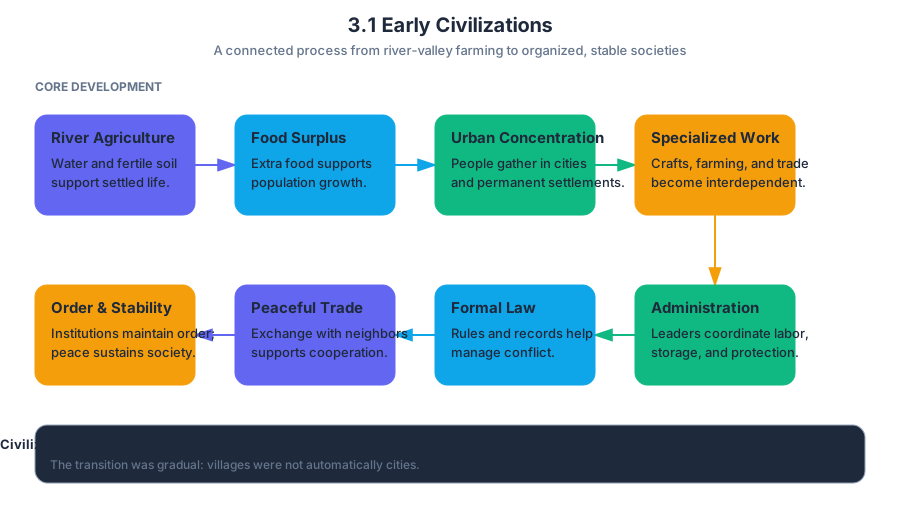
The central pattern can be expressed as a chain of connected developments:
- river-valley agriculture supported settled communities;
- settled agriculture produced food surpluses;
- surpluses supported population growth and urban concentration;
- cities required specialized occupations;
- specialization created economic interdependence;
- interdependence encouraged administrative, political, and religious authority;
- complex administration contributed to writing, record keeping, and formal law.
No single feature alone defines every early civilization. The important point is the relationship among these features. Food production made concentration possible, concentration made specialization necessary, and specialization created institutions capable of coordinating thousands of people.
River-Valley Settlement and Agriculture
Agriculture changed the scale of human society. A hunting-and-gathering group generally moved according to the availability of plants and animals. Farming communities, by contrast, invested labor in fields, houses, storage facilities, and irrigation works. Remaining in one place made it possible to accumulate material goods and increase the number of people living together.
River valleys were especially valuable because they combined water with fertile land. Farmers could cultivate fields near the river and, in some areas, redirect water through channels, canals, and dikes. These systems did not merely improve harvests; they also required planning, labor coordination, maintenance, and decisions about who received water. Agriculture therefore connected environmental management to social and political organization.
The decisive economic development was the agricultural surplus, meaning food produced beyond what farmers immediately needed for their own families. Surplus grain and other materials could be stored and redistributed. They supported people who did not farm full time, including artisans, religious officials, administrators, and rulers. In this way, a farmer’s harvest sustained an entire urban system.
Agricultural surpluses also encouraged population growth. Farming communities could support larger families; the text associates food abundance with family sizes of six or seven children and with a dramatic increase in the human population. As population grew, agricultural production expanded, and expanding production helped support larger settlements. The relationship was reinforcing rather than one-directional: more food supported more people, while more people could provide more labor for fields, construction, craft production, and public works.
The First Urban Societies
Urbanization is the concentration of people in towns and cities. It transformed social relationships because residents no longer relied primarily on their own households for food, tools, clothing, and religious or political services. Farmers often lived in surrounding rural areas and sent food into cities, where it was distributed through systems of exchange.
Some early urban areas reached populations as high as $6{,}000$. By later standards this number was modest, but it represented a major change from small, relatively self-sufficient communities. Thousands of people living close together required systems for storage, trade, dispute settlement, public labor, worship, and defense.
Urbanization did not eliminate agriculture; it reorganized it. Cities depended on the countryside for food and raw materials, while rural producers depended on cities for tools, manufactured goods, religious services, protection, and access to exchange. The city and its agricultural hinterland formed an economic system rather than two separate worlds.
Occupational Specialization and Interdependence
In a self-sufficient household, the same family might produce food, clothing, tools, and shelter. Urban populations could instead depend on occupational specialization, the concentration of work in particular skilled tasks. Farmers produced food, while artisans made tools and objects, weavers produced cloth, religious officials conducted rituals, and governors or administrators managed political affairs.
Specialization increased productivity and made new skills possible, but it also created economic interdependence. Farmers needed artisans’ tools and clothing. Artisans needed farmers to provide food and raw materials. Religious and political officials depended on the surplus generated by producers, while producers depended on institutions that organized exchange and protected the community.
The decorated box found in a royal tomb at Ur, dating to about $2550$ BCE, illustrates this development materially. Its red limestone, lapis lazuli, and marine shell show access to specialized craftsmanship and long-distance materials. The object’s royal context also reveals that specialized production and accumulated wealth were connected to hierarchy: some people controlled resources and commissioned objects that others made.
Social Stratification
Urban society produced sharper differences in wealth, status, and power than earlier relatively egalitarian communities. Social stratification is the division of society into ranked groups with unequal access to resources, authority, and prestige.
At the top of early urban societies stood political and religious elites. Below them were administrators, skilled specialists, laborers, farmers, and other producers. This hierarchy was not merely an arrangement of occupations. It affected who controlled surplus food, who directed labor, who possessed valuable goods, and whose decisions carried the greatest authority.
The contrast with earlier communities is important. In smaller societies, leaders often relied heavily on negotiation and consensus. In cities, the scale of the population and the complexity of exchange made coordination more demanding. Elites could claim authority over resources and labor, while ordinary producers supplied the material basis of urban life.
Political and Religious Authority
Early rulers justified command by presenting themselves as necessary protectors and providers. Kings and other powerful authorities claimed the right to direct subjects in exchange for protection, prosperity, and order. Subjects, in turn, were expected to provide obedience, labor, goods, or other resources.
Political authority and religious authority reinforced one another. Religious officials interpreted rituals and maintained relationships with the gods, while rulers could present their commands as part of a divinely ordered world. Political organization therefore involved more than force. It also required explanations for why some people should rule and others should obey.
Administrative systems made authority practical. Leaders needed to know how much food had been produced, where it was stored, who had received it, and what labor or goods were owed. Record keeping allowed institutions to manage resources beyond the capacity of personal memory.
Sumerian Innovations: Water, Wheels, and Records
Sumerian cities developed several innovations that strengthened urban life. Irrigation used channels, canals, and dikes to divert river water into fields. Irrigation increased the reliability and reach of agriculture, but it also required collective labor and continuing supervision. Those who organized water management gained an important source of political authority.
The Sumerians also developed the wheel, an innovation useful for transportation and craft production. Wheeled vehicles could move materials and agricultural goods, while the wheel’s broader mechanical uses supported specialized work. Like irrigation, the wheel mattered because it connected technology to the needs of a growing urban economy.
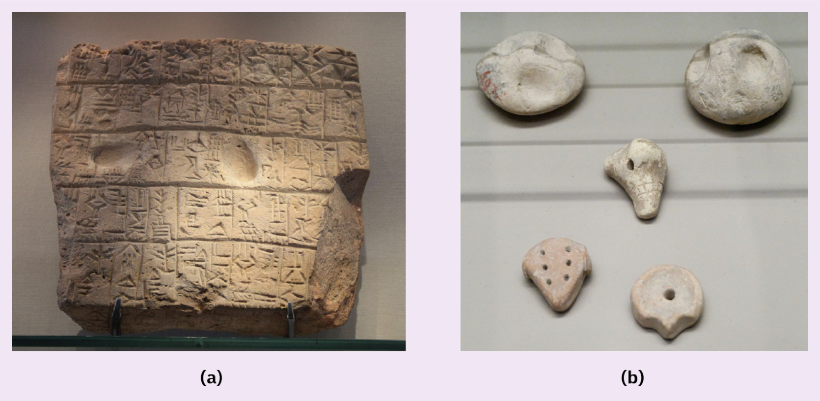
Sumerian administrative record keeping grew from the practical problem of tracking goods. One theory holds that early accounting used small clay tokens representing commodities. These tokens may have been enclosed in marked clay containers called bullae. Over time, marks on the containers and representations of their contents offered a path toward flat clay tablets recording transactions.
This explanation is presented as a theory about the invention of writing, not as an uncontested certainty. It emphasizes that writing may have begun as administration rather than literature: accounting for food, goods, and exchanges created pressure for durable records. Writing therefore supported both economic specialization and political authority.
Sumerian eventually ceased to be spoken early in the second millennium BCE, yet later Mesopotamian cities continued to collect and preserve Sumerian literary works. This demonstrates that a language can remain culturally important after it disappears from everyday speech. Written traditions allowed later societies to preserve, study, and reuse the intellectual heritage of earlier urban communities.
Law and the Durability of Authority
Formal law offered another way for rulers to organize unequal and complex societies. Hammurabi’s Code became influential in Mesopotamia and continued to shape legal systems for centuries after Hammurabi’s death. Its long-term influence shows that political authority did not end with the individual ruler. Laws, records, and institutions could outlast a king and transmit assumptions about order, responsibility, and justice across generations.
The common misconception is that civilization simply means technological progress or the existence of large buildings. Early civilization was more fundamentally a system of relationships: farmers supported specialists, specialists served urban communities, elites controlled resources, religious institutions legitimized authority, and administrative practices made large-scale coordination possible. Cities, writing, irrigation, law, and hierarchy developed together as responses to the opportunities and pressures created by concentrated populations.
Content adapted from OpenStax World History, Volume 1: to 1500 by Ann Kordas et al., licensed CC BY 4.0.


Source Materials
Study World History Volume 1 on Lykke
This course page is free to open: signed out, you can read its first two sections, and signing in, on any plan, opens the rest. The free Lykke Chrome extension syncs your own Canvas courses, so ChatGPT, Claude and Muse can answer from your classes and deadlines. It only reads Canvas.
Add the free extensionSign in to open every sectionAll sections of World History Volume 1 · Browse more course pages