From the free course World History Volume 1 on Lykke
10.1 The Eastward Shift
By the end of this section the student can: Explain how and why the political focus of the Roman Empire shifted eastward during Late Antiquity; Discuss how the adoption of Christianity as the official religion of the Roman Empire altered
10.1 The Eastward Shift
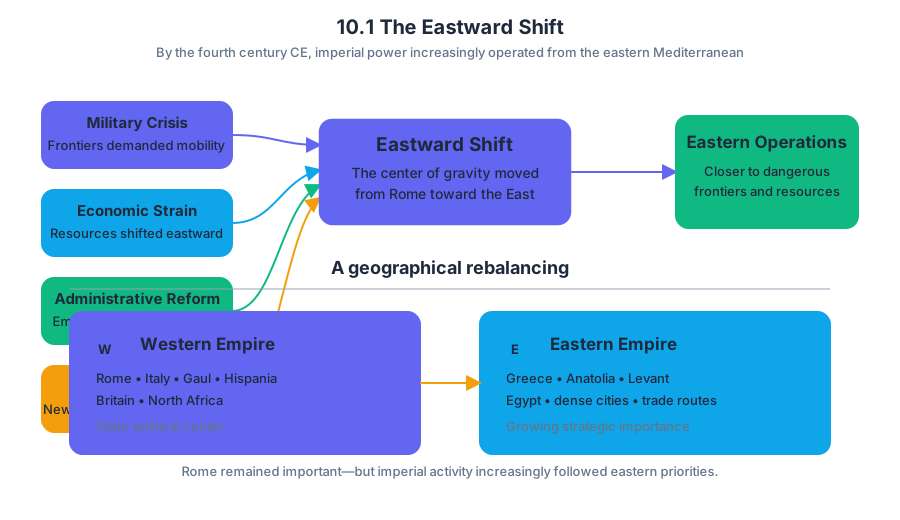
By the fourth century CE, the Roman Empire’s political center of gravity had moved decisively eastward—from the city of Rome toward the wealthy, strategically vital eastern Mediterranean. This shift did not happen because Rome suddenly became unimportant. It emerged from a combination of military crisis, economic instability, administrative reform, religious transformation, and the growing importance of the eastern provinces.
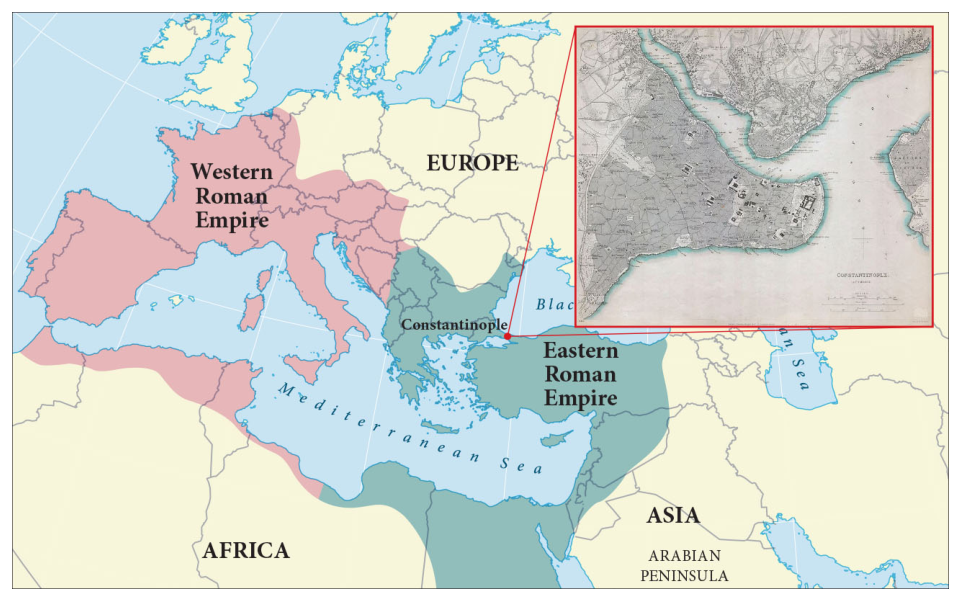
The change is easiest to picture geographically. The western empire included Italy, Gaul, Hispania, Britain, and parts of North Africa; the eastern empire included Greece, Anatolia, the Levant, and Egypt. The eastern regions contained major cities, productive farmland, dense populations, and long-established trade routes. As emperors struggled to defend an enormous frontier, they increasingly operated from locations closer to the empire’s most dangerous borders and most valuable resources.
The Crisis of the Third Century
Between $235$ and $284$ CE, approximately twenty-six claimants ruled the Roman Empire. This period, known as the Crisis of the Third Century, was marked by military rebellions, civil wars, invasions, economic disruption, and rapid changes of emperor. Many emperors gained power through the support of armies rather than through a stable process of succession. Their authority therefore depended heavily on military loyalty, which encouraged soldiers and commanders to elevate new candidates whenever an emperor appeared weak.
The crisis exposed a basic problem in Roman imperial government: one ruler could not easily control a territory stretching across Europe, North Africa, and the Near East while also responding quickly to threats along multiple frontiers. Armies stationed far from Rome often acted with considerable independence. A commander who successfully defended a region might be proclaimed emperor by his troops, creating another rival and intensifying civil conflict.
External enemies added pressure. The Roman Empire faced attacks and incursions along its European frontiers and conflict with powerful states to the east, including the Sasanians. A Sasanian victory over the Romans at Edessa in $260$ CE demonstrated that Rome’s eastern enemies could defeat Roman armies and even capture an emperor. The rock relief at Naqsh-e Rostam in modern Iran presents Sasanian King Shapur I celebrating this victory, making the contest between Rome and Persia visible in monumental form.
Military conflict also damaged economic life. Wars disrupted agriculture, trade, and taxation. Repeatedly changing rulers weakened confidence in imperial money, while the government’s need to pay armies increased pressure on the currency and on provincial populations. The crisis was therefore not a single disaster with one cause. Political instability, frontier warfare, and economic strain reinforced one another.
Diocletian and the Tetrarchy
The empire began to recover under Diocletian, who ruled from $284$ to $305$ CE. His central insight was administrative: the empire needed more than one emperor if its borders were to be defended and its government made effective. Diocletian created the tetrarchy, meaning “rule by four.” Two senior emperors, called augusti, governed alongside two junior emperors, called caesares.
The tetrarchy was not originally intended to divide the Roman Empire into four independent states. Instead, it created a coordinated system in which several rulers could respond to crises in different regions. Each emperor had a sphere of responsibility, an administrative center, and armies nearby. The famous sculpture known as The Four Tetrarchs portrays the four rulers as nearly identical partners, emphasizing cooperation, shared authority, and military unity rather than individual personality.
The tetrarchy addressed the empire’s geographic problem by placing imperial power closer to the frontiers. Its deeper importance was that it treated the empire as too large for one emperor to govern effectively from Rome alone.
Diocletian also reorganized imperial administration. The government increased its presence in the provinces and strengthened the hierarchy of officials responsible for taxation, law, and military affairs. These measures made the empire more bureaucratic and more demanding. They helped emperors collect the resources necessary for defense, but they also increased the obligations imposed on local communities.
Economic controls
Diocletian attempted to confront inflation and economic disorder through measures that included the Edict on Maximum Prices. The edict established official maximum prices for a wide range of goods and services. Its purpose was to prevent merchants from charging what the government considered excessive prices and to stabilize the economy.
Price controls could express imperial authority, but they could not by themselves eliminate the causes of inflation. The empire still faced military expenses, disrupted production, and difficulties moving goods across a vast territory. Diocletian’s economic reforms therefore illustrate both the growing power of the late Roman state and the limits of government commands when underlying economic pressures remain.
The Eastward Shift and Constantinople
The reforms of Diocletian helped stabilize the empire, but they also accelerated the movement of imperial attention away from Rome. Emperors increasingly spent time in cities closer to the Rhine, Danube, and eastern frontiers. These locations offered better access to active military zones than Rome did.
The eastern Mediterranean was especially important because it combined strategic position with economic strength. Anatolia, Syria, and Egypt connected the empire to trade routes reaching across the Mediterranean, the Red Sea, and western Asia. A ruler based in the East could respond to threats from Persia while also supervising prosperous provinces and major urban centers.
Constantine later established Constantinople—the city of Byzantium, refounded and renamed in his honor—as a new imperial center. Its location on the Bosporus connected Europe and Asia and placed the city near the empire’s eastern and European frontiers. Constantinople’s rise did not instantly erase Rome’s symbolic importance, but it confirmed that the empire’s practical center had moved eastward.
Christianity and the Transformation of Roman Society
The adoption of Christianity as the official religion of the Roman Empire transformed Mediterranean society. Christianity had begun as a minority faith within the Roman world, but imperial support changed its institutional position. Churches, bishops, Christian communities, and religious patronage became increasingly important parts of public life.
This change altered the relationship between political authority and religious practice. Earlier Roman religion involved public rituals honoring many gods and linking religious observance to the welfare of the state. The emperor’s authority was closely connected to these traditions. Christian emperors, however, supported a religion that rejected the worship of traditional Roman gods. The removal of pagan images could therefore become a highly controversial political act.
A winged Victory once stood outside the Roman Senate house as a representation of pagan religious tradition. Christian emperors removed the statue in $357$ and again in $382$ CE. Many pagan senators opposed these decisions because they understood the statue not merely as decoration but as a symbol of Rome’s traditions and military success. The controversy shows that Christianization was not simply a private change in belief. It reshaped public spaces, political symbols, and ideas about Roman identity.
Christianization also created new forms of authority. Bishops and churches became influential institutions in cities and provinces. Christian leaders could provide charity, organize communities, and speak publicly about moral and political issues. At the same time, disagreements within Christianity could become matters of imperial concern because religious unity increasingly appeared connected to social and political stability.
The Collapse of Roman Authority in the West
The eastward shift did not mean that the Roman Empire disappeared in the fourth century. Rather, Roman authority developed unevenly. The eastern empire retained stronger urban networks, agricultural wealth, administrative resources, and military capacity. In the West, imperial authority became increasingly fragile as emperors struggled to control distant provinces and respond to migrations and invasions.
Germanic peoples moved across Roman frontiers for different reasons, including pressure from other migrating groups, opportunities within Roman territory, and the attraction of Roman land and wealth. These movements were not one simple invasion by a single people. Some groups entered the empire as migrants or military allies; others fought Roman forces and established independent kingdoms when Roman authority weakened.
The Vandals crossed the Rhine in $406$ CE. They settled in Gaul, were pushed into Spain, and eventually established a kingdom in North Africa. Their movement illustrates how frontier populations could become major political actors as Roman control deteriorated. North Africa was especially valuable because it was a major agricultural region and an important source of grain.
Roman military and political life also depended increasingly on commanders of non-Roman origin. Stilicho, a notable Roman commander of Vandal origin, became guardian of the young emperor Honorius. Stilicho had married into the imperial family and gained popularity through military victories. His career reveals the complicated reality of the late empire: Roman identity and imperial service did not always correspond neatly to ancestry, even as competition for power intensified.
The weakening of western authority resulted from several connected developments: recurring civil wars, military pressure, economic problems, and the settlement of Germanic groups inside former Roman territories. By contrast, imperial government survived more effectively in the East. The western empire’s collapse was therefore not the collapse of Roman civilization everywhere. It was the breakdown of western imperial authority alongside the continued strength of the eastern Roman state.
Historical Significance
The eastward shift was a transformation rather than a simple transfer of power. Diocletian’s tetrarchy responded to the empire’s vast geography; economic reforms attempted to sustain the state; Christianity changed public authority and social institutions; and Constantinople became the center of an eastern imperial tradition. Meanwhile, Germanic migrations and invasions fragmented Roman rule in the West.
A common misconception is that Rome “fell” suddenly in one moment and that the eastern empire was no longer Roman. The developments of Late Antiquity show a more complicated process. Western imperial authority declined over time, while the eastern Roman Empire survived and continued Roman political traditions. The political map changed, but the Roman past remained active in the institutions, religions, cities, and successor kingdoms of the Mediterranean world.
Content adapted from OpenStax World History, Volume 1: to 1500 by Ann Kordas et al., licensed CC BY 4.0.
Source Materials
Study World History Volume 1 on Lykke
This course page is free to open: signed out, you can read its first two sections, and signing in, on any plan, opens the rest. The free Lykke Chrome extension syncs your own Canvas courses, so ChatGPT, Claude and Muse can answer from your classes and deadlines. It only reads Canvas.
Add the free extensionSign in to open every sectionAll sections of World History Volume 1 · Browse more course pages