From the free course World History Volume 1 on Lykke
7.2 Slavery in the Roman Empire
Key concepts: Slavery as a fundamental part of Roman daily life · Sources of enslavement in the Roman Empire · Prisoners of war as enslaved people · Natural reproduction and the enslavement of children · Exposure and slave trading · Self-sale into slavery and debt bondage · Labor and varied contexts of enslaved people · Harsh conditions and treatment of enslaved people · Manumission · Freedpeople in the Roman economy and political order
By the end of this section the student can: Describe the legal and social structures that supported slavery in the Roman Empire; Discuss the different experiences of enslaved men, women, and children; Explain the importance of gladiators in Roman culture
7.2 Slavery in the Roman Empire
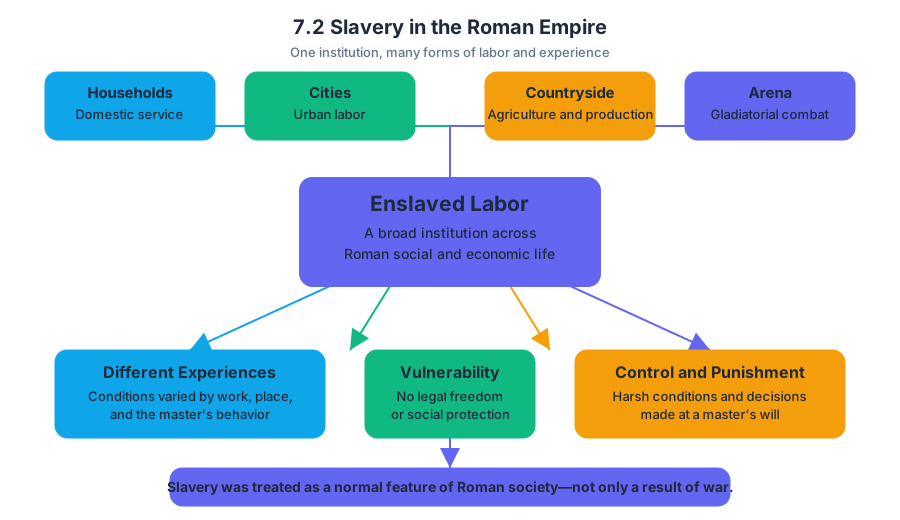
Slavery was a fundamental part of everyday life in the Roman Empire, not an exceptional condition confined to mines, plantations, or gladiatorial arenas. Enslaved people came from many regions of the empire, entered slavery through several different paths, and worked in cities, the countryside, households, workshops, and arenas. Their experiences varied widely, but all were vulnerable to the authority, demands, whims, and punishment of their masters.
A common misconception is that Roman slavery had one primary source—military conquest—and one typical setting, such as agricultural labor. War was indeed central, especially during the Roman Republic, but the imperial system depended on a changing combination of capture, birth, abandonment, kidnapping, piracy, debt, and self-sale. Understanding these different routes explains why slavery remained deeply embedded in Roman society even when the supply of war captives declined.
Slavery as a Fundamental Part of Roman Daily Life
Enslaved people performed a wide variety of work. Some served within households; others labored in cities and the countryside. The range of occupations meant that there was no single “slave experience.” Conditions depended on the work assigned, the location, and the behavior of the master, yet enslaved people remained legally and socially vulnerable. They could be subjected to harsh conditions, punishment, and decisions made according to a master’s wishes.
Some enslaved men were trained as gladiators, professional fighters paid to battle before an audience. Gladiatorial combat could continue until death, making the arena one of the most visible and dangerous forms of enslaved labor in Roman culture. Yet gladiators represented only one part of a much broader institution. The existence of spectacular public combats should not obscure the many enslaved people whose labor took place in ordinary urban and rural settings.
Slavery therefore connected the public and private sides of Roman life. It appeared in entertainment, production, domestic service, and other forms of work that supported Roman households and communities. Because enslaved labor operated across so many settings, Roman society treated slavery as a normal feature of the social order rather than as a temporary emergency produced only by war.
Sources of Enslavement in the Roman Empire
Enslavement resulted from several different circumstances in the Roman world; no single mechanism sustained the system. During the Roman Republic, it appears that many enslaved people were former soldiers captured in war. Slave dealers purchased captives from defeated armies and transported them to markets throughout the empire, where buyers seeking labor could purchase them.
This process linked military conflict to commercial exchange. A person captured in war could be separated from the place where the fighting occurred, sold through a market, and sent to an entirely different region for work. The empire’s size made this movement possible: enslaved people could be drawn from many parts of the Roman world and redistributed according to demand.
Prisoners of War as Enslaved People
War captives were especially important during the Republic, when Roman expansion and civil conflict created large numbers of defeated soldiers and populations vulnerable to enslavement. The capture of people in war was therefore not simply a military consequence. It also supplied slave dealers and labor buyers, making conquest part of the system’s economic foundation.
After the civil wars during the reign of Augustus, however, prisoners of war became less numerous. As a result, the Roman system relied more heavily on other sources of enslaved labor. This change is crucial: the decline in one source did not produce the decline of slavery itself. Instead, Roman slavery adapted by drawing more extensively on reproduction, abandonment, kidnapping, piracy, and other forms of enslavement.
Natural Reproduction and the Enslavement of Children
Some historians believe natural reproduction—the birth of children to enslaved women—accounted for a large number of new enslaved people. Children born to enslaved women were considered the property of the household in which their mothers lived. Birth could therefore reproduce the labor force internally, without the capture or purchase of a new adult from outside the household.
This process also meant that slavery could continue across generations. A child born into an enslaved mother’s household inherited an enslaved condition rather than entering a free community. The Roman system thus depended not only on external expansion but also on the reproduction of enslaved populations within households.
Exposure and Slave Trading
Another route into slavery began with exposure, the abandonment of infants by families that did not want or could not afford to care for a child. Exposed children often ended up in the hands of slave traders. An infant abandoned by a family could therefore become part of a commercial system that moved children into households or other labor settings.
Enslavement could also result from kidnapping and piracy. These practices supplied slave markets with people who had not been captured in formal warfare. Slave markets were often kept supplied through piracy, demonstrating that the system relied on violence both inside and outside the battlefield.
The market at Delos illustrates the scale of this trade. Active especially in the second and early first centuries BCE, it was the largest slave market in the Roman world described here. Upwards of ten thousand enslaved people might be sold there in a single day. That figure conveys not merely the size of one marketplace but the ability of Roman commercial networks to turn human captivity into a large-scale exchange.
Self-Sale into Slavery and Debt Bondage
Economic hardship could also lead people into slavery. Although voluntary debt bondage had been outlawed since the early Roman Republic, people could sell themselves into slavery in order to pay debts. Debt bondage means being compelled to work because of an obligation owed to another person; in the Roman case described here, the older practice had been prohibited, but self-sale remained possible.
This distinction reveals the complexity of Roman slavery. Not every enslaved person entered the system as a prisoner of war or as the victim of kidnapping. Some entered through desperate economic decisions. Self-sale did not make the resulting condition free or equal; it transferred a person into a system whose masters could control labor and impose punishment.
Manumission and the Place of Freedpeople
Manumission was the freeing of an enslaved person. In Rome, manumission was an expected practice, and it commonly occurred during an enslaved person’s lifetime. The rate is difficult to assess, so historians cannot simply assume that a fixed proportion of enslaved people were freed. Nevertheless, freeing enslaved people was sufficiently common to form a recognized part of Roman social and economic life.
Manumission did not erase the importance of slavery. Instead, it helped connect slavery and freedom within Roman society. Freedpeople—formerly enslaved people who had been manumitted—were important to the continued functioning of the Roman economy and political order. Their labor, relationships, and participation helped sustain institutions that depended on both enslaved workers and people who had moved out of slavery.
Manumission also existed alongside coercion and resistance. Violent conflicts involving enslaved people, including the revolt led by Spartacus in 71 BCE, demonstrated the dangers that Roman authorities associated with a large enslaved population. Following such conflicts, Rome appears to have made efforts to prevent future revolts. The laws of Augustus controlled the practice of manumission, showing that freeing enslaved people was both socially expected and politically regulated.
A System Built from Many Pathways
Roman slavery endured because it was flexible in its sources and extensive in its uses. When war supplied fewer captives after Augustus, reproduction, exposure, piracy, kidnapping, and self-sale helped maintain the labor force. Enslaved people then entered many different work environments, while manumission connected their lives to the population of freedpeople who supported Roman economic and political life. The system’s significance lies precisely in this combination: slavery was not one narrow institution but a changing structure woven through Roman society.
Content adapted from OpenStax World History, Volume 1: to 1500 by Ann Kordas et al., licensed CC BY 4.0.
Source Materials
Study World History Volume 1 on Lykke
This course page is free to open: signed out, you can read its first two sections, and signing in, on any plan, opens the rest. The free Lykke Chrome extension syncs your own Canvas courses, so ChatGPT, Claude and Muse can answer from your classes and deadlines. It only reads Canvas.
Add the free extensionSign in to open every sectionAll sections of World History Volume 1 · Browse more course pages