From the free course World History Volume 1 on Lykke
3.3 Ancient Egypt
Key concepts: Nile River Valley civilization · Unification of Upper and Lower Egypt · Centralized pharaonic government · Old, Middle, and New Kingdom periods · Old Kingdom pyramid building · Ma’at: Egyptian ideals of order, truth, and justice · Egyptian religious traditions involving Re and Amon · Trade and military relations with Nubia, Canaan, Syria, and the Sinai · New Kingdom rulers and imperial expansion · Amarna-period religious and artistic changes under Akhenaten and Nefertiti
By the end of this section the student can: Discuss the unification of Ancient Egypt and the development of a distinct culture there; Analyze the accomplishments of the pharaohs under the Old Kingdom; Describe the changes in government and society in Egypt during the Middle Kingdom
3.3 Ancient Egypt
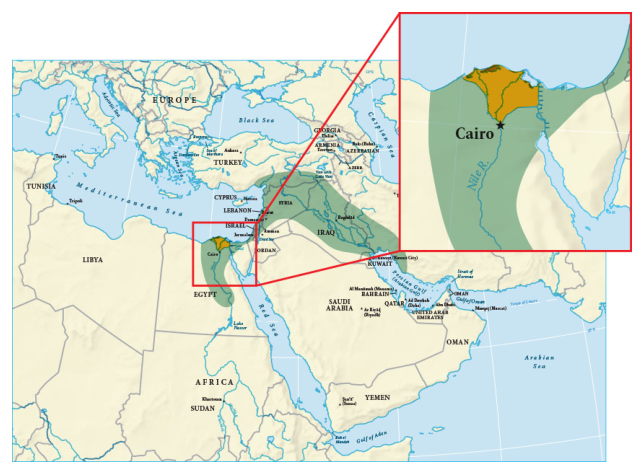
The Nile River made centralized government possible by turning a narrow strip of fertile land into a connected political world. Along its banks, communities that might otherwise have remained separate were brought together under one ruler around $3150$ BCE, creating ancient Egypt.
The Nile Valley and the Unification of Egypt
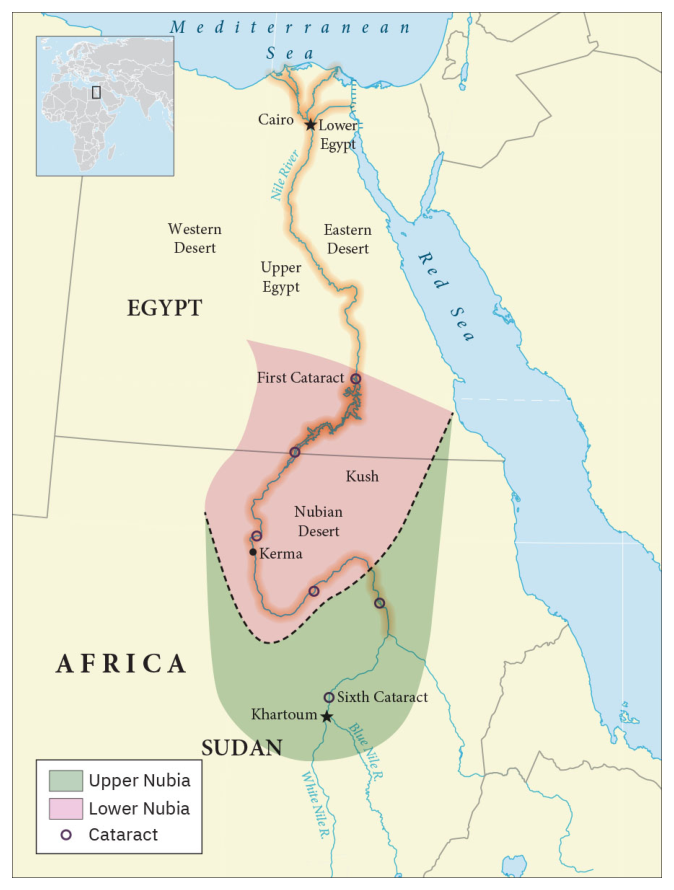
Ancient Egypt arose along the Nile River Valley during the fourth millennium BCE. The river supported settled agriculture and concentrated population in a relatively narrow, fertile region. This geography encouraged political centralization: communities depended on the same river system, and authority could coordinate farming, protection, taxation, transportation, and trade across the valley.
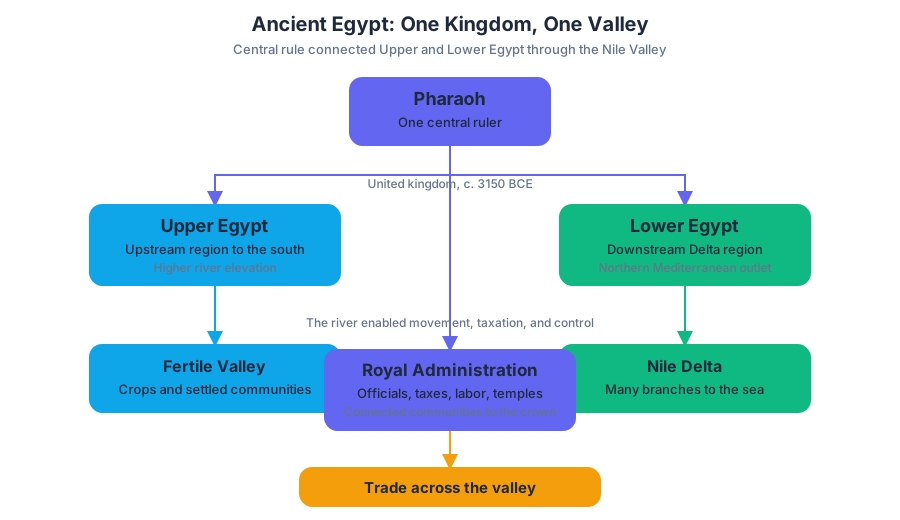
Lower Egypt was the northern region surrounding the Nile Delta, where the river spread into multiple branches before reaching the Mediterranean. Upper Egypt was the region upriver to the south. Although “upper” and “lower” may seem geographically reversed on a modern map, the terms refer to elevation along the river: Upper Egypt lay upstream, while Lower Egypt lay downstream.
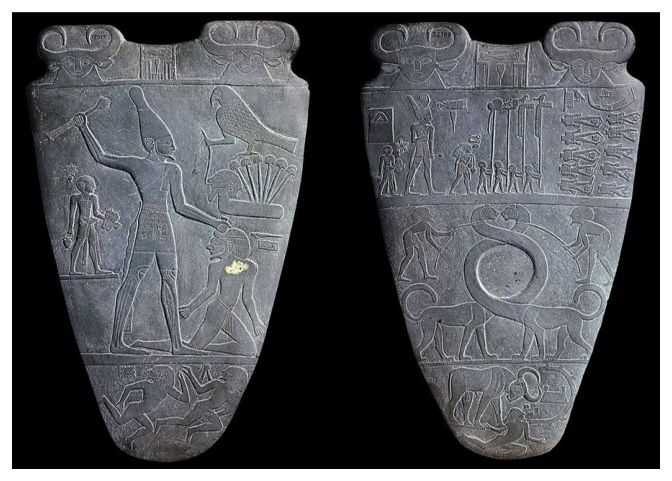
Around $3150$ BCE, the peoples of the Nile Valley were united under a single ruler. The unified kingdom included both Upper and Lower Egypt, establishing a political structure that endured for much of Egyptian history. Egypt was not continuously peaceful or unified; it later experienced brief periods of disunity when regional officials or foreign powers challenged the authority of the pharaoh. Nevertheless, reunification repeatedly restored the ideal of one kingdom governed by one central ruler.
The fertile Nile Valley therefore shaped more than Egypt’s economy. It also supported a strongly centralized political structure. The pharaoh stood at the center of government, while officials administered agriculture, labor, taxation, religious institutions, and the movement of goods. Egypt’s political organization depended on the ability to connect many communities to a common royal authority.
The Pharaonic State and Ma’at
Egyptian kings were known as pharaohs, rulers whose authority was both political and religious. The pharaoh was not simply a monarch who issued commands. Egyptian society understood royal rule as part of the larger order that governed nature, human relationships, and the universe. Government, religion, justice, and the regular functioning of society were therefore closely connected.
The central Egyptian ideal was Ma’at, meaning order, truth, and justice. Egyptians believed that Ma’at governed daily life and the universe. A well-ordered society was one in which people fulfilled their responsibilities, justice prevailed, and the pharaoh maintained stability. Disorder was not merely an administrative failure; it threatened the balance of the entire world.
Ma’at was the Egyptian ideal that order, truth, and justice structured both human society and the universe.
This belief helps explain why centralized government mattered so deeply in Egypt. The pharaoh’s rule was presented as a defense of order against disorder. Maintaining irrigation, protecting borders, supervising temples, regulating trade, and enforcing justice all contributed to the preservation of Ma’at. The system did not separate religious responsibility from political authority in the modern sense; royal government was part of the universe’s proper arrangement.
The Old Kingdom and Pyramid Building
The Old Kingdom was the era of pyramid building. The pyramids were monumental expressions of royal authority, religious belief, and the state’s ability to organize labor and resources. Their construction required centralized planning, skilled workers, supplies, transportation, and administrative coordination. Pyramid building therefore reveals the practical power of the pharaonic government as well as the symbolic importance of kingship.
A pyramid was not simply a large tomb. It represented the pharaoh’s place within Egyptian religious and political order. The enormous scale of pyramid construction demonstrated that the state could mobilize people and materials on a massive scale. It also connected the ruler’s death and continued existence to the stability of the kingdom. The achievement was both architectural and governmental: Egypt’s rulers turned centralized authority into stone.
The strength of the Old Kingdom did not last permanently. Periods of weakened central control followed the major kingdoms. During the First Intermediate Period, regional governors gained power at the expense of the pharaohs. This illustrates an important tension in Egyptian history: the Nile Valley favored unity, but the kingdom still depended on the ability of the central government to command officials and resources throughout the country.
The Middle Kingdom: Renewal and Expansion
The Middle Kingdom was a period of renewed strength and prosperity. After the disunity of the First Intermediate Period, Egyptian rulers restored centralized authority and expanded their territorial influence. The Middle Kingdom’s importance lies not only in recovery but also in the restoration of the political ideal that Egypt should again function as one kingdom under a strong pharaoh.
The pattern of Egyptian history was therefore not a simple uninterrupted rise. Kingdoms of strong central control were separated by Intermediate Periods, when authority weakened and regional or foreign powers became more influential. During the Second Intermediate Period, traditional Egyptian nobles lost control of the Nile Delta to the Hyksos people, while the kingdom of Kush controlled far Upper Egypt. These developments divided political authority within the Nile Valley.
The territories and political authority lost during the Second Intermediate Period were later reconquered with the inauguration of the New Kingdom. Egypt’s history thus combined continuity and disruption: the ideal of unified pharaonic rule remained powerful even when actual control fractured.
| Period | Characteristic emphasized in Egyptian history |
|---|---|
| Old Kingdom | Pyramid building and strong centralized authority |
| First Intermediate Period | Regional governors gained power at the expense of the pharaoh |
| Middle Kingdom | Renewed strength, prosperity, and territorial expansion |
| Second Intermediate Period | The Hyksos controlled the Nile Delta, while Kush controlled far Upper Egypt |
| New Kingdom | Reunification and renewed imperial campaigns |
Trade and Egypt’s Wider Connections
Egypt was not isolated within the Nile Valley. Archaeological and inscriptional evidence shows substantial trade between Lower Egypt and the Canaanites of Palestine and Syria. Egypt also obtained valuable goods from neighboring regions. Nubia supplied ivory, ebony, leopard skins, incense, and gold, while mines in Sinai produced turquoise, alabaster, and quartzite.
Egyptian goods moved outward as well. Exports included pottery, grain, papyrus, linen, and many other products. The Egyptian state helped protect these commercial connections by providing border protection, supervising toll roads, and ensuring the safety of merchants. Trade consequently depended not only on individual exchange but also on organized political power.
These networks show how the Nile supported both internal unity and external connection. The river linked Egypt’s settlements, while roads and military power connected the kingdom to Nubia, Sinai, Palestine, and Syria. Egypt’s centralized government was therefore useful not only for agriculture and monument building but also for managing long-distance trade.
The New Kingdom and Royal Power
New Kingdom rulers used military campaigns to defend and enlarge Egyptian power. Thutmose I and his son Thutmose II both campaigned in Nubia and Syria. Thutmose I marched as far as the Euphrates River in Syria, likely as a demonstration of force against emerging powers in the region. These campaigns show that New Kingdom kingship involved active military leadership as well as religious and administrative authority.
Tutankhamun later sent armies into Nubia and Canaan. He also repaired temples damaged under Akhenaten, restoring important religious institutions and reconnecting royal rule with established traditions. His actions demonstrate that military activity and religious restoration were both tools of pharaonic legitimacy.
New Kingdom religious tradition also brought together regional divine traditions. Re was the northern creator god, while Amon was the southern sky god. Their combination produced a deity portrayed as king of the gods and father of each pharaoh. This synthesis reflected Egypt’s broader political structure: the kingdom united different regions, and its religious tradition could incorporate gods associated with those regions into a larger royal order.
Hatshepsut and the Legitimacy of Rule
Hatshepsut faced a particular challenge because Egyptian kingship was represented through established male imagery. To legitimize her rule, she adopted traditional male pharaonic iconography, including the ceremonial beard and pharaonic headdress. Her use of these symbols did not merely express personal identity; it presented her authority according to the visual standards Egyptians associated with legitimate kingship.
Hatshepsut’s mortuary temple at Deir el-Bahri, beneath cliffs near the Valley of the Kings, further illustrates the relationship between royal power, architecture, and landscape. Its large ramps and terraces were designed to blend with the cliffs behind it. The monument placed Hatshepsut within the sacred and royal geography of Egypt while displaying the resources and organization available to the pharaoh.
Why Ancient Egypt Endured
Ancient Egypt endured because several systems reinforced one another. The Nile supported agriculture and settlement; the valley’s geography encouraged political integration; centralized government organized labor, trade, defense, and religious institutions; and Ma’at supplied a moral and cosmic justification for royal authority. When central control weakened, Egypt entered an Intermediate Period, but the ideal of unified pharaonic order remained available for later rulers to restore.
The most common misconception is that Egyptian history was a single, unchanging civilization ruled by uninterrupted pharaohs. In reality, Egypt experienced periods of fragmentation, foreign control, political recovery, military expansion, religious change, and debate over the symbols of legitimate rule. Its continuity came not from the absence of change, but from the repeated power of the Nile Valley, the pharaonic institution, and the ideal of Ma’at to organize Egyptian society.
Content adapted from OpenStax World History, Volume 1: to 1500 by Ann Kordas et al., licensed CC BY 4.0.

Source Materials
Study World History Volume 1 on Lykke
This course page is free to open: signed out, you can read its first two sections, and signing in, on any plan, opens the rest. The free Lykke Chrome extension syncs your own Canvas courses, so ChatGPT, Claude and Muse can answer from your classes and deadlines. It only reads Canvas.
Add the free extensionSign in to open every sectionAll sections of World History Volume 1 · Browse more course pages