From the free course World History Volume 1 on Lykke
10.2 The Byzantine Empire and Persia
By the end of this section the student can: Explain the evolution of the Byzantine Empire in Late Antiquity; Describe Sasanian culture and society in Late Antiquity; Analyze the relationship between the Roman Empire and Sasanian Persia in Late Antiquity
10.2 The Byzantine Empire and Persia
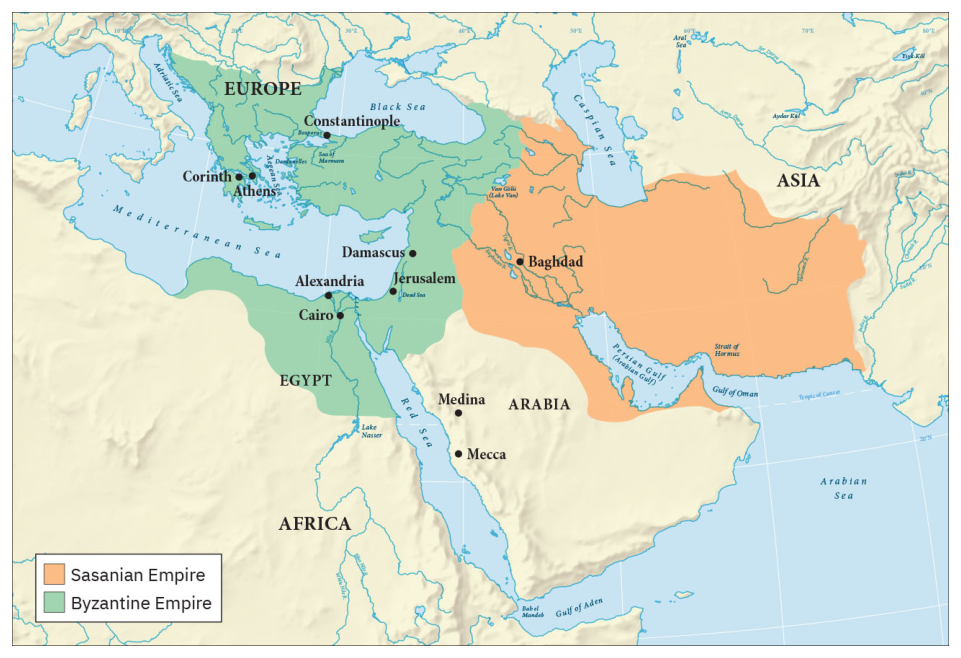
The Byzantine and Sasanian Empires were the two dominant powers of Late Antiquity, competing for control of the eastern Mediterranean, Mesopotamia, the Caucasus, and the trade routes connecting the Mediterranean to Central Asia. Rome’s political center had shifted eastward, but the Roman state did not simply disappear: in the eastern Mediterranean it continued as the Byzantine Empire, while a powerful Persian monarchy emerged under the Sasanians.
Late Antique Rome
Late Antiquity was defined by a tension between continuity and transformation. The Roman state, especially in the East, continued to use Roman political traditions, administrative structures, and imperial authority. Many inhabitants still understood themselves as participants in the classical Mediterranean order. At the same time, the empire’s culture, institutions, and religious life had changed substantially. This combination makes Late Antiquity neither merely a continuation of the ancient world nor simply a prelude to the Middle Ages.
The eastern Roman Empire became increasingly centered on Constantinople, a city positioned at the intersection of Europe and Asia and connected to the Black Sea, the eastern Mediterranean, and the overland routes toward Persia. Its rulers continued to call themselves Roman emperors, and their subjects often considered themselves Romans. The later name Byzantine Empire is a modern term used to distinguish this eastern Roman state from the earlier empire centered on Rome.
The empire’s government became highly bureaucratic. A bureaucracy is an organized administrative system staffed by officials who collect taxes, enforce laws, manage public works, and carry out imperial decisions. In Late Antique Rome, the expansion of this system strengthened the emperor’s ability to rule, but it also gave wealthy elites considerable influence. Wealthy landowners could control offices and local government in ways that placed burdens on poorer inhabitants.
The Roman Senate illustrates this institutional transformation. In earlier centuries, the Senate had performed important administrative functions for the wider Roman state. By Late Antiquity, however, it operated largely as an aristocratic “city council” for Rome itself. It made few meaningful decisions beyond managing the city, and many senators chose not to participate regularly. The Senate therefore survived as an institution while losing much of its earlier political power.
Justinian and the Byzantine Imperial Project
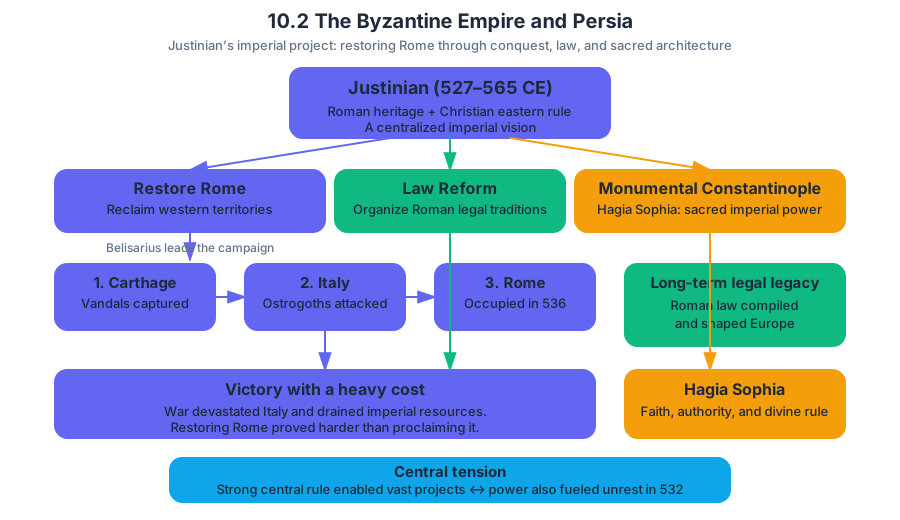
The reign of the emperor Justinian, from 527 to 565 CE, expressed the central tension of Byzantine identity: the empire looked back to its Roman past while governing a Christian society in the eastern Mediterranean. Justinian did not regard the eastern empire as a new state detached from Rome. Instead, he sought to restore Roman imperial territory and authority.
Justinian’s most ambitious project was the reconquest of former Roman territories in the western Mediterranean. After the successful capture of Carthage from the Vandals in North Africa, he turned toward Italy, which was controlled by the Ostrogoths. He sent his trusted general Belisarius to lead the campaign. Despite having a relatively small force, Belisarius occupied Rome in 536 and began recapturing additional Italian cities.
The reconquest was costly and difficult. Fighting in Italy continued for years, and the territory was devastated by warfare. Justinian’s effort demonstrated the reach of imperial ambition, but it also consumed resources that the empire needed elsewhere. The Byzantine Empire could claim important victories, yet restoring the old Roman world was far more difficult than proclaiming that restoration as a political goal.
Justinian also strengthened the empire through law and monumental construction. His government gathered and organized Roman legal traditions, preserving them in a form that later influenced European legal systems. His building program transformed Constantinople, most famously through the construction of Hagia Sophia, a massive church that symbolized imperial power and Christian devotion. The building’s scale communicated that the emperor governed not merely by military force but as the divinely supported ruler of a Christian empire.
Justinian’s rule also revealed the dangers of concentrated imperial power. In 532, unrest known as the Nika Revolt threatened his government in Constantinople. The revolt grew out of conflict among competing groups associated with chariot racing, but it became a broader challenge to imperial authority. Justinian’s forces suppressed the uprising, allowing him to remain in power. The episode showed both the vulnerability of urban politics and the coercive strength of the imperial state.
From Parthian to Sasanian Persia
While the Roman Empire developed into Byzantium, a new Persian dynasty rose in the East. The Sasanian Empire was founded in 224 CE by Ardashir I, who overthrew the Parthian ruling house. The Sasanians presented themselves as restorers of Persian power and established a more centralized monarchy than the Parthians had maintained.
The Sasanian Empire was based in the Iranian plateau and extended across a broad zone between the Roman world and Central Asia. Its territory included regions corresponding to parts of modern Iran, Iraq, Armenia, Georgia, and neighboring lands. The empire’s capital at Ctesiphon, located near the Tigris River, became a major political and cultural center.
Sasanian rulers supported Zoroastrianism, the religious tradition associated with the prophet Zarathustra. Zoroastrianism emphasized the struggle between the forces of good and evil and treated fire as a powerful symbol of purity and divine presence. The monarchy and Zoroastrian religious institutions supported one another, giving the empire an ideological foundation. The king ruled as the central political authority, while religious leaders helped define proper belief and practice.
Sasanian society was hierarchical. At the top stood the king and royal family, followed by powerful nobles, military leaders, and religious officials. Administrators, landowners, merchants, artisans, peasants, and enslaved people occupied lower positions. This hierarchy helped the empire mobilize taxes, soldiers, and labor, but it also concentrated wealth and authority among a relatively small elite.
The empire was not culturally or religiously uniform. Zoroastrianism held privileged status, but Christians, Jews, and other religious communities lived within Sasanian territory. Their position could vary according to political circumstances, the policies of individual rulers, and relations with the Byzantine Empire. Religious identity was therefore connected to international politics: Christians in Persia could be viewed with suspicion when Persia was at war with the Christian Byzantine Empire.
Sasanian Culture and Trade
Sasanian culture combined older Persian traditions with influences from the many peoples and regions incorporated into the empire. Royal art emphasized the authority of the monarch through images of enthronement, hunting, victory, and submission. The rock relief at Naqsh-e Rostam depicting the Sasanian victory over the Romans at Edessa in 260 CE illustrates how rulers used monumental art to record military success and project power.
The Sasanians also benefited from their location between the Roman Empire and China. Their empire stood astride major land routes that connected western and eastern markets. Through the Silk Roads, a network of overland routes rather than a single road, Sasanian territory was linked to numerous regional trading partners. Merchants moved luxury goods, raw materials, technologies, and ideas across these routes.
This geographic position gave the Sasanians an advantage in long-distance commerce. Their influence reached beyond their political borders because trade networks extended into Central Asia and toward China. The empire’s strength therefore rested not only on agriculture, taxation, and military organization but also on its ability to participate in and benefit from Afro-Eurasian exchange.
Byzantium and Sasanian Persia in Rivalry
The Byzantine and Sasanian Empires were neighboring great powers, and their relationship combined warfare, diplomacy, trade, and cultural exchange. They competed for control of frontier regions such as Armenia and Georgia, for influence in Mesopotamia, and for access to commercial routes. Neither empire could ignore the other: each represented the most serious external challenge to the other’s security and ambitions.
The conflict had deep roots. The Sasanians claimed the legacy of earlier Persian empires, while Byzantine emperors claimed continuity with Rome. Military victories therefore carried symbolic importance. A battlefield success could be presented as proof that a ruler had inherited the authority and glory of his civilization. The Naqsh-e Rostam relief celebrating Shapur I’s victory over the Romans at Edessa is one example of this political use of historical memory.
At the same time, these empires were not isolated enemies. They exchanged goods, technologies, artistic motifs, and diplomatic representatives. Their rivalry helped shape the political geography of the eastern Mediterranean and western Asia, but their interaction also connected their societies. War and exchange were not opposites; they operated together within the same imperial system.
The final and most destructive phase of Byzantine-Sasanian conflict occurred in the early seventh century. The Sasanian king Khosrow II conquered large Byzantine territories, including Syria, Palestine, and Egypt. The Byzantine emperor Heraclius eventually counterattacked and defeated the Sasanians. The war exhausted both empires, weakened their economies and armies, and left their populations vulnerable to new political forces.
Later artistic memory preserved the importance of this struggle. A medieval image titled “Sassanid King Khosrow II submitting to the Byzantine Emperor Heraclius” depicts the Persian ruler yielding to the Byzantine emperor. Although created centuries after the events, the image shows how later societies remembered the conflict as a contest between imperial powers and as a decisive episode before the rise of Islam.
Historical Significance
The Byzantine and Sasanian Empires demonstrate why Late Antiquity cannot be understood simply as the collapse of Rome. In the East, Roman political traditions survived in a powerful Christian empire centered on Constantinople. In Persia, the Sasanians built a centralized monarchy with a distinctive religious culture, sophisticated administration, and extensive trade connections.
Their rivalry shaped the eastern Mediterranean and western Asia for centuries. Yet their final wars also weakened both states. The result was a transformed political environment in which smaller and newer powers could challenge the old imperial order. The Byzantine and Sasanian experience therefore links the Roman past to the major political and religious changes that followed in the seventh century.
Content adapted from OpenStax World History, Volume 1: to 1500 by Ann Kordas et al., licensed CC BY 4.0.
Source Materials
Study World History Volume 1 on Lykke
This course page is free to open: signed out, you can read its first two sections, and signing in, on any plan, opens the rest. The free Lykke Chrome extension syncs your own Canvas courses, so ChatGPT, Claude and Muse can answer from your classes and deadlines. It only reads Canvas.
Add the free extensionSign in to open every sectionAll sections of World History Volume 1 · Browse more course pages