From the free course World History Volume 1 on Lykke
13.4 The Crusading Movement
Key concepts: Christian views of conflict with Islam · Religious claims to formerly Christian territories · God’s favor and crusading success · Church of the Holy Sepulchre · Al-Aqsa Mosque · Jerusalem as a sacred city · Shared religious significance of Abraham · The Crusader States
By the end of this section the student can: Describe the centrality of the city of Jerusalem to Judaism, Christianity, and Islam; Explain how the Crusader States in the Middle East complicated the relationships between the
13.4 The Crusading Movement
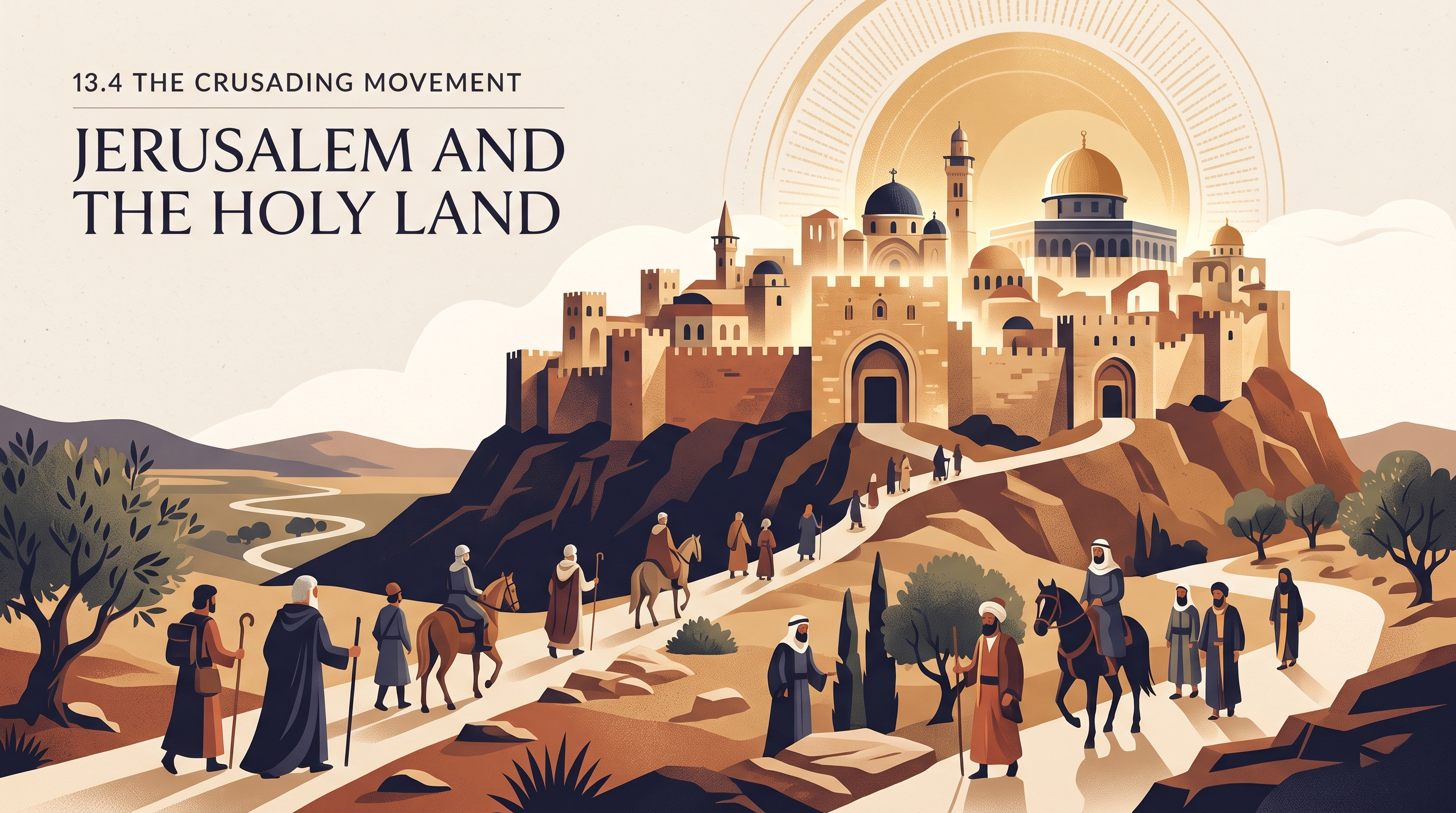
Jerusalem became the focal point of a conflict in which Christians, Muslims, and Jews attached exceptional spiritual meaning to the same city and surrounding land. The Crusading Movement therefore cannot be understood only as a military campaign: it was also a struggle over sacred memory, pilgrimage, religious authority, and the interpretation of political success.
The Rhetoric of Holy War
Some Christians came to believe that territories that had once been Christian should always belong to Christians. This idea was especially powerful when applied to the Holy Land, even though the region was also deeply important to Muslims and Jews. The claim transformed a complicated political and religious landscape into a seemingly simple moral question: if Christians had once controlled the territory, did Christians have a permanent right to reclaim it?
This argument also shaped Christian views of conflicts with Islam in places beyond the eastern Mediterranean, including Spain. In such settings, military struggles could be described not merely as contests over land or political power but as efforts to carry out the will of God. The language of sacred duty made compromise difficult because opponents were treated not simply as rival rulers but as enemies of a divinely sanctioned order.
Religious claims to formerly Christian territories meant that some Christians regarded land’s earlier Christian association as a continuing title to possession, especially in the Holy Land.
The rhetoric of holy war depended on interpretation. A Christian victory could be read as evidence that God supported the campaign, while defeat could require explanation: perhaps the warriors had sinned, lacked devotion, or failed to fulfill their religious obligations. This logic made military events appear to reveal divine judgment. It also encouraged crusaders and their supporters to understand political outcomes through a religious lens rather than treating them as the result only of strategy, resources, alliances, or geography.
Jerusalem and the Holy Land
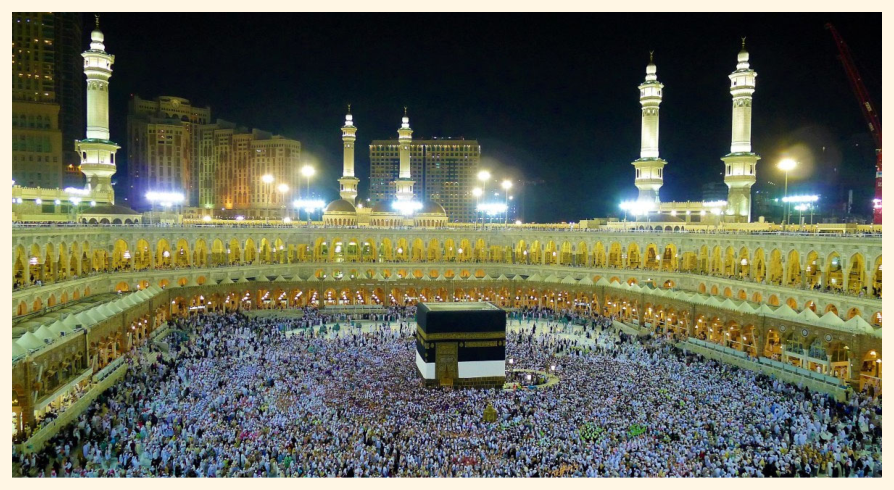
Judaism, Christianity, and Islam all possess traditions of pilgrimage, understood as sacred journeys that can deepen a person’s connection with God, express penitence, or give thanks. Pilgrimage was therefore more than travel to an interesting place. It was intended to be transformative: the pilgrim physically approached a location associated with holy people, sacred events, or divine action.
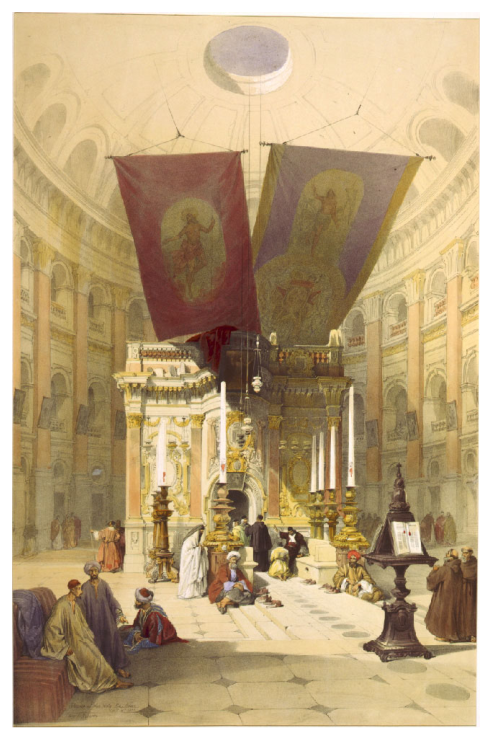
Jerusalem held an unusual position within this shared religious geography. For Christians, the city was associated with the earthly life, death, and burial of Jesus. The Church of the Holy Sepulchre was believed to contain both Jesus’s tomb and the rock thought to have sealed it. For many Christians, being able to see and touch the physical places where Jesus had lived and died made the sacred past feel immediate and tangible.
The importance of physical contact with holy places became especially powerful in Christian Europe during a period when church reforms emphasized the earthly life of Jesus. Writings by monks and nuns also described heaven as a “heavenly Jerusalem.” This image strengthened the desire to visit the earthly Jerusalem: the city was imagined simultaneously as a real place connected to Jesus and as a reflection of the promised heavenly city.
Jerusalem was equally significant within Islam. The Al-Aqsa Mosque was built on Jerusalem’s old Temple Mount and is described as the third holiest site in Islam. It is associated with Muhammad’s special journey to Jerusalem and with his ability to pray there and glimpse God before continuing his mission to convert others to Islam. The Quran mentions the site several times as the “Furthest Mosque,” a meaning reflected in the name Al-Aqsa.
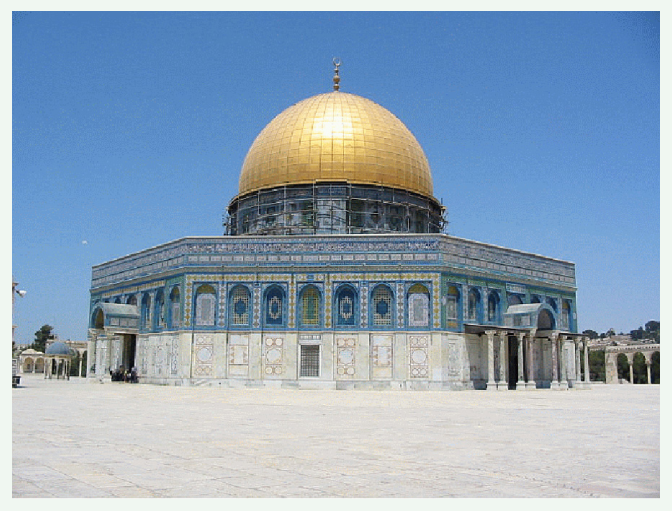
The Dome of the Rock, built near Al-Aqsa Mosque, was also associated with Muhammad’s journey and with the biblical figure Abraham. Abraham was important to Muslims, Christians, and Jews alike. His presence in the traditions of all three faiths helps explain why Jerusalem could possess overlapping, rather than exclusive, sacred meanings. Each community connected the city to foundational stories, revered figures, and relationships with God.
Jerusalem’s exceptional importance came from its place in the sacred histories of three religions, not from its importance to Christianity alone.
This shared sanctity created both connection and conflict. Muslims, Christians, and Jews could recognize the significance of Abraham and of Jerusalem while disagreeing over which traditions gave the city its most authoritative meaning and who should govern its holy places. The result was not a simple opposition between a sacred city and a secular world. It was a contest among religious communities that all treated the city as spiritually consequential.
The First, Second, and Third Crusades
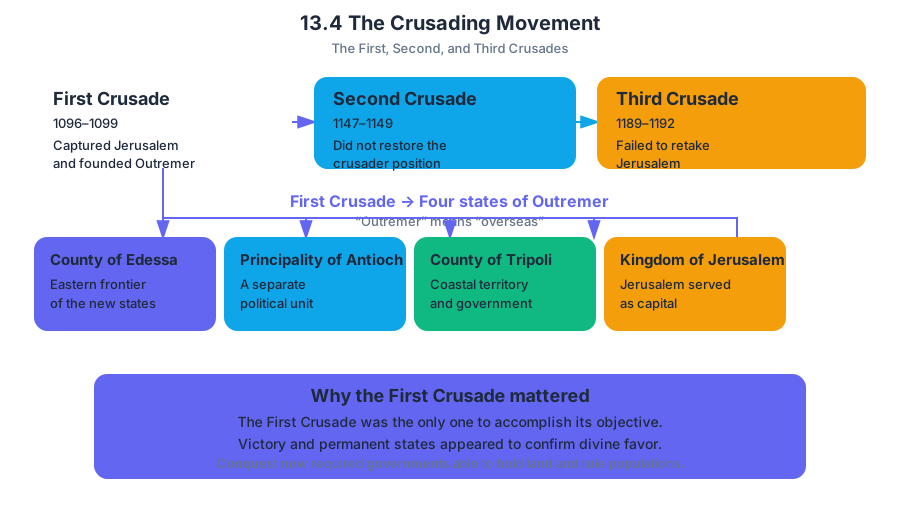
The First Crusade produced the most direct and lasting territorial result of the crusading movement. Crusaders established four states in the Middle East: the County of Edessa, the Principality of Antioch, the County of Tripoli, and the Kingdom of Jerusalem. Collectively, these territories were called Outremer, a French term meaning “overseas.” The crusaders claimed Jerusalem as their capital.
These states were not a single unified kingdom. Their names indicate different political units, each centered on its own territory and ruling structure. Yet together they represented the effort to convert crusading conquest into a permanent political order. The movement had begun with religious and military claims; it now required governments capable of holding land and ruling populations in a region whose religious importance extended far beyond western Europe.
Of all the Crusades, the First Crusade was the only one that accomplished its objective. Its success had major consequences for Christian interpretations of the movement. A victory that resulted in the capture of Jerusalem and the establishment of Outremer could be understood as a clear sign of God’s favor. For Christians committed to the crusading cause, the outcome appeared to confirm that the campaign had fulfilled a divine purpose.
God’s Favor and Crusading Success
The belief that success revealed God’s favor gave crusading victories a significance beyond their immediate military effects. The capture of sacred territory was interpreted not merely as the outcome of armed struggle but as evidence that God had chosen to support the crusaders. This interpretation strengthened the authority of the movement’s religious claims and helped connect battlefield success to Christian ideas about providence, or divine direction of human events.
Yet this interpretation also created a problem. If victory demonstrated divine favor, then defeat seemed to demand a religious explanation. Military failure could raise doubts about whether the crusaders had acted properly or whether God continued to support their efforts. The same belief system that magnified success therefore made failure especially difficult to absorb.
Why Crusading Success Was Difficult to Sustain
The crusading movement changed over time. As its campaigns continued, fewer Christians joined later Crusades, even though the legend and romance of crusading became more popular in the European imagination. This distinction matters: cultural fascination with crusading did not necessarily produce the people, resources, or commitment required for repeated military success.
The Crusader States also faced the practical difficulty of maintaining territories far from western Europe. Their existence depended on continued military and political support, while the populations and religious communities of the region did not share a single identity or allegiance. Holding Jerusalem and the other territories therefore required more than the original energy of conquest. It required stable institutions, sustained defense, and workable relations among communities with competing claims to the same land.
The history of the Crusades thus reveals a tension between sacred purpose and political reality. The First Crusade’s success encouraged the conviction that God favored the movement, but later difficulties showed that religious confidence could not by itself guarantee lasting control. Jerusalem remained spiritually central to Muslims, Christians, and Jews, while the political structures created by the crusaders remained vulnerable.
The central issue was never simply who could reach Jerusalem first. It was how communities interpreted sacred history, pilgrimage, divine favor, and rightful possession. The Crusading Movement emerged from Christian claims about recovering formerly Christian lands, achieved its only clear objective through the First Crusade, and then confronted the enduring complexity of ruling a city revered by three faiths.
Content adapted from OpenStax World History, Volume 1: to 1500 by Ann Kordas et al., licensed CC BY 4.0.
Source Materials
Study World History Volume 1 on Lykke
This course page is free to open: signed out, you can read its first two sections, and signing in, on any plan, opens the rest. The free Lykke Chrome extension syncs your own Canvas courses, so ChatGPT, Claude and Muse can answer from your classes and deadlines. It only reads Canvas.
Add the free extensionSign in to open every sectionAll sections of World History Volume 1 · Browse more course pages