From the free course World History Volume 1 on Lykke
16.2 Famine, Climate Change, and Migration
Key concepts: Fourteenth-century climate change · Adverse weather and natural disasters · Famine and food shortages · Migration · Demographic transformation · Ecological transformation · Environmental history · Tree rings as historical climate evidence · Human-environment interaction · Settlement and development
By the end of this section the student can: Explain how climate change affected Afro-Eurasian societies in the fourteenth century; Discuss the reasons medieval people migrated and how they did so
16.2 Famine, Climate Change, and Migration
Climate and weather are not merely background conditions in human history: in the fourteenth century, shifts in temperature, rainfall, and seasonal patterns helped turn ordinary hardships into famine, population movement, and profound demographic and ecological change. The central historical question is therefore not whether nature or humans “caused” crisis, but how environmental disruption and human activity interacted.
Fourteenth-Century Climate Change
The fourteenth century experienced significant global climate change. In different regions, people encountered different expressions of this change: colder conditions, unusually wet seasons, irregular rainfall, drought, and freezing lakes and rivers. These were not identical experiences everywhere. Climate change operated across a large world, but its effects were local because communities depended on particular crops, water sources, soils, animals, and systems of food distribution.
Climate change is a long-term alteration in environmental conditions such as temperature and rainfall. Historical climate change must be understood through both broad patterns and the local conditions that determined how communities experienced them.
The period is associated with the early stages of what historians and climatologists call the Little Ice Age, a period of generally cooler and more unstable conditions. In China and northern Europe, cold weather was especially pronounced. Lakes and rivers froze, affecting transportation, fishing, water access, and agricultural routines. Elsewhere in Europe and Asia, the major problem was excessive precipitation rather than simple cold. Beginning in 1314, extraordinary rains produced abnormally cold and wet winters and made cultivation increasingly difficult.
A common misconception is that climate change acts like a single worldwide event with exactly the same consequences everywhere. The fourteenth-century evidence shows otherwise. The same broad environmental shift could produce freezing in one region, destructive rain in another, and drought or irregular rainfall elsewhere. Historical analysis must therefore connect global climate patterns to local geography, economic systems, and human decisions.
Adverse Weather and Natural Disasters
Adverse weather means weather conditions that damage human livelihoods, including prolonged cold, excessive rain, drought, irregular rainfall, and destructive storms. In the fourteenth century, these conditions disrupted the basic relationship between land and food. Farmers struggled to cultivate already overworked soil, while cold or wet seasons shortened growing periods and damaged harvests.
The effects could accumulate over several years. A single poor harvest might be endured if communities possessed reserves, functioning markets, or assistance from political authorities. Repeated poor harvests, however, depleted stored grain, weakened animals, raised prices, and left households with fewer ways to survive the next crisis. Environmental disruption thus became more dangerous when it interacted with economic inequality, intensive land use, fragile institutions, and limited access to food.
The broader historical lesson is that natural events are never entirely “natural” in their consequences. Rain falls, rivers freeze, and crops fail, but human activity determines how severely those events affect society. Communities that had exhausted their land, lacked reliable food reserves, or could not move supplies efficiently were more vulnerable than communities with greater resources. Climate change must therefore be analyzed alongside human activity rather than treated as an isolated force.
Famine and Food Shortages
One of the most important consequences of adverse environmental conditions was famine. Famine is a widespread and severe shortage of food that produces hunger, rising mortality, social distress, and economic disruption. It is not simply the same as an individual experiencing hunger. Famine affects communities and regions, and it often transforms prices, labor, trade, health, and political relationships.
The rains that began in 1314 produced poor harvests in parts of Europe and Asia. People attempted to cultivate land that was already overworked, but excessive precipitation made successful farming difficult. Irregular rainfall and periods of drought in other areas also dramatically reduced crop yields. In China and northern Europe, cold weather added another danger by freezing lakes and rivers and intensifying the pressure on food-producing communities.
The English monk and chronicler Johannes de Trok elowe described the effects of the Great Famine in 1315. His account shows how environmental crisis entered everyday life. Meat and eggs became scarce; capons and fowl were difficult to find; animals died of disease; and pigs could not be fed because fodder had become too expensive. The crisis therefore affected both human food and the animals that supported household economies.
Trok elowe also recorded rapidly rising prices. A quarter of wheat, beans, or peas sold for twenty shillings, whereas a quarter of wheat had sold for five shillings in 1313. Wheat prices had therefore risen by a factor of $4$. Barley sold for a mark, oats for ten shillings, and salt for thirty-five shillings, a price he described as previously unheard of. When King Edward II came to St. Albans on August 10, it was barely possible to find enough bread for his household.
This account is valuable because it connects large environmental processes to measurable human consequences: scarcity, price inflation, animal death, and the difficulty of feeding even a royal household. It also reminds us that famine was not only a biological crisis. It was an economic crisis in which people with money, land, political connections, or access to trade might survive more easily than the poor.
Migration and Changing Communities
Environmental disruption also influenced migration. When harvests failed, pasture deteriorated, water supplies changed, or food prices became unsustainable, individuals and communities had reasons to leave familiar places. Migration is the movement of people from one location to another, whether temporarily or permanently. In this period, migration was connected to environmental conditions because people responded to the effects of famine, scarcity, and changing possibilities for settlement.
Migration should not be imagined as a simple automatic response in which climate change directly pushed everyone from one place to another. People also weighed family ties, political authority, economic opportunity, access to trade, and the availability of land and food. Some communities moved; others remained and adapted. Environmental conditions influenced the continued settlement and development of peoples around the world, but they did not determine a single outcome for every society.
This connection between environment and movement helps explain why demographic transformation could extend beyond the immediate victims of a bad harvest. Population decline, relocation, altered settlement patterns, and changing labor arrangements could reshape communities over time. Migration could also carry skills, customs, technologies, and social practices into new regions. The fourteenth-century environmental crisis therefore affected not only how many people lived in particular places, but also where communities could continue to develop.
Demographic and Ecological Transformation
Demographic transformation means major change in the size, distribution, or composition of a population. Climate change, famine, and migration contributed to demographic transformation by influencing survival, fertility, settlement, and movement. Environmental conditions could reduce populations through hunger and disease, while migration redistributed people across landscapes.
The same processes produced ecological transformation, meaning a significant change in the relationship between human communities and the environments they inhabited. When people abandoned fields, intensified cultivation, moved toward new resources, or altered patterns of animal keeping, they changed landscapes. Conversely, changing landscapes affected which communities could remain and which forms of subsistence were possible.
These transformations were interconnected. Poor weather reduced harvests; food shortages raised prices; famine weakened people and animals; weakened communities became more likely to move or lose population; and migration altered patterns of settlement and land use. No single factor explains the entire process. The historical importance lies in the interaction among climate, food systems, population, mobility, and human institutions.
Reconstructing Past Climates
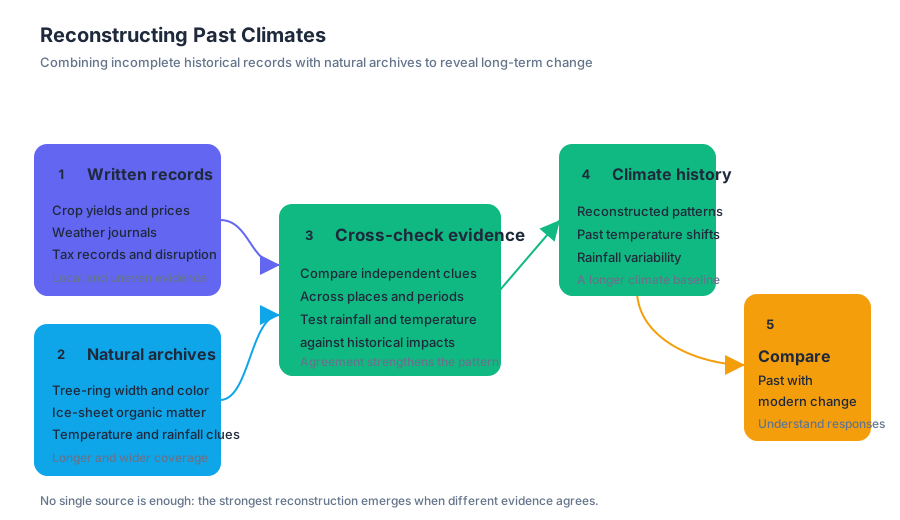
Studying fourteenth-century climate is difficult because modern scholars cannot directly observe the weather of the past. Traditional historical sources remain important: historians examine references to crop yields, descriptions of weather fluctuations, weather journals, and tax records. Such evidence can reveal when harvests failed, prices rose, or unusual weather disrupted daily life, but written records are unevenly preserved and usually describe only particular places.
To expand the evidence base, scholars combine historical research with scientific data. They study tree rings and organic material trapped beneath ice sheets in different parts of the world. These sources provide information about past temperature fluctuations and rainfall patterns, allowing scholars to compare environmental conditions across regions and over longer periods.
Trees are especially useful because some can live for hundreds or even thousands of years. During their lives, they experience changing environmental conditions. Their rings preserve evidence of those fluctuations: the color and width of rings can provide clues about past climate conditions. Historical climatologists analyze these patterns as hidden records of the natural world.
Tree-based evidence does not replace written history. It complements it. A narrow or unusually colored ring may indicate stressful environmental conditions, but scholars must interpret that evidence alongside rainfall patterns, temperature data, crop records, tax documents, and other historical clues. The strongest reconstruction emerges when independent kinds of evidence point toward the same pattern.
Comparing reconstructed past climates with modern conditions helps scholars understand long-term environmental change. It places contemporary climate patterns within a much longer history and makes it possible to ask how societies responded to earlier periods of instability. The fourteenth century therefore matters not only as a period of famine and migration, but also as an opportunity to study how environmental pressures and human choices have shaped history across time.
Content adapted from OpenStax World History, Volume 1: to 1500 by Ann Kordas et al., licensed CC BY 4.0.
Source Materials
Study World History Volume 1 on Lykke
This course page is free to open: signed out, you can read its first two sections, and signing in, on any plan, opens the rest. The free Lykke Chrome extension syncs your own Canvas courses, so ChatGPT, Claude and Muse can answer from your classes and deadlines. It only reads Canvas.
Add the free extensionSign in to open every sectionAll sections of World History Volume 1 · Browse more course pages