From the free course World History Volume 1 on Lykke
1.3 Causation and Interpretation in History
Key concepts: Historical causation · Primary, secondary, and tertiary causes · Immediate and long-term causes · Multicausal explanations · Human agency and choice in history · Historical interpretation · Historiographical disagreement · The role of social context in historical explanations · Colonialism and historical experience · The importance of ordinary and lower-class people in history
By the end of this section the student can: Describe causation as it is used in the study of history; Identify the levels of causation; Analyze the role of interpretation in producing an accurate historical record
1.3 Causation and Interpretation in History
Chinua Achebe’s Things Fall Apart gained meaning far beyond the story of one Igbo community because readers recognized their own experiences in it. Achebe’s reflection shows why history is never only a sequence of events: historians must explain why events happened, how people understood them, and why later generations interpret them differently. The central question is not simply what happened? but why did it happen in this way rather than another?
The historian’s main task is therefore to explain the past. A chronological list can tell us that a siege occurred, a war began, or an empire expanded, but it cannot by itself explain the forces that made the event possible. Historical explanation requires identifying causes, weighing their importance, and considering the choices made by human beings within particular social, political, and cultural circumstances.
Historical Causation
Historical causation is the study of the relationships among the conditions, decisions, and circumstances that produce an event. Historians ask why something happened by examining both the immediate situation and the deeper conditions that shaped it. They do not assume that every cause had equal power. Instead, they rank causes according to how directly and significantly they contributed to the outcome.
Historical causation explains an event by identifying and weighing the circumstances and choices that brought it about.
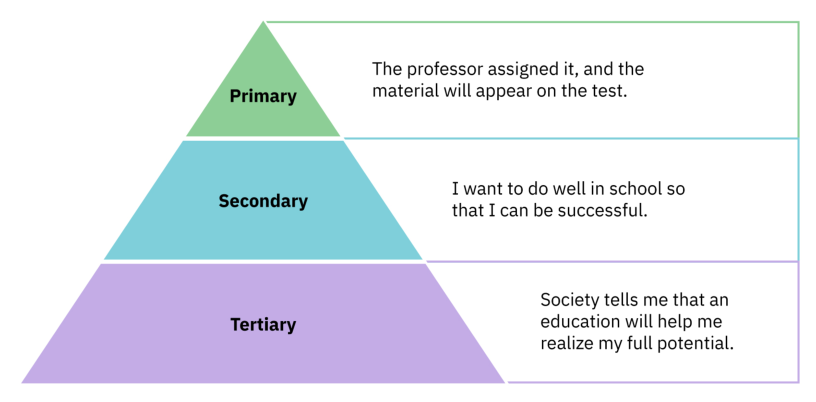
A useful everyday example is the question, “Why are you reading this textbook?” The most immediate answer might be that an instructor assigned it and that the material will appear on a test. A deeper answer might be that you want to succeed in your education and prepare for a career. A still broader answer could involve the value employers place on education or the social expectations surrounding college attendance. Each answer is valid, but each operates at a different level of causation.
This example demonstrates an important historical principle: an event usually has multiple causes that operate at different distances from the event itself. Historians distinguish among primary, secondary, and tertiary causes to organize these relationships. These terms do not mean “good” and “bad” causes, nor do they refer to primary and secondary sources. Here, they describe how close a cause is to the event being explained.
Primary, Secondary, and Tertiary Causes
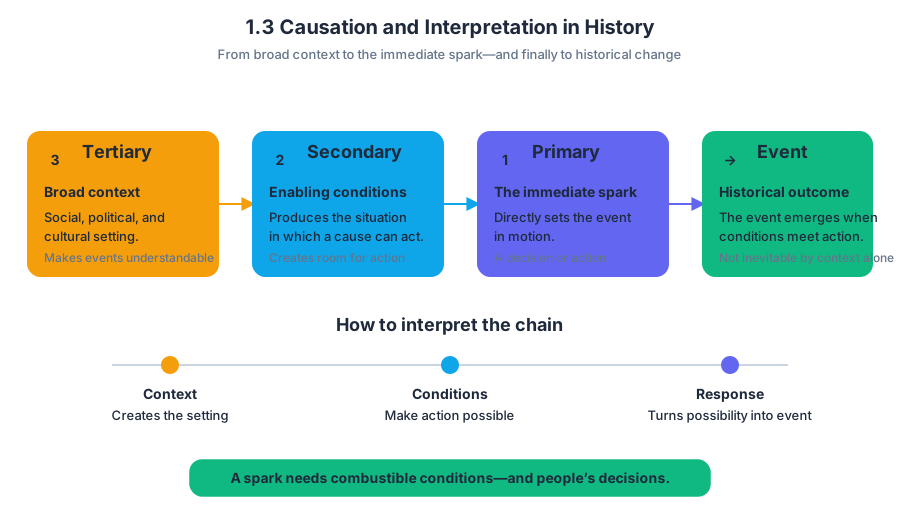
A primary cause is the most immediate cause, or the “spark,” of an event. It is the circumstance that directly sets the event in motion. A secondary cause is one step removed: it helps create the situation in which the immediate cause can operate. A tertiary cause provides the broader social, political, or cultural context that makes the event understandable.
The three levels can be arranged as follows:
| Level of causation | Meaning | Historical function |
|---|---|---|
| Primary | The immediate cause or “spark” | Directly triggers the event |
| Secondary | A cause one step removed | Helps produce the immediate circumstances |
| Tertiary | Broader social, political, or cultural context | Explains the larger setting in which the event occurs |
The levels are best understood as connected rather than isolated. A spark cannot produce an outcome unless combustible conditions already exist. Likewise, long-term conditions do not automatically produce an event; people must respond to those conditions through decisions and actions.
Immediate and Long-Term Causes
Historians examine both immediate causes and long-term causes. Immediate causes explain why an event occurred at a particular moment. Long-term causes explain why the event was possible, likely, or significant within a much longer historical development. Focusing only on the immediate cause can make history appear accidental. Focusing only on long-term conditions can make human decisions disappear.
The United States’ entry into World War II illustrates this distinction. Among the contributing circumstances were Britain’s efforts to prevent a potential German invasion and longstanding tensions between Japan and the United States over the use of power in the Pacific. These conditions formed part of a wider international situation. A historian might rank one circumstance as the immediate trigger while treating the others as secondary or tertiary causes.
The important point is not that one explanation eliminates all others. Rather, historians construct a hierarchy of causes. Two historians may agree about the major facts—the countries involved, the sequence of events, and the decisions made—while disagreeing about which cause mattered most. One historian may emphasize the immediate military or diplomatic circumstances; another may emphasize longer-term struggles over power in the Pacific or the international context created by the threat of German expansion.
Multicausal Explanations and Human Agency
Historical events can have more than three causes. The primary-secondary-tertiary model is a tool for organizing explanation, not a rule limiting the number of causes to three. Complex events often result from several political, economic, military, social, and cultural factors operating together.
Human agency means the capacity of people to make choices and act upon them. Human agency always plays a role in history. Broad forces may shape what choices are available, but individuals and groups still decide how to respond. This is why historians cannot explain events entirely through impersonal structures such as geography, economics, or political institutions.
The siege of Constantinople in 1453 demonstrates the relationship between context and choice. Mehmed II laid siege to the city and ultimately conquered it. The Ottoman Empire’s continuous expansion created the broader setting, making the conquest part of a larger imperial development. Mehmed II’s desire to prove his ability provided the immediate spark. The event therefore involved both a long-term political context and a personal decision by a ruler.
Different historians could rank these causes differently. One might place Ottoman expansion first because it explains the strategic setting. Another might emphasize Mehmed II’s ambitions because his decision transformed a continuing imperial process into a specific siege. Both interpretations could accept the same basic facts while assigning different weight to the causes.
A common misconception is that recognizing large historical forces means individuals do not matter. The opposite is also misleading: focusing on a famous individual does not mean that person acted outside historical circumstances. Historical explanation connects the two. Mehmed II made a choice, but he made it within the circumstances created by Ottoman expansion, the political position of Constantinople, and the possibilities available in his time.
Interpretation in History
Causation leads directly to historical interpretation, the process of deciding how evidence and events should be understood and connected. Historians do not merely collect facts. They determine which facts are most relevant, how they relate to one another, and which causes deserve the greatest emphasis.
Interpretation does not mean that historians can invent any version of the past they prefer. Historical interpretations must remain accountable to evidence. The evidence constrains what historians can reasonably claim, but it may not determine a single explanation in every case. When evidence permits several plausible rankings of causes, historians may reach different conclusions while still practicing responsible history.
The distinction between fact and interpretation is therefore important. The fact that Mehmed II besieged Constantinople in 1453 can be established. The interpretation concerns why he did so, which conditions made the conquest possible, and whether his personal ambition, Ottoman expansion, or another factor should receive the greatest emphasis.
Dueling Voices
Historians can also disagree because they ask different questions about the same past. The comparison between the arguments of Thomas Carlyle and Leo Tolstoy illustrates competing approaches to historical interpretation. The question is not simply whose account contains more facts. It is whose explanation more convincingly accounts for the evidence and the relationship between individual action and larger historical forces.
Such disagreements are productive when they clarify the assumptions behind an argument. One interpretation may give greater importance to leaders and dramatic decisions. Another may stress the actions and experiences of broader populations or the power of social conditions. Evaluating the arguments requires attention to the evidence each historian uses, the causes each ranks most highly, and what each explanation leaves less fully explained.
Historical interpretation also changes as historians ask new questions. Earlier histories often concentrated on political leaders, wars, and states. Over time, historians increasingly examined people from lower social classes and treated their experiences as integral to human history. This expansion did not make earlier events irrelevant; it changed the range of people whose choices and experiences historians considered historically meaningful.
Colonialism, Experience, and Interpretation
Achebe’s comments on Things Fall Apart show how historical interpretation is shaped by lived experience. When he wrote the novel, he understood its meaning for his Igbo people, but he was uncertain whether readers elsewhere would recognize its significance. Its resonance demonstrated that people outside his community could connect the story to their own experiences while also learning about the historical effects of colonialism.
Colonialism influenced the writing of history because colonial power shaped whose experiences were recorded, whose perspectives were treated as authoritative, and which events appeared important. Achebe’s work helped present an Indigenous experience of colonial change rather than treating colonialism only from the viewpoint of colonial powers. Readers’ responses showed that interpretation can create connections across different societies without erasing the specific history of the people represented.
Achebe’s example reinforces the central lesson of historical interpretation: the past is shared, but it is not experienced identically by everyone. Accurate history must therefore attend to evidence, causation, human choices, and perspective. Historians seek explanations that are both factually responsible and sufficiently broad to account for the different experiences produced by the same historical developments.
To explain an event well, a historian should identify its immediate spark, examine the secondary circumstances that made the event possible, place it within broader long-term conditions, and account for the choices made by people involved. The final interpretation may differ from another historian’s interpretation, but it must remain grounded in evidence and open to reasoned comparison.
Content adapted from OpenStax World History, Volume 1: to 1500 by Ann Kordas et al., licensed CC BY 4.0.
Source Materials
Study World History Volume 1 on Lykke
This course page is free to open: signed out, you can read its first two sections, and signing in, on any plan, opens the rest. The free Lykke Chrome extension syncs your own Canvas courses, so ChatGPT, Claude and Muse can answer from your classes and deadlines. It only reads Canvas.
Add the free extensionSign in to open every sectionAll sections of World History Volume 1 · Browse more course pages