From the free course World History Volume 1 on Lykke
8.1 Populating and Settling the Americas
Key concepts: Early human migration and settlement of the Americas · Migration through an ice-free corridor after glacial retreat · Kennewick Man and debates over ancestry, identity, and repatriation · Pacific Northwest hunter-gatherer societies and marine-resource adaptation · Hafted stone tools used as spears and darts · Independent development of agriculture in the Americas · The Andean, Mesoamerican, and Amazonian agricultural regions · Caral and connections between coastal and inland settlements · Domestication of camelids and guinea pigs · The transition from hunting and gathering to village agriculture
By the end of this section the student can: Identify patterns of early migration to the Americas; Describe the lifestyles of people living in Archaic America; Explain how and when the Neolithic Revolution occurred in different regions of the Americas
8.1 Populating and Settling the Americas
Human settlement of the Americas began with migrations from Asia during the last Ice Age and eventually extended from the far north to the southern tip of South America. The process was not a single expedition but a series of movements, adaptations, and regional settlements that unfolded as environments changed.
Populating the Americas
Homo sapiens—modern humans—were the first human species firmly associated with the initial settlement of the Americas. Although earlier human ancestors such as Homo erectus had migrated out of Africa nearly two million years ago and spread through Asia, the Near East, and Europe, no solid evidence places them in the Americas.
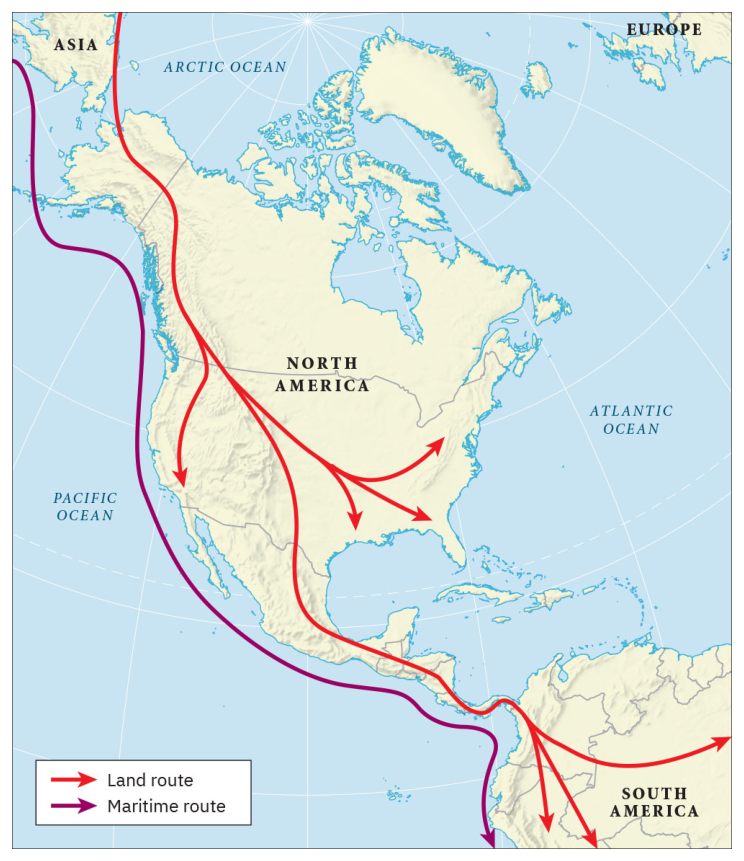
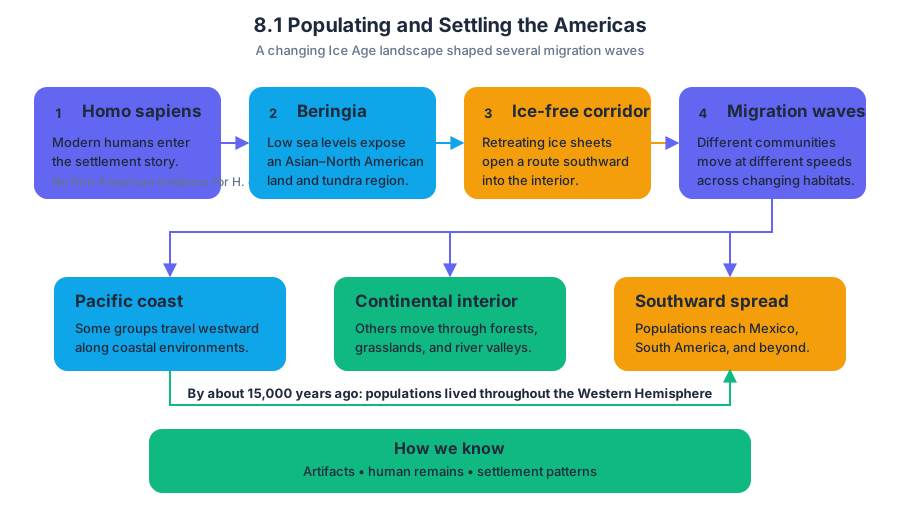
During the last Ice Age, enormous quantities of the earth’s water were locked in glaciers. Lower sea levels created Beringia, a broad region of land and tundra that connected northeastern Asia and northwestern North America. As glacial ice later retreated, migrants traveled through a corridor between two melting ice sheets. From there, populations spread in waves across the continent.
Beringia was the Ice Age land region connecting Asia and North America, while the later corridor between retreating ice sheets provided a route southward into the continental interior.
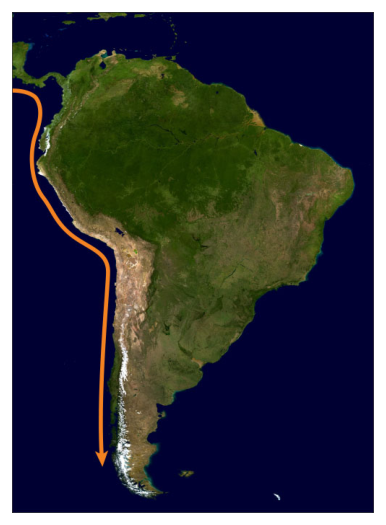
The migrants did not all follow one route or move at the same speed. Some traveled westward and settled along the Pacific coast. Others moved into the Northeast and Southeast. Still others passed through the center of the continent into what is now Mexico, Central America, and South America. By approximately fifteen thousand years ago, human populations had reached the southern tip of South America and were living throughout the Western Hemisphere.
The phrase “waves” is important because it avoids the mistaken idea that one original group suddenly populated the entire hemisphere. Migration occurred across changing landscapes, and different communities developed distinct ways of living in deserts, forests, grasslands, mountains, river valleys, and coastal environments. Archaeologists reconstruct these movements from artifacts, human remains, and settlement patterns, so interpretations can change as new discoveries appear.
The Clovis People
The Clovis people are associated with one of the earliest widely recognized archaeological traditions in North America. Their name comes from distinctive stone points first identified near Clovis, New Mexico. These points were carefully shaped and hafted so that they could be attached to shafts, probably made of wood.
Hafted tools are stone implements attached to handles or shafts. A hafted point could serve as a spear point or as the tip of another thrown hunting weapon, such as a dart.
Hafting transformed a small stone point into a more effective hunting instrument. The stone itself did not need to be large; its usefulness came from its sharp edge, its attachment to a shaft, and the force and distance supplied by the weapon’s design. Such tools demonstrate technological adaptation rather than merely the ability to shape stone.
The Clovis people are often connected with hunting large animals, including mammoths and other Ice Age fauna. Yet the larger story of early settlement cannot be reduced to big-game hunting. Early populations used varied resources and occupied diverse environments. The survival of communities depended on adjusting to local ecosystems, not on relying everywhere on the same animals or technologies.
A common misconception is that the Clovis people were necessarily the first inhabitants of every part of the Americas. The broader evidence points to a more complicated pattern of migration and settlement. Clovis technology represents an important archaeological tradition, but it does not by itself explain all early populations, all routes, or all regional adaptations.
Dueling Voices: Kennewick Man
The discovery and study of Kennewick Man, one of the oldest human remains found in the Americas, generated both scientific debate and a major dispute over Indigenous identity and the treatment of ancestral remains. Initial analysis of his skull suggested affinities with Ainu or Polynesian populations, including groups living in Japan and Polynesia. These early cranial comparisons encouraged scholars to reconsider existing theories about the origins and migration routes of the earliest Americans.
Later DNA analysis produced a different and more decisive conclusion: Kennewick Man was most closely related to Native American populations. This finding corrected the impression created by the earlier cranial analysis and showed why conclusions based on skeletal appearance alone can be uncertain. Physical similarities may reflect the limits of cranial comparison, shared ancient ancestry, or patterns of variation that do not map neatly onto modern cultural categories.
The changing interpretation matters because scientific accounts of migration are built from evidence that can be revised. Early cranial analysis suggested one set of relationships; later genetic evidence supported another. Rather than proving that scholars had no knowledge of the past, the case demonstrates how historical and archaeological explanations change when stronger forms of evidence become available.
The controversy did not end with the genetic findings. Native American communities, including the Umatilla, claimed Kennewick Man as an ancestor and opposed the removal and scientific study of his remains. They insisted that ancestral bodies should remain buried according to tribal customs.
Genetic relatedness does not by itself determine cultural identity, tribal affiliation, or the appropriate treatment and repatriation of ancestral remains. The Kennewick Man debate therefore involved more than the question of where an ancient individual’s distant ancestors lived. It also concerned who has authority over Indigenous ancestral remains, how scientific research should be conducted, and whether human remains should be treated primarily as research materials or as members of continuing communities.
Peopling the Pacific Northwest
Some early migrants continued westward toward the resource-rich Pacific Northwest. There, they developed complex hunter-gatherer societies—communities that obtained food from wild plants and animals rather than relying primarily on domesticated crops and livestock.
These societies were especially well adapted to the region’s abundant marine life. They may have followed caribou into the area and then adjusted to the dense forests, rivers, and coastlines of the Northwest. Their food sources included beavers, elk, seals, birds, sea lions, salmon, and many other fish.
Salmon were particularly important. During their fall migration upstream to spawn, salmon became extremely abundant in rivers and streams. A predictable seasonal supply could support larger populations and encourage more permanent or repeated settlement than a highly mobile hunting pattern might permit.
The Pacific Northwest example shows that hunter-gatherer life was not automatically simple, impoverished, or environmentally passive. Communities could develop detailed knowledge of animal behavior, seasonal cycles, waterways, forests, and coastal resources. Their societies were shaped by adaptation to abundance as well as by adaptation to scarcity.
The Neolithic Revolution in the Americas
The transition toward agriculture occurred independently in three American regions: the Andes, Mesoamerica, and the Amazon. This process is called the Neolithic Revolution, meaning the gradual shift toward cultivating plants, domesticating animals, and living in agricultural villages.
The Neolithic Revolution was not a single event or a sudden replacement of hunting and gathering. In the Americas, it developed gradually and independently in several regions.
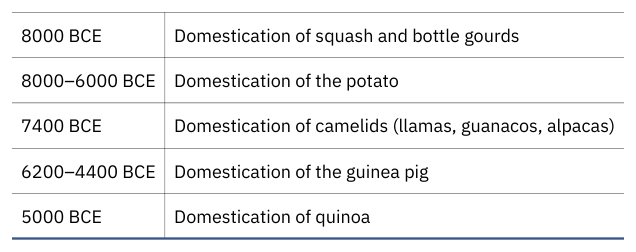
The earliest evidence for this shift comes from the Andes. Domestication occurred piecemeal, with communities gradually managing particular plants and animals. In the Andes, camelids—including llamas, guanacos, and alpacas—were domesticated around $7400$ BCE. Guinea pigs were domesticated between approximately $6200$ and $4400$ BCE. These animals supplied food and, in the case of camelids, supported Andean lifeways in ways suited to mountain environments.
In Mesoamerica, the domestication of maize around $5000$ BCE contributed to the emergence of agricultural villages. Maize did not immediately eliminate hunting and gathering. Early agricultural villagers often continued to hunt wild animals and collect wild plants while adopting cultivation. Agriculture was therefore an addition to an existing economic system before it became the foundation of settled village life.
The Caral site in the Andes illustrates how early agriculture was connected to older coastal lifeways rather than isolated from them. Evidence suggests relationships between coastal settlements and the inland site. Smaller coastal communities appear to have supplied the larger Caral site with marine resources. These connections may indicate organized exchange or provisioning, and perhaps some form of authority linking several settlements, although there is no solid evidence that a single ruling system governed them all.
This relationship is historically significant because it complicates the assumption that agriculture developed only when people abandoned coastal resources. Inland agricultural communities could remain connected to maritime settlements and continue to depend on fish and other marine foods. Early village life emerged through combinations of cultivation, hunting, gathering, fishing, exchange, and regional specialization.
The independent development of agriculture in the Andes, Mesoamerica, and the Amazon demonstrates that communities responded creatively to local environments. The Americas did not receive farming as one imported package from a single center. Different peoples domesticated different plants and animals, at different times, while maintaining older practices during the transition. Those agricultural foundations later supported the larger settlements and civilizations examined in the history of the ancient Americas.
The central pattern is gradual adaptation: migration opened new environments, technology made local resources usable, and cultivation developed independently where communities found it advantageous.
Content adapted from OpenStax World History, Volume 1: to 1500 by Ann Kordas et al., licensed CC BY 4.0.
Source Materials
Study World History Volume 1 on Lykke
This course page is free to open: signed out, you can read its first two sections, and signing in, on any plan, opens the rest. The free Lykke Chrome extension syncs your own Canvas courses, so ChatGPT, Claude and Muse can answer from your classes and deadlines. It only reads Canvas.
Add the free extensionSign in to open every sectionAll sections of World History Volume 1 · Browse more course pages