From the free course World History Volume 1 on Lykke
6.4 The Roman Republic
By the end of this section the student can: Identify the key institutions of the Roman Republic; Discuss class differences and conflict in the Roman Republic; Analyze the challenges that strained democratic institutions in the Roman Republic, including the
6.4 The Roman Republic
Rome began as a small settlement on the Italian peninsula and eventually built a political system that governed a rapidly expanding Mediterranean power. The central historical problem is that Rome’s institutions were designed for a city-state, while its military victories transformed it into an empire. The resulting tension between republican traditions, elite control, popular demands, and conquest shaped Roman history.
The Origins of Rome
Rome’s earliest history combines archaeology, tradition, and legend. The city developed in central Italy along the Tiber River, a location that offered access to inland routes, agricultural land, and the Mediterranean world. The region was inhabited by several peoples, including the Latins, Sabines, and Etruscans. The Etruscans, who lived north of Rome in Etruria, strongly influenced early Roman culture, political organization, religion, engineering, and architecture.
According to Roman tradition, Rome was founded in 753 BCE by the twin brothers Romulus and Remus. The story says that they were abandoned as infants, nursed by a she-wolf, and later raised by a shepherd. After a quarrel over where to establish their settlement, Romulus killed Remus and became Rome’s first king. Although historians do not treat every detail of this story as literal history, the legend expressed important Roman values: military strength, competition, loyalty to the community, and the idea that Rome possessed a special destiny.
Rome was ruled by kings until approximately 509 BCE. Roman tradition presents the final king, Lucius Tarquinius Superbus, as a tyrant whose abuses provoked a revolt. The story of Lucretia helped explain why Romans rejected monarchy. According to the account, Sextus Tarquinius, the king’s son, raped Lucretia, the wife of the Roman aristocrat Lucius Tarquinius Collatinus. After reporting the assault to her family and demanding that they avenge her, Lucretia killed herself. Her death became the immediate symbol of resistance to royal abuse.
In Their Own Words: The Rape of Lucretia
The story of Lucretia emphasizes the Roman value of virtue, meaning moral excellence expressed through loyalty, courage, self-control, and devotion to the community. Lucretia was presented as an ideal Roman woman because she defended her sexual purity and loyalty to her husband even at the cost of her safety, autonomy, and life. Modern readers should also notice the limits of the story: Lucretia’s virtue is defined through obedience to male-centered expectations, and her death becomes politically useful to the men who overthrow the king.
Roman authors used this tradition to portray the Republic as a liberation from tyranny. Yet the new system did not create political equality. Power moved from a king to a group of aristocratic families. The Republic therefore rejected one-man rule while preserving strong social and political control by wealthy men.
The Roman Republic
A republic is a political system in which citizens participate in government through elected officials rather than being ruled by a hereditary monarch. The Roman Republic established several institutions intended to prevent any one person from becoming king. Two consuls served as the chief magistrates, held office for a limited period, and could check one another’s authority. The Senate, dominated by aristocratic men, advised magistrates and exercised enormous influence over foreign policy, finances, and administration.
Roman society was divided between patricians and plebeians. Patricians were members of Rome’s old aristocratic families. Plebeians included the majority of Roman citizens, such as farmers, artisans, merchants, and soldiers. Although plebeians could serve in the army and participate in assemblies, patricians initially controlled the most important offices and religious positions.
The conflict between these groups is known as the Conflict of the Orders. Plebeians used their economic and military importance to demand greater political rights. Because Rome relied heavily on citizen-soldiers, plebeian resistance could threaten the state’s ability to fight. One important tactic was secession, in which plebeians withdrew from the city and refused to serve until their demands were addressed.
Over time, plebeians gained the right to elect tribunes. A tribune was an official who represented plebeian interests and could veto actions that harmed them. The tribunes gave plebeians a formal political defense, although the institution did not eliminate social inequality. The Twelve Tables, Rome’s earliest written law code, also made legal rules more public. Written law did not make Roman society equal, but it reduced the ability of officials to manipulate unwritten traditions without public scrutiny.
Roman government depended on a mixture of elections, offices, assemblies, and aristocratic influence. Magistrates generally served short terms, and many offices were arranged in a sequence known as the cursus honorum, or “course of offices.” Men who held office could later enter or strengthen their position in the Senate. This structure encouraged political competition among elites while presenting the Republic as a system governed by law and civic participation.
The patron-client system was another crucial element of Roman politics. A patron was usually a wealthy citizen who offered legal, financial, and social assistance to clients, who were normally less affluent citizens. In return, clients supported their patrons, including by voting as directed in Roman assemblies. Patrons could inherit clients, so powerful families accumulated networks of dependence across generations. Rome’s political life therefore involved both formal institutions and personal relationships of obligation.
Roman republican government balanced competition and cooperation, but it was never a democracy in the modern sense. Ordinary citizens possessed political rights, yet wealth, family status, patronage, and control of offices allowed the upper classes to dominate the most important decisions.
The Expansion of the Roman Republic
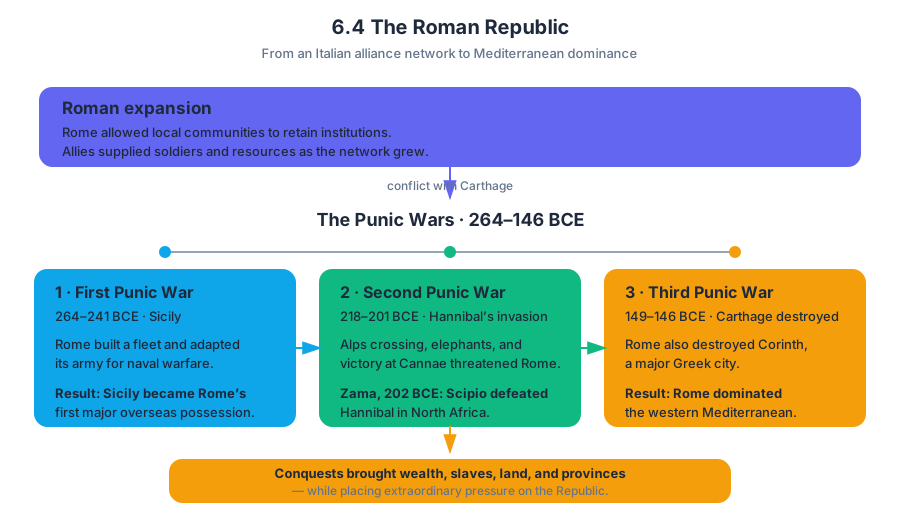
Roman expansion began in Italy. Rome fought neighboring peoples, incorporated defeated communities, and extended citizenship or partial citizenship to some conquered populations. This approach differed from simple destruction: Rome could demand tribute and military service while allowing local communities to retain certain institutions. The result was a growing network of allies and subjects that supplied soldiers and resources.
Roman expansion brought Rome into conflict with Carthage, a powerful North African city founded by Phoenicians. The three Punic Wars were fought between Rome and Carthage from 264 to 146 BCE. They were not a single continuous conflict but a series of wars over control of territory, trade routes, and influence in the western Mediterranean.
The First Punic War, fought from 264 to 241 BCE, centered largely on Sicily. Rome was initially less experienced at naval warfare than Carthage, but it built a fleet and adapted its military methods. Rome’s victory gave it control of Sicily, its first major overseas possession. Rome later acquired Sardinia and Corsica, strengthening its position in the western Mediterranean.
The Second Punic War, fought from 218 to 201 BCE, brought Rome’s survival into question. The Carthaginian general Hannibal invaded Italy from Hispania, crossing the Alps with his army and elephants. He defeated Roman forces in several battles, including the devastating Battle of Cannae. Hannibal’s victories did not persuade Rome’s Italian allies to abandon it in sufficient numbers, and Rome continued to mobilize armies despite enormous losses.
Rome changed the strategic situation by sending an army to North Africa to attack Carthage. Hannibal was recalled to defend his homeland and was defeated by the Roman general Scipio Africanus at the Battle of Zama in 202 BCE. Carthage surrendered, lost much of its territory, and was prohibited from waging war without Roman permission.
The Third Punic War ended in 146 BCE with the destruction of Carthage. In the same year, Rome also destroyed Corinth, a major Greek city. These victories confirmed Rome’s dominance in the Mediterranean. Rome’s conquests brought wealth, slaves, land, and new provinces, but they also placed extraordinary pressure on Roman society and republican politics.
A Republic of Troubles
Constant warfare during the third and second centuries BCE transformed the Roman economy. Small farmers, who formed the backbone of the citizen army, could be absent from their farms for long periods. Some returned to debt or found that their land had deteriorated. Wealthy Romans expanded large estates called latifundia, often using enslaved labor captured during conquest. These estates competed with small farms and contributed to economic inequality.
The growth of wealth also intensified the contrast between rich and poor. Successful generals and aristocrats gained land, political influence, and personal military reputations, while many ordinary citizens struggled to maintain independence. Rome’s conquests therefore created the resources that enriched the Republic but also weakened the social conditions on which its earlier political system had depended.
The brothers Tiberius and Gaius Gracchus attempted to address these problems. Tiberius was elected tribune in 133 BCE and proposed redistributing public land to poorer citizens. The Roman assembly approved his proposal, but many senators opposed it because they feared losing land and political control. They were also angered that Tiberius had appealed directly to popular opinion and challenged traditional elite authority. The Senate declared a state of emergency, and a group of senators beat Tiberius to death.
Ten years later, Tiberius’s brother Gaius was elected tribune. He won support from poor Roman farmers by proposing new colonies that would provide them with land. He also supported free grain for the poor and called for public works programs. Like his brother, Gaius challenged the Senate’s control over major decisions. Political conflict escalated, and Gaius ultimately died during the violence that followed.
The deaths of the Gracchi revealed a dangerous change in republican politics. Roman elites had long competed intensely, but they increasingly treated political opponents as enemies who could be killed rather than as rivals who could be defeated through ordinary procedures. At the same time, popular leaders learned to use assemblies, tribuneships, and mass support to challenge the Senate. The Republic’s institutions still existed, but the shared traditions that restrained political violence were weakening.
The Republic’s expansion thus produced a contradiction. Military success made Rome richer and more powerful, but conquest also widened inequality, increased the importance of ambitious commanders, and made old city-state institutions harder to manage. The political crisis that followed was not caused by one event alone. It grew from the interaction of social conflict, economic change, military expansion, and competing ideas about who should control the Roman state.
Rome had conquered much of the Mediterranean, but it had not solved the political problems created by conquest. The struggles surrounding land, citizenship, patronage, popular reform, and senatorial authority prepared the way for the later conflicts that would bring the Roman Republic to an end.
Content adapted from OpenStax World History, Volume 1: to 1500 by Ann Kordas et al., licensed CC BY 4.0.
Source Materials
Study World History Volume 1 on Lykke
This course page is free to open: signed out, you can read its first two sections, and signing in, on any plan, opens the rest. The free Lykke Chrome extension syncs your own Canvas courses, so ChatGPT, Claude and Muse can answer from your classes and deadlines. It only reads Canvas.
Add the free extensionSign in to open every sectionAll sections of World History Volume 1 · Browse more course pages