From the free course World History Volume 1 on Lykke
2.1 Early Human Evolution and Migration
Key concepts: Human evolution · Biological adaptation · Australopithecus · Lucy · Genus Homo · Homo habilis · Homo erectus · Bipedalism · Early human diet · Fossil evidence
By the end of this section the student can: Discuss the process of human evolution in a biological and anthropological context; Explain how and why Paleolithic humans migrated; Describe the tools and technologies used in the Paleolithic Age
2.1 Early Human Evolution and Migration
Human evolution began with ancestors that increasingly left the security of trees to walk upright on the ground. That change did not happen as a single dramatic leap from “ape” to “human.” It unfolded through populations that combined older ape-like traits with new adaptations suited to life on land. The fossil record preserves fragments of this long process, allowing historians, archaeologists, and biological anthropologists to reconstruct a story that remains partly uncertain and subject to revision.
Human Evolution
Evolution means change in living populations over time. A useful way to understand early human evolution is to imagine an animal that must solve a new environmental problem: trees offer protection and places to find food, but life on the ground may provide access to different resources and wider spaces. Once some ancestors spent more time on land, walking upright became increasingly important. Upright walking, or bipedalism, means moving primarily on two legs rather than four.
The movement from trees to ground created both opportunities and dangers. Ground-dwelling ancestors could travel across open landscapes and reach foods that were not concentrated in trees, but they were also more exposed to predators. Living on the ground therefore required changes in the body, behavior, and diet. These changes accumulated over very long periods rather than appearing all at once.
A common misconception is that human evolution forms a straight ladder, with one species simply turning into a more advanced version of the next. The evidence instead points to a branching and incomplete history. Different early human species lived at different times and retained different combinations of traits. Some populations may have contributed to later species, while others disappeared. Because fossils are rare and fragmentary, scholars must interpret limited evidence rather than observe the entire process directly.
Biological Adaptation
Biological adaptation is a characteristic that helps an organism survive and reproduce in a particular environment. In early human evolution, upright walking was an important adaptation because it allowed ancestors to move across the ground in a more humanlike posture. Over time, this change affected other parts of the body and altered how early humans obtained food and responded to danger.
Adaptation should not be confused with conscious improvement. Early humans did not decide individually to evolve larger brains or more efficient bodies. Rather, populations with inherited characteristics better suited to changing environments were more likely to survive and pass those characteristics on. The fossil record shows the physical results of such changes, but it rarely reveals every step or the exact reasons a particular trait became common.
Australopithecus
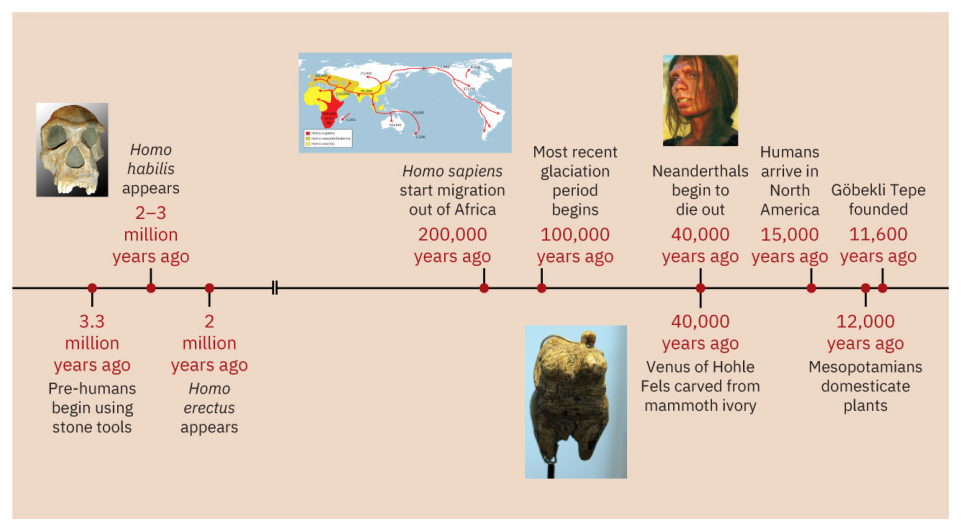
One important early human group was Australopithecus, a name meaning “southern ape.” Australopithecus lived in eastern and southern Africa between about $4$ million and $2.5$ million years ago. Its members illustrate the transitional character of early human evolution: they walked increasingly upright on land but still retained substantial abilities associated with tree climbing.
Australopithecus had a brain approximately one-third the size of a modern human brain. Its smaller brain does not mean that it was simply an inferior or unfinished human. It was well suited for climbing trees, an ability that remained important even as some members spent more time on the ground. Australopithecus therefore combined a relatively small brain and ape-like physical characteristics with upright movement—an arrangement that challenges the idea that all human traits appeared simultaneously.
Lucy
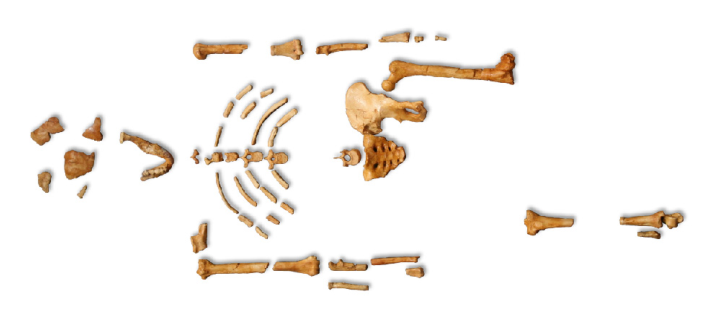
The most famous Australopithecus fossil is Lucy, discovered in Ethiopia by Donald Johanson in $1974$. Approximately $40%$ of her skeleton was recovered. Lucy was an adult who died approximately $3.2$ million years ago and belonged to the species Australopithecus afarensis. Her nickname came from the Beatles song “Lucy in the Sky with Diamonds,” which researchers heard during the excavation.
Lucy matters because a partial skeleton provides more information than an isolated bone. The preserved remains help scholars investigate posture, movement, body structure, and the combination of climbing and upright-walking abilities in Australopithecus. Yet Lucy does not answer every question about her species or about human origins. One individual cannot represent every member of a population, and the fossil record remains incomplete.
The Genus Homo
The genus Homo includes humans and several closely related early species. According to the evidence presented here, Homo evolved from Australopithecus. This does not mean that Australopithecus suddenly became Homo in a single generation. It means that over many generations, populations related to Australopithecus gave rise to forms with increasingly humanlike characteristics.
The appearance of Homo involved changes in several connected areas, including brain size, teeth, posture, movement, diet, and tool use. These traits did not necessarily develop at the same speed. Early members of the genus could possess a more humanlike brain while retaining ape-like features elsewhere in the body. Evolutionary history is therefore best understood as a mosaic: different adaptations appeared in combination and at different times.
Homo habilis
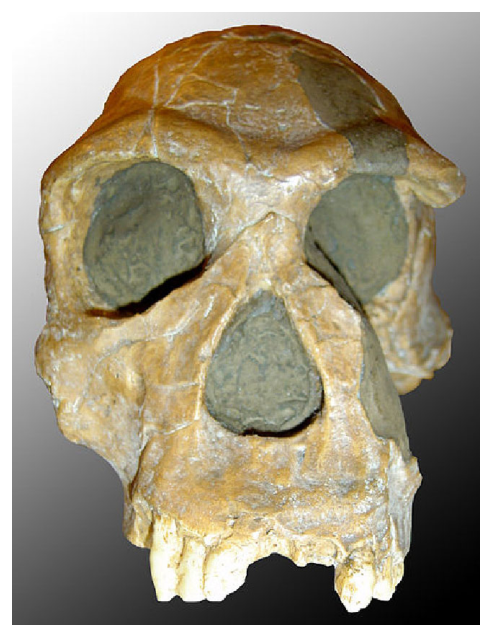
Homo habilis was possibly one of the earliest members of the genus Homo. The species had a larger, more humanlike brain and smaller teeth than Australopithecus, but it retained some ape-like characteristics. The word habilis is associated with skill, and the species is especially important in discussions of early human development because it occupied a position between earlier australopithecines and later, more humanlike members of Homo.
The evidence does not support treating Homo habilis as a completely modern human in appearance or behavior. Its larger brain and smaller teeth suggest significant biological change, while its remaining ape-like characteristics show that evolution was gradual. Homo habilis demonstrates why fossil interpretation requires comparison: scholars examine several traits together rather than deciding a species’ place in human history from one feature alone.
Homo erectus and Life on the Ground
Around $2$ million years ago, Homo erectus appeared in East Africa. The name erectus, meaning “upright,” reflects the species’ more complete commitment to life on the ground. Homo erectus walked—and even ran—exclusively in an upright position and was more similar to modern humans than earlier species described here. It likely evolved from Homo habilis.
Living entirely on the ground produced major consequences. Upright posture pulled the digestive organs downward and placed them into a smaller space. This change required a shift away from especially tough plants toward foods that were easier to digest, including nuts, fruits, tubers, honey, and even meat. The point is not that one fixed menu suddenly replaced another, but that bodily changes and dietary changes were connected.
Ground life was also more dangerous because it made escape from predators more difficult. At the same time, upright posture left Homo erectus’s hands free for using tools. This advantage likely encouraged further evolutionary changes that made the hands more dexterous, or capable of finer and more controlled movements, and supported the wider adoption of increasingly sophisticated tools.
Homo erectus also displayed characteristics closely associated with later human societies. Archaeologists have found strong evidence that members of the species cared for sick and elderly individuals. Some people survived debilitating diseases for a long time, indicating that assistance was both necessary and provided by others. Cooperation of this kind, together with physical adaptability, helped Homo erectus survive across changing climates and environments. Populations continued until as recently as about $100{,}000$ years ago.
Migration Beyond East Africa
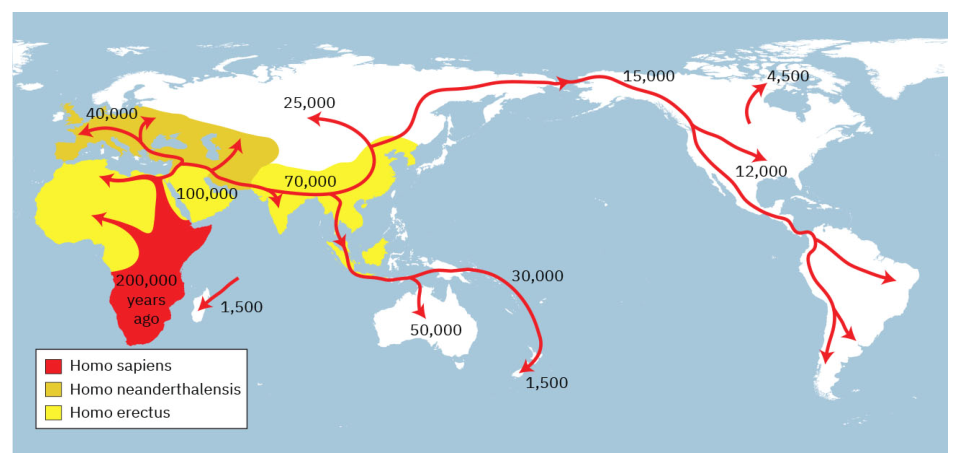
Sometime between $1.8$ million and $1.5$ million years ago, Homo erectus began migrating into other parts of Africa and beyond. Over hundreds of thousands of years, populations reached North Africa, the Near East, Europe, and eastern and southern Asia. The reasons for this extensive movement remain debated, but likely factors included climate change and the desire to follow particular types of prey.
Homo erectus appears to have remained close to rivers and lakes during these migrations. Such locations provided access to water and supported animal populations. Evidence indicates that Homo erectus hunted and ate animals including rhinoceroses, bears, pigs, and crocodiles. These migrations were not a single organized expedition across a map; they were long-term movements by populations responding to environmental conditions and available resources.
The history of Homo erectus connects biological adaptation to migration. Upright movement, changing diets, tool use, cooperation, and environmental flexibility made it possible to occupy a wider range of landscapes. Migration, in turn, exposed populations to new climates, foods, dangers, and opportunities. The result was not simply geographic expansion but continued adaptation to different environments.
Reconstructing an Uncertain Past
Knowledge of early human history comes from incomplete fossil evidence, archaeological discoveries, and interpretation. Fossils rarely preserve an entire body, and many periods contain large gaps. Scholars must therefore piece together evidence and sometimes make educated inferences about movement, diet, behavior, and relationships among species.
Theories change when new evidence emerges. A discovery may support an existing interpretation, challenge it, or require scholars to discard an older theory. Even with scientific investigation, some questions about early humans may never be answered with certainty. The strongest historical conclusions are consequently those that explain the available evidence while acknowledging its limits.
The central pattern is clear even when every detail is not: early human ancestors increasingly descended from trees, walked upright on land, developed bodies and behaviors suited to greater terrestrial danger, and spread across wider regions. Australopithecus, Lucy, Homo habilis, and Homo erectus mark important points in that developing story, but none should be mistaken for a simple rung on a ladder. They are evidence of a complex evolutionary history reconstructed from fragments.
Content adapted from OpenStax World History, Volume 1: to 1500 by Ann Kordas et al., licensed CC BY 4.0.

Source Materials
Study World History Volume 1 on Lykke
This course page is free to open: signed out, you can read its first two sections, and signing in, on any plan, opens the rest. The free Lykke Chrome extension syncs your own Canvas courses, so ChatGPT, Claude and Muse can answer from your classes and deadlines. It only reads Canvas.
Add the free extensionSign in to open every sectionAll sections of World History Volume 1 · Browse more course pages