From the free course World History Volume 1 on Lykke
7.4 Religion in the Roman Empire
Key concepts: Religious borrowing and syncretism · Zoroastrianism · Judaism’s influence from Zoroastrianism · Christianity’s relationship to Judaism and Zoroastrianism · Polytheistic religious practices · Vedic traditions · Indo-European religious traditions · The development of religions through cultural contact
By the end of this section the student can: Identify the major cults and religions found in the Roman Empire; Discuss how Romans accepted and adapted religions from other areas of the Empire; Explain the rise of Christianity in Rome
7.4 Religion in the Roman Empire
A Roman religious life could include sacrifices to traditional gods, devotion to a favorite deity, participation in a mystery cult imported from another region, and loyalty to the emperor—all without necessarily appearing contradictory. Roman religion was not a single, exclusive creed. It was a flexible system of obligations, rituals, stories, and public practices that absorbed influences from across the empire.
The Latin word religio, from which the English word “religion” derives, referred to an obligation toward the gods. Romans were expected to attend to divine matters, especially sacrifice. By offering animals to the gods, they hoped to receive divine favor and preserve the proper relationship between human beings and the supernatural world. This practical relationship helps explain both the resilience of traditional Roman religion and its openness to religious borrowing.
The Emperor and the Virgins
Roman religion was woven into public life so thoroughly that political authority and religious duty could not be separated easily. The emperor was not merely a secular administrator. Imperial ceremonies, public sacrifices, and honors for the emperor expressed the belief that Rome’s success depended on maintaining the goodwill of the gods. Religious practice therefore helped connect the empire’s people to the state and to one another.
One of Rome’s most important religious institutions was the college of the Vestal Virgins, priestesses devoted to Vesta, the goddess of the hearth. Their central responsibility was to maintain the sacred fire in Vesta’s temple. Because the hearth symbolized the continuity and safety of Rome, the Vestals’ work carried significance far beyond a private religious ceremony. Their ritual purity was understood as essential to the well-being of the entire community.
The Vestal Virgins served for a fixed period and were expected to remain sexually pure during their service. Their virginity was not simply a personal condition; it was a public religious resource. Romans believed that the purity of these priestesses helped protect the city, while a breach of their vows could endanger Rome and require severe punishment. Their position combined extraordinary honor, political visibility, and strict control over their bodies and conduct.
The story of Claudia Quinta illustrates the symbolic power associated with Vestal purity. According to the Roman tradition, a ship carrying the goddess Magna Mater, the Great Mother, became stranded. Claudia Quinta, whose reputation had been damaged by accusations concerning her sexual morality, proved her purity by pulling the ship to safety. Her ability to move the vessel demonstrated that the goddess accepted her as chaste and worthy.
The story mattered because it joined personal reputation, female religious authority, and the safety of Rome. Claudia Quinta’s virginity functioned as evidence of divine favor, while Magna Mater represented one of the foreign religious traditions that Rome adopted. The episode therefore captures two recurring features of Roman religion: public religious roles could have political importance, and Roman religious culture could incorporate deities and practices from outside Italy.
The emperor and the Vestals occupied different positions, but both represented Rome’s obligation to the gods. The emperor embodied the state’s authority, while the Vestals maintained one of its most ancient sacred institutions. Together, they show why Roman religion cannot be reduced to private belief. It was a public system of ritual action through which Romans sought to preserve order, legitimacy, and divine protection.
Religions of the Empire
Roman religion began with a pantheon—an organized group of gods—strongly influenced by the Greek pantheon. Romans adapted Greek gods to Roman culture and language: the names and civic meanings could change even when myths and divine functions remained related. Traditional Roman religion consequently combined inherited Roman customs with Greek stories, images, and religious concepts.
Romans nevertheless treated tradition as flexible rather than permanently closed. New gods could be added, and particular groups could develop special attachments to favorite gods or patron deities, meaning divine protectors associated with a person, occupation, community, or military unit. Soldiers, for example, might favor particular gods who seemed especially suited to warfare, travel, protection, or personal fortune.
This process is often described as syncretism, the blending or combining of religious beliefs and practices from different traditions. Religious borrowing did not always erase older beliefs. Instead, Romans frequently interpreted a foreign god through familiar categories, connected that deity with a Roman or Greek counterpart, or incorporated the new cult into existing public and private life. The empire’s cultural diversity thus encouraged religious adaptation.
The Persian religion of Zoroastrianism provides an important example of a major tradition within the wider imperial world. Zoroastrianism was the religion of the Persians, but the Persian Empire included Armenians, Nubians, Libyans, Phoenicians, Egyptians, Babylonians, Ionian Greeks, Bactrians, Judeans, and many other peoples. Persian rulers generally expected loyalty and tribute rather than complete religious uniformity.
The policy of Cyrus II toward the Judeans illustrates this imperial pattern. After the Judeans had been exiled in Babylon, Cyrus permitted them to return to Judah and rebuild their temple. The episode shows that imperial rule could coexist with distinct religious communities. It also helps explain why the history of Judaism cannot be separated from the political and religious environments of the ancient Near East.
Zoroastrian ideas influenced Jewish religious development, especially ideas concerning cosmic conflict, moral judgment, death, and the ultimate fate of human beings. Judaism did not simply become Zoroastrianism; it remained a distinct tradition. Yet contact with Persian religion contributed to the religious environment in which later Jewish and Christian beliefs developed. Christianity therefore inherited ideas through Judaism that had themselves been shaped partly by earlier Persian influence.
Another important imported cult was the worship of Isis, an Egyptian goddess. The Temple of Isis at Pompeii demonstrates that Egyptian religious practice had a visible place in a Roman city. Its location and public architectural form suggest that such worship was not merely a hidden curiosity. The cult could participate in the social and urban life of the empire while retaining associations with Egypt, fertility, protection, and the care of devotees.
The cult of Mithras originated in ancient Persia, in the region that is now Iran, and reached Rome by the second century CE. Mithraic belief centered on the idea that life originated from the sacrifice of a sacred bull by the god Mithras, who was often associated with the Sun. The practices of the cult are difficult to reconstruct because the evidence is limited and its rituals were not fully recorded in surviving texts.
Initiations into the cult appear to have taken place in caves or cave-like sanctuaries. Mithraism was especially popular among Roman soldiers, whose mobility helped carry the cult across the empire. Its appeal may have rested partly in its initiatory structure, shared rituals, and strong communal identity, although the precise meanings of its ceremonies remain uncertain. The surviving evidence warns historians not to treat every Roman cult as equally well documented.
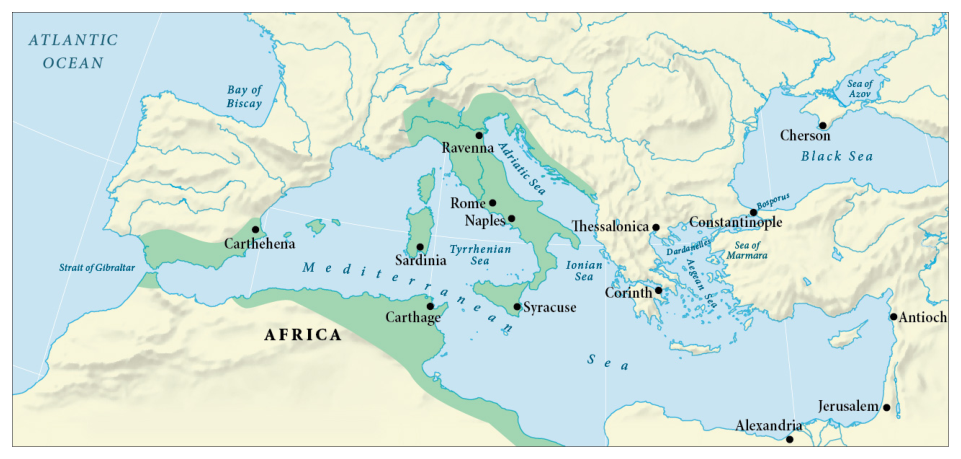
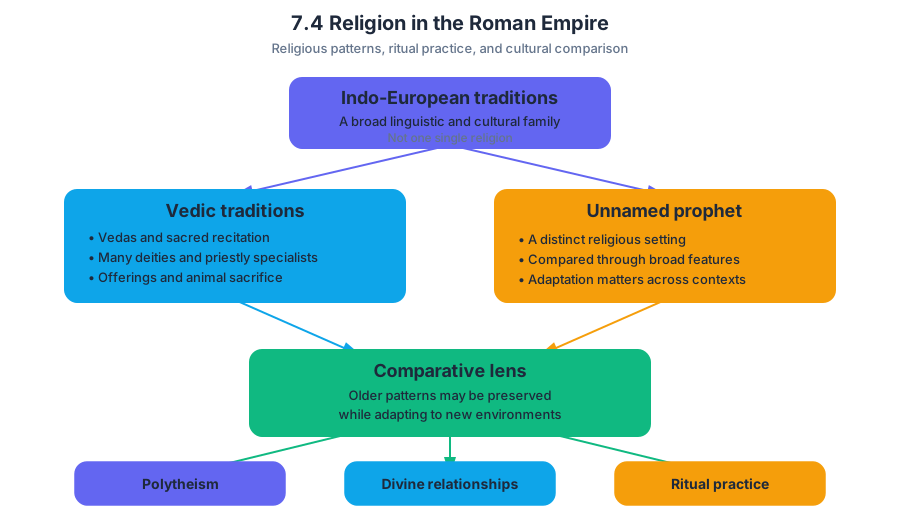
Roman religious diversity also included Judaism and traditions that developed farther east, including Vedic traditions associated with South Asia. The empire’s networks of conquest, migration, commerce, and military service brought people and religious practices into contact. The crucial point is not that Romans adopted every foreign religion in the same way, but that the empire created repeated opportunities for religious exchange, reinterpretation, and combination.
A common misconception is that Roman polytheism meant that Romans accepted every god in an uncomplicated spirit of tolerance. In practice, acceptance depended on circumstances. A new cult could be welcomed when it appeared to strengthen the community or fit Roman expectations, but religious behavior that seemed to reject public obligations could create suspicion. Roman religion was pluralistic, yet it was also concerned with loyalty, ritual participation, and social order.
Christianity
Christianity entered the diverse religious landscape of the Roman Empire during the first century CE. Its relationship with traditional Roman religion was often strained because Christians generally refused to participate in some established rituals. They did not initially form a single, cohesive group, but their unwillingness to perform certain traditional practices distinguished them from mainstream religious life.
Christianity emerged from Judaism. Jesus and his earliest followers belonged to the Jewish religious world, and Christian scripture, moral teachings, and understanding of God were deeply connected to Jewish traditions. At the same time, Christianity developed a distinctive claim: Jesus was the promised Messiah and occupied a unique role in salvation. The movement therefore remained connected to Judaism while becoming a separate religious community.
The Roman world helped Christianity spread. Roads, cities, commercial routes, military movement, and the common political framework of the empire allowed religious ideas and letters to travel widely. Christian communities could form in different cities while maintaining connections through missionaries, correspondence, shared teachings, and common rituals. The same imperial integration that moved soldiers and merchants also moved religious movements.
Christianity’s monotheism and exclusive claims created tension with Roman religious expectations. Roman public religion assumed that communities should honor the gods through sacrifices and ceremonies. Christians’ refusal to sacrifice to Roman gods—or to treat the emperor’s religious status as compatible with their worship of one God—could be interpreted as disloyalty. The conflict was therefore not simply theological; it involved competing ideas about citizenship, public order, and political allegiance.
Christianity’s growth also reflected the adaptability of the Roman religious environment. Like other movements in the empire, it traveled across cultural boundaries and gathered people from different regions and social backgrounds. Unlike many polytheistic cults, however, Christianity demanded commitment to one God and developed a strong communal identity around Jesus, Christian teaching, worship, and mutual support.
Christianity should therefore be understood neither as an isolated rejection of the Roman world nor as a simple product of Roman culture. It arose from Judaism, developed in a world shaped partly by earlier Persian religious influence, and spread through Roman imperial networks. Its rise illustrates the central pattern of Roman religious history: traditions interacted, borrowed, adapted, and sometimes came into sharp conflict over which obligations human beings owed to the divine.
By the end of the period addressed here, Christianity had joined the empire’s many religious communities, but its exclusive worship and expanding organization made it fundamentally different from the flexible polytheism of traditional Roman religion. The Roman Empire’s religious diversity made Christianity’s spread possible; Roman expectations about sacrifice and loyalty also made its presence controversial.
Content adapted from OpenStax World History, Volume 1: to 1500 by Ann Kordas et al., licensed CC BY 4.0.
Source Materials
Study World History Volume 1 on Lykke
This course page is free to open: signed out, you can read its first two sections, and signing in, on any plan, opens the rest. The free Lykke Chrome extension syncs your own Canvas courses, so ChatGPT, Claude and Muse can answer from your classes and deadlines. It only reads Canvas.
Add the free extensionSign in to open every sectionAll sections of World History Volume 1 · Browse more course pages