From the free course World History Volume 1 on Lykke
15.2 Medieval Sub-Saharan Africa
Key concepts: Environmental diversity and human adaptation in Africa · African language families and migration · Bantu expansion across sub-Saharan Africa · Plant and animal domestication · Agriculture and the Neolithic Revolution · Iron smelting and metallurgy · The relationship between technology and social transformation · The African Sahel as a geographic transition zone · Geography’s influence on settlement and economic development · Independent development and diffusion of innovations
By the end of this section the student can: Discuss the uniqueness of West African civilization in the premodern world; Explain the source of wealth and power held by Ghana and Mali; Describe how Mapungubwe and Great Zimbabwe developed as a result of the Bantu migrations
15.2 Medieval Sub-Saharan Africa
West African empires grew rich not because gold was abundant everywhere, but because rulers controlled the routes, markets, and political systems that moved gold, salt, and other goods across ecological zones. Farther south, Bantu-speaking farmers, herders, and ironworkers transformed the Zimbabwean Plateau, creating settlements whose stone architecture still records the scale of their power.
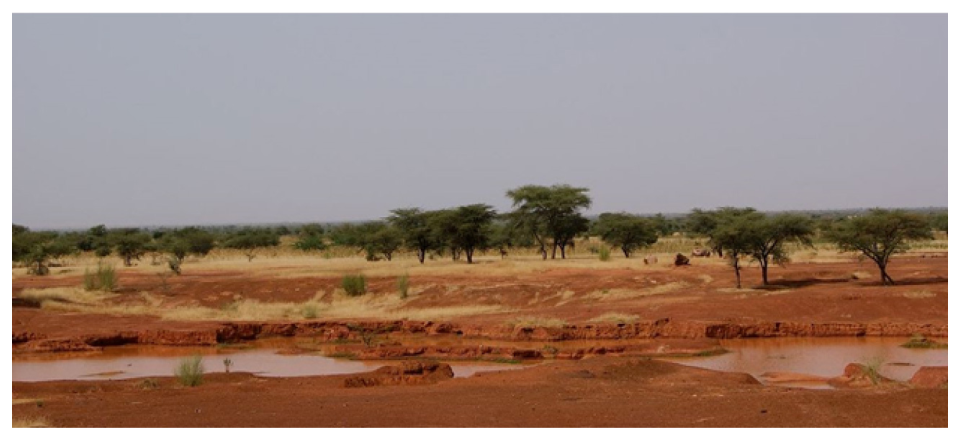
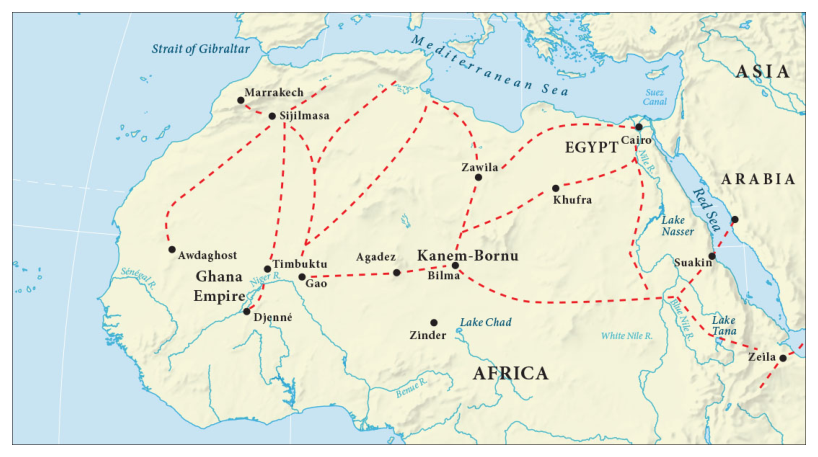
The societies described here developed within Africa’s environmental diversity. The Sahel—the grassland belt along the southern edge of the Sahara—connected desert caravan routes with the wetter savannas and woodlands farther south. This transition made West Africa especially important for long-distance exchange: salt came south from the Sahara, while gold and other products moved north. Wealth therefore depended not only on possessing resources but also on taxing and protecting trade.
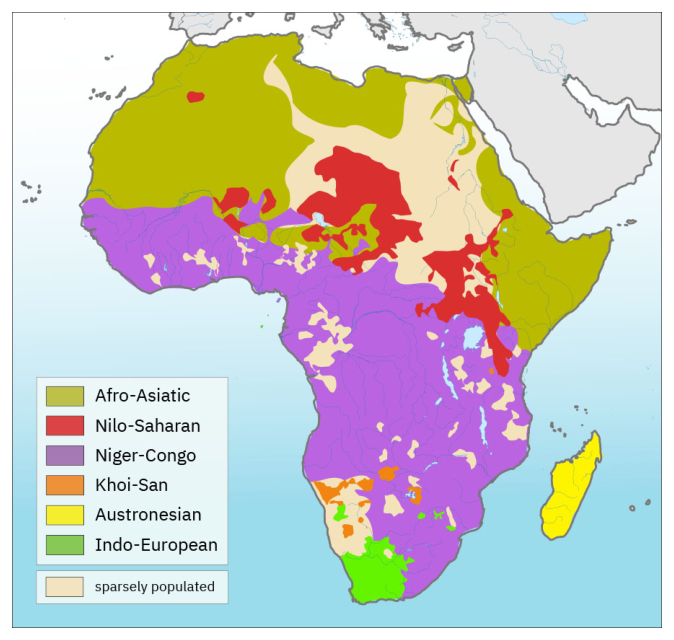
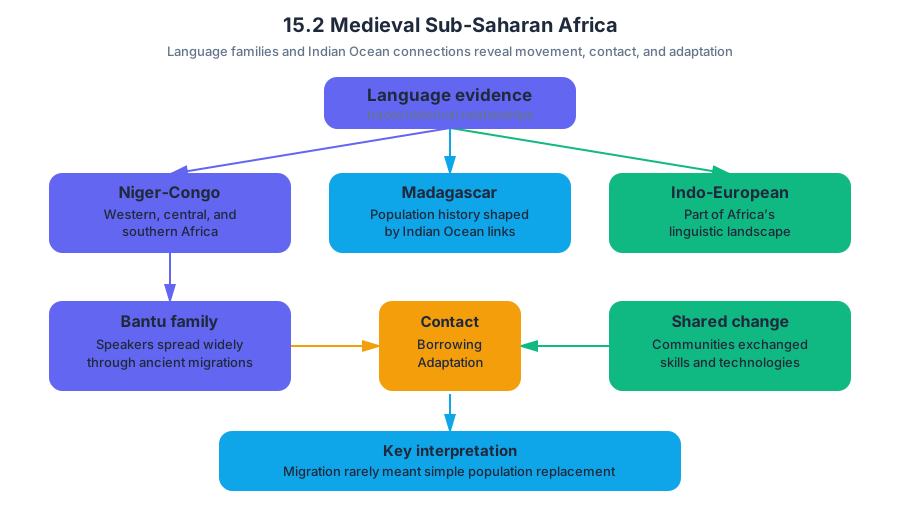
A major force in the settlement of central, eastern, and southern Africa was the movement of Bantu-speaking peoples. “Bantu” is a modern linguistic term formed from the common stem ntu, meaning “person” or “people,” and the plural prefix ba. It does not identify one single ethnic group or kingdom. Rather, it refers to related languages and to the populations who spoke them. Beginning around $2000$–$1500$ BCE, Bantu-speaking communities expanded from regions of west-central Africa. By approximately $1500$ BCE, migrations were moving both eastward and westward, and over many centuries Bantu languages became dominant across much of central, eastern, and southern Africa.
The expansion involved more than movement across a map. Bantu-speaking communities carried agricultural practices, animal husbandry, ironworking, and distinctive forms of social and political organization. Neolithic agriculture—the cultivation of plants and domestication of animals—supported larger and more permanent settlements than hunting and gathering alone. Iron tools helped farmers clear land and cultivate it, while iron weapons strengthened communities in conflict. These technologies did not produce identical societies everywhere, but their combination with migration reshaped the political landscape of sub-Saharan Africa.
The Ghana Empire
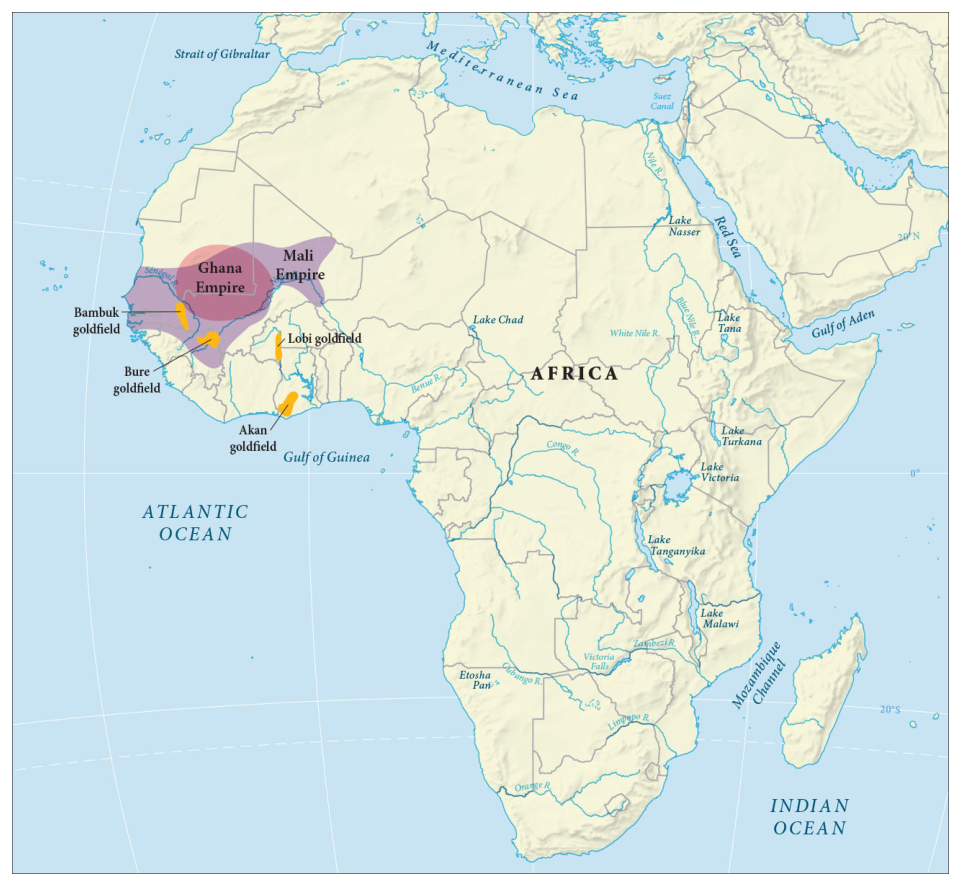
The Ghana Empire was the first of the great medieval West African empires. Its name can be misleading: “Ghana” was probably a royal title meaning something like “war chief” or “king,” while the state itself was known in local traditions as Wagadu. The empire occupied parts of present-day southeastern Mauritania and western Mali, near the southern edge of the Sahara. Its power rested on its position between the gold-producing regions to the south and the salt-producing regions of the Sahara and North Africa.
The origins of Ghana are uncertain. The section presents the empire’s beginnings as shrouded in mystery and notes a theory that Soninke people founded it. The Soninke were speakers of a Mande language, and their communities were well positioned to organize trade across the Sahel. Ghana’s rulers did not need to mine every ounce of gold themselves. Their authority came from controlling access to trade routes and taxing merchants who crossed their territory.
Gold was the central source of Ghana’s wealth, but salt was nearly as important to the commercial system. Salt was essential for human health and food preservation, yet it was scarce in the wetter regions of West Africa. Large slabs of salt traveled southward across the Sahara, while gold moved northward toward North Africa and the Mediterranean world. In medieval West Africa, salt was second only to gold in value and was transported by camel caravans in much the same way as gold.
Ghana’s rulers strengthened this trade by imposing taxes on goods entering and leaving the empire. The king reportedly kept gold nuggets in the royal treasury while allowing gold dust to circulate in commerce. This policy gave the monarchy control over the most valuable form of the commodity without stopping trade altogether. Taxes on caravans, markets, and imported goods provided the resources to support the court, armies, and administrative structure.
Ghana’s capital, usually identified as Koumbi Saleh, appears in Arabic descriptions as a large urban center divided into separate areas. One area contained the king’s court and the royal compounds; another housed Muslim merchants and included mosques. This arrangement illustrates an important feature of Ghanaian rule. The monarchy maintained its own religious traditions while permitting Muslim merchants and officials to live and work within the kingdom. Islam therefore supported commercial and diplomatic connections without immediately replacing indigenous religious practices.
The most important written account of Ghana comes from the eleventh-century Andalusi scholar al-Bakri, who described the king’s court, the capital’s two sections, the king’s treasury, and the political importance of gold. His account is valuable but not neutral: he relied on reports from merchants and travelers rather than personal experience of every place he described. Historians therefore use al-Bakri alongside archaeology, oral traditions, and evidence from the wider trans-Saharan trade.
The decline of Ghana cannot be explained with certainty by a single event. One argument connects it with the Almoravids, a reforming Muslim movement from North Africa that expanded southward in the eleventh century. Some older accounts claimed that the Almoravids conquered and destroyed Ghana. Many historians now regard that interpretation as too simple or unsupported. Other explanations emphasize shifts in trade routes, environmental pressures, political fragmentation, and the rise of competing powers. By the thirteenth century, Ghana had lost its dominant position, creating an opportunity for Mali.
The Mali Empire
The Mali Empire inherited and enlarged the economic system that had made Ghana powerful. It developed in the upper Niger River region and controlled important gold-producing areas as well as the trade routes linking the western Sudan to North Africa. Mali’s rulers gained wealth through taxation, military power, and control of commercial centers. The empire’s political authority was therefore built from the same basic relationship that had shaped Ghana: valuable goods crossed ecological and cultural boundaries, and rulers profited by controlling that movement.
Mali’s foundation is associated with Sundiata Keita, a ruler of the Mande-speaking peoples. According to oral traditions preserved by griots—specialists who memorized and performed genealogies, histories, and praise poetry—Sundiata defeated the Soso ruler Sumanguru around $1235$. Sundiata then created an alliance among several communities and established the foundations of imperial rule. The traditions surrounding him combine political history with heroic narrative, so historians treat them as important evidence while also recognizing that they were transmitted orally and shaped by later performance.
Mali’s rulers used the title mansa, meaning king or emperor. Under the mansas, the empire incorporated territories and communities across the western Sudan. Its authority was not based on uniform administration in every locality. Instead, rulers often permitted local leaders to remain in place as long as they acknowledged Mali’s authority, supplied tribute, and supported the imperial system. This flexible arrangement helped Mali govern a large region without eliminating every existing political structure.
The most famous Mali ruler was Mansa Musa, who reigned from approximately $1312$ to $1337$. His pilgrimage to Mecca in $1324$ made Mali known across the Islamic world. Mansa Musa traveled with a huge caravan and distributed so much gold in Cairo that, according to accounts, the value of gold declined there for years. Whether every detail of the story can be measured precisely, the accounts demonstrate the extraordinary wealth associated with Mali and the power of its ruler to display that wealth publicly.
Mansa Musa’s pilgrimage also connected Mali to the broader Islamic world. He visited important centers, encountered scholars and merchants, and returned with architects and learned people. He sponsored mosques and encouraged Islamic learning, especially in cities such as Timbuktu. Islam was influential among rulers, merchants, and scholars, but Mali remained religiously diverse. The imperial court could support Islam while many subjects continued older religious practices.
Timbuktu became one of Mali’s most celebrated cities because of its position near the Niger River and the trans-Saharan trade routes. It was a center of commerce, scholarship, and Islamic culture. Gao, farther east and on the edge of Mali’s power, was another important political and commercial center. Mansa Musa’s successors could not always maintain the same level of authority. Internal succession disputes, the independence of formerly subordinate kingdoms, and pressure from expanding rivals weakened the empire.
The section emphasizes that the historical record for Mali combines oral traditions with Arabic written sources. Griots preserve the memory of Sundiata and the founding of the empire, while writers such as al-Umari recorded information about Mansa Musa and Mali’s wealth. Later historians, including Ibn Khaldun, also discussed Mali and its rulers. These sources do not provide identical accounts. Oral traditions preserve local perspectives and political memory; Arabic writers often emphasize Islam, trade, rulers, and courtly wealth. Historians compare them rather than treating any single account as complete.
Mali remained powerful even after it began to weaken. In $1438$, pressure from Gao helped lead Mali to abandon both Gao and Timbuktu. Mema, a kingdom that had formed an alliance with Sundiata, broke away and became independent again. Although weakened, Mali retained control over parts of its former territory. Its history shows that imperial decline was usually gradual: political authority contracted unevenly rather than disappearing in one moment.
The Zimbabwean Plateau
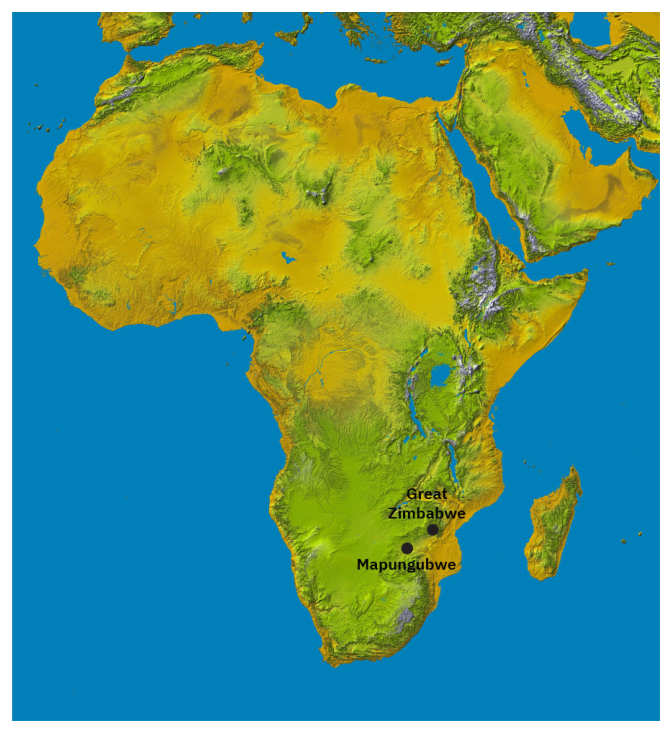
The Zimbabwean Plateau lies between the Zambezi and Limpopo Rivers in the interior of southern Africa. From approximately the tenth century, relatively powerful Bantu kingdoms began to appear in the savanna south of the central African rainforest and across this plateau. Their rise resulted from the interaction of population movement, agriculture, animal husbandry, and Iron Age technologies. Larger settlements could support specialized labor, political leadership, and long-distance exchange.
Bantu-speaking communities on the plateau practiced farming and herding, while iron tools and weapons increased their ability to cultivate land, manage resources, and defend settlements. Their expansion displaced or absorbed earlier inhabitants of some regions. This process should not be imagined as one uniform conquest. Migration, intermarriage, economic integration, and conflict all contributed to the formation of new societies.
Mapungubwe developed between approximately the eleventh and thirteenth centuries. It became a major settlement and political center on a hill overlooking the surrounding landscape. Its location helped its rulers control agriculture, livestock, and trade. Archaeological evidence indicates social inequality: elite burials and prestigious goods distinguish the ruling class from other residents. Mapungubwe’s wealth was connected to regional and long-distance commerce, including the exchange of gold and other goods through the eastern African trading world.
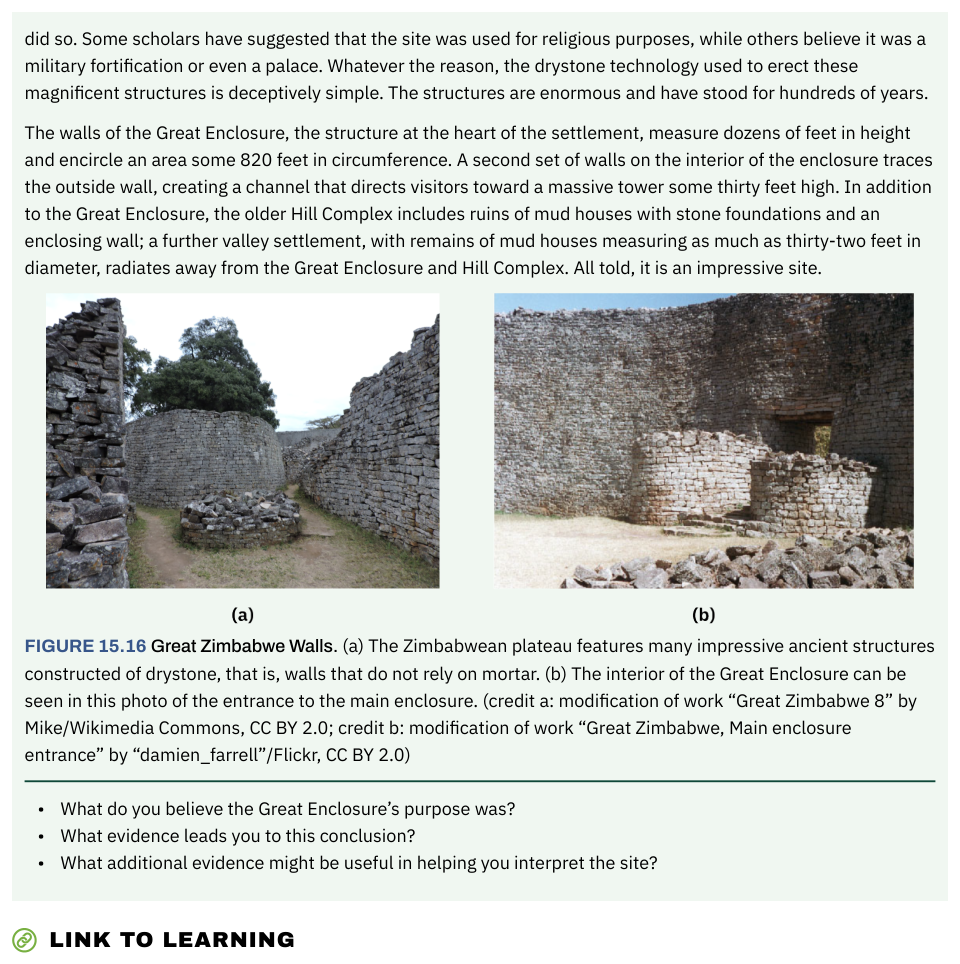
Great Zimbabwe emerged later and became the best-known state of the plateau. Its name refers to the massive stone structures built without mortar. The walls, enclosures, and elevated areas required organized labor and demonstrate the authority of rulers who could mobilize workers and direct resources. The settlement flourished roughly from $1100$ to $1450$, although its influence and occupation changed over time.
Great Zimbabwe’s economy rested on farming, cattle keeping, craft production, and trade. Its rulers benefited from the movement of gold from the interior toward the Indian Ocean coast. Imported objects found at the site show that the plateau was connected to broader commercial networks rather than isolated from the outside world. Great Zimbabwe therefore illustrates how Bantu-speaking societies created powerful inland states by combining local production with long-distance exchange.
The stone architecture also corrects a persistent misconception: Great Zimbabwe was not built by outsiders. Its builders were the ancestors of Shona-speaking peoples, and the settlement developed from the political and economic changes associated with Bantu migrations. The Zimbabwean Plateau demonstrates that sub-Saharan African societies independently developed complex states, specialized production, monumental architecture, and international trade.
Mapungubwe and Great Zimbabwe eventually declined, probably because of changing environmental conditions, exhausted resources, shifting trade routes, and political changes rather than one universally accepted catastrophe. Their histories, like those of Ghana and Mali, are reconstructed from archaeology, oral traditions, and written accounts produced by outsiders or later observers. Taken together, they show that medieval African civilization was diverse: Sahelian empires drew power from trans-Saharan commerce, while southern African kingdoms built authority through agriculture, cattle, metallurgy, stone construction, and links to Indian Ocean trade.
Content adapted from OpenStax World History, Volume 1: to 1500 by Ann Kordas et al., licensed CC BY 4.0.
Source Materials
Study World History Volume 1 on Lykke
This course page is free to open: signed out, you can read its first two sections, and signing in, on any plan, opens the rest. The free Lykke Chrome extension syncs your own Canvas courses, so ChatGPT, Claude and Muse can answer from your classes and deadlines. It only reads Canvas.
Add the free extensionSign in to open every sectionAll sections of World History Volume 1 · Browse more course pages