From the free course World History Volume 1 on Lykke
6.2 Ancient Greece
Key concepts: Ancient Greek city-states · Post-Mycenaean Greece · Classical Greece · Greek philosophy · Greek literature and epic poetry · Greek art and temple architecture · Athens and democracy · Sparta and militarism · Helots and Spartan conquest · Homer’s Iliad and the Trojan War
By the end of this section the student can: Identify the historical factors that shaped the development of the Greek city-state; Describe the evolution of the political, economic, and social systems of Athens and Sparta; Discuss the alliances and hostilities among the Greek city-states during the Classical period; Identify the major accomplishments of Ancient Greek philosophy, literature, and art
6.2 Ancient Greece
Greek civilization developed through a striking tension: its communities fought constantly among themselves, yet their philosophy, literature, art, architecture, and political experiments shaped European culture for centuries. The foundations of that world emerged after the collapse of the Bronze Age Mycenaean kingdoms around $1100$ BCE.
Post-Mycenaean Greece
The Mycenaean kingdoms were palace-centered societies of the Bronze Age. Around $1100$ BCE, those kingdoms collapsed. The political order that had organized much of the Greek mainland disappeared, and the period that followed was marked by warfare among rival communities. Out of this instability, Greek city-states gradually developed.
A city-state, or polis, was a politically independent Greek community organized around a central settlement and the surrounding territory. Greece did not become one unified kingdom during this period. Instead, many separate communities developed their own governments, customs, armies, and civic identities. Their rivalry was a persistent feature of Greek history, not a temporary interruption.
The post-Mycenaean period therefore involved both political fragmentation and cultural formation. Constant warfare made military strength essential, while the independence of individual communities encouraged different experiments in government and social organization. By the Archaic period, Athens and Sparta had emerged as two of the most important city-states, and their governments and cultures would dominate the Greek world during the Classical period.
Greek memory preserved the heroic age associated with the Mycenaean kingdoms through epic poetry. Homer’s Iliad tells the story of the Trojan War, presenting King Agamemnon of Mycenae as the leader of the Greek forces. The poem is not a straightforward contemporary record of the Bronze Age conflict; rather, it is an enduring literary representation of a legendary past. Its continued importance shows how later Greeks connected their own identity to stories about earlier heroes, warfare, honor, and the gods.
Classical Greece
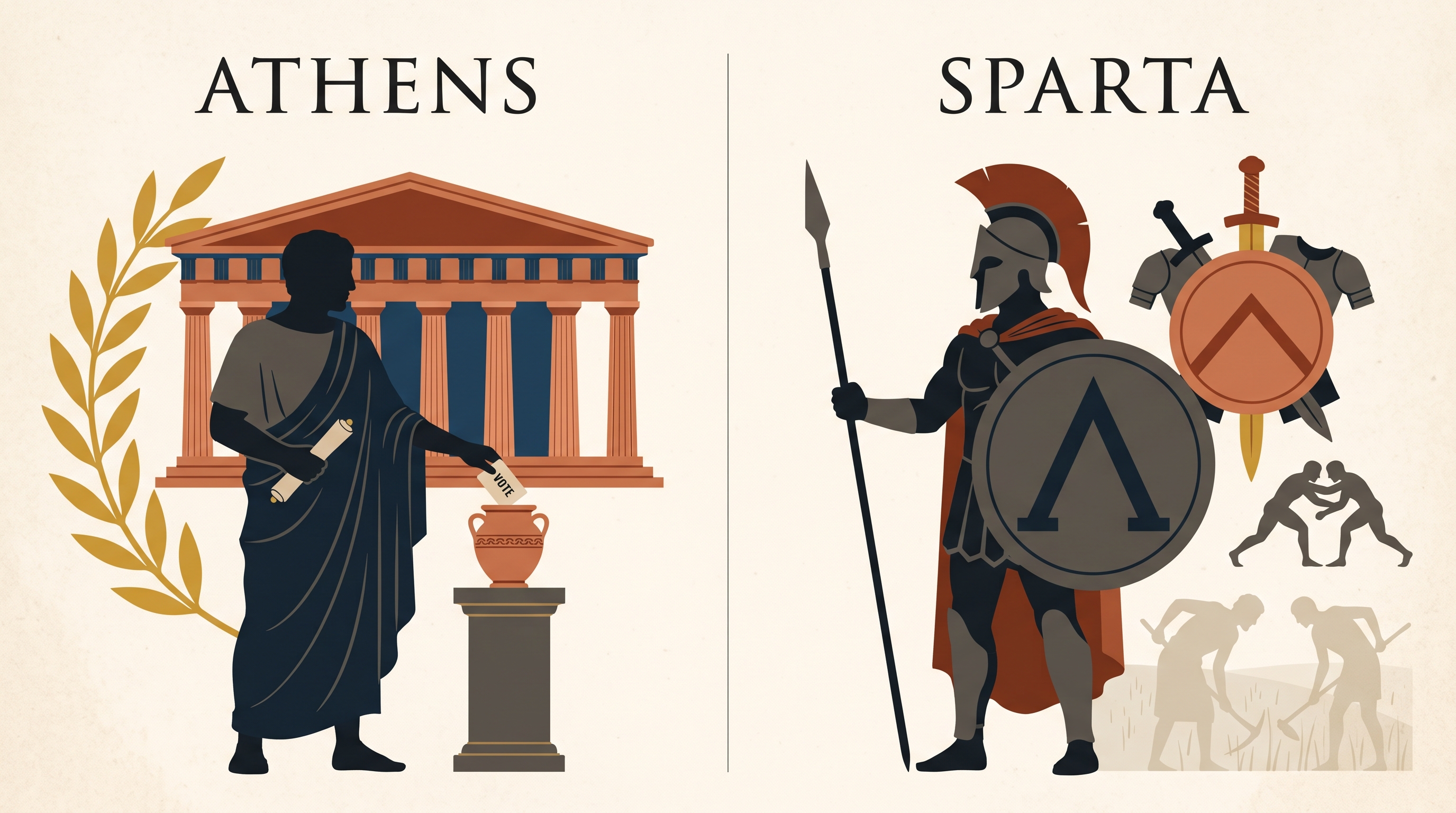
The Classical period became the best-known phase of ancient Greek history. Athens and Sparta stood at its center, but they represented sharply different ways of organizing civic life. Athens became a major center of Greek culture and is identified as the birthplace of democracy. Sparta, by contrast, built a militarized society whose government and culture dominated its own population and influenced the wider Greek world.
Athens developed a reputation for political innovation, cultural achievement, and intellectual life. The Athenian statesman and lawgiver Solon is associated with reforms around $594$ BCE that addressed economic and political tensions, including debt and the structure of government. These reforms did not create a fully developed democracy immediately, but they helped establish conditions for later political change. Athens therefore illustrates how the city-state could become a setting for conflict over power as well as experimentation in governance.
Sparta organized its society around military discipline. Its power depended not only on the training of Spartan citizens but also on the conquest and control of neighboring peoples. In the seventh century BCE, Sparta conquered Messenia, appropriated its farmland, and forced many of its inhabitants into hereditary labor as helots. Helots were an unfree laboring population whose work supported Spartan society. Their subordination made it possible for Spartan citizens to devote themselves heavily to military preparation and communal discipline.
Spartan culture emphasized physical strength, endurance, and readiness for war. Training and competition were important for both boys and girls, although their social roles were not identical. A later painting by Edgar Degas, based on a passage from Plutarch’s Life of Lycurgus, depicts Spartan girls encouraging and challenging boys preparing for running and wrestling exercises. The image is modern, but it draws attention to the ancient tradition that Sparta valued physical conditioning as a civic responsibility.
The contrast between Athens and Sparta should not be reduced to a simple opposition between “civilization” and “militarism.” Sparta was a highly organized political society with a distinctive culture, while Athens’ cultural achievements existed alongside political conflict and imperial ambition. Their rivalry demonstrates how the Greek city-state system produced both creative diversity and persistent warfare.
Greek Philosophy
Greek philosophers subjected traditional ideas to critical examination. Rather than accepting inherited explanations simply because they were ancient or religiously authoritative, they developed new ways of thinking about nature, knowledge, ethics, politics, and human conduct.
Philosophy means the disciplined pursuit of wisdom through questioning and reasoned argument. In the Greek world, philosophical inquiry challenged customary explanations and encouraged people to ask what could be known, how claims should be justified, and what principles should guide human life. This did not mean that Greek thinkers all rejected religion or agreed with one another. Its importance lay in the practice of examining ideas critically.
Greek philosophy mattered because it treated questions about the world and society as subjects for sustained reasoning. Philosophers sought new methods of thinking rather than merely repeating traditional accounts. Their arguments became part of a long intellectual inheritance that influenced European writers, artists, and thinkers for centuries.
Greek Literature and Epic Poetry
Greek literature produced enduring works in several forms, but epic poetry remained especially powerful. Epic poems are long narrative works centered on heroic figures, warfare, destiny, and the actions of gods and humans. Homer’s Iliad became one of the defining examples.
The Iliad tells the story of the Trojan War and identifies Agamemnon, king of Mycenae, as the leader of the Greek side. Its subject is not only military conflict. The poem examines honor, anger, loyalty, leadership, grief, and the consequences of choices made by both heroes and gods. Because it linked later Greek audiences to the age of Mycenae, it also helped preserve a cultural memory of a distant heroic past after the Mycenaean kingdoms themselves had disappeared.
Greek literary works and artistic forms continued to influence European artists and writers for centuries. Their influence did not depend on the Greeks having created a politically unified state. Indeed, the competing city-states generated multiple local traditions while sharing language, myths, religious practices, and artistic ideals. Greek cultural unity therefore coexisted with political division.
Greek Art and Temple Architecture
Greek city-states constructed many new temples during this period. These buildings were religious structures, but they also expressed civic identity, collective wealth, political power, and devotion to particular gods. A temple could represent the community that built it as much as the deity honored within it.
The Parthenon, built on the Athenian Acropolis in the fifth century BCE, honored Athena. It was large and richly constructed, demonstrating the resources and ambitions of Classical Athens. The temple was rebuilt after its destruction during the Persian War, using tribute money collected by Athens. That decision angered some other Greek city-states because the funds had been associated with a wider alliance and were being used to display Athenian power.
The Parthenon therefore carried several meanings at once. Architecturally, it represented Greek temple design and the achievements of Classical art. Religiously, it honored Athena, the city’s patron deity. Politically, its reconstruction proclaimed the wealth and authority of Athens. Its grandeur also revealed tensions within the Greek world: a monument celebrating Athenian culture could simultaneously remind other city-states of Athenian dominance.
Greek art also appeared in objects used in everyday civic and economic life. Athenian silver coinage from the fifth century BCE depicted Athena on one side and an owl, Athena’s symbol, on the other. The coin connected money, city, goddess, and identity. Its imagery announced that the currency belonged to Athens while presenting the city through symbols associated with its patron deity.
Ancient Greece was thus not a single kingdom but a competitive world of city-states whose conflicts shaped political life. From the collapse of the Mycenaean kingdoms came new communities with distinct institutions; from Athens and Sparta came contrasting models of civic organization; and from Greek philosophers, poets, artists, and builders came works that outlasted the rivalries of the communities that produced them. The enduring Greek legacy rests precisely in this combination of political fragmentation and shared cultural influence.
Content adapted from OpenStax World History, Volume 1: to 1500 by Ann Kordas et al., licensed CC BY 4.0.
Source Materials
Study World History Volume 1 on Lykke
This course page is free to open: signed out, you can read its first two sections, and signing in, on any plan, opens the rest. The free Lykke Chrome extension syncs your own Canvas courses, so ChatGPT, Claude and Muse can answer from your classes and deadlines. It only reads Canvas.
Add the free extensionSign in to open every sectionAll sections of World History Volume 1 · Browse more course pages