From the free course World History Volume 1 on Lykke
6.5 The Age of Augustus
Key concepts: Julius Caesar · Augustus · Personal charisma and leadership styles · Fall of the Roman Republic · Rise of the first emperor · Dictatorship · Execution of political enemies · Reform of Roman laws · Sulla’s resignation and retirement in 79 BCE · Roman territorial expansion through Caesar’s conquest of Gaul and Pompey’s conquest of Syria
By the end of this section the student can: Identify the key events of the First and Second Triumvirate; Analyze the personal charisma and leadership styles of Julius Caesar and Augustus; Explain the fall of the Roman Republic and the rise of the first emperor
6.5 The Age of Augustus
By $44$ BCE, Rome controlled an empire that included territories added through Julius Caesar’s victories in Gaul and Pompey’s victories in Syria. Yet the republic’s territorial success concealed a political crisis: institutions designed for a city-state struggled to govern a vast empire whose armies, wealth, and rival leaders had become increasingly powerful. The central question of the Age of Augustus is therefore not simply who ruled Rome, but how personal authority replaced republican government while continuing to use republican language.
From Republican Crisis to Dictatorship
The Roman Republic had traditionally depended on offices and institutions that were supposed to be temporary and shared. The rise of powerful military commanders disrupted that balance. The social troubles that followed the Punic Wars encouraged popular leaders such as the Gracchi, while military leaders such as Sulla demonstrated that an army could be used directly in Roman politics. Sulla’s march on Rome showed that republican institutions could no longer reliably contain disputes among ambitious elites.
A dictator was a Roman officeholder granted extraordinary authority, traditionally for a limited period during an emergency. In practice, the office became dangerous when its temporary character was weakened. During Sulla’s time as dictator, he ordered the execution of political enemies and reformed the laws. His actions were intended to restore order and reinforce the power of the traditional elite in the Senate.
In $79$ BCE, Sulla relinquished the office and retired from public life, convinced that he had saved the republic and preserved the political power of the traditional senatorial elite. His decision reveals an important distinction between constitutional intention and historical consequence. Sulla believed that extraordinary power could be used to repair the republic and then set aside. Instead, his dictatorship helped establish the precedent that a Roman commander might seize exceptional authority in the name of restoring republican stability.
The significance of Sulla’s example lies in this contradiction: a leader could claim to defend the republic while damaging the rules that made republican government possible. Once armies became personally loyal to commanders and political disagreements became military conflicts, the republic’s formal institutions remained in place but lost much of their ability to regulate power.
The First Triumvirate: Caesar, Pompey, and Crassus
The First Triumvirate was an informal alliance among Julius Caesar, Pompey, and Crassus. It was not a new constitutional office but a partnership among three exceptionally powerful men who used cooperation to advance their political interests. Its importance was that it showed how Roman politics increasingly operated through personal agreements among military leaders rather than through the normal balance of republican offices.
Pompey and Caesar represented different but complementary kinds of authority. Pompey had achieved major military victories, including the addition of Syria to the Roman Empire. Caesar later expanded Roman territory through his victories in Gaul. Their success brought wealth, prestige, and loyal soldiers, but it also made their personal ambitions difficult to contain within a system built around short-term public offices.
Crassus added wealth and political influence to the alliance. Together, the three men could exert pressure that none of them could easily match alone. The arrangement illustrates how Roman power was becoming concentrated in client armies: forces whose loyalty was tied closely to a commander who rewarded service with land, wealth, and advancement. The republic had not formally disappeared, but military loyalty increasingly followed individuals rather than the state.
The alliance eventually broke down. Competition between Caesar and Pompey became a struggle over who would control Rome’s political future. The conflict was not merely a personal quarrel; it represented a larger collision between the republican expectation that commanders should surrender exceptional power and the new reality that successful generals possessed armies, wealth, and reputations capable of challenging the Senate.
Julius Caesar and the Open Concentration of Power
Julius Caesar’s leadership combined military achievement, political ambition, and personal charisma. Personal charisma means the ability to attract loyalty and obedience through an individual’s reputation, confidence, achievements, and emotional appeal. Caesar’s victories in Gaul gave him enormous prestige, while his ability to mobilize supporters made him more than an ordinary officeholder. His authority rested not only on legal position but also on the personal loyalty attached to his name.
To prosecute the war against Pompey, Caesar had himself appointed dictator in $48$ BCE. The traditional dictatorship was temporary, but Caesar’s appointments progressively extended his tenure. In $46$ BCE, he was appointed dictator for a term of ten years. In $44$ BCE, his dictatorship was made permanent, or for life. This sequence transformed dictatorship from an emergency office into a form of continuing personal rule.
Caesar’s political style was therefore direct and visibly exceptional. He did not merely exercise influence behind republican institutions; he accumulated formal authority in a manner that made his supremacy unmistakable. Many Romans were unnerved by this concentration of power because they deeply distrusted the idea that one person should stand above the political community. Caesar’s charisma could attract supporters, but the same personal prominence alarmed those who feared monarchy.
Caesar’s dictatorship also demonstrates why the fall of the republic cannot be explained only as the result of weak laws. The crisis involved competing ideas of legitimate leadership. Caesar could present his authority as necessary for governing a vast empire and ending political disorder. His opponents could interpret the same authority as the destruction of republican liberty. The disagreement concerned not only who should rule, but whether Rome could remain a republic while one commander controlled the state.
The Assassination of Caesar and the Second Triumvirate
Caesar’s permanent dictatorship intensified fears that Rome was becoming a monarchy. His assassination in $44$ BCE did not restore the old republic. Instead, it opened another struggle among powerful leaders. The killing removed Caesar but did not remove the military networks, personal loyalties, and political instability that had enabled his rise.
The Second Triumvirate was a later alliance formed by Octavian, Mark Antony, and Lepidus. Like the First Triumvirate, it concentrated political authority in the hands of a small group rather than restoring ordinary republican competition. Its existence confirmed that Rome’s political future would be decided by commanders with personal armies and supporters, not simply by the Senate’s traditional procedures.
The two triumvirates had a similar structural meaning but different historical outcomes. The First Triumvirate joined Caesar, Pompey, and Crassus in an informal partnership that operated through influence and cooperation. The Second Triumvirate followed Caesar’s assassination and represented a more explicit effort by Octavian, Antony, and Lepidus to control the Roman state. Both revealed the republic’s dependence on personal power; the second helped clear the way for Octavian’s eventual supremacy.
Augustus and the Rise of the First Emperor
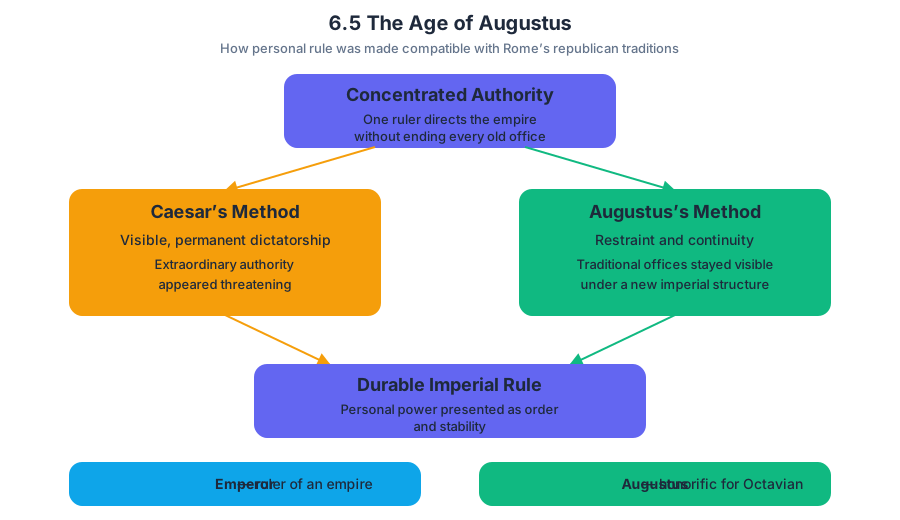
Augustus, originally known as Octavian, became Rome’s first emperor. His rise marked the political result of the republican crisis: Rome continued to preserve many republican forms, but ultimate authority was concentrated in one ruler. The title emperor identifies a ruler of an empire, while Augustus was the honorific associated with Octavian’s established authority. His achievement was not simply winning power but making personal rule appear compatible with Rome’s political traditions.
Augustus’s leadership style differed from Caesar’s in political presentation. Caesar’s authority became increasingly visible through the permanent extension of dictatorship. Augustus instead relied more heavily on restraint, continuity, and the appearance that republican institutions still mattered. This did not mean that power ceased to be personal. It meant that personal rule was organized and presented in a form less likely to provoke the immediate resistance that Caesar’s dictatorship had generated.
The contrast between the two men is therefore one of political method rather than a simple contrast between ambition and virtue. Caesar openly accumulated extraordinary authority, while Augustus made concentrated authority more durable by presenting it as the restoration of order and stability. Caesar’s personal charisma helped him dominate politics but also made him appear threatening. Augustus used authority in a way that allowed Rome’s traditional offices and elite to remain visible within a new imperial structure.
Comparing Caesar, Pompey, and Augustus
Julius Caesar, Pompey, and Augustus were all central to Rome’s transformation, but they occupied different political roles. Pompey was a victorious general whose conquests, including the addition of Syria, expanded Roman power and made him a major political force. Caesar was both a conqueror—especially in Gaul—and a dictator who converted military success into direct personal control. Augustus emerged from the struggles after Caesar’s assassination and became the first emperor by making one-man rule politically sustainable.
Their achievements also point to different stages in the collapse of republican government. Pompey helped demonstrate the political importance of victorious commanders. Caesar turned that military authority into permanent dictatorship. Augustus inherited the crisis produced by these conflicts and stabilized it through a system in which republican appearances coexisted with imperial power.
Why the Republic Fell
The Roman Republic fell because its traditional institutions could not adapt to the political landscape created by territorial expansion, military command, and rival personal loyalties. The empire governed territories far beyond Italy, including Gaul and Syria, but political authority remained organized around older republican expectations. Wealth, armies, and prestige increasingly accumulated around individual commanders, while the Senate and other institutions struggled to control them.
The careers of Sulla and Caesar reveal the danger of using dictatorship to solve republican problems. Sulla believed he could seize extraordinary power, reform the laws, defeat his enemies, and then retire after restoring the traditional elite. Caesar extended dictatorship from a temporary emergency measure to a ten-year appointment and finally to rule for life. In both cases, extraordinary authority was justified as a response to crisis; in practice, it weakened the expectation that Roman leaders must surrender power.
Augustus did not revive the old republic in its original form. He created a more stable political order from the conditions produced by its collapse. His success rested on making imperial rule acceptable to Romans who still valued republican traditions. The lasting importance of the Age of Augustus is thus the creation of a system in which the empire could be governed by a single dominant ruler while the language and institutions of the republic continued to lend that rule legitimacy.
The shift from republic to empire was not caused by one ambitious man alone. Sulla established a precedent for dictatorship, Pompey demonstrated the political weight of military conquest, Caesar made personal authority explicit, and Augustus transformed that authority into a durable imperial settlement. Their careers show how Rome moved from shared republican offices toward centralized rule through a series of crises in which emergency power increasingly became permanent power.
Content adapted from OpenStax World History, Volume 1: to 1500 by Ann Kordas et al., licensed CC BY 4.0.
Source Materials
Study World History Volume 1 on Lykke
This course page is free to open: signed out, you can read its first two sections, and signing in, on any plan, opens the rest. The free Lykke Chrome extension syncs your own Canvas courses, so ChatGPT, Claude and Muse can answer from your classes and deadlines. It only reads Canvas.
Add the free extensionSign in to open every sectionAll sections of World History Volume 1 · Browse more course pages