From the free course World History Volume 1 on Lykke
6.1 Early Mediterranean Peoples
Key concepts: Phoenician maritime trade and colonization · Carthage · Greek city-states and democracy · Olympic Games · Persian Empire and the Ionian Revolt · Alexander the Great and Macedonian expansion · Classical Greek art and culture · Socrates and Athenian philosophy · Hellenistic successor kingdoms · Etruscans and early Rome
By the end of this section the student can: Identify the regional peoples of the Mediterranean before 500 BCE; Discuss the technological achievements of the early Mediterranean peoples; Describe the interconnectedness of the early Mediterranean peoples
6.1 Early Mediterranean Peoples
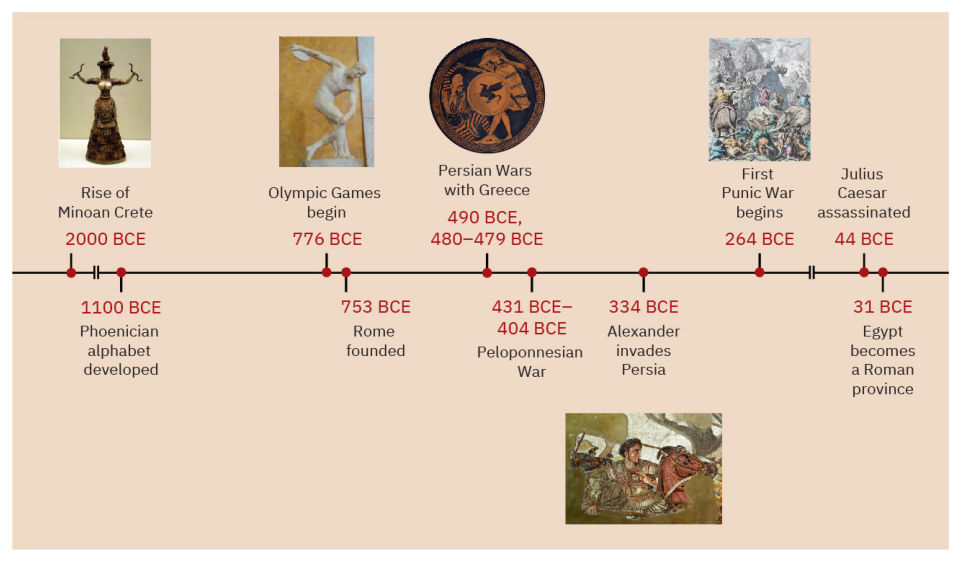
The Mediterranean was not a collection of isolated shores. It was a maritime crossroads where merchants, settlers, soldiers, athletes, artists, and political ideas moved between North Africa, the Aegean, the Levant, and southern Europe. During the Bronze Age, approximately $3300$–$1200$ BCE, trade connected the peoples of Greece and the Aegean islands, including Crete. By the Iron Age, these connections had helped produce a region in which Phoenician traders, Greek city-states, Persian imperial power, Macedonian conquest, and later Hellenistic kingdoms all shaped one another.
A useful way to picture the early Mediterranean is as a chain of ports rather than a set of modern national borders. A ship could carry goods, languages, religious practices, artistic styles, and political information from one coast to another. Control of a harbor or island could therefore matter as much as control of farmland. This geography helps explain both Phoenician colonization and the rapid spread of Greek and Macedonian influence.
Regional Peoples and Cultures before $500$ BCE
The eastern Mediterranean contained several important peoples before $500$ BCE. Minoans and Mycenaeans had earlier connected the Aegean world through trade and seafaring. Later, Phoenician cities on the eastern Mediterranean coast developed extensive maritime networks, while Greek-speaking communities organized themselves into independent city-states. Farther east, the Persian Empire assembled a large imperial territory that brought many peoples and regions under one political authority.
These societies did not develop in isolation. Greek culture absorbed influences from neighboring Mediterranean peoples, and Greek influence later contributed to the development of Latin and Etruscan cultures. Rome itself began as a Latin settlement and was later shaped by Etruscan rule and cultural influence; it should not be described simply as an Etruscan colony founded around $600$ BCE. The larger historical point is interaction: Mediterranean societies borrowed, adapted, competed, and sometimes conquered.
Phoenician Maritime Trade and Colonization
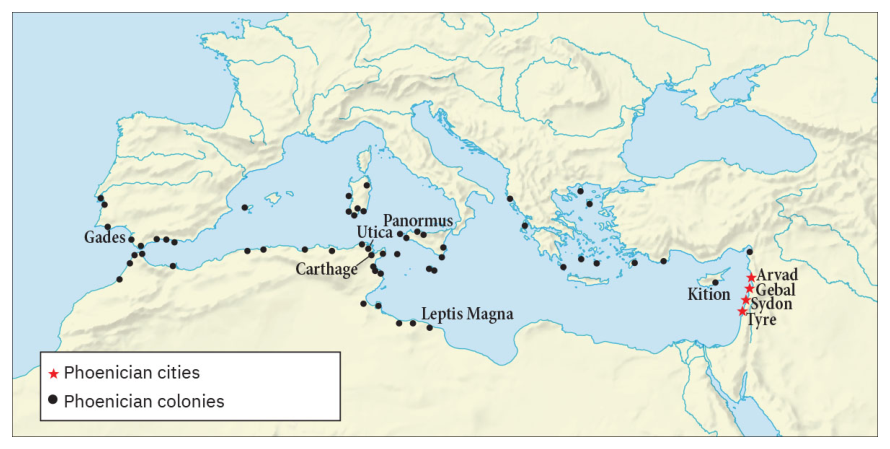
The Phoenicians were maritime traders whose cities occupied the eastern Mediterranean coast. Their commercial success depended on ships, navigational knowledge, and a willingness to establish regular stopping places far from their original homeland. Phoenician merchants created trading posts in Cyprus, North Africa, Sicily, Sardinia, and Spain. They also sailed toward the British Isles in search of markets and valuable goods such as tin.
A trading post was more than a warehouse. It could provide a harbor, supplies, local contacts, and a secure place to exchange goods. By linking such posts across the Mediterranean, Phoenician merchants created a network that made long-distance trade more practical. Their activity illustrates how commerce could produce cultural connection even when no single empire controlled the entire sea.
Carthage
Phoenician merchants founded Carthage in North Africa around $700$ BCE. It began as a stopping place on the voyage to Spain, but its location allowed it to become much more than a temporary station. Situated near important western Mediterranean routes, Carthage grew wealthy and powerful. Its rise shows how a settlement created to support trade could develop into a major political and economic center.
Carthage also demonstrates the long-term consequences of colonization. Phoenician commercial expansion did not merely move objects from one port to another; it established communities that could control local resources, organize shipping, and compete for influence. In this sense, maritime trade and political power were closely connected. The same routes that carried tin, agricultural products, and other goods could later support military expansion and rivalry.
Greek City-States and Civic Life
Greek communities commonly organized themselves as city-states, or independent political communities centered on a city and its surrounding territory. A city-state was not simply a city in the modern sense. It was a political society with its own laws, institutions, citizens, and military responsibilities. The independence of these communities encouraged experimentation with different forms of government, even though the Greek world shared language, religious traditions, athletic festivals, and cultural practices.
Athens developed into a powerful democracy, a form of government in which citizens participate in political decision-making. Athenian democracy, however, was limited rather than universal. Adult male citizens could participate in government, while women and other groups were excluded from citizenship and political participation. The term “democracy” therefore describes an important political development without implying that all residents possessed equal rights.
Athens’s political culture also included disagreement about authority, justice, and the responsibilities of citizens. Socrates became an enduring symbol of this culture. He was forced to drink hemlock, a poisonous liquid, and his death has remained an example of the tensions that could arise between philosophical questioning and the political community. His fate illustrates that Athenian public life valued debate but could also punish challenges to accepted ideas or civic authority.
Shared Greek Institutions: Olympia and Artistic Change
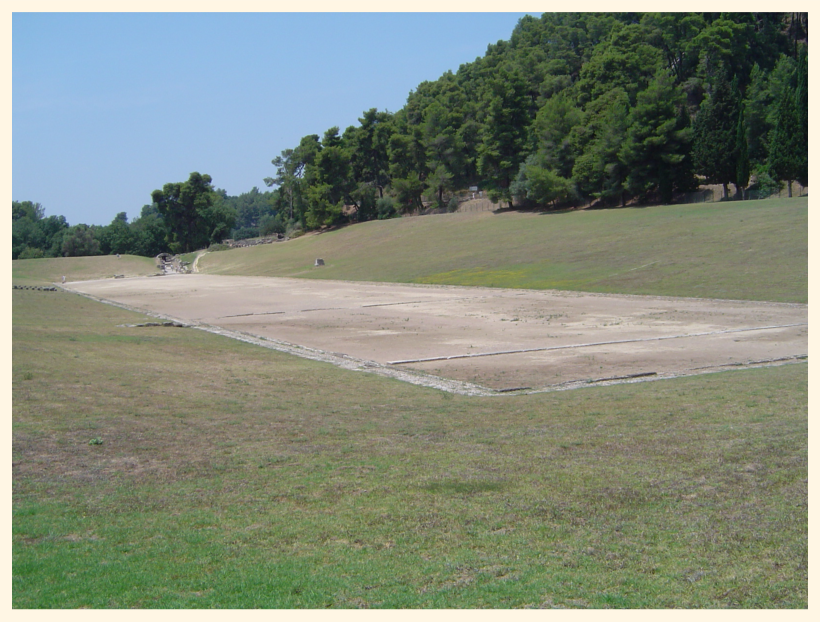
Beginning in $776$ BCE, according to Aristotle, Greeks traditionally traveled to Olympia every four years to compete in athletic contests held in honor of Zeus. These contests gave rise to the Olympic Games. Olympia was therefore both a religious center and a meeting place for Greek communities. Athletic competition expressed ideals of physical excellence, honor, and devotion to the gods while creating a shared institution across otherwise independent city-states.
The Olympic Games reveal an important balance in Greek history. Greek communities were politically divided, but they also recognized cultural practices that connected them. Shared religious festivals and athletic contests did not eliminate rivalry among city-states; instead, they created occasions in which members of different communities could participate in a broader Greek identity.
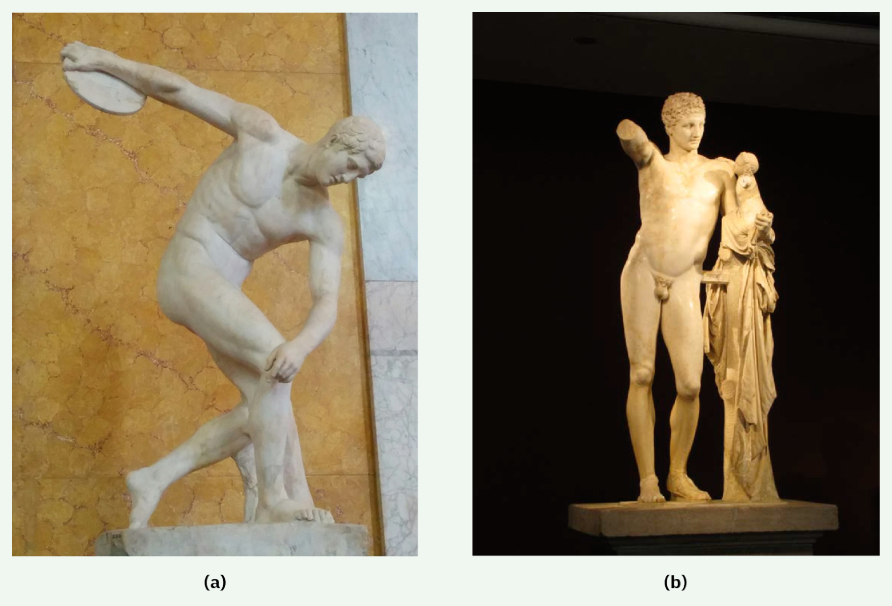
Art provides another record of changing Greek ideas. During the Classical era, especially in Athens, vase painters relied less heavily on geometric patterning and increasingly depicted realistic scenes from myths and daily life. Greek pottery could show chariot drivers, mythological episodes, and human movement with greater attention to recognizable bodies and actions. This shift suggests a growing interest in representing the human world, not merely decorating a surface with repeated designs.
The Persian Empire and the Ionian Revolt
The Persian Empire brought a vast and diverse territory under imperial rule. Greek communities in Ionia, on the western coast of Anatolia, came into conflict with Persian authority. In $499$ BCE, Athens intervened in the Ionian Revolt, the rebellion of Ionian communities against Persian rule. Persian forces eventually crushed rebellions in Ionia and Cyprus by $494$ BCE.
The revolt mattered because it turned local resistance into a wider confrontation involving Athens and the Persian Empire. Persian suppression demonstrated the strength of imperial power, while Athenian intervention showed that Greek city-states could become involved in conflicts beyond their immediate territory. The episode also illustrates a recurring Mediterranean pattern: trade routes, coastal settlements, political alliances, and imperial ambitions could transform a regional dispute into an international conflict.
Alexander the Great and Macedonian Expansion
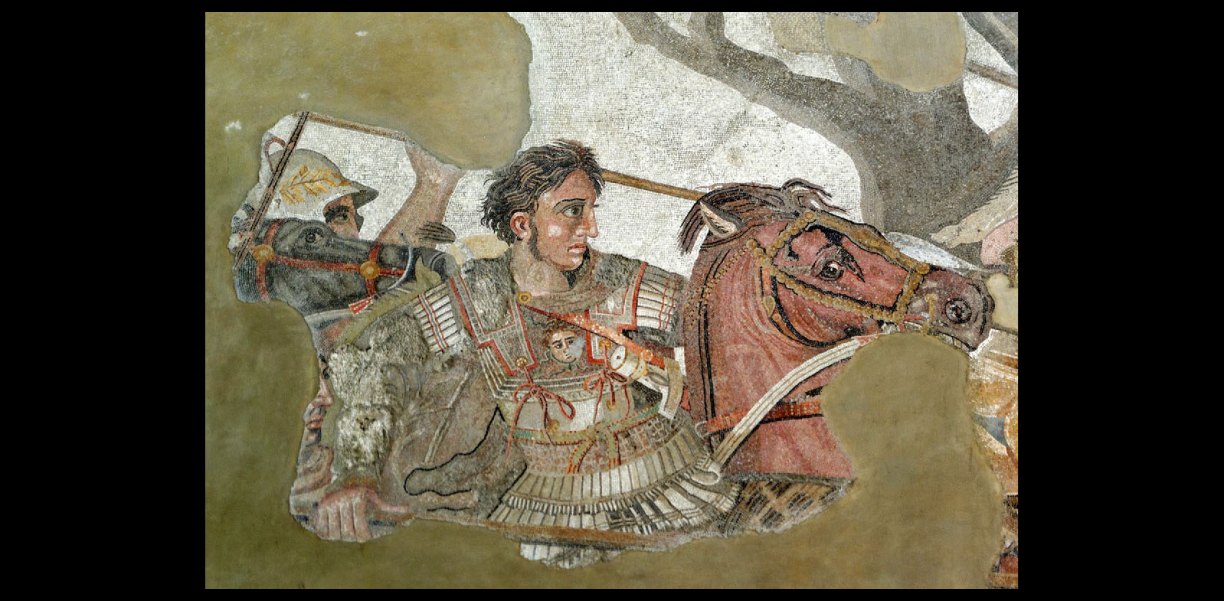
Macedonian expansion later reshaped the political and cultural geography of the eastern Mediterranean and western Asia. Alexander the Great, the Macedonian king, led a conquest of the Persian Empire. A mosaic discovered in Pompeii depicts Macedonians led by Alexander defeating the Persians at the Battle of Issus in $333$ BCE. Although the mosaic was created centuries after Alexander’s campaigns, it shows how Roman-era audiences remembered and admired his victory.
Alexander’s importance extended beyond the battles themselves. His conquests connected Greek and Macedonian power with the territories of the former Persian Empire. Greek cultural influence traveled with armies, administrators, settlers, and rulers. This wider cultural impact is why Alexander became a shared Greek and Roman cultural symbol: later societies remembered him not only as a conqueror but also as the figure associated with the spread of Greek influence across a vast region.
Hellenistic Kingdoms and Succession
After Alexander’s conquests, Hellenistic rulers and kingdoms governed different parts of his former empire. Hellenistic refers to the period and cultures shaped by the spread and adaptation of Greek influence after Alexander. The Seleucid and Ptolemaic dynasties were among the important successor regimes. Their histories were marked by political succession struggles, because control of Alexander’s territories depended on contested inheritance, military power, and the ability of rulers to maintain authority across diverse populations.
The Hellenistic world therefore was not simply “Greek culture replacing everything else.” It was a world of political and cultural interaction created by conquest. Greek influence became important across the eastern Mediterranean and western Asia, but local traditions, populations, and institutions remained part of the societies ruled by Hellenistic dynasties. The result was a connected yet politically fragmented world.
Why Early Mediterranean Interconnection Matters
The early Mediterranean peoples were connected through several overlapping systems: Phoenician maritime commerce, Greek religious and athletic institutions, city-state politics, Persian imperial rule, and Macedonian conquest. Carthage grew from a Phoenician stopping place into a wealthy power; Olympia created a shared Greek gathering; Athens developed a restricted form of democracy; Persian suppression of the Ionian Revolt revealed the force of empire; and Alexander’s victories created the Hellenistic political and cultural environment that followed.
The central pattern is not the rise of one permanent civilization but the movement of people and institutions around a shared sea. Ships carried goods and ideas, colonies became independent powers, artistic styles changed, citizens debated political authority, and conquerors created new cultural mixtures. By $500$ BCE, the Mediterranean already possessed the interconnected political and cultural world that would shape the Classical era and the later development of Greek, Roman, and Hellenistic societies.
Content adapted from OpenStax World History, Volume 1: to 1500 by Ann Kordas et al., licensed CC BY 4.0.
Source Materials
Study World History Volume 1 on Lykke
This course page is free to open: signed out, you can read its first two sections, and signing in, on any plan, opens the rest. The free Lykke Chrome extension syncs your own Canvas courses, so ChatGPT, Claude and Muse can answer from your classes and deadlines. It only reads Canvas.
Add the free extensionSign in to open every sectionAll sections of World History Volume 1 · Browse more course pages