From the free course Anatomy and Physiology on Lykke
Foundations of Anatomy and Physiology
Key concepts: Levels of structural organization from subatomic particles to the human organism · Atoms, molecules, and chemical building blocks of the body · Atomic structure and the roles of protons, neutrons, and electrons · Chemical reactions, including synthesis, decomposition, exchange, and reversibility · Cellular-level functions and examples of specialized cells · Oxygen-dependent chemical reactions and ATP production · Short-term physiological responses to cold · Anatomical directional terminology, including medial, caudal, and superior · Organ and organ-system organization · The historical development of human anatomy and dissection
Orient the student to Levels of Organization: what each chapter in it teaches and how the chapters build on one another (Chapter 1, An Introduction to the Human Body; Chapter 2, The Chemical Level of Organization; Chapter 3, The Cellular Level of Organization; Chapter 4, The Tissue Level of Organization).
Foundations of Anatomy and Physiology
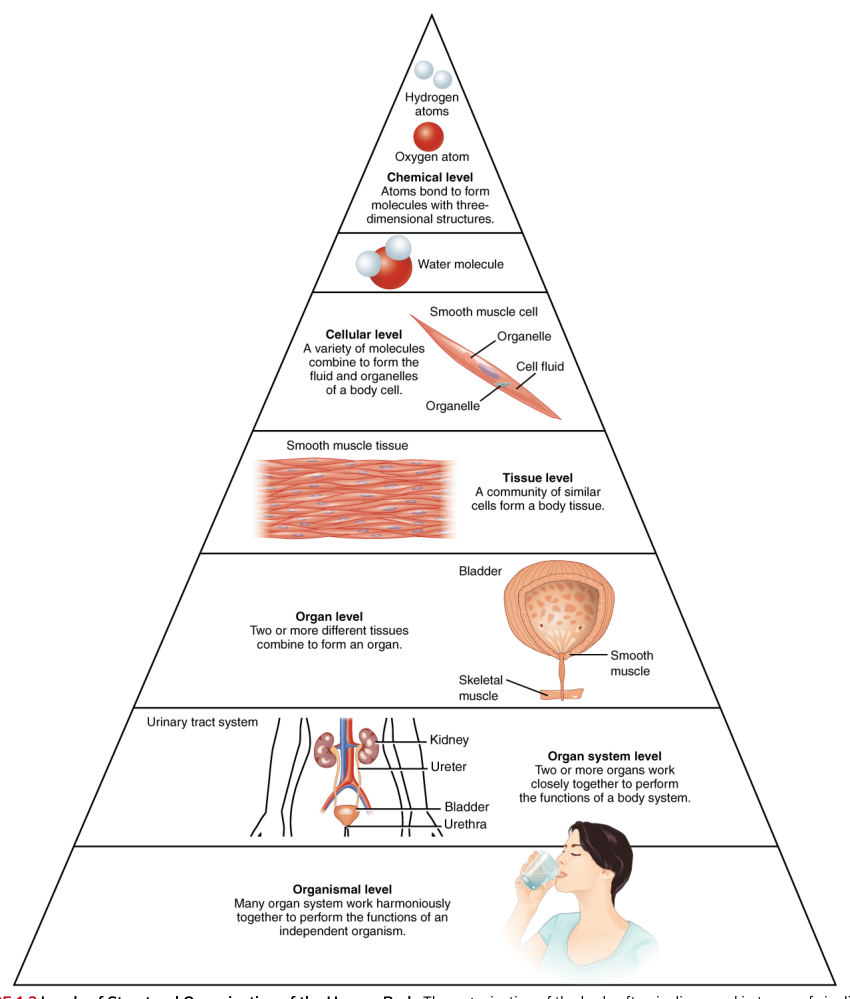
A human body begins with particles too small to see and ends as a living organism capable of movement, secretion, transport, and coordinated response. The key idea is organization: smaller chemical components combine into molecules, molecules assemble into cells, and cells provide the living foundation for tissues and larger body structures.
From particles to living structure
The smallest level relevant to the body is the subatomic level, consisting of particles such as protons, neutrons, and electrons. These particles combine to form atoms, the basic units of chemical elements. Two or more atoms can bond to form a molecule. Molecules then become the chemical building blocks of cells, including water, proteins, and sugars. At the cellular level, molecules combine to produce structures such as cell fluid and organelles, allowing a cell to function independently.
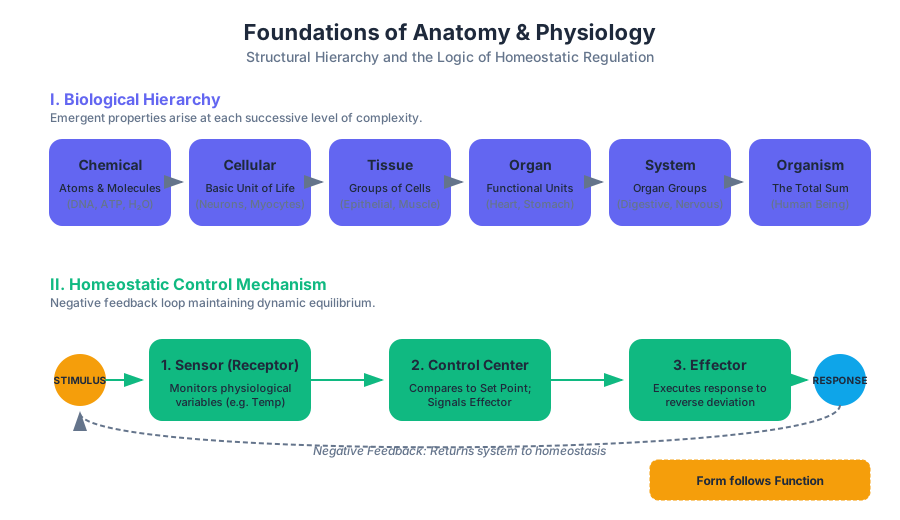
A cell is the smallest independently functioning unit of a living organism. A bacterium, although extremely small, is a complete independently living organism because it consists of one cell. Every living structure in human anatomy contains cells, and nearly all functions of human physiology are performed by cells or initiated by them. Groups of specialized cells form tissues, and tissues contribute to larger structures. The body’s organization therefore increases in complexity from subatomic particles and atoms through molecules and cells, and ultimately to tissues, organs, organ systems, and the organism.
Atoms and their subatomic particles
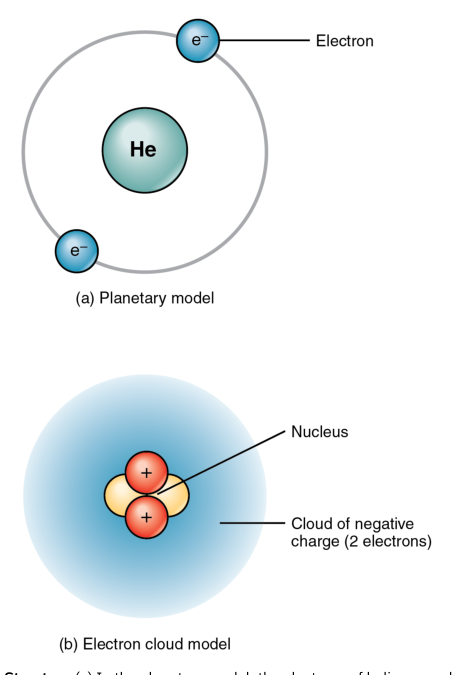
An atom is the smallest quantity of an element that retains the properties of that element. The three major subatomic particles are protons, neutrons, and electrons. Protons have a positive electrical charge, neutrons have no electrical charge, and electrons have a negative electrical charge. Particles of the same type are identical regardless of the atom in which they occur: a proton in a hydrogen atom is the same kind of proton found in an oxygen atom.
Protons and neutrons occupy the atom’s central nucleus. Electrons occupy regions surrounding the nucleus. The number of protons identifies the element; for example, every hydrogen atom has one proton, whereas every oxygen atom has eight. The electrical behavior of an atom depends especially on its electrons, because electrons participate directly in chemical interactions.
The electrons farthest from the nucleus occupy the valence shell, the outermost electron shell. Valence-shell electrons are the electrons most involved when atoms interact and form chemical bonds. Because electrons all carry a negative charge, they repel one another. This repulsion helps determine how electrons are arranged around the nucleus and how atoms interact with other atoms.
Atoms do not literally touch one another in the usual physical sense. What is described as atoms “touching” or “bonding” refers to interactions among their electron clouds and the electrical forces between charged particles.
This distinction matters because chemical behavior depends on electrical attraction and repulsion rather than on solid, miniature balls pressing against one another. The arrangement of valence-shell electrons determines whether atoms are likely to form molecules and what kinds of reactions those molecules can undergo.
Molecules: the chemical building blocks of cells
A molecule forms when two or more atoms combine through chemical bonding. Water provides a familiar example: each water molecule contains two hydrogen atoms bonded to one oxygen atom, represented as $H_2O$. The atoms are not merely mixed together; they are chemically connected in a specific arrangement that gives water its properties.
Molecules such as water, proteins, and sugars are the chemical building blocks of body structures. Inside a cell, many different molecules combine to form the fluid and organelles that support cellular activity. The organization is therefore cumulative: atoms provide the ingredients, molecules provide functional chemical structures, and cells use those structures to carry out life processes.
Chemical reactions: rearranging matter
A chemical reaction changes one set of molecules into another by breaking existing chemical bonds, forming new bonds, or both. The substances present at the beginning are called reactants; the substances formed by the reaction are called products. A reaction can be represented generally as
$$ \text{reactants} \rightarrow \text{products} $$
In a synthesis reaction, smaller substances combine to form a larger or more complex product. Its general pattern is
$$ A + B \rightarrow AB $$
Synthesis is important when cells assemble larger molecules from smaller building blocks. The reaction moves toward increased molecular complexity.
In a decomposition reaction, a larger molecule is broken into smaller substances:
$$ AB \rightarrow A + B $$
Decomposition is central to the breakdown of stored materials and other molecules. It does not make matter disappear; it rearranges the atoms into different products.
An exchange reaction combines features of synthesis and decomposition. Parts of two reactants are exchanged to produce two different products:
$$ AB + CD \rightarrow AC + BD $$
The bonds within the original molecules are rearranged, creating new molecular combinations.
Many chemical reactions are reversible, meaning that they can proceed in either direction when appropriate conditions are present:
$$ A + B \rightleftharpoons AB $$
A product formed by synthesis may later be decomposed into its original components, while conditions such as concentration, temperature, or the presence of other substances influence which direction is favored. A common misconception is that a reaction has only one permanent direction. In living systems, many reactions continually shift according to cellular needs and available reactants.
Cells specialize to keep the body functioning
Cells are not identical copies of one another. Their structures are specialized for particular functions, yet their activities support the operation of the body as a whole. Red blood cells move through the body, transporting material within the circulation. White blood cells also move through the body and participate in defense. Muscle cells contract and relax, producing force and movement. Gland cells secrete chemicals, releasing substances that affect nearby tissues or other parts of the body.
These examples show why the cell is both a structural and functional foundation. A muscle cell’s ability to contract depends on specialized internal molecules and structures. A gland cell’s ability to secrete depends on producing, processing, and releasing chemical substances. A blood cell’s function depends on its ability to travel through the body and perform its particular transport or defense role. Cellular specialization creates division of labor without eliminating the shared chemical basis of life.
Oxygen and ATP production
Atmospheric air contains about $20%$ oxygen. Oxygen is essential for chemical reactions that keep the body alive, including reactions involved in producing adenosine triphosphate, or ATP. ATP is the immediate energy-bearing molecule used to support cellular work, including activities such as movement, transport, and synthesis.
Oxygen-dependent reactions help cells extract usable energy from nutrients. Some of the released energy is captured in ATP, while some is released as heat. ATP can then provide energy for cellular processes by undergoing hydrolysis:
$$ ATP + H_2O \rightarrow ADP + P_i + \text{energy} $$
Here, $ADP$ is adenosine diphosphate and $P_i$ represents inorganic phosphate. The reaction illustrates a larger principle: chemical reactions do not merely alter substances; they transfer energy in forms cells can use.
The importance of oxygen becomes especially visible during cold exposure. Shivering consists of rapid, involuntary, and somewhat random muscle movements. These contractions generate heat and provide a short-term response to cold. Cold can also increase the breakdown of stored energy, supplying chemical fuel for the reactions that support heat production. Thus, muscle activity and metabolism are connected: chemical energy is transformed into mechanical activity and heat.
An organ system consists of two or more organs working together to perform related functions. For example, the urinary tract system includes the kidneys, ureters, bladder, and urethra. Each organ is built from tissues, each tissue from specialized cells, and each cell from molecules whose behavior depends on atoms and their electrons. The chemical level therefore remains active inside every larger anatomical level: the visible function of an organ system ultimately depends on microscopic reactions and cellular work.
The body’s visible activities—movement, secretion, transport, and heat production—are outcomes of organized chemical interactions. Atoms form molecules, molecules support cells, and specialized cells perform the processes that sustain the organism.
Content adapted from OpenStax Anatomy and Physiology 2e by J. Gordon Betts et al., licensed CC BY 4.0.

Source Materials
Study Anatomy and Physiology on Lykke
This course page is free to open: signed out, you can read its first two sections, and signing in, on any plan, opens the rest. The free Lykke Chrome extension syncs your own Canvas courses, so ChatGPT, Claude and Muse can answer from your classes and deadlines. It only reads Canvas.
Add the free extensionSign in to open every sectionAll sections of Anatomy and Physiology · Browse more course pages