From the free course Anatomy and Physiology on Lykke
Chapter 6: Bone Tissue and the Skeletal System
Key concepts: Bone is a living connective tissue with an extracellular matrix containing collagen fibers and mineralized ground substance. · The skeletal system consists of bones and cartilage. · The skeletal system supports the body, facilitates movement, and protects internal organs. · Bone tissue contributes to calcium and mineral homeostasis by storing and releasing calcium ions. · Yellow bone marrow contains adipose tissue whose triglycerides can serve as an energy source. · Red bone marrow is the site of hematopoiesis, or blood-cell production. · Bone density continues to increase slowly until the late 20s, after much skeletal growth has occurred. · The adult human skeleton contains 206 bones. · Bones are classified according to their shape, including long bones. · Orthopedists diagnose and treat disorders and injuries of the musculoskeletal system.
By the end of this chapter the student can: List and describe the functions of bones; Describe the classes of bones; Discuss the process of bone formation and development; Explain how bone repairs itself after a fracture; Discuss the effect of exercise, nutrition, and hormones on bone tissue; Describe how an imbalance of calcium can affect bone tissue.
Chapter 6: Bone Tissue and the Skeletal System
A child’s skeleton is not an inert framework like a fossil: it is living tissue that grows, repairs damage, and continuously changes while supporting the body. Bone must therefore do two jobs at once. It must be strong enough to bear loads and protect delicate organs, yet biologically active enough to store minerals, house marrow, and respond to the body’s changing needs.
Bone as living connective tissue
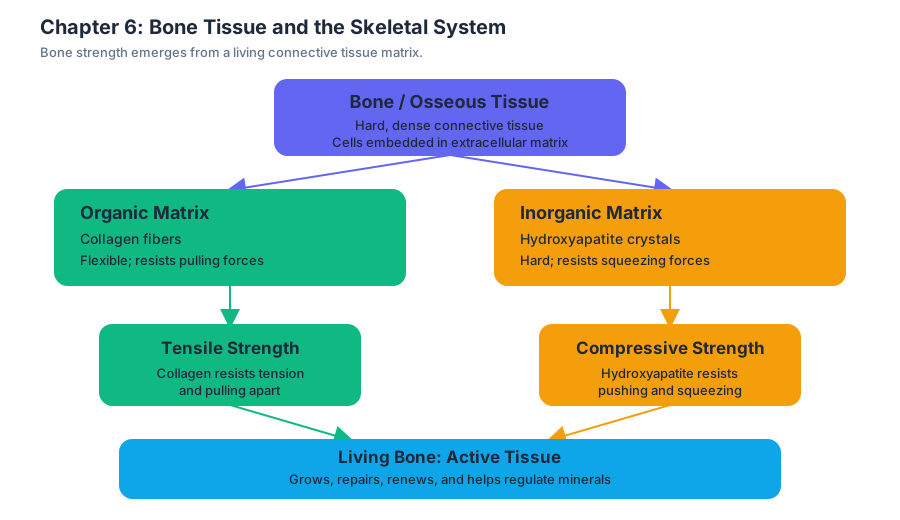
Bone, also called osseous tissue, is a hard, dense connective tissue that forms most of the adult skeleton. Like other connective tissues, it consists of cells surrounded by an extracellular matrix. What makes bone unusual is that its matrix combines flexible organic material with rigid inorganic mineral.
The organic portion of bone matrix contains mostly collagen fibers. Collagen gives bone a degree of flexibility and tensile strength, meaning it helps the tissue resist being pulled apart. Embedded among those fibers is a mineralized ground substance containing hydroxyapatite, a crystalline form of calcium phosphate. Hydroxyapatite gives bone hardness and compressive strength, allowing it to resist forces that push or squeeze it.
Key insight: Collagen helps bone resist tension, while hydroxyapatite helps it resist compression. Bone’s strength comes from the interaction of both components, not from mineral alone.
This explains why fossilized bone and living bone are not equivalent. A fossil may preserve the shape and mineral content of an ancient skeleton, but it no longer grows, repairs itself, or participates in mineral regulation. Living bone remains an active tissue that is continually renewed and connected to the functions of other organ systems.
Functions of the skeletal system
The skeletal system consists of bones and cartilage. Together, these structures provide a rigid but not completely inflexible framework. Bone supplies much of the body’s structural support, whereas cartilage provides flexible strength and smooth surfaces where movement or cushioning is needed.
The skeletal system has several closely connected functions:
- Support: Bones form the internal framework that supports soft tissues and helps maintain the body’s shape.
- Movement: Muscles act on bones to produce movement. The skeleton provides the firm structures against which muscles can pull.
- Protection: Bones surround and shield vulnerable organs. The ribs protect the lungs and heart, the vertebrae protect the spinal cord, and the cranium protects the brain.
- Mineral storage: Bone stores calcium and other mineral salts in its matrix. These minerals can be deposited into bone or released into body fluids.
- Energy storage: Yellow bone marrow contains adipose tissue, whose cells store triglycerides that can serve as a potential energy source.
- Blood-cell production: Red bone marrow performs hematopoiesis, the production of blood cells.
Protection is especially easy to understand as a relationship between form and location. The rib cage creates a bony enclosure around organs essential for breathing and circulation. The vertebral column forms a protective series of bony structures around the spinal cord. The cranium forms a hard case around the brain. In each example, skeletal tissue is positioned where mechanical injury would be especially dangerous.
Bone and calcium homeostasis
Bone is also a mineral reservoir. Calcium homeostasis means maintaining the concentration of calcium ions in the blood within a suitable range, approximately $10\ \mathrm{mg/dL}$. Bone can take up calcium ions when they are available and release them when the blood requires them.
This storage function matters because calcium ions, written as $Ca^{2+}$, are essential for more than building bone. They participate in muscle contraction, nervous-system function, blood coagulation, and other physiological processes. If blood calcium falls too low, called hypocalcemia, problems can arise with muscle contraction, nerve function, blood coagulation, and bone strength. If blood calcium rises too high, called hypercalcemia, normal body functions can also be disrupted.
Bone therefore is not merely a rigid support structure. It is part of a regulated mineral system involving the skeletal system and other organs. Hormonal signals influence whether bone-forming activity deposits mineral salts and collagen fibers or whether bone-resorbing activity releases stored minerals into the blood.
Bone marrow: blood production and fat storage
The internal spaces of some bones contain bone marrow, a tissue with functions that change according to its composition. Red bone marrow is the site of hematopoiesis, or blood-cell production. It produces the cellular components needed for oxygen transport, immune defense, and blood clotting.
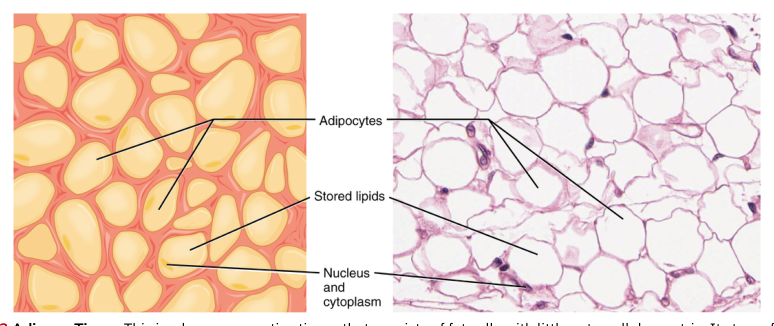
Yellow bone marrow contains adipocytes, or fat cells. These adipocytes store triglycerides. The triglycerides are not simply structural padding; they represent a potential energy reserve that the body can use when energy demands or nutritional conditions require it.
Distinction to remember: Red marrow is associated with blood-cell production; yellow marrow is associated with triglyceride storage.
Bone density, exercise, and nutrition
The total amount of bone tissue is called bone density. Bone density does not reach its maximum immediately after adolescence. Although growth in bone length may slow earlier, the total amount of bone tissue continues to increase slowly until the late $20$s.
Bone tissue responds to mechanical stress. Exercise places forces on bones, stimulating the deposition of mineral salts and collagen fibers. In contrast, during long space missions, astronauts can lose approximately $1$ to $2%$ of their bone mass per month. The reduced mechanical stress associated with low gravitational forces is thought to contribute to the loss of mineral salts and collagen fibers, weakening bone.
Nutrition also affects the matrix. Calcium is the predominant mineral in bone, but calcium cannot be absorbed effectively from the small intestine when vitamin D is lacking. Sunlight can trigger the body to produce vitamin D in the skin; vitamin D can also come from foods such as fatty fish or fortified milk and cereal. Deficiency is more likely in people with limited sunlight exposure, including people living at northern latitudes or people with darker complexions, and a physician may prescribe supplementation when needed.
Bone classification by shape
The adult human skeleton contains $206$ bones. These bones are divided into five categories based on their shapes. Shape is not an arbitrary labeling system: the form of a bone is related to the function it performs.
A long bone is one of the bone-shape classifications. Its defining feature is a length greater than its width. Long-bone structure is associated with support and movement because these bones can act as rigid levers when muscles pull on them. The classification system allows a bone’s general architecture to provide an initial clue about its mechanical role, even before its individual landmarks and articulations are studied.
Worked application: predicting the consequence of reduced mechanical stress
Problem: An astronaut spends several months in an environment with very low gravitational forces. Based on bone physiology, predict what will happen to bone tissue and explain why.
Solution: Bone mass is expected to decrease. Low gravitational forces reduce the mechanical stress placed on bones. Reduced stress decreases the stimulus for depositing mineral salts and collagen fibers, so bone tissue can lose both mineral and organic matrix components. The result is weaker bone and reduced bone density.
Why this reasoning works: It connects matrix composition to whole-body function. Mineralized hydroxyapatite contributes hardness, and collagen contributes tensile strength. Losing either component can impair bone strength; losing both makes the skeleton less able to support the body and protect internal organs.
The detailed organization of the cranium, vertebral column, ribs, and other skeletal regions follows directly from these principles: each region combines living bone tissue, protective architecture, and mechanical function in a distinctive way.
Content adapted from OpenStax Anatomy and Physiology 2e by J. Gordon Betts et al., licensed CC BY 4.0.
Source Materials
Study Anatomy and Physiology on Lykke
This course page is free to open: signed out, you can read its first two sections, and signing in, on any plan, opens the rest. The free Lykke Chrome extension syncs your own Canvas courses, so ChatGPT, Claude and Muse can answer from your classes and deadlines. It only reads Canvas.
Add the free extensionSign in to open every sectionAll sections of Anatomy and Physiology · Browse more course pages