From the free course Anatomy and Physiology on Lykke
Fluids, Transport, and Maintenance
Key concepts: Cardiovascular System · Lymphatic and Immune Systems · Respiratory System · Digestive System · Urinary System
Examines the systems that transport nutrients and oxygen while removing waste, including the cardiovascular, respiratory, digestive, and urinary systems.
Fluids, Transport, and Maintenance
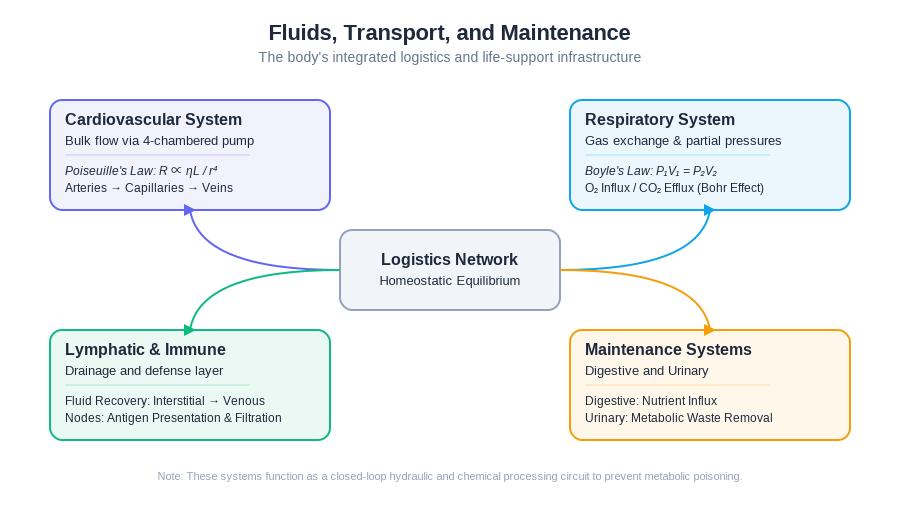
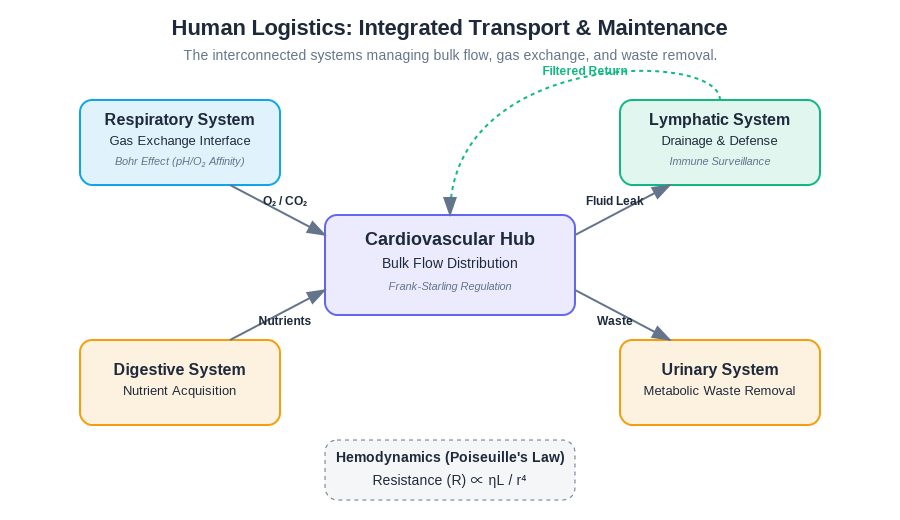
The human body is a complex biological machine that operates far from thermodynamic equilibrium. To maintain this state, it requires a constant influx of energy and nutrients, a robust transport mechanism to distribute these resources, and a sophisticated waste-management infrastructure to prevent metabolic poisoning. This section explores the Fluids, Transport, and Maintenance systems—comprising the Cardiovascular, Lymphatic, Respiratory, Digestive, and Urinary systems—which collectively function as the body's logistics and life-support network.
The Cardiovascular System: The Central Transport Hub
The Cardiovascular System is a closed-loop hydraulic circuit powered by a four-chambered muscular pump: the heart. Its primary objective is the bulk flow of blood, a specialized fluid connective tissue, to ensure that every cell remains within a few micrometers of a capillary for efficient diffusion.
Hemodynamics and Vessel Architecture
The physics of blood flow is governed by Poiseuille's Law, which states that resistance ($R$) is proportional to the viscosity of the blood ($\eta$) and the length of the vessel ($L$), but inversely proportional to the fourth power of the radius ($r^4$). This means that small changes in vessel diameter (vasoconstriction or vasodilation) have a massive impact on blood pressure and flow distribution.
| Vessel Type | Primary Function | Structural Feature | Pressure Level |
|---|---|---|---|
| Arteries | Pressure Reservoirs | Thick Tunica Media (Elastic/Muscular) | High |
| Arterioles | Resistance Vessels | High Smooth Muscle content | Variable (Control) |
| Capillaries | Exchange Vessels | Single layer of Endothelium (Tunica Intima) | Low |
| Venules | Collection | Thin walls, porous | Very Low |
| Veins | Volume Reservoirs | Presence of Valves; High Compliance | Lowest |
The Cardiac Cycle
The heart operates via a rhythmic alternation between Systole (contraction/ejection) and Diastole (relaxation/filling). This cycle is coordinated by an intrinsic conduction system, starting at the Sinoatrial (SA) Node, often called the natural pacemaker.
Key Insight: The Frank-Starling Law of the Heart The heart possesses an intrinsic ability to adapt to changing volumes of inflowing blood. Specifically, the force of cardiac contraction is directly proportional to the initial length of the muscle fiber (Preload). This ensures that the output of the left and right ventricles remains balanced over time.
Lymphatic and Immune Systems: The Drainage and Defense Layer
While the cardiovascular system is a closed loop, it is "leaky." At the capillary level, Hydrostatic Pressure forces fluid out into the interstitial space. Not all of this fluid returns via Osmotic Pressure.
Fluid Recovery and Filtration
The Lymphatic System acts as a secondary circulatory route. It picks up excess interstitial fluid (now called lymph), filters it through lymph nodes, and returns it to the venous circulation via the subclavian veins.
- Lymphatic Capillaries: Highly permeable, "blind-ended" vessels.
- Lymph Nodes: Biological "checkpoints" packed with lymphocytes (B and T cells) that scan for pathogens.
- Spleen: The largest lymphatic organ, responsible for filtering blood and recycling aged red blood cells.
The Immune Response
The immune system is categorized into Innate Immunity (non-specific, immediate) and Adaptive Immunity (specific, memory-based). The lymphatic system provides the physical infrastructure where these two systems interact, particularly during Antigen Presentation.
The Respiratory System: The Gas Exchange Interface
The respiratory system's primary function is to maintain the partial pressure gradients of Oxygen ($O_2$) and Carbon Dioxide ($CO_2$) between the atmosphere and the blood.
Mechanics of Ventilation
Breathing is driven by pressure changes in the thoracic cavity, governed by Boyle's Law ($P_1V_1 = P_2V_2$). When the diaphragm contracts, thoracic volume increases, pressure drops below atmospheric pressure, and air rushes in.
Gas Transport and the Bohr Effect
Oxygen is transported primarily bound to Hemoglobin in red blood cells. The affinity of hemoglobin for $O_2$ is not static; it changes based on the local environment—a phenomenon known as the Bohr Effect.
\text{pH and Hemoglobin Affinity (Simplified)} \\
\uparrow [H^+] \text{ (lower pH)} \rightarrow \text{Right shift in dissociation curve} \rightarrow \downarrow \text{Affinity for } O_2 \\
\text{This ensures } O_2 \text{ is dropped off at metabolically active (acidic) tissues.}
| Parameter | Definition | Typical Value (Adult Male) |
|---|---|---|
| Tidal Volume (TV) | Volume of air moved in/out during normal breath | 500 mL |
| Inspiratory Reserve (IRV) | Extra air that can be forcibly inhaled | 3000 mL |
| Residual Volume (RV) | Air remaining in lungs after maximal exhalation | 1200 mL |
| Vital Capacity (VC) | Total exchangeable air (TV + IRV + ERV) | 4800 mL |
The Digestive System: The Nutrient Extraction Engine
The digestive system is a continuous tube (the Alimentary Canal) that processes raw materials into chemical energy and structural building blocks.
The Processing Pipeline
- Ingestion and Mechanical Digestion: Mastication (chewing) in the mouth and churning in the stomach.
- Chemical Digestion: The enzymatic breakdown of macromolecules.
- Absorption: The movement of nutrients from the lumen of the small intestine into the blood or lymph.
- Defecation: The elimination of indigestible substances.
Enzymatic Breakdown
Different regions of the GI tract specialize in different macromolecules:
| Enzyme | Source | Substrate | Optimal pH |
|---|---|---|---|
| Salivary Amylase | Salivary Glands | Polysaccharides | 6.7 - 7.0 |
| Pepsin | Stomach (Chief Cells) | Proteins | 1.5 - 2.0 |
| Pancreatic Lipase | Pancreas | Triglycerides | 7.0 - 8.0 |
| Trypsin | Pancreas | Proteins/Peptides | 7.0 - 8.0 |
Key Concept: The Hepatic Portal System All blood draining from the digestive organs (except the lower rectum) is diverted to the Liver via the hepatic portal vein. This allows the liver to process nutrients, detoxify metabolic byproducts, and store glycogen before the blood reaches the rest of the body.
The Urinary System: The Homeostatic Filter
The Urinary System is the body's master chemist. While often thought of as just "making urine," its primary role is the precise regulation of blood volume, blood pressure, and blood pH.
The Nephron: The Functional Unit
Each kidney contains approximately one million nephrons. The process of urine formation occurs in three distinct stages:
- Glomerular Filtration: Non-selective "bulk" filtration of water and small solutes out of the blood.
- Tubular Reabsorption: Reclaiming useful substances (glucose, ions, water) back into the blood.
- Tubular Secretion: Active transport of wastes (H+, K+, drugs) from the blood into the filtrate.
The RAAS Pathway
The Renin-Angiotensin-Aldosterone System (RAAS) is the primary hormonal mechanism for long-term blood pressure regulation.
System Integration: The Maintenance Loop
These systems do not operate in isolation. They are linked by feedback loops that maintain Homeostasis.
Case Study: pH Buffering
When you exercise, your muscles produce $CO_2$ and Lactic Acid.
- Respiratory Response: The brainstem detects rising $CO_2$ (via pH drop) and increases ventilation rate to "blow off" $CO_2$.
- Urinary Response: The kidneys secrete $H^+$ ions into the urine and reabsorb Bicarbonate ($HCO_3^-$) to buffer the blood.
- Cardiovascular Response: Heart rate increases to transport $CO_2$ to the lungs and $O_2$ to the muscles faster.
Common Pitfalls in Understanding
- Arteries vs. Veins: A common mistake is defining arteries as "carrying oxygenated blood." While usually true, the Pulmonary Artery carries deoxygenated blood to the lungs. The correct definition is based on direction: Arteries go Away from the heart; Veins return to the heart.
- Filtration vs. Secretion: In the kidney, filtration is a passive process driven by blood pressure in the glomerulus. Secretion is an active, selective process occurring later in the tubule.
- Lymph Flow: Unlike the cardiovascular system, the lymphatic system has no central pump. Lymph moves via the "skeletal muscle pump" and respiratory pressure changes.
Summary of Maintenance Functions
| System | Primary Maintenance Role | Key Regulatory Variable |
|---|---|---|
| Cardiovascular | Convective Transport | Mean Arterial Pressure (MAP) |
| Lymphatic | Fluid Balance / Defense | Interstitial Fluid Volume |
| Respiratory | Gas Exchange | Partial Pressure of $CO_2$ ($PCO_2$) |
| Digestive | Nutrient Acquisition | Blood Glucose / Amino Acid levels |
| Urinary | Waste Removal / Osmolarity | Plasma Osmolarity / pH |
This integrated network ensures that despite massive fluctuations in external environment and internal activity, the "internal sea" (the extracellular fluid) remains stable enough for life to persist.
Interactive demos for this section
- Hemodynamics: Poiseuille's Law Demo: a free interactive demo that runs in your browser
Source Materials
Study Anatomy and Physiology on Lykke
This course page is free to open: signed out, you can read its first two sections, and signing in, on any plan, opens the rest. The free Lykke Chrome extension syncs your own Canvas courses, so ChatGPT, Claude and Muse can answer from your classes and deadlines. It only reads Canvas.
Add the free extensionSign in to open every sectionAll sections of Anatomy and Physiology · Browse more course pages