From the free course Anatomy and Physiology on Lykke
Reproduction and Human Development
Key concepts: Reproductive Systems · Embryology · Genetics · Human Development
Covers the biological processes of the reproductive systems, human development from conception to birth, and the principles of inheritance.
Reproduction and Human Development
The biological imperative of any species is the successful transmission of genetic material to the next generation. In humans, this process is an intricate orchestration of anatomical specialization, hormonal signaling, and molecular precision. This article explores the mechanisms of human reproduction, the trajectory of embryological development, and the foundational principles of genetics that govern inheritance.
Reproductive Systems: The Architecture of Continuity
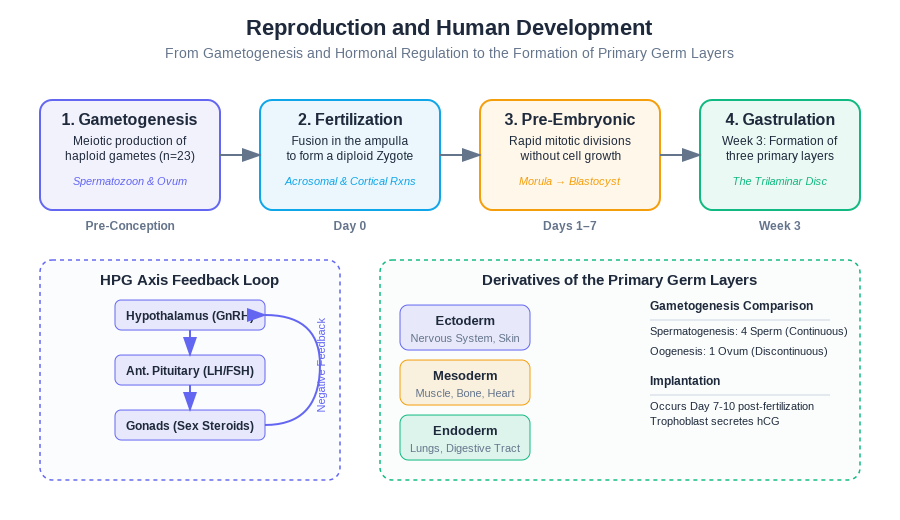
Human reproduction relies on anisogamy, the fusion of two morphologically distinct gametes: the small, motile spermatozoon and the large, nutrient-rich ovum. The systems responsible for producing these gametes are regulated by the Hypothalamic-Pituitary-Gonadal (HPG) axis, a complex feedback loop involving Gonadotropin-Releasing Hormone (GnRH), Luteinizing Hormone (LH), and Follicle-Stimulating Hormone (FSH).
Comparative Physiology of Gametogenesis
While both sexes utilize meiosis to produce haploid cells ($n=23$), the timing and output of these processes differ significantly.
| Feature | Spermatogenesis | Oogenesis |
|---|---|---|
| Location | Seminiferous tubules (Testes) | Ovaries |
| Timing | Puberty until death | Begins in utero; arrested until puberty; ends at menopause |
| Meiotic Continuity | Continuous process | Discontinuous (arrested in Prophase I and Metaphase II) |
| Output | 4 functional sperm cells | 1 functional ovum + 2-3 polar bodies |
| Cycle Duration | ~64–72 days | ~28 days (monthly cycle) |
The HPG Axis Feedback Loop
The regulation of reproductive function is a classic example of a homeostatic control system. In males, testosterone provides negative feedback to the hypothalamus and anterior pituitary. In females, the feedback is more complex, switching from negative to positive feedback to trigger the LH surge required for ovulation.
Embryology: From Zygote to Neonate
Embryology is the study of the first eight weeks of development following fertilization. This period is characterized by rapid cellular proliferation, migration, and differentiation.
Fertilization and the Pre-Embryonic Stage
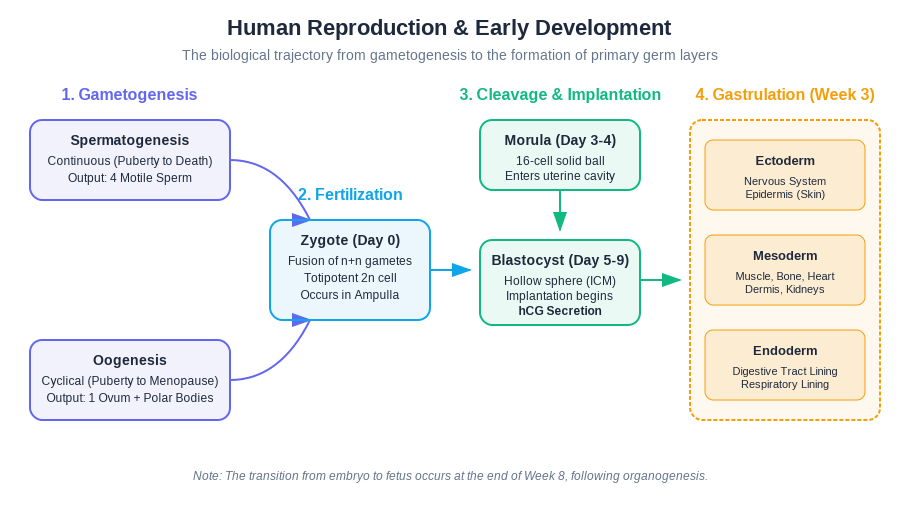
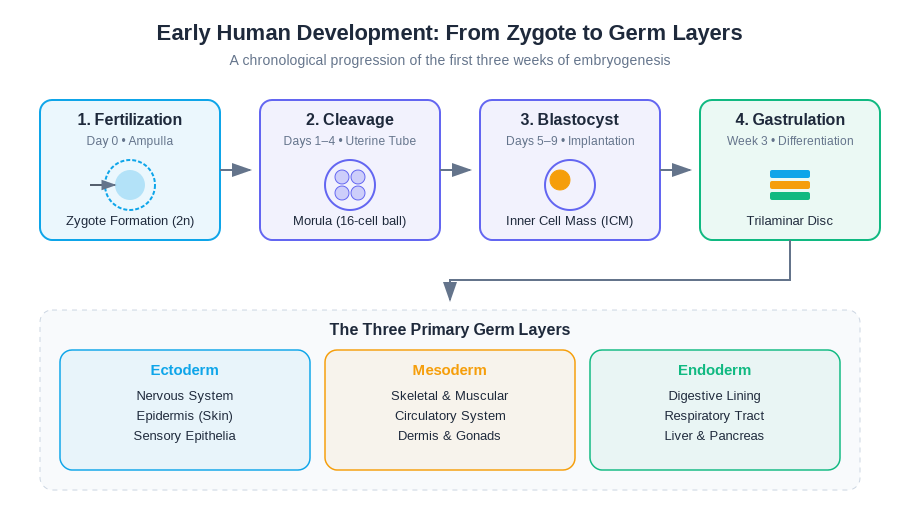
Fertilization typically occurs in the ampulla of the uterine tube. It is not a single event but a sequence of biochemical hurdles:
- Capacitation: Sperm undergo membrane changes in the female tract to become fertile.
- Acrosomal Reaction: Enzymes are released to penetrate the zona pellucida.
- Cortical Reaction: Once a sperm penetrates, the oocyte releases granules to prevent polyspermy (fertilization by multiple sperm).
Definition: The Zygote The diploid cell ($2n=46$) resulting from the fusion of a haploid spermatozoon and a haploid secondary oocyte. It represents the first stage of a unique genetic individual.
Cleavage and Implantation
Following fertilization, the zygote undergoes cleavage, a series of rapid mitotic divisions without intervening growth. This leads to the formation of a morula (16-cell solid ball) and eventually a blastocyst.
| Stage | Time Post-Fertilization | Key Characteristics |
|---|---|---|
| Zygote | Day 0 | Single diploid cell; totipotent. |
| Morula | Day 3-4 | Solid ball of cells; enters the uterine cavity. |
| Blastocyst | Day 5-7 | Hollow sphere; contains Inner Cell Mass (ICM) and Trophoblast. |
| Implantation | Day 7-10 | Trophoblast invades the endometrium; hCG production begins. |
Gastrulation and Germ Layer Formation
During the third week, the process of gastrulation transforms the two-layered embryonic disc into a three-layered structure. These three germ layers are the precursors to all adult tissues:
- Ectoderm: Becomes the nervous system and epidermis.
- Mesoderm: Becomes muscle, bone, circulatory system, and dermis.
- Endoderm: Becomes the epithelial lining of the digestive and respiratory tracts.
Fetal Development and Placentation
The transition from embryo to fetus occurs at the end of week 8. The fetal period (weeks 9–40) is primarily focused on growth and functional maturation of organ systems.
The Placenta: The Life-Support Interface
The placenta is a unique fetomaternal organ. It performs respiratory, nutritive, excretory, and endocrine functions without ever allowing the direct mixing of maternal and fetal blood.
- Maternal Side: Decidua basalis (modified endometrium).
- Fetal Side: Chorionic villi containing fetal capillaries.
- Diffusion Barrier: Oxygen, glucose, and antibodies (IgG) cross into fetal circulation; $CO_2$ and urea cross into maternal circulation.
Trimester Milestones
| Trimester | Duration | Primary Focus | Critical Events |
|---|---|---|---|
| First | Weeks 1–12 | Organogenesis | Heart begins beating (Wk 4); most vulnerable to teratogens. |
| Second | Weeks 13–28 | Growth & Detail | Fetal movement (quickening); vernix caseosa and lanugo form. |
| Third | Weeks 29–Birth | Weight Gain & Prep | Surfactant production in lungs; rapid brain development. |
Genetics and Human Inheritance
Genetics is the study of how traits are transmitted via DNA. The human genome consists of approximately 20,000–25,000 genes distributed across 23 pairs of chromosomes.
Mendelian vs. Non-Mendelian Inheritance
While Gregor Mendel’s laws of segregation and independent assortment provide the foundation, human genetics often involves more complex patterns.
- Autosomal Dominant/Recessive: Traits on non-sex chromosomes (e.g., Cystic Fibrosis is recessive).
- Incomplete Dominance: The phenotype is an intermediate (e.g., Familial Hypercholesterolemia).
- Codominance: Both alleles are expressed equally (e.g., ABO blood groups).
- Polygenic Inheritance: Traits determined by multiple genes (e.g., skin color, height).
Logic of the Punnett Square
To predict the probability of offspring genotypes, we use a matrix approach. For a dihybrid cross (two traits), the complexity increases to a $4 \times 4$ grid.
Epigenetics and Environmental Interaction
The phenotype is not merely the result of the genotype ($P = G + E$). Epigenetics refers to heritable changes in gene expression that do not involve changes to the underlying DNA sequence. Mechanisms include:
- DNA Methylation: Adding methyl groups to cytosine bases, typically silencing genes.
- Histone Acetylation: Modifying the proteins DNA wraps around to make genes more or less accessible.
Clinical Applications and Data Management
In modern medicine, reproductive data and genetic screening are vital for prenatal care and treating infertility.
IVF and Assisted Reproductive Technology (ART)
In Vitro Fertilization involves the hormonal stimulation of ovaries, oocyte retrieval, fertilization in a lab setting, and embryo transfer. Managing the data for these procedures requires rigorous tracking.
Common Pitfalls in Understanding
- The "Master Plan" Fallacy: Development is often viewed as a blueprint being followed. In reality, it is a self-organizing system where local cellular interactions and chemical gradients (morphogens) drive the process.
- Genetic Determinism: The belief that "genes are destiny." Most human traits are multifactorial, involving significant environmental and stochastic (random) components.
- Identical vs. Fraternal Twins: Monozygotic (identical) twins come from one zygote that splits; Dizygotic (fraternal) twins come from two separate eggs fertilized by two separate sperm. They are genetically no more similar than regular siblings.
Inclusive Instruction: Diversity in Development
Modern biological education recognizes that "male" and "female" represent the ends of a biological spectrum. Intersex variations (such as Androgen Insensitivity Syndrome or Klinefelter Syndrome) demonstrate that chromosomal sex ($XX/XY$), gonadal sex (ovaries/testes), and phenotypic sex (external genitalia) do not always align in a binary fashion. Understanding these variations is essential for equitable healthcare and a complete scientific understanding of human development.
Summary of Developmental Timeline
- Week 1: Fertilization, Cleavage, Blastocyst formation.
- Week 2: Implantation, Bilaminar disc formation.
- Week 3: Gastrulation (Ecto, Meso, Endoderm), Neurulation begins.
- Weeks 4-8: Organogenesis; all major systems established.
- Weeks 9-Birth: Fetal period; growth, maturation, and preparation for extrauterine life.
The study of reproduction and development is a study of ourselves—how we begin as a single cell and, through the precise execution of genetic instructions and environmental cues, become the most complex structures in the known universe.
Interactive demos for this section
- Embryogenesis: From Zygote to Implantation: a free interactive demo that runs in your browser
Source Materials
Study Anatomy and Physiology on Lykke
This course page is free to open: signed out, you can read its first two sections, and signing in, on any plan, opens the rest. The free Lykke Chrome extension syncs your own Canvas courses, so ChatGPT, Claude and Muse can answer from your classes and deadlines. It only reads Canvas.
Add the free extensionSign in to open every sectionAll sections of Anatomy and Physiology · Browse more course pages