From the free course Anatomy and Physiology on Lykke
Support, Movement, and Control
Key concepts: Integumentary System · Skeletal System · Muscular System · Nervous System · Endocrine System
Explores the systems responsible for the body's structure, movement, and internal communication, including the skeletal, muscular, nervous, and endocrine systems.
Support, Movement, and Control: The Biomechanical and Cybernetic Framework
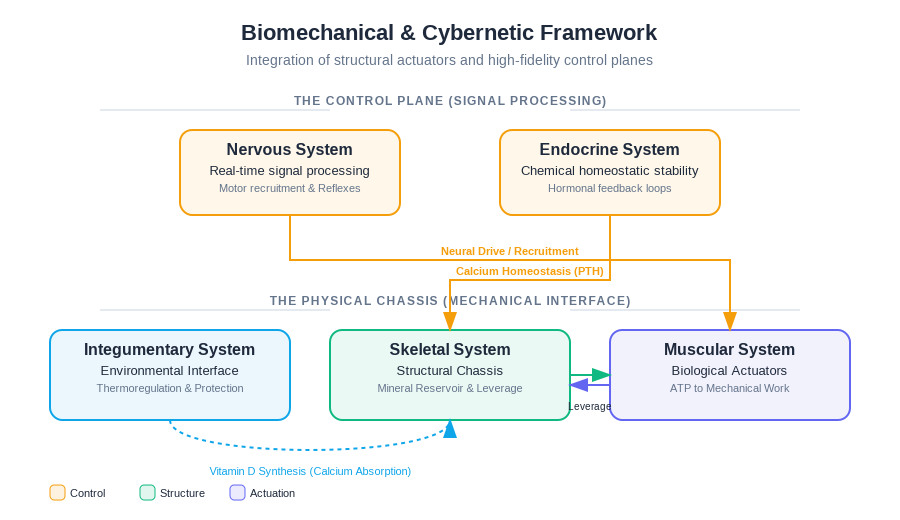
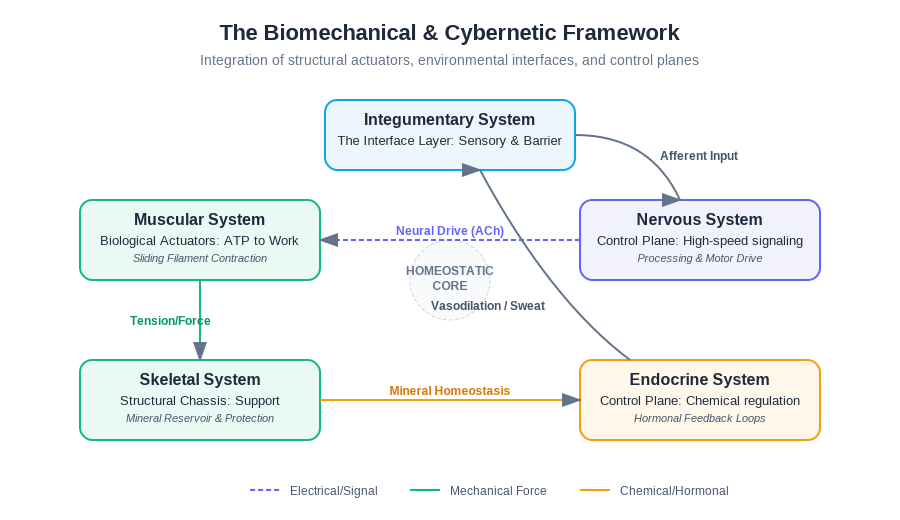
In the architecture of the human body, the systems governing support, movement, and control represent a sophisticated integration of structural engineering and high-fidelity signal processing. While the Integumentary, Skeletal, and Muscular systems provide the physical chassis and actuators required for interaction with the physical world, the Nervous and Endocrine systems function as the control plane, managing real-time responses and long-term homeostatic stability.
This article decomposes these systems into their functional components, examining the mechanics of movement, the chemistry of signaling, and the feedback loops that maintain biological integrity.
### The Integumentary System: The Interface Layer
The Integumentary System is the body's primary interface with the external environment. Far from being a passive container, it is a dynamic organ system comprising the skin, hair, nails, and exocrine glands. It serves as the first line of defense (innate immunity), a sensory receptor array, and a critical thermoregulatory heat exchanger.
1. What it is
The skin is organized into two primary layers: the Epidermis (the epithelial outer layer) and the Dermis (the connective tissue layer), resting upon the Hypodermis (subcutaneous fascia).
The Acid Mantle: A very thin, slightly acidic film on the surface of human skin acting as a barrier to bacteria, viruses, and other potential contaminants. It is formed by the mix of sebum (oil) and sweat.
2. Why it matters
Without the integumentary system, the body would succumb to rapid dehydration (desiccation), uncontrolled infection, and thermal failure. It also facilitates the synthesis of Vitamin D, which is essential for calcium absorption in the skeletal system—showing the first major link between these "separate" systems.
3. How it works: Thermoregulation Pipeline
When core temperature rises, the hypothalamus triggers two primary mechanisms:
- Vasodilation: Dermal blood vessels dilate to increase heat loss via radiation.
- Sudoriferous Activation: Eccrine sweat glands secrete water and electrolytes; evaporation provides latent heat cooling.
| Layer | Primary Tissue Type | Key Cell Types | Functional Role |
|---|---|---|---|
| Epidermis | Stratified Squamous Epithelium | Keratinocytes, Melanocytes | Waterproofing, UV protection, Barrier |
| Dermis | Dense Irregular Connective | Fibroblasts, Macrophages | Structural integrity, Sensation, Blood supply |
| Hypodermis | Adipose / Areolar | Adipocytes | Insulation, Energy storage, Shock absorption |
### The Skeletal System: The Structural Chassis
The Skeletal System provides the rigid framework required for locomotion and the protection of soft-tissue "payloads" (organs). It is a metabolically active system that undergoes constant remodeling in response to mechanical stress.
1. What it is
The system is divided into the Axial Skeleton (central axis: skull, vertebral column, thoracic cage) and the Appendicular Skeleton (limbs and girdles).
2. How it works: Bone Remodeling (Wolff’s Law)
Bones are not static. They operate under Wolff’s Law, which states that bone grows or remodels in response to the forces or demands placed upon it. This is managed by two competing cell populations:
- Osteoblasts: Bone-forming cells (the "builders").
- Osteoclasts: Bone-resorbing cells (the "demolition crew").
3. Concrete Example: Calcium Homeostasis
The skeletal system acts as a mineral reservoir. If blood calcium levels drop, the Parathyroid Hormone (PTH) stimulates osteoclasts to break down bone matrix, releasing $Ca^{2+}$ into the bloodstream.
4. Common Pitfalls
A common misconception is that bone is "dead" material like wood or stone. In reality, bone is highly vascularized. If you break a bone, the "healing" is a rapid cellular response involving hematoma formation and fibrocartilaginous callus production—processes impossible in non-living structures.
### The Muscular System: Biological Actuators
The Muscular System converts chemical energy (ATP) into mechanical work. It is the only tissue in the body capable of active contraction.
1. What it is
Muscles are categorized by their control (voluntary vs. involuntary) and their cellular morphology (striated vs. smooth).
| Muscle Type | Control | Location | Histology |
|---|---|---|---|
| Skeletal | Voluntary | Attached to bones | Striated, Multinucleated |
| Cardiac | Involuntary | Heart wall | Striated, Intercalated discs |
| Smooth | Involuntary | Walls of hollow organs | Non-striated, Spindle-shaped |
2. How it works: The Sliding Filament Theory
Contraction occurs at the Sarcomere level. When a motor neuron releases Acetylcholine (ACh), it triggers an action potential in the muscle fiber, releasing $Ca^{2+}$ from the sarcoplasmic reticulum.
### The Nervous System: The High-Speed Data Bus
The Nervous System is the body's rapid-response control center. It processes sensory input, integrates information, and initiates motor output via electrochemical signals.
1. The Protocol: The Action Potential
The fundamental unit of communication is the Action Potential. This is a binary "all-or-none" event where the membrane potential of a neuron rapidly rises and falls.
2. Mathematical Representation
The equilibrium potential for a specific ion is calculated using the Nernst Equation:
E_{ion} = \frac{RT}{zF} \ln \frac{[ion]_{outside}}{[ion]_{inside}}
Where:
- $R$ is the universal gas constant.
- $T$ is absolute temperature.
- $z$ is the valence of the ion.
- $F$ is Faraday's constant.
3. Pseudocode: Synaptic Transmission Logic
FUNCTION Synaptic_Transfer(PreSynaptic_Signal):
    IF PreSynaptic_Signal.Voltage > Threshold THEN
        OPEN Voltage_Gated_Ca_Channels()
        RELEASE Neurotransmitter(Vesicles)
        DIFFUSE Neurotransmitter across Synaptic_Cleft
        BIND Neurotransmitter to PostSynaptic_Receptors

        IF Receptor_Type == EXCITATORY:
            DEPOLARIZE PostSynaptic_Membrane
        ELSE IF Receptor_Type == INHIBITORY:
            HYPERPOLARIZE PostSynaptic_Membrane
    END IF
END FUNCTION
### The Endocrine System: The Global Broadcast System
If the Nervous System is a fiber-optic network (point-to-point, high speed), the Endocrine System is a wireless broadcast system (global signal, slower latency, high persistence). It uses Hormones secreted into the blood to reach distant target cells.
1. Mechanisms of Action
Hormones act only on cells with specific receptors. They are categorized by chemical structure:
- Amino Acid Derivatives: (e.g., Epinephrine) - Fast acting, membrane-bound receptors.
- Lipid-Derived (Steroids): (e.g., Testosterone, Cortisol) - Slow acting, cross the cell membrane to alter gene expression directly.
2. Feedback Loops: The PID Controller of Biology
Most endocrine functions are regulated by Negative Feedback Loops. For example, the regulation of blood glucose by Insulin and Glucagon acts like a thermostat.
| Parameter | High Blood Glucose | Low Blood Glucose |
|---|---|---|
| Sensor | Pancreatic Beta Cells | Pancreatic Alpha Cells |
| Hormone Released | Insulin | Glucagon |
| Target Action | Glucose uptake by cells, Glycogenesis | Glycogenolysis, Gluconeogenesis |
| Result | Glucose levels decrease | Glucose levels increase |
### Synthesis: The Integrated Control Loop
The true complexity of "Support, Movement, and Control" is found in the intersection of these systems.
Case Study: The "Fight or Flight" Response
- Nervous System: Amygdala perceives a threat and signals the Hypothalamus.
- Endocrine System: The Adrenal Medulla releases Epinephrine (Adrenaline) into the blood.
- Muscular System: Increased blood flow and glucose availability prepare muscles for explosive contraction.
- Integumentary System: Sudoriferous glands activate (cold sweat) to prepare for the heat of exertion.
- Skeletal System: Acts as the lever system for the muscles to execute the escape.
Comparison of Control Systems
| Feature | Nervous System | Endocrine System |
|---|---|---|
| Signal Type | Electrical (Impulses) & Chemical (NTs) | Chemical (Hormones) |
| Transmission Path | Neurons / Synapses | Bloodstream |
| Speed of Onset | Milliseconds | Seconds to Days |
| Duration of Effect | Very Short (Transient) | Long-lasting |
| Specificity | High (Targeted to specific cells) | Broad (Any cell with receptors) |
### Common Pitfalls in Systemic Integration
- The "Isolation" Fallacy: Students often study the Skeletal system as a dry collection of bones. However, bones are the primary site of Hematopoiesis (blood cell production). A failure in the skeletal system (e.g., leukemia in bone marrow) immediately compromises the immune and respiratory systems.
- Confusing "Control" with "Consciousness": Most "Control" is autonomic. The Nervous system manages heart rate, digestion, and pupil dilation without any CPU cycles from the conscious mind (Prefrontal Cortex).
- Hormonal Latency: Engineers often forget that endocrine signals have a "washout" period. Unlike a light switch (Nervous), an endocrine signal is like a dye in a river; even after the source stops, the signal persists until cleared by the liver or kidneys.
End of Article
Interactive demos for this section
- Sarcomere Dynamics: The Sliding Filament Theory: a free interactive demo that runs in your browser
Source Materials
Study Anatomy and Physiology on Lykke
This course page is free to open: signed out, you can read its first two sections, and signing in, on any plan, opens the rest. The free Lykke Chrome extension syncs your own Canvas courses, so ChatGPT, Claude and Muse can answer from your classes and deadlines. It only reads Canvas.
Add the free extensionSign in to open every sectionAll sections of Anatomy and Physiology · Browse more course pages