From the free course Anatomy and Physiology on Lykke
Chapter 2: The Chemical Level of Organization
Key concepts: Matter and its properties · Elements as building blocks of matter · Atoms and atomic structure · Protons, neutrons, and electrons · Chemical compounds and chemical bonds · Organic and inorganic compounds · Macronutrients and energy-yielding nutrients · Water, salts, acids, and bases · Chemical reactions and energy transfer · DNA, nucleotide bases, and genetic information
By the end of this chapter the student can: Describe the fundamental composition of matter; Identify the three subatomic particles; Identify the four most abundant elements in the body; Explain the relationship between an atom’s number of electrons and its relative stability; Distinguish between ionic bonds, covalent bonds, and hydrogen bonds; Explain how energy is invested, stored, and released via chemical reactions, particularly those reactions that are critical to life; Explain the importance of the inorganic compounds that contribute to life, such as water, salts, acids, and bases.
Chapter 2: The Chemical Level of Organization
Elements, atoms, compounds, and chemical reactions provide the materials and energy required for life. Every structure in the human body, from a mineral in bone to the genetic instructions in DNA, depends on chemical organization.
Matter and Its Properties
Matter is anything that occupies space and has mass. A glass of water, a breath of air, a protein molecule, and a human body are all matter because they take up space and possess mass.
Mass is the amount of matter in an object. Weight is the force exerted on that mass by gravity.
Mass and weight are related but not identical. Your mass remains essentially the same if you travel from Earth to the Moon, but your weight decreases on the Moon because the Moon’s gravitational pull is weaker. In anatomy and physiology, this distinction matters when describing body composition, measuring substances, or interpreting forces acting on the body.
Matter can exist as solids, liquids, or gases. A solid has a definite shape and volume; a liquid has a definite volume but takes the shape of its container; and a gas changes both shape and volume to fill its container. These physical states result from how strongly the particles of matter attract one another and how freely they move.
Elements: The Building Blocks of Matter
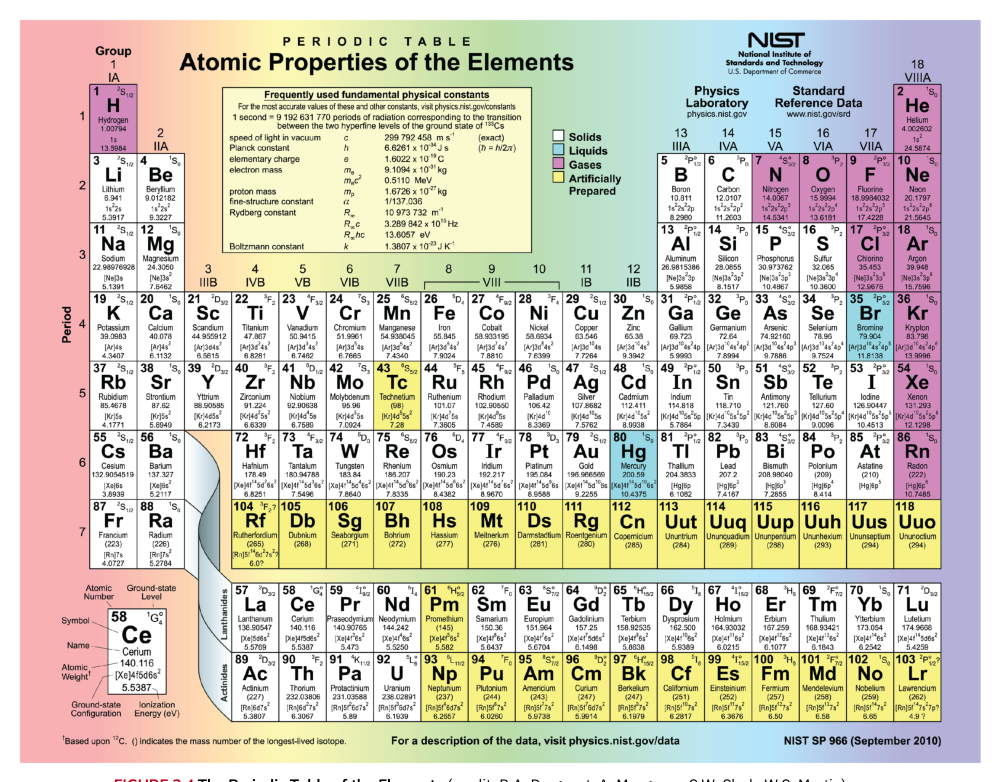
An element is a pure substance that cannot be broken down into a simpler substance by ordinary chemical means. The human body must obtain elements from the environment, primarily through food, water, and air. Oxygen, carbon, hydrogen, and nitrogen are the four most abundant elements in the body, but many other elements are essential in smaller amounts.
Elements are identified by their chemical properties and by the number of protons in their atoms. Oxygen atoms always contain $8$ protons; carbon atoms always contain $6$ protons. Changing the number of protons changes the element itself. Elements are organized in the periodic table, which groups elements according to recurring chemical properties.
Some elements contribute directly to body structure, while others participate in energy transformation, electrical activity, or muscle contraction. The elements found in living organisms were formed through processes occurring in stars, and they later became part of the molecules used by human cells.
Atoms and Atomic Structure
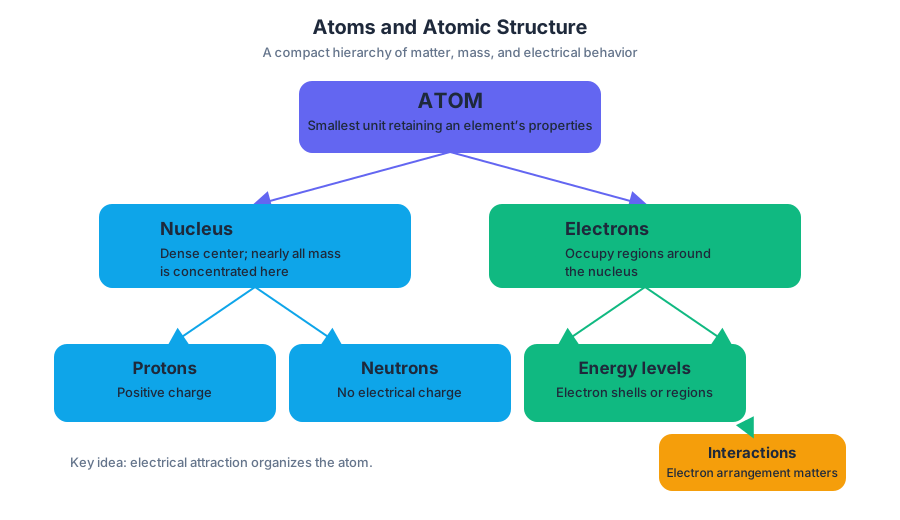
An atom is the smallest amount of an element that can exist while retaining the properties of that element. Atoms are extraordinarily small. A useful mental image is a tiny central nucleus surrounded by a diffuse region in which electrons are found—not a miniature solid solar system, but a structure organized by electrical attraction and the behavior of subatomic particles.
Atoms contain a dense nucleus, made of protons and neutrons, surrounded by electrons. Nearly all of an atom’s mass is concentrated in its nucleus. The electrons occupy regions around the nucleus often described as electron shells or energy levels. The arrangement of these electrons strongly influences how an atom interacts with other atoms.
Protons, Neutrons, and Electrons
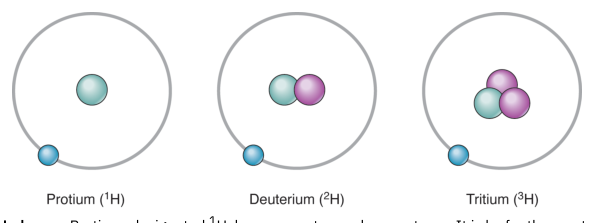
A proton is a positively charged subatomic particle. A neutron has no electrical charge. An electron is negatively charged and has only about $1/2{,}000$ the mass of a proton or neutron.
In an electrically neutral atom, the number of protons equals the number of electrons, so the positive and negative charges balance. If an atom gains or loses electrons, it becomes an ion, an electrically charged atom. Losing electrons produces a positively charged ion called a cation; gaining electrons produces a negatively charged ion called an anion.
The number of protons identifies the element, while differences in the number of neutrons or electrons do not change the element’s identity. However, they can change its mass or electrical behavior. Electrons in the outermost occupied shell are especially important because atoms may gain, lose, or share these electrons when forming chemical bonds.
Chemical Compounds and Chemical Bonds
A compound is a substance consisting of two or more different elements joined by chemical bonds. The properties of a compound can differ greatly from the properties of the elements that form it. For example, glucose contains carbon, hydrogen, and oxygen, yet glucose has its own distinctive structure and function as an important fuel for the body.
A chemical bond is an attractive force that holds atoms together. Bonds form when atoms transfer or share electrons, allowing the resulting arrangement to become more stable. The major bond types emphasized in human physiology are ionic bonds, covalent bonds, and hydrogen bonds.
Ionic, Covalent, and Hydrogen Bonds
An ionic bond forms when one atom transfers one or more electrons to another atom. The atom that loses electrons becomes a cation, and the atom that gains electrons becomes an anion. Their opposite charges attract. A compound such as sodium chloride, $\text{NaCl}$, forms an ionic crystal composed of equal numbers of $\text{Na}^+$ and $\text{Cl}^-$ ions.
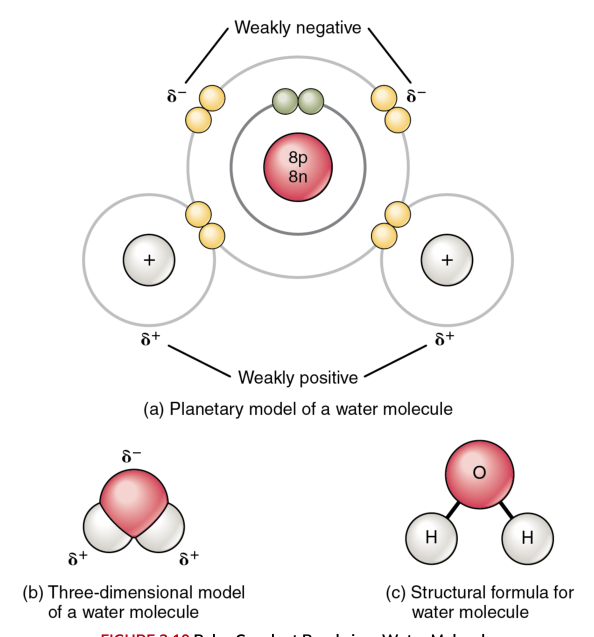
When sodium chloride dissolves in water, it does not remain as intact $\text{NaCl}$ molecules. Instead, the ionic attractions are disrupted, and the ions separate. Water molecules orient around the ions: the partially negative oxygen region faces $\text{Na}^+$, while the partially positive hydrogen regions face $\text{Cl}^-$. These surrounding water molecules form hydration shells.
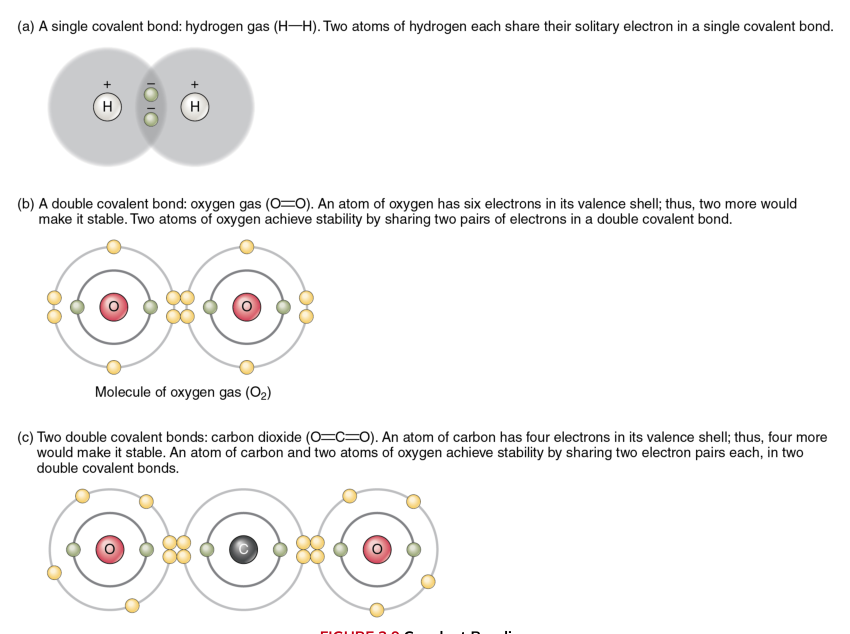
A covalent bond forms when atoms share electrons. A molecule of oxygen gas, $\text{O}_2$, contains two oxygen atoms sharing electrons. Carbon dioxide, $\text{CO}_2$, contains carbon joined to two oxygen atoms through covalent bonds. In a nonpolar covalent bond, electrons are shared relatively equally. In a polar covalent bond, one atom attracts the shared electrons more strongly than the other, producing partial charges.
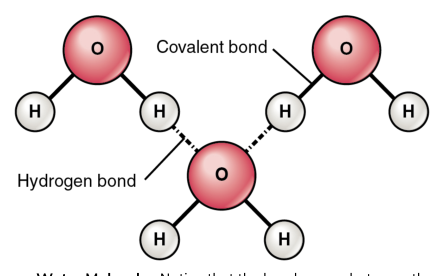
Water, $\text{H}_2\text{O}$, is a polar covalent molecule. Oxygen attracts the shared electrons more strongly than hydrogen, giving the oxygen region a partial negative charge and the hydrogen regions partial positive charges. These partial charges help water interact with ions and with other polar molecules.
A hydrogen bond is a weak attraction between a slightly positive hydrogen region of one polar molecule and a slightly negative region of another molecule or another part of the same molecule. Individually, hydrogen bonds are weaker than covalent bonds, but many together can strongly influence the shape and behavior of biological molecules.
Inorganic and Organic Compounds
Compounds important to life are often classified as inorganic or organic. In this context, organic compounds are generally carbon-based molecules associated with living organisms. Inorganic compounds include water, salts, acids, and bases. The distinction is useful, but it does not mean that inorganic compounds are unimportant to life or that every carbon-containing compound is biologically complex.
Water and energy-yielding nutrients are macronutrients, meaning the body requires them in relatively large amounts. Water is the most abundant inorganic compound in the body and provides the environment in which many chemical reactions occur. Salts provide ions needed for fluid balance, electrical activity, and other physiological functions. Acids and bases influence the chemical conditions under which biological reactions occur.
The following comparison summarizes the major distinction:
| Category | Typical examples | Importance to life |
|---|---|---|
| Inorganic compounds | Water, salts, acids, and bases | Provide solvent, ions, and chemical conditions necessary for physiological processes |
| Organic compounds | Proteins, carbohydrates, lipids, and nucleic acids | Form body structures, provide or store energy, regulate processes, and carry genetic information |
The same elements can participate in both inorganic and organic compounds. Carbon, hydrogen, and oxygen, for example, occur in glucose, an organic compound used as body fuel, while oxygen and hydrogen also occur in water, an inorganic compound essential for life. What matters is not merely which elements are present, but how their atoms are arranged and bonded.
The Four Major Organic Compound Classes
Carbohydrates contain carbon, hydrogen, and oxygen and include sugars and starches. Glucose is especially important because cells can break it down during chemical reactions to help provide usable energy.
Lipids are carbon-based compounds that include fats, oils, phospholipids, and steroids. They contribute to energy storage, cellular structures, and chemical signaling.
Proteins are built from amino acids. Their functions include providing structural support, transporting substances, defending the body, and acting as enzymes that accelerate chemical reactions.
Nucleic acids include DNA and RNA. Nucleotides—the building blocks of nucleic acids—contain a nitrogen-containing base, a pentose sugar, and one or more phosphate groups. RNA and DNA participate in the storage and use of genetic information, while the nucleotide ATP transfers energy for cellular work.
Human DNA forms a double helix and is organized into $46$ chromosomes. It contains approximately $3$ billion nucleotide bases whose sequence provides instructions for building and maintaining the body. These instructions do not float independently of chemistry: DNA’s structure depends on covalent bonds within each strand and hydrogen bonds between complementary bases.
Chemical Reactions and Energy
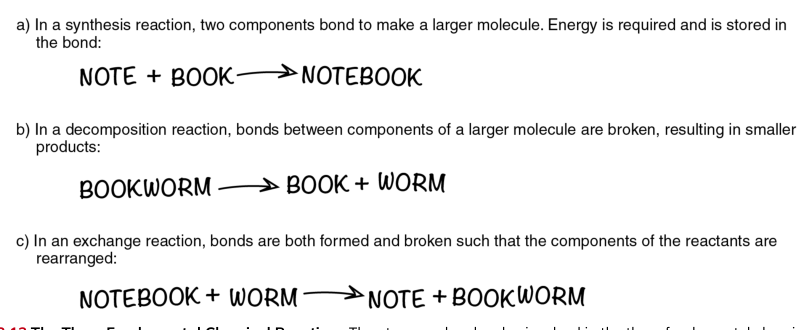
A chemical reaction occurs when chemical bonds are broken, formed, or rearranged. Reactants are the starting substances, and products are the substances formed. Through chemical reactions, energy can be invested, stored, and released. Reactions critical to life include the breakdown of nutrients, the synthesis of cellular molecules, and the transfer of energy through ATP.
Energy may be stored as potential energy, the energy of position or arrangement, or expressed as kinetic energy, the energy of motion. Chemical bonds can represent stored potential energy. When reactions rearrange molecules, some energy can become available for biological work, such as muscle contraction, active transport, or the synthesis of larger molecules.
A common misconception is that energy is simply “created” when food is used. Instead, chemical reactions transform energy from one form to another. Catabolic reactions break larger molecules into smaller ones and commonly release energy; anabolic reactions use energy to build larger molecules. ATP acts as a principal intermediate for transferring energy between these processes.
The chemical level therefore connects directly to every higher level of organization. The elements obtained from the environment become atoms; atoms form compounds; compounds participate in reactions; and those reactions supply both the materials and the energy required to maintain the human body.
Content adapted from OpenStax Anatomy and Physiology 2e by J. Gordon Betts et al., licensed CC BY 4.0.
Source Materials
Study Anatomy and Physiology on Lykke
This course page is free to open: signed out, you can read its first two sections, and signing in, on any plan, opens the rest. The free Lykke Chrome extension syncs your own Canvas courses, so ChatGPT, Claude and Muse can answer from your classes and deadlines. It only reads Canvas.
Add the free extensionSign in to open every sectionAll sections of Anatomy and Physiology · Browse more course pages