From the free course Anatomy and Physiology on Lykke
Chapter 18: The Cardiovascular System: Blood
Key concepts: Hematopoiesis from blood-forming stem cells · Myeloid blood-cell lineages · Red blood cells (erythrocytes) · White blood cells (leukocytes) and immune defense · Platelets (thrombocytes) and blood clotting · Plasma as the liquid extracellular matrix of blood · Leukocyte movement across blood-vessel endothelium · Kidney-produced erythropoietin · Blood transport of nutrients, salts, wastes, and hormones · Oxygen transport for aerobic muscle respiration
By the end of this chapter the student can: Identify the primary functions of blood, its fluid and cellular components, and its physical characteristics; Identify the most important proteins and other solutes present in blood plasma; Describe the formation of the formed element components of blood; Discuss the structure and function of red blood cells and hemoglobin; Classify and characterize white blood cells; Describe the structure of platelets and explain the process of hemostasis; Explain the significance of AB and Rh blood groups in blood transfusions; Discuss a variety of blood disorders.
Chapter 18: The Cardiovascular System: Blood
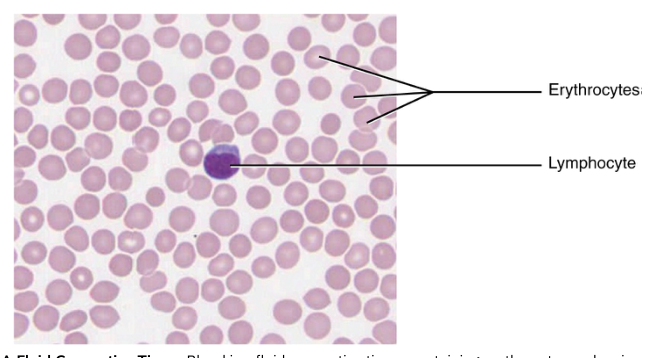
A single drop of blood contains millions of cells, yet blood is not simply a suspension of cells in water. It is a connective tissue whose cells and cell fragments circulate through a liquid extracellular matrix called plasma. Its organization solves several problems at once: red blood cells transport oxygen, white blood cells defend against threats, platelets limit blood loss, and plasma carries dissolved materials between tissues and organs.
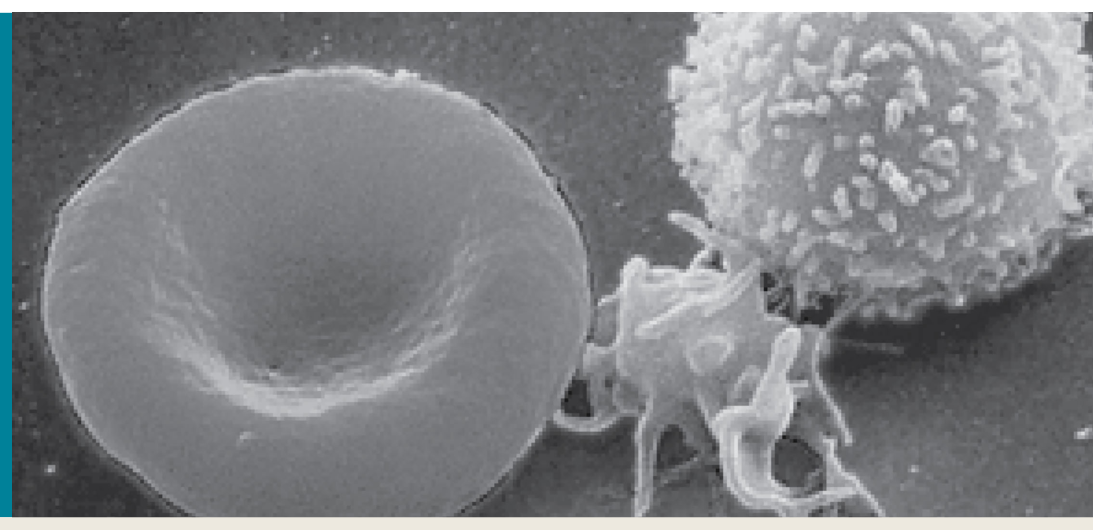
The cellular portion is often called the formed elements of blood. These include erythrocytes, or red blood cells; leukocytes, or white blood cells; and thrombocytes, more commonly called platelets. The formed elements are produced through hematopoiesis, the process by which blood cells proliferate, differentiate, and mature, primarily in red bone marrow.
Hematopoiesis: one stem cell, many blood-cell types
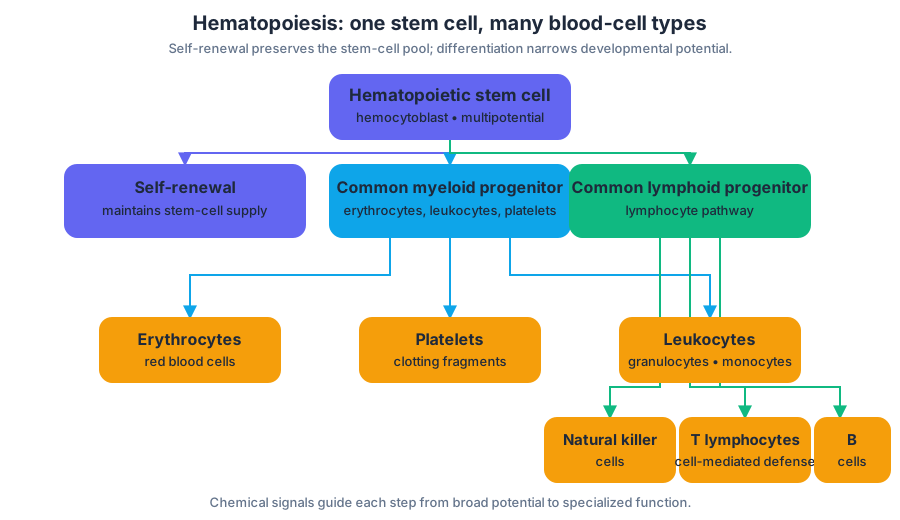
Hematopoiesis begins with a multipotential hematopoietic stem cell, also called a hemocytoblast. A stem cell is an unspecialized cell capable of both self-renewal and differentiation—the production of more specialized cell types. This matters because the body must continuously replace blood cells that age, become damaged, or are consumed during immune defense and clotting.
Chemical signals guide the stem cell into progressively more specialized pathways. One daughter cell can remain a stem cell, preserving the blood-forming population, while another becomes a progenitor cell. The two major progenitor pathways are the common myeloid progenitor and the common lymphoid progenitor. These progenitors have less developmental flexibility than the original stem cell, but they can still produce several related mature cell types.
The common myeloid pathway produces erythrocytes, several leukocytes, and platelets. The common lymphoid pathway produces lymphocytes, including natural killer cells, T lymphocytes, and B lymphocytes. The essential pattern is hierarchical: a broad developmental potential narrows through progenitor stages until a mature cell acquires a specialized structure and function.
Myeloid blood-cell lineages
A myeloblast is an intermediate precursor in the myeloid lineage. Myeloblasts give rise to four important white blood cell types: basophils, neutrophils, eosinophils, and monocytes. Basophils, neutrophils, and eosinophils are granulocytes because their cytoplasm contains visible granules. Monocytes are agranulocytes and have a large, distinctive nucleus.
Monocytes illustrate how a blood cell’s role can change after it leaves the circulation. A monocyte can cross the endothelial lining of a blood vessel and enter nearby tissue, where it differentiates into a macrophage or a dendritic cell. Macrophages are large cells that engulf material and contribute to immune defense. Dendritic cells help present antigens to other immune cells, linking detection of foreign material with activation of immune responses.
The lymphoid pathway produces a natural killer cell and the small lymphocytes that develop into T lymphocytes and B lymphocytes. B lymphocytes can further differentiate into plasma cells. Although all of these cells begin with a common hematopoietic origin, their mature functions are different: some engulf material, some release immune signals, some kill abnormal cells, and others support highly specific immune responses.
Erythrocytes: specialized oxygen carriers
Erythrocytes, or red blood cells, are the most numerous formed elements. Their central task is to transport oxygen from the lungs to body tissues. Oxygen is especially important to skeletal muscle, where it supports aerobic respiration, the process by which muscle cells generate usable energy in the presence of oxygen.
An erythrocyte’s structure is closely matched to this role. The mature cell is a flexible, biconcave disc, giving it a large surface area for gas exchange and allowing it to bend through narrow blood vessels. It is packed with hemoglobin, the oxygen-binding protein responsible for much of blood’s color. The erythrocyte’s specialization also leaves little internal machinery for functions unrelated to gas transport; it is designed primarily as a mobile oxygen carrier.
Red blood cell production is regulated according to oxygen demand. When tissues receive insufficient oxygen, the kidneys produce and release erythropoietin, often abbreviated EPO. Erythropoietin stimulates red bone marrow to increase erythrocyte production. This is a useful feedback relationship: reduced oxygen delivery prompts a hormonal signal that increases the number of cells available to carry oxygen.
Key distinction: erythropoietin does not carry oxygen and is not itself a blood cell. It is a kidney-produced hormone that regulates the production of erythrocytes.
Leukocytes: mobile immune defense
Leukocytes, or white blood cells, protect the body from pathogens, abnormal cells, and other threats. Unlike erythrocytes, leukocytes retain cellular structures needed for active behaviors such as movement, engulfment, signaling, and recognition. They are less numerous than red blood cells, but their diversity allows the immune system to respond to many types of danger.
White blood cells do not remain confined to the bloodstream. Some can leave blood vessels by passing between cells of the endothelium, the thin cellular lining of the vessel wall. This movement into adjacent tissues allows leukocytes to reach sites of infection or injury rather than merely circulating past them. Monocytes use this route before becoming macrophages or dendritic cells, and other leukocytes also move between blood and tissues as immune conditions require.
The major leukocyte groups reflect different defensive strategies. Neutrophils are important early responders; eosinophils participate in defense associated with parasites and allergic reactions; basophils release substances involved in inflammation; monocytes become tissue macrophages or dendritic cells; and lymphocytes support cellular, antibody-related, or natural-killer defenses. These categories should not be treated as interchangeable names: each represents a distinct lineage and functional specialization.
Platelets and blood clotting
Platelets, or thrombocytes, are not complete cells. They are small, membrane-bound fragments shed by very large bone-marrow cells called megakaryocytes. The megakaryocyte remains in red bone marrow while portions of its cytoplasm break away and enter the circulation as platelets.
Platelets contain granules and respond rapidly when a blood vessel is damaged. Their central function is hemostasis, the process that helps prevent blood loss. Platelets adhere to damaged areas, interact with one another, and contribute to the formation of a blood clot. They also release growth factors that support tissue repair and healing.
Calling platelets “cell fragments” is important. A platelet can perform specialized clotting functions even though it lacks the complete structure of a mature cell. Conversely, a low platelet number can impair hemostasis, while abnormal platelet activity can contribute to unwanted clot formation. Their small size is therefore not a sign of insignificance; it enables large numbers of them to respond quickly across an injured surface.
Plasma: the liquid extracellular matrix
Plasma is the pale, liquid extracellular matrix in which the formed elements circulate. It is mostly water, but its dissolved contents make it physiologically active rather than an inert fluid. Plasma carries nutrients, salts, wastes, and hormones through the cardiovascular system, allowing organs to exchange materials even when they are far apart.
Nutrients dissolved in plasma can be delivered to cells for energy production, growth, and repair. Salts contribute to fluid balance and cellular function. Wastes move through plasma toward organs that remove them, and hormones travel in plasma from endocrine tissues to their target cells. Plasma therefore serves as both the environment surrounding blood cells and a transport medium connecting the body’s tissues.
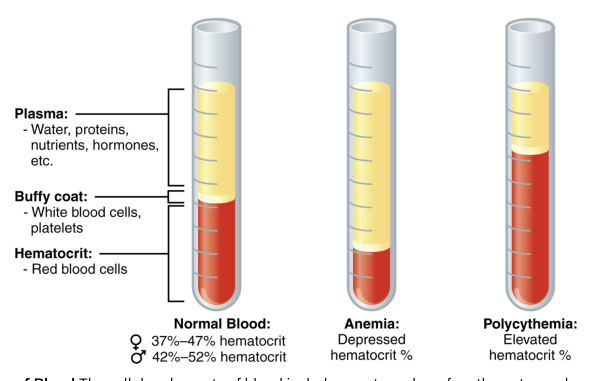
The distinction between plasma and formed elements is functional as well as structural. Plasma is the fluid matrix; erythrocytes, leukocytes, and platelets are the circulating formed elements. Hematocrit, or packed cell volume, expresses the proportion of blood occupied by formed elements, while the remaining portion is plasma. The exact proportions vary, but both components are necessary: plasma permits movement and exchange, while the formed elements perform specialized transport, defense, and clotting tasks.
Blood works because these parts operate as one coordinated tissue: hematopoiesis continually supplies specialized cells and fragments, plasma carries dissolved substances and suspends them, erythrocytes support oxygen delivery to aerobic tissues, leukocytes can leave vessels to defend tissues, and platelets respond to vessel injury. No single component can substitute for the others without disrupting homeostasis.
Content adapted from OpenStax Anatomy and Physiology 2e by J. Gordon Betts et al., licensed CC BY 4.0.
Source Materials
Study Anatomy and Physiology on Lykke
This course page is free to open: signed out, you can read its first two sections, and signing in, on any plan, opens the rest. The free Lykke Chrome extension syncs your own Canvas courses, so ChatGPT, Claude and Muse can answer from your classes and deadlines. It only reads Canvas.
Add the free extensionSign in to open every sectionAll sections of Anatomy and Physiology · Browse more course pages