From the free course Anatomy and Physiology on Lykke
Chapter 26: Fluid, Electrolyte, and Acid-Base Balance
Key concepts: Acid–base balance and physiological buffer systems · Carbonic acid–bicarbonate buffer system · Carbon dioxide transport in the blood · Role of carbonic anhydrase in red blood cells · Kidney regulation of urine osmolarity · Renal regulation of major ions, including sodium · Kidney contribution to acid–base balance · Portal systems in the kidney · Sodium regulation and extracellular osmolarity · Metabolic acidosis and bicarbonate therapy
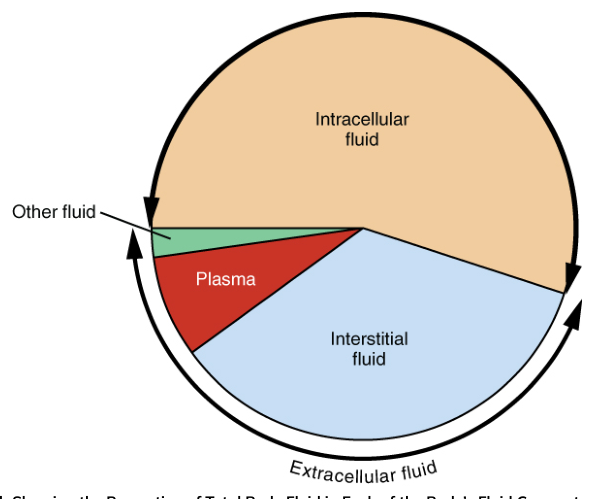
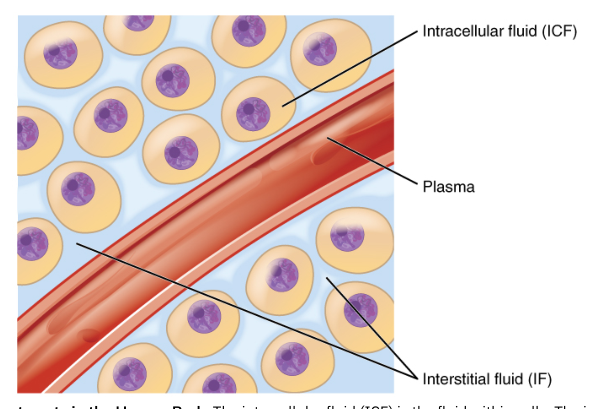
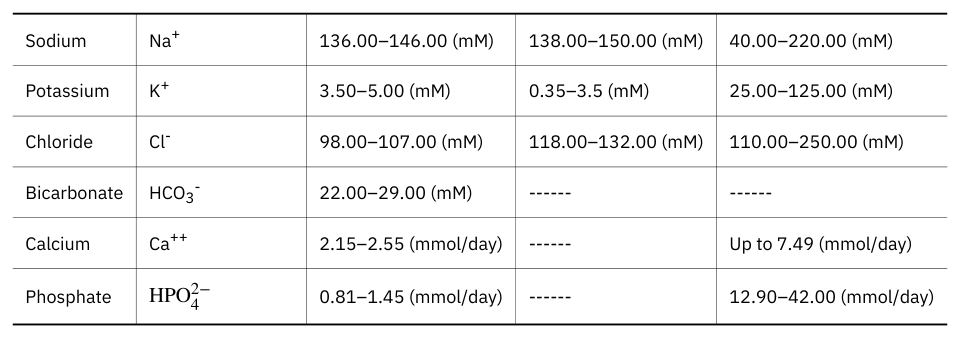
By the end of this chapter the student can: Identify the body’s main fluid compartments; Define plasma osmolality and identify two ways in which plasma osmolality is maintained; Identify the six ions most important to the function of the body; Define buffer and discuss the role of buffers in the body; Explain why bicarbonate must be conserved rather than reabsorbed in the kidney; Identify the normal range of blood pH and name the conditions where one has a blood pH that is either too high or too low.
Chapter 26: Fluid, Electrolyte, and Acid-Base Balance
A person who is breathing rapidly may be trying to correct an overly acidic internal environment: faster ventilation removes more carbon dioxide, shifting blood chemistry toward a higher pH. If acidosis becomes severe, an intravenous bicarbonate solution may be administered because bicarbonate can temporarily absorb excess hydrogen ions. These responses illustrate a central principle of homeostasis: body fluids must resist sudden changes in acidity, water content, and ion concentration.
Why pH must be controlled
Acid–base balance is the regulation of hydrogen-ion concentration in body fluids. Because pH is related logarithmically to hydrogen-ion concentration, even a relatively small chemical change can affect protein structure, enzyme activity, membrane transport, and cellular metabolism. The body therefore maintains fluid composition within narrow limits rather than allowing acids or bases to accumulate freely.
A buffer is a substance or system that resists a change in pH by binding excess hydrogen ions or releasing hydrogen ions when their concentration falls.
Buffers do not eliminate acids or bases. Instead, they temporarily bind or release ions so that the immediate change in free hydrogen-ion concentration is smaller. This buys time for the lungs and kidneys to remove the underlying disturbance. A common misconception is that a buffer “neutralizes” all acid permanently; in reality, a buffer shifts between chemical forms while other organs complete the correction.
Physiological buffer systems
The body uses several buffer systems. Protein buffers are important because proteins contain both acidic and basic components. Depending on the surrounding pH, these components can accept or donate hydrogen ions. Hemoglobin inside red blood cells is especially important because it can bind hydrogen ions generated as carbon dioxide is processed.
The phosphate buffer system is particularly useful inside cells and in the kidney filtrate. It involves forms of phosphate that can either accept or release hydrogen ions. By shifting between these forms, phosphate helps limit changes in intracellular and urinary pH.
The most important buffer system in extracellular fluid is the bicarbonate–carbonic acid buffer system. It is effective because its two components are linked to different organs: the lungs regulate carbonic acid by controlling carbon dioxide exhalation, while the kidneys regulate bicarbonate by conserving it or removing it in urine.
The carbonic acid–bicarbonate buffer system
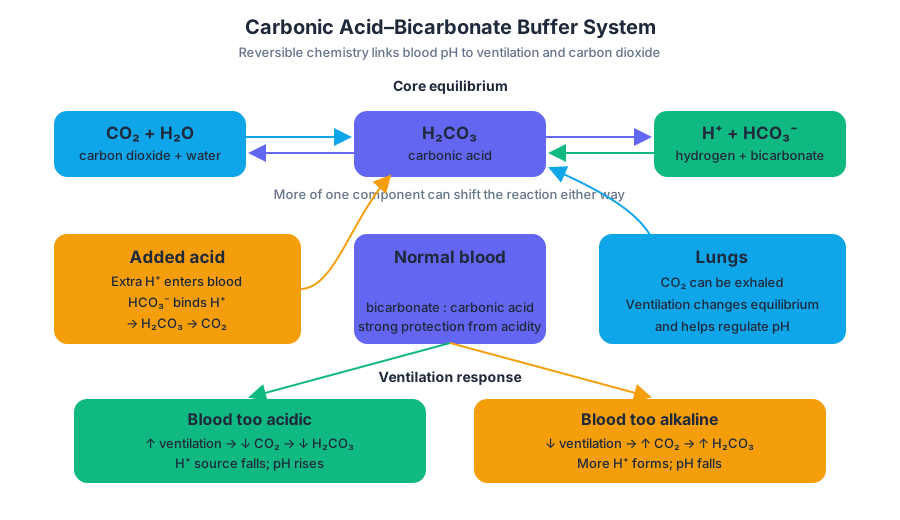
The bicarbonate system depends on a reversible series of reactions:
$$ \text{CO}_2 + \text{H}_2\text{O} \rightleftharpoons \text{H}_2\text{CO}_3 \rightleftharpoons \text{H}^+ + \text{HCO}_3^- $$
Carbon dioxide and water form carbonic acid, written as $\text{H}_2\text{CO}_3$. Carbonic acid can then dissociate into a hydrogen ion, $\text{H}^+$, and a bicarbonate ion, $\text{HCO}_3^-$. Because the reaction is reversible, increasing one component can drive the reaction in either direction.
When excess acid enters the blood, bicarbonate binds some of the added hydrogen ions:
$$ \text{HCO}_3^- + \text{H}^+ \rightleftharpoons \text{H}_2\text{CO}_3 \rightleftharpoons \text{CO}_2 + \text{H}_2\text{O} $$
The resulting carbon dioxide can be exhaled through the lungs. In normal blood, bicarbonate and carbonic acid are present at approximately a $20:1$ ratio. Because bicarbonate is much more abundant, this system is especially effective against changes that would make the blood more acidic. This is physiologically useful because many metabolic wastes, including lactic acid and ketone bodies, are acids.
If blood becomes too acidic, increased ventilation removes more $\text{CO}_2$. Removing $\text{CO}_2$ pulls the reaction toward the left, decreasing carbonic acid and reducing the source of hydrogen ions. Blood pH therefore rises toward its normal range. Conversely, if blood becomes too alkaline, slower ventilation retains $\text{CO}_2$, increasing carbonic acid and helping lower pH.
Carbon dioxide transport in the blood
Carbon dioxide produced by cellular metabolism must travel from tissues to the lungs. It is transported in three forms: dissolved directly in plasma, bound to hemoglobin inside red blood cells, and converted into bicarbonate ions within red blood cells. Bicarbonate is the major transport form because it can travel dissolved in the plasma.
A small amount of carbon dioxide remains physically dissolved in plasma. Another portion binds to hemoglobin, forming a reversible association with the protein. The largest functional pathway begins when carbon dioxide diffuses from tissues into nearby capillaries and then into red blood cells.
Carbonic anhydrase and red blood cells
Inside red blood cells, the enzyme carbonic anhydrase rapidly catalyzes the reaction between carbon dioxide and water:
$$ \text{CO}_2 + \text{H}_2\text{O} \xrightleftharpoons{\text{carbonic anhydrase}} \text{H}_2\text{CO}_3 $$
Carbonic acid then dissociates:
$$ \text{H}_2\text{CO}_3 \rightleftharpoons \text{H}^+ + \text{HCO}_3^- $$
Carbonic anhydrase is important because the uncatalyzed reaction would proceed too slowly to support the rapid exchange of gases occurring in active tissues and lungs. The enzyme does not change the final equilibrium; it accelerates the rate at which the reversible reaction reaches that equilibrium.
The newly formed bicarbonate tends to accumulate inside the erythrocyte. Because its concentration becomes higher inside the cell than in the surrounding plasma, bicarbonate moves out of the red blood cell down its concentration gradient. It leaves in exchange for chloride ions, $\text{Cl}^-$. This exchange is called the chloride shift.
The chloride shift preserves electrical neutrality. Bicarbonate carries a negative charge, and chloride also carries a negative charge, so exchanging one negative ion for another does not substantially alter the electrical charge of the red blood cell or the blood. Once in plasma, bicarbonate travels to the lungs, where the reactions reverse: bicarbonate and hydrogen ions form carbonic acid, carbonic acid becomes carbon dioxide and water, and carbon dioxide is exhaled.
Respiratory regulation and clinical application
The respiratory system provides a rapid form of acid–base regulation because ventilation can change within seconds. In respiratory compensation for acidosis, increased breathing removes carbon dioxide, reduces carbonic acid, and raises blood pH. In compensation for alkalosis, decreased breathing retains carbon dioxide, increases carbonic acid, and lowers blood pH.
This compensation is limited. Hyperventilation cannot remove an unlimited amount of acid, and hypoventilation cannot safely retain unlimited carbon dioxide because oxygen delivery and carbon dioxide removal would become impaired. The kidneys provide slower but more sustained regulation by adjusting bicarbonate and hydrogen-ion handling.
The clinical example of intravenous bicarbonate illustrates how a buffer may be used when the body is struggling with acidosis and difficulty breathing. Administered bicarbonate can bind excess hydrogen ions and shift the equilibrium toward carbonic acid and carbon dioxide. The carbon dioxide can then be eliminated through respiration, provided ventilation is adequate. Bicarbonate treatment addresses the chemical disturbance, but the underlying cause of the acidosis still requires attention.
Kidney regulation of acid–base balance
The kidneys help maintain acid–base balance by regulating ions and urine composition. They conserve bicarbonate from the renal filtrate, return it to the blood, and excrete hydrogen ions or other acid-related substances when necessary. Unlike the lungs, which alter carbon dioxide rapidly, the kidneys change body-fluid composition over a longer period.
Conservation of bicarbonate
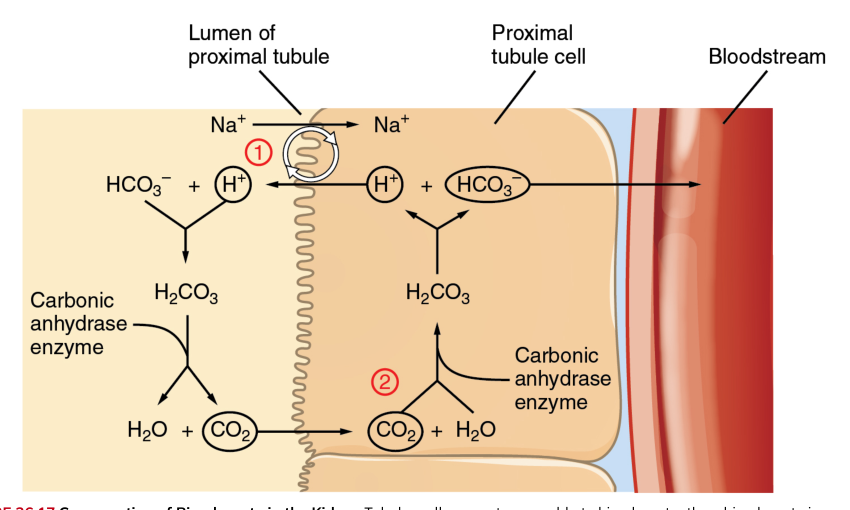
In the proximal tubule, filtered bicarbonate is conserved through a sequence involving hydrogen ions, carbon dioxide, water, and carbonic anhydrase. Tubule cells secrete hydrogen ions into the lumen. There, hydrogen ions combine with filtered bicarbonate to form carbonic acid:
$$ \text{H}^+ + \text{HCO}_3^- \rightleftharpoons \text{H}_2\text{CO}_3 $$
Carbonic acid is converted into carbon dioxide and water. Carbon dioxide diffuses into the proximal tubule cell, where carbonic anhydrase catalyzes its reaction with water to reform carbonic acid. That carbonic acid dissociates into hydrogen ions and bicarbonate. The hydrogen ions can be secreted again, while the bicarbonate moves into the bloodstream. In this way, bicarbonate that might otherwise be lost in urine is conserved and returned to extracellular fluid.
This process demonstrates why carbonic anhydrase appears in both respiratory and renal physiology. In red blood cells, it supports rapid carbon dioxide transport and acid–base buffering. In the kidney, it supports bicarbonate recovery and the controlled movement of hydrogen ions.
Urine osmolarity and hormonal regulation
Urine osmolarity describes the concentration of dissolved particles in urine. It is hormonally regulated so that the kidneys can conserve water when body fluids are concentrated or excrete more water when the body has an excess.
The key hormone is antidiuretic hormone, or ADH. When the body is dehydrated or extracellular fluid becomes too concentrated, ADH increases the permeability of portions of the renal tubules and collecting ducts to water. More water moves from the tubular fluid back into the blood, producing a smaller volume of more concentrated urine. When ADH levels are low, less water is reabsorbed, and urine is more dilute.
The kidney therefore does not simply produce a fixed urine concentration. It adjusts urine osmolarity according to the body’s water status. This prevents excessive cellular dehydration during water loss and prevents unnecessary retention of water when intake is high.
Renal regulation of major ions
The kidneys regulate major ions by filtering them, selectively reabsorbing needed amounts, and secreting additional amounts into the tubular fluid. This control is essential because ions influence osmotic balance, membrane potentials, blood volume, muscle contraction, and nerve function.
Sodium regulation
Sodium, $\text{Na}^+$, is the principal cation of extracellular fluid. Its concentration strongly influences extracellular osmolarity and fluid volume. When the kidneys reabsorb sodium, water often follows osmotically, helping maintain blood volume and pressure. When sodium is excreted, water tends to remain in the tubular fluid and leave the body.
Aldosterone promotes sodium reabsorption in the later portions of the nephron. It also promotes potassium secretion, linking sodium balance to potassium balance. When sodium retention increases, water retention may also increase. This is why renal regulation of sodium is closely connected to regulation of extracellular fluid volume and blood pressure.
Other hormones modify this system. Atrial natriuretic peptide, released when the heart is stretched by increased blood volume, promotes sodium excretion and therefore favors loss of water. In contrast, hormonal signals associated with reduced blood volume support sodium and water retention. These opposing influences allow the kidneys to respond to changing circulatory conditions.
Other ions
The kidneys also regulate chloride, potassium, calcium, phosphate, and bicarbonate. Chloride often accompanies sodium and helps maintain electrical neutrality. Potassium must be controlled carefully because abnormal extracellular potassium can disrupt the electrical activity of cardiac and skeletal muscle. Calcium and phosphate balance supports bone and cellular function, while bicarbonate balance is central to acid–base regulation.
The most important connection is that water and ion regulation cannot be separated. Sodium affects extracellular osmolarity; osmolarity influences water movement; water changes alter blood volume; and blood volume affects renal and hormonal responses. At the same time, bicarbonate, hydrogen ions, phosphate, and proteins work together to protect the pH required for normal cellular activity.
Buffer systems provide the immediate chemical resistance, the lungs provide rapid carbon dioxide control, and the kidneys provide sustained regulation of bicarbonate, hydrogen ions, water, and major electrolytes. Together, these mechanisms keep body fluids chemically stable even as metabolism, breathing, diet, exercise, and water intake change.
Content adapted from OpenStax Anatomy and Physiology 2e by J. Gordon Betts et al., licensed CC BY 4.0.
Source Materials
Study Anatomy and Physiology on Lykke
This course page is free to open: signed out, you can read its first two sections, and signing in, on any plan, opens the rest. The free Lykke Chrome extension syncs your own Canvas courses, so ChatGPT, Claude and Muse can answer from your classes and deadlines. It only reads Canvas.
Add the free extensionSign in to open every sectionAll sections of Anatomy and Physiology · Browse more course pages