From the free course Anatomy and Physiology on Lykke
Chapter 24: Metabolism and Nutrition
Key concepts: Metabolism as the sum of the body's energy-requiring and energy-consuming processes · Anabolism and catabolism · Anabolic reactions building larger molecules from smaller molecules or atoms · Catabolic reactions breaking complex substances into simpler molecules · Polymers and monomers · Nutrient absorption and the role of nutrients as building blocks for metabolism · Energy-releasing chemical reactions and the importance of oxygen · Mitochondrial energy transfer · Hormonal regulation of metabolism and glucose levels · Vitamins, protein metabolism, and thermoregulation
By the end of this chapter the student can: Describe the processes involved in anabolic and catabolic reactions; List and describe the steps necessary for carbohydrate, lipid, and protein metabolism; Explain the processes that regulate glucose levels during the absorptive and postabsorptive states; Explain how metabolism is essential to maintaining body temperature (thermoregulation); Summarize the importance of vitamins and minerals in the diet.
Chapter 24: Metabolism and Nutrition
A person can remain still while thousands of metabolic reactions consume energy, release heat, build cellular structures, and maintain precisely controlled internal conditions. Metabolism is the sum of all chemical reactions in the body, including every energy-releasing and energy-consuming process required to maintain life.
Metabolism is not simply “burning calories.” It includes constructing proteins, storing glucose, repairing tissues, maintaining ion gradients, producing body heat, powering muscle contraction, and supporting electrical activity in nerve cells. Because these reactions occur continuously, metabolism is essential for life, health, and homeostasis, the maintenance of relatively stable internal conditions.
Anabolism and Catabolism
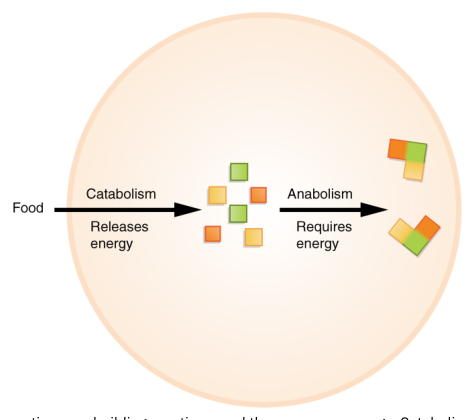
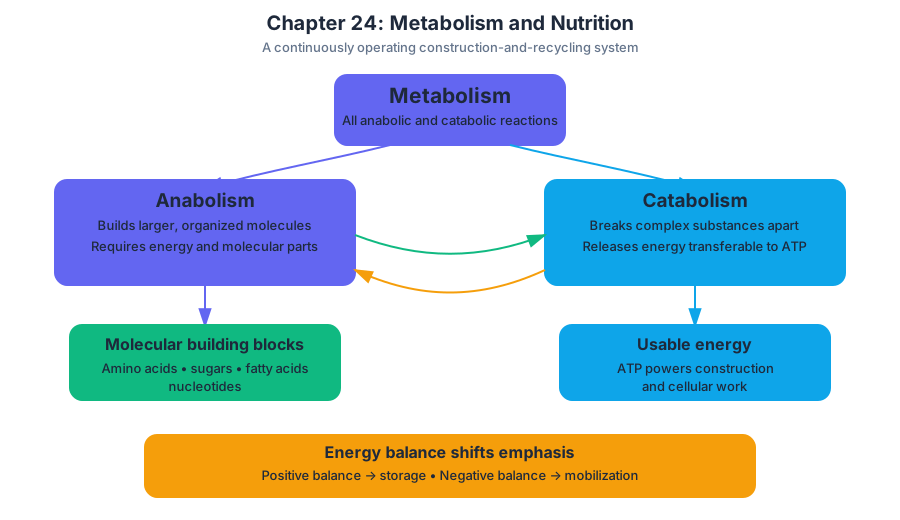
The two major directions of metabolism are anabolism and catabolism. Anabolism builds; catabolism breaks down. They are not separate phases that take turns. Both occur simultaneously and continuously throughout the body.
Metabolism is the sum of all anabolic and catabolic reactions that take place in the body.
Anabolic reactions, also called biosynthetic reactions, combine smaller molecules or atoms to form larger, more complex molecules. The body uses anabolism to build proteins from amino acids, glycogen from glucose molecules, triglycerides from smaller components, and nucleic acids from nucleotides. These reactions require an input of energy because the products contain greater molecular organization than the starting materials.
Catabolic reactions break larger, more complex substances into smaller, simpler molecules. Digestion provides familiar examples: proteins are broken into amino acids, complex carbohydrates into simpler sugars, and triglycerides into fatty acids and glycerol. Inside cells, catabolic pathways continue processing these smaller molecules and release energy that can be transferred to ATP.
A useful way to visualize the relationship is as a continuously operating construction-and-recycling system. Catabolism supplies smaller molecular parts and usable energy; anabolism uses those parts and energy to construct the body’s molecules. A meal can therefore support both directions at once: some nutrients may be oxidized to produce ATP, while others are assembled into glycogen, fat, or proteins.
The body’s energy balance affects which pathways are emphasized. A positive net energy balance, in which energy intake exceeds energy use, favors storage, particularly as body fat. A negative energy balance, in which energy use exceeds intake, promotes the mobilization of stored molecules. Even during fasting, however, anabolism does not stop completely; tissues still require repair and replacement. Likewise, after eating, catabolism continues because cells still need ATP.
Polymers and Monomers
Many biologically important molecules are polymers, large molecules made by joining repeated smaller units called monomers. Proteins are polymers of amino acids, nucleic acids are polymers of nucleotides, and complex carbohydrates can be polymers of monosaccharides such as glucose.
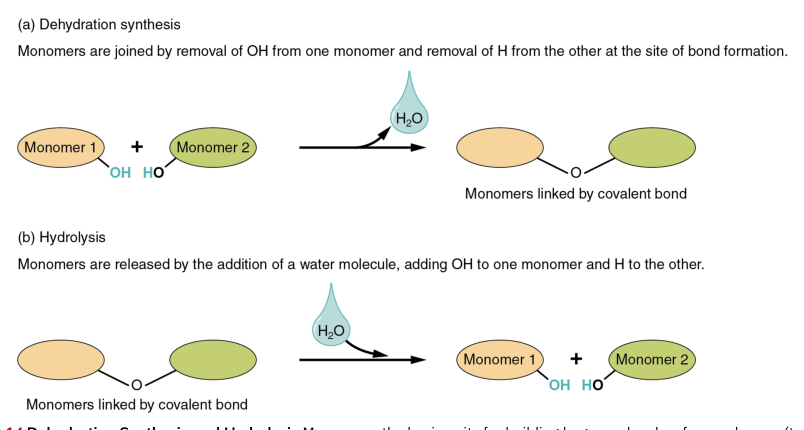
To use a polymer from food, the body must first break it into absorbable units. This process commonly involves hydrolysis, a chemical reaction in which water is used to split a bond. In simplified form, hydrolysis can be represented as
$$\text{polymer} + H_2O \rightarrow \text{monomers}$$
The digestive system performs this breakdown before or during absorption. Digestive enzymes hydrolyze dietary polymers into smaller molecules that can cross epithelial surfaces. A protein, for example, must be reduced to amino acids and small peptides before its components can become useful substrates for cellular metabolism.
The reverse metabolic direction combines monomers into polymers. In a condensation or dehydration-synthesis reaction, a bond forms while a molecule of water is removed:
$$\text{monomer} + \text{monomer} \rightarrow \text{polymer} + H_2O$$
Cells use this type of anabolic chemistry to assemble amino acids into proteins, nucleotides into nucleic acids, and glucose units into glycogen. The point is not merely to store food molecules intact. The body dismantles dietary molecules into reusable building blocks and then rearranges those blocks according to current needs.
Nutrients as Metabolic Building Blocks
The body must absorb a range of nutrients because no single nutrient supplies every material required for metabolism. Carbohydrates provide monosaccharides that can be oxidized for ATP production or assembled into glycogen. Lipids provide fatty acids and glycerol for energy storage, membrane construction, and other cellular functions. Proteins provide amino acids for enzymes, structural proteins, transport proteins, and many other molecules. Nucleic-acid components provide units that can be reused in nucleotide metabolism.
Absorption is therefore more than the movement of digested food into the internal environment. It supplies the raw materials from which cells build and maintain themselves. Nutrients absorbed from the digestive tract enter the blood or lymph and become available for catabolic and anabolic pathways. The liver and other tissues then distribute, transform, store, or release these materials according to the body’s metabolic state.
Oxygen, Mitochondria, and Energy Release
Many energy-releasing reactions depend on oxidation, the removal of electrons from a molecule. In aerobic metabolism, oxygen acts as the final electron acceptor in the reactions that extract energy from nutrient molecules. This does not mean that food simply “combines with oxygen” in one step. Rather, electrons are transferred through a series of controlled reactions, allowing their energy to be captured gradually.
The mitochondria are the principal organelles in which much of this aerobic energy extraction occurs. Nutrient-derived molecules enter mitochondrial pathways, and the energy released during their oxidation is used to produce ATP. Without sufficient oxygen, cells cannot sustain the same rate of aerobic ATP production and must rely more heavily on less efficient pathways.
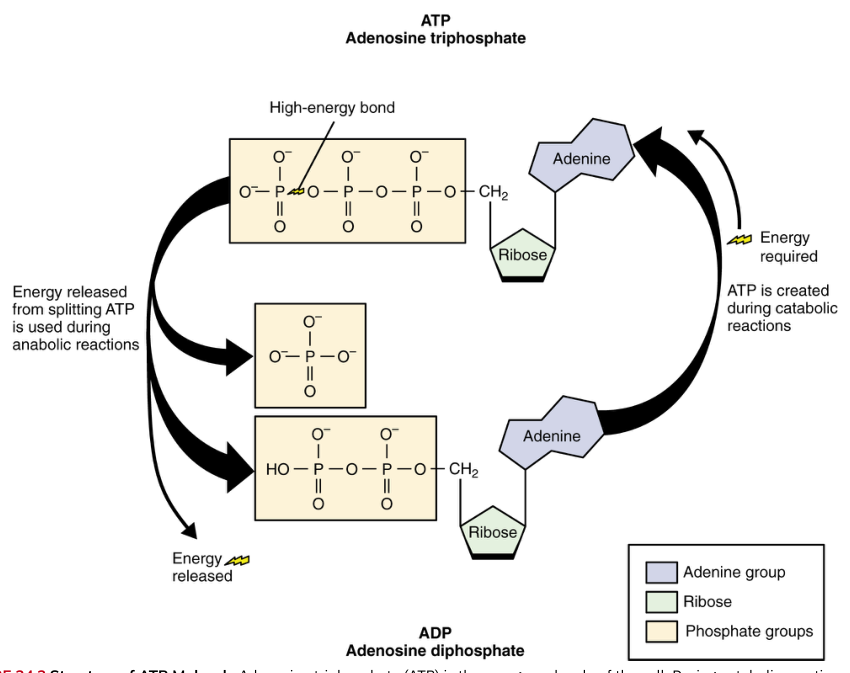
ATP, or adenosine triphosphate, is the cell’s immediate energy currency. It consists of adenine, ribose, and three phosphate groups. When ATP is hydrolyzed, its terminal phosphate group is removed:
$$ATP + H_2O \rightarrow ADP + P_i + \text{energy}$$
Here, $ADP$ is adenosine diphosphate and $P_i$ is inorganic phosphate. The released energy can power anabolic synthesis, muscle contraction, nerve-cell electrical activity, active transport, and nutrient absorption. Catabolic reactions then help regenerate ATP from ADP and $P_i$.
Approximately $40%$ of the energy released by catabolic reactions is captured in ATP. Much of the remaining energy is released as heat. This is not wasted in the physiological sense: heat contributes to maintaining body temperature. Metabolism therefore supports both cellular work and thermoregulation, the control of body temperature.
Glucose Regulation During Absorptive and Postabsorptive States
During the absorptive state, nutrients are entering the blood from the digestive tract. Blood glucose tends to rise, so cells use glucose for immediate ATP production while excess glucose is stored, especially as glycogen. Anabolic pathways are relatively prominent because absorbed nutrients are available for synthesis and storage.
During the postabsorptive state, absorption from a recent meal has declined and blood glucose must be maintained from internal reserves. The body increases catabolic pathways that mobilize stored fuels. Liver glycogen can be broken down to release glucose, and other molecules can be used to support glucose production. Glucagon, released by pancreatic alpha cells when blood glucose is low or additional energy is needed, stimulates glycogen breakdown in the liver. During stress, cortisol also contributes to increased blood glucose through pathways involving fats and proteins.
These states illustrate why anabolism and catabolism cannot be treated as mutually exclusive. After a meal, glucose may be stored while other nutrients are oxidized. During fasting, stored molecules are broken down for energy while essential cellular structures continue to be maintained and rebuilt.
Metabolism and Body Temperature
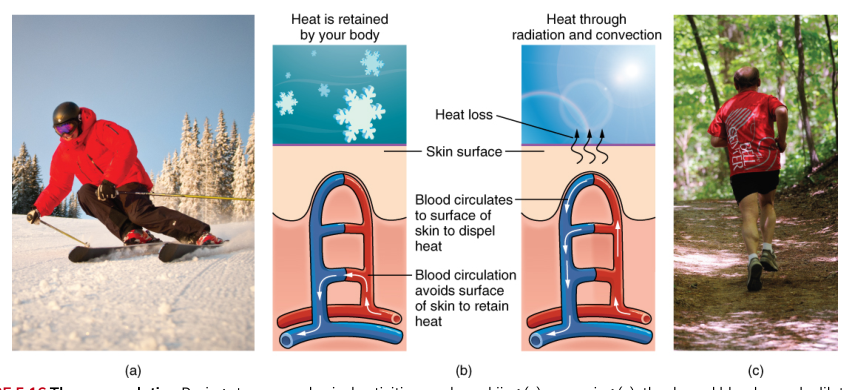
The body’s chemical reactions constantly transform energy. Because only part of the energy from catabolism is captured in ATP, the remainder appears as heat. Increased metabolic activity, such as during exercise, raises heat production because muscles require more ATP and therefore increase energy-releasing reactions.
Thermoregulation depends on balancing this metabolic heat production with heat loss to the environment. At rest, metabolism provides the heat needed to maintain normal body temperature; during physical activity, additional heat must be dissipated. A sustained imbalance can threaten health: inadequate energy production can impair cellular function, whereas excessive heat production or insufficient heat loss can produce dangerous hyperthermia.
The central idea is therefore an integrated one: nutrients supply both the materials and the chemical energy of life. Catabolism reduces complex nutrients to usable components and releases energy; ATP transfers much of that energy to cellular work; anabolism uses energy and molecular building blocks to construct the body; and the heat produced along the way helps regulate temperature. Metabolism is the continuous coordination of all these processes, not a single pathway or a synonym for digestion.
Content adapted from OpenStax Anatomy and Physiology 2e by J. Gordon Betts et al., licensed CC BY 4.0.

Source Materials
Study Anatomy and Physiology on Lykke
This course page is free to open: signed out, you can read its first two sections, and signing in, on any plan, opens the rest. The free Lykke Chrome extension syncs your own Canvas courses, so ChatGPT, Claude and Muse can answer from your classes and deadlines. It only reads Canvas.
Add the free extensionSign in to open every sectionAll sections of Anatomy and Physiology · Browse more course pages