From the free course Anatomy and Physiology on Lykke
Chapter 10: Muscle Tissue
Key concepts: The three types of muscle tissue: skeletal, cardiac, and smooth · Voluntary versus involuntary muscle movements · Skeletal muscle structure and distinguishing features · Smooth muscle structure and functions · Muscle tissue responses to nerve signals, hormones, and local stimuli · The role of smooth muscle in moving food through the digestive system · The role of the arrector pili muscle in causing hair to stand up · The sympathetic nervous system’s control of arrector pili contraction · Muscle development and regeneration · Connections between exercise and muscle performance
By the end of this chapter the student can: Explain the organization of muscle tissue; Describe the function and structure of skeletal, cardiac muscle, and smooth muscle; Explain how muscles work with tendons to move the body; Describe how muscles contract and relax; Define the process of muscle metabolism; Explain how the nervous system controls muscle tension; Relate the connections between exercise and muscle performance; Explain the development and regeneration of muscle tissue.
Chapter 10: Muscle Tissue
A tennis player’s rapid serve, heartbeat, intestinal contractions, and goose bumps all depend on muscle tissue—but they do not use the same kind of muscle or the same control system. The human body contains three types of muscle tissue: skeletal muscle, cardiac muscle, and smooth muscle. Each can generate force by contraction, yet each is specialized for a different location, structure, and pattern of control.
The three types of muscle tissue
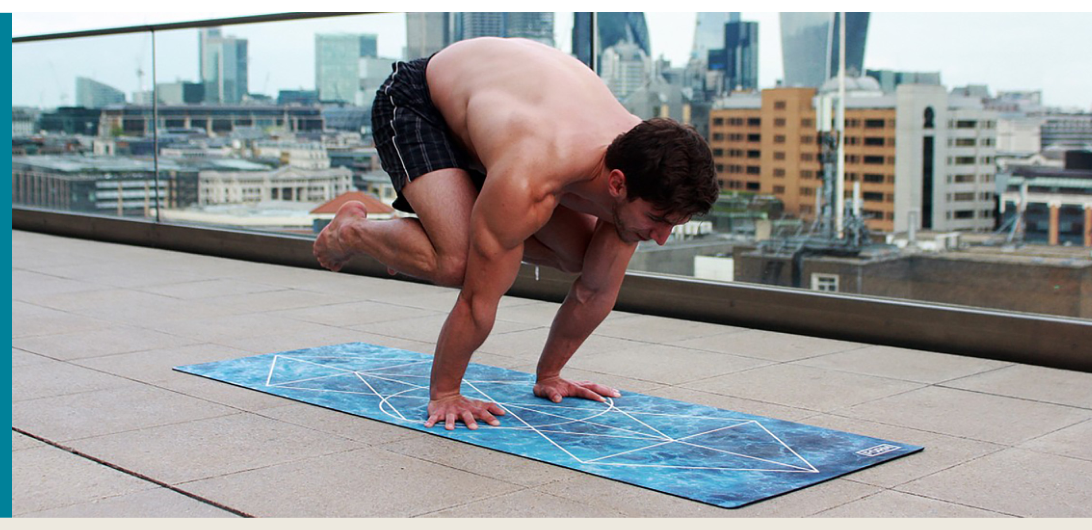
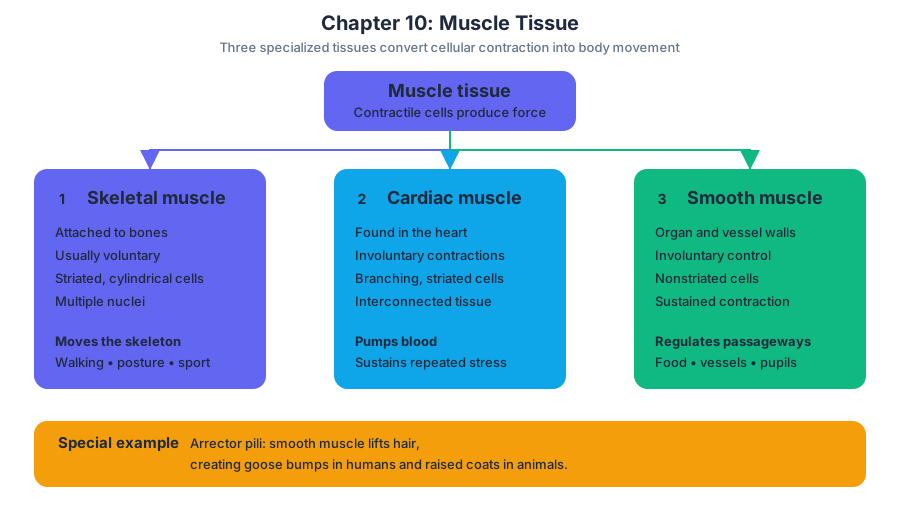
Skeletal muscle is usually attached to bones and produces movements of the skeleton. It is the muscle most visible beneath the skin, especially in the limbs, and it enables activities such as walking, running, posture maintenance, and athletic movement. Athletes rely on well-developed skeletal muscles to generate the force required for movement.
Cardiac muscle is found in the heart. Its contractions pump blood through the circulatory system. Cardiac muscle is involuntary: the heart continues to contract without conscious initiation of every heartbeat. Its cells branch and interconnect, allowing the heart muscle to function as a coordinated pumping tissue. These connections are especially important because cardiac contractions must withstand repeated mechanical stress without the cells pulling apart.
Smooth muscle forms part of the walls of many hollow organs and tubes. It produces involuntary movements such as moving food through the digestive tract, changing the diameter of blood vessels, and adjusting the opening of the pupil. Smooth muscle is also found in the skin. A small smooth muscle called the arrector pili connects a hair follicle to surrounding tissue. When sympathetic nervous-system signals cause it to contract, the external hair shaft stands up, producing goose bumps in humans and a much more obvious raised coat in animals such as cats and dogs.
| Muscle type | Principal location | Typical control | Structural distinction | Major function |
|---|---|---|---|---|
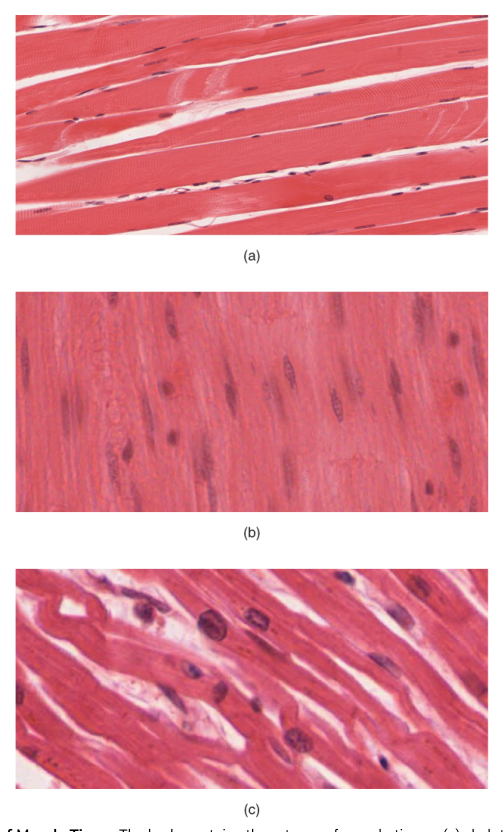
| Skeletal | Attached to bones | Usually voluntary | Striated, cylindrical cells with multiple nuclei | Moves the skeleton and supports posture |
| Cardiac | Heart | Involuntary | Striated, branching interconnected cells | Pumps blood |
| Smooth | Walls of hollow organs, vessels, and skin structures | Involuntary | Nonstriated cells specialized for sustained contraction | Moves substances and regulates passageways |
Voluntary and involuntary movement
Voluntary movement is movement initiated under conscious control. Skeletal muscle is generally classified as voluntary because a person can intentionally contract it to move a limb or change posture. The classification is useful, but it does not mean that every skeletal-muscle contraction requires conscious attention; many skeletal movements can also occur through reflex pathways or automatic patterns.
Involuntary movement occurs without conscious control. Cardiac muscle contraction is involuntary, as are most contractions of smooth muscle. A clear example is pupil constriction in bright light. When bright light enters the eye, smooth muscle in the iris contracts to reduce the pupil’s diameter. The person does not need to decide to make this happen; the response protects the retina by limiting the amount of incoming light.
The arrector pili provides another example. Cold or fright can activate sympathetic nervous-system pathways, causing the arrector pili to contract and raise the hair shaft. In a thickly furred animal, this can trap a layer of air for insulation and make the animal appear larger. In humans, the same response is visible mainly as goose bumps because our body hair is relatively sparse.
Shared mechanism of contraction
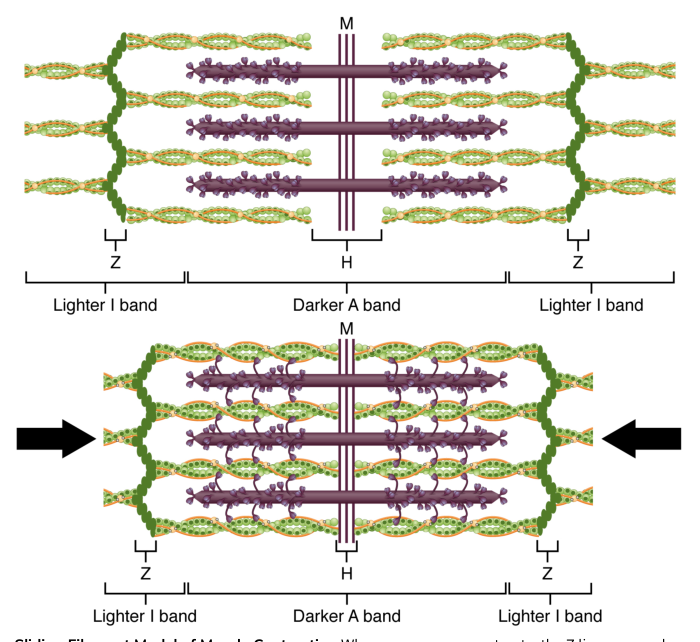
Although the three muscle types differ in appearance and control, their contractions depend on interactions between two proteins: actin and myosin. Myosin pulls on actin, causing the muscle cell to shorten or generate tension. In striated skeletal and cardiac muscle, contraction begins after calcium ions, written as $\mathrm{Ca^{2+}}$, interact with regulatory proteins that expose binding sites on actin.
The contraction process requires cellular energy in the form of adenosine triphosphate, or $\mathrm{ATP}$. Calcium ions help initiate the interaction between actin and myosin, while $\mathrm{ATP}$ supplies energy for the repeated molecular events that produce force. Contraction therefore does not mean that actin and myosin themselves become shorter; rather, the proteins move relative to one another, allowing the muscle cell to shorten or maintain tension.
Muscle contraction is the production of force when myosin pulls on actin; in striated muscle, calcium ions expose actin’s binding sites, and $\mathrm{ATP}$ provides the energy for the interaction.
Skeletal muscle: structure and function
Skeletal muscle has three particularly important identifying features: striations, cylindrical cells, and multiple nuclei. Striations are the visible alternating bands produced by the orderly arrangement of contractile proteins inside the cell. Under a microscope, skeletal muscle fibers appear long and cylindrical, with several nuclei located within each cell.
The word fiber is commonly used for an individual skeletal muscle cell. These fibers are organized into larger structures by connective tissue. The organization allows force produced inside many cells to be transmitted through the muscle and ultimately to a tendon or other attachment. When skeletal muscle contracts across a joint, the resulting force can move a bone.
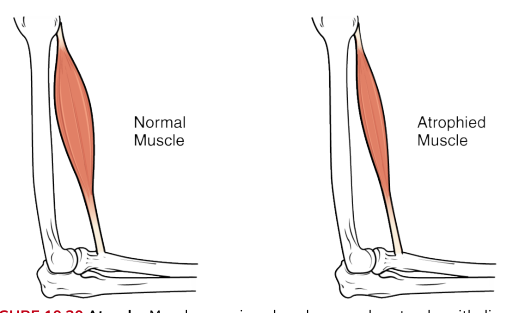
Skeletal muscle also contributes to body stability and heat production. Muscle activity releases heat as energy is used, helping support body temperature. Exercise illustrates the relationship between structure and performance: repeated training can improve the ability of skeletal muscles to generate and sustain force, while fatigue or injury can reduce performance.
Smooth muscle: structure, control, and digestive movement
Smooth muscle lacks the obvious striations of skeletal and cardiac muscle. Its cells are generally tapered at both ends and contain a single central nucleus. The contractile proteins are arranged differently from those in striated muscle, but actin and myosin still interact to produce force.
Smooth muscle is especially important in organs that must move their contents without conscious direction. In the digestive tract, smooth muscle contractions push food through the alimentary canal. Coordinated contractions behind a mass of food and relaxation ahead of it produce a traveling wave called peristalsis. This movement does not depend on gravity alone: it can propel digestive contents through the tract even when the body’s position changes.
Smooth muscle can also regulate the diameter of passageways. In the iris, contraction changes pupil size. In blood-vessel walls, contraction can narrow the vessel, while relaxation can allow it to widen. In the digestive system, changes in smooth-muscle contraction help mix contents and move them from one region to the next.
How muscle tissue responds to signals
Nerves are important sources of muscle stimulation, but they are not the only sources. Muscle tissue can respond to hormones and local stimuli as well. This is particularly important for smooth muscle, which often operates as part of an organ’s automatic regulation rather than as a direct response to conscious commands.
A nerve signal can trigger smooth muscle in the arrector pili, producing hair elevation. Local conditions in an organ can influence smooth-muscle activity, and hormones can alter the strength or pattern of contraction. In this way, muscle activity can be matched to the needs of the surrounding tissue—for example, moving digestive contents after a meal or changing the diameter of a passageway.
The distinction between a stimulus and a conscious decision is therefore essential. A muscle may contract because of a motor-neuron signal, a hormone circulating in the blood, or a chemical or mechanical change in its local environment. The resulting movement can still be biologically precise even when it is not consciously perceived.
Development and regeneration
Muscle tissue develops from embryonic cells that become specialized for contraction. During development, muscle cells acquire the structural features that fit their roles: skeletal cells become long and multinucleate, cardiac cells form an interconnected pumping tissue, and smooth-muscle cells become suited for controlled contractions in organs and vessels.
The three muscle types also differ in their ability to repair themselves after injury. Skeletal muscle has limited regenerative capacity, cardiac muscle has very limited replacement of damaged cells, and smooth muscle generally has a greater ability to regenerate. The extent of recovery depends on the tissue type, the severity of injury, and whether functional muscle cells can be replaced without disrupting the organization required for contraction.
Worked application: identifying the muscle response
Suppose a person eats a meal, steps outside into cold air, and enters bright sunlight. Several muscle responses occur at once:
- Food movement: smooth muscle in the digestive tract contracts in coordinated waves, producing peristalsis and moving food forward.
- Cold response: sympathetic nervous-system signals stimulate the arrector pili muscles, causing the hair shafts to stand up.
- Bright light: smooth muscle in the iris contracts involuntarily, reducing pupil size.
- Intentional movement: skeletal muscle contracts voluntarily if the person walks back indoors.
The key reasoning step is to identify both the tissue and the control signal. Digestive propulsion, goose bumps, and pupil constriction are involuntary smooth-muscle responses, although their triggers differ. Walking is primarily voluntary skeletal-muscle activity. The same body can therefore coordinate several forms of movement simultaneously without conscious control of every contraction.
Content adapted from OpenStax Anatomy and Physiology 2e by J. Gordon Betts et al., licensed CC BY 4.0.
Source Materials
Study Anatomy and Physiology on Lykke
This course page is free to open: signed out, you can read its first two sections, and signing in, on any plan, opens the rest. The free Lykke Chrome extension syncs your own Canvas courses, so ChatGPT, Claude and Muse can answer from your classes and deadlines. It only reads Canvas.
Add the free extensionSign in to open every sectionAll sections of Anatomy and Physiology · Browse more course pages