From the free course College Algebra on Lykke
9.7 Probability
Key concepts: Fundamental counting principle · Tree diagrams for counting outcomes · Combinations and choosing without regard to order · Binomial coefficients · The combinations formula using factorials · Calculator nCr function · Binomial theorem and binomial expansions · Pascal’s triangle · Finding specific terms of a binomial expansion · Permutations and arrangements where order matters
By the end of this section the student can: Construct probability models; Compute probabilities of equally likely outcomes; Compute probabilities of the union of two events; Use the complement rule to find probabilities; Compute probability using counting theory
9.7 Probability
Probability measures how likely an event is to occur. A fair six-sided die, for example, has six possible outcomes, but the event “rolling an even number” contains three of them. Probability turns that structure into the number $\frac{3}{6}=\frac{1}{2}$.
Constructing Probability Models
A probability model describes a random experiment by identifying its possible outcomes and assigning a probability to each outcome. The sample space, denoted by $S$, is the set of all possible outcomes. An event is a subset of the sample space; it consists of one or more outcomes that satisfy a specified condition.
A probability model must satisfy the following rules:
For every outcome $s$ in the sample space $S$, $0\leq P(s)\leq 1$.
The sum of the probabilities of all outcomes in $S$ is $1$: $$P(S)=1.$$
The probability of an event $E$ is the sum of the probabilities of the outcomes contained in $E$.
To construct a probability model, first list the sample space, then assign probabilities to its outcomes, and finally identify the event whose probability is wanted. The outcomes must be distinct and must include every possibility. Leaving out an outcome makes the probabilities incorrect because their total will no longer represent the entire experiment.
Example. A pair of fair dice is rolled. Construct a probability model for the event $E$ that the sum of the numbers is $7$.
The outcome of rolling two dice is an ordered pair $(a,b)$, where $a$ is the number on the first die and $b$ is the number on the second die. Each die has six outcomes, so the sample space contains
$$ 6\cdot 6=36 $$
equally likely outcomes:
$$ S={(1,1),(1,2),\ldots,(6,6)}. $$
The outcomes whose sum is $7$ are
$$ E={(1,6),(2,5),(3,4),(4,3),(5,2),(6,1)}. $$
There are $6$ outcomes in $E$, and each ordered pair has probability $\frac{1}{36}$. Therefore,
$$ \begin{aligned} P(E) &=P(1,6)+P(2,5)+P(3,4)+P(4,3)+P(5,2)+P(6,1)\ &=\frac{1}{36}+\frac{1}{36}+\frac{1}{36}+\frac{1}{36}+\frac{1}{36}+\frac{1}{36}\ &=\frac{6}{36}\ &=\frac{1}{6}. \end{aligned} $$
The probability model is complete because all $36$ outcomes are included, every outcome has a probability between $0$ and $1$, and the probabilities of all outcomes add to $1$.
Computing Probabilities of Equally Likely Outcomes
When all outcomes in a finite sample space are equally likely, the probability of an event can be computed by counting. If $E$ is an event in a sample space $S$, then
$$P(E)=\frac{n(E)}{n(S)},$$
where $n(E)$ is the number of outcomes in $E$ and $n(S)$ is the total number of outcomes in the sample space.
The numerator counts favorable outcomes. The denominator counts all possible outcomes. A common mistake is to count only the favorable outcomes and forget that probability compares favorable outcomes with the entire sample space.
Example. Two fair dice are rolled. Find the probability that the roll includes a $2$.
There are
$$ n(S)=6\cdot 6=36 $$
equally likely ordered outcomes. To include a $2$, either the first die is $2$ or the second die is $2$. Listing the favorable outcomes gives
$$ E={(2,1),(2,2),(2,3),(2,4),(2,5),(2,6),(1,2),(3,2),(4,2),(5,2),(6,2)}. $$
The outcome $(2,2)$ appears only once because it satisfies both conditions but is still only one outcome. Thus,
$$ n(E)=11. $$
Using the equally likely outcomes formula,
$$ \begin{aligned} P(E) &=\frac{n(E)}{n(S)}\ &=\frac{11}{36}. \end{aligned} $$
Therefore, the probability that the roll includes a $2$ is
$$ \boxed{\frac{11}{36}}. $$
Computing the Probability of the Union of Two Events
The union of two events $E$ and $F$, written $E\cup F$, is the event that $E$ occurs, $F$ occurs, or both occur. The word “or” in probability is inclusive unless the problem specifically says that only one event may occur.
For any two events, the probability of their union is
$$P(E\cup F)=P(E)+P(F)-P(E\cap F).$$
Here, $E\cap F$ is the intersection, the event that both $E$ and $F$ occur. The intersection is subtracted because its outcomes are counted once in $P(E)$ and again in $P(F)$.
Example. Two fair dice are rolled. Find the probability that the roll includes a $2$ or results in a pair.
Let
$$ E={\text{the roll includes a }2} $$
and
$$ F={\text{the roll is a pair}}. $$
From the previous counting, $E$ contains $11$ outcomes:
$$ P(E)=\frac{11}{36}. $$
The pair outcomes are
$$ F={(1,1),(2,2),(3,3),(4,4),(5,5),(6,6)}, $$
so
$$ P(F)=\frac{6}{36}=\frac{1}{6}. $$
The only outcome that both includes a $2$ and is a pair is $(2,2)$. Therefore,
$$ P(E\cap F)=\frac{1}{36}. $$
Apply the union rule:
$$ \begin{aligned} P(E\cup F) &=P(E)+P(F)-P(E\cap F)\ &=\frac{11}{36}+\frac{6}{36}-\frac{1}{36}\ &=\frac{11+6-1}{36}\ &=\frac{16}{36}\ &=\frac{4}{9}. \end{aligned} $$
Thus, the probability is
$$ \boxed{\frac{4}{9}}. $$
Computing the Probability of Mutually Exclusive Events
Two events are mutually exclusive if they cannot occur at the same time. Their intersection is empty:
$$ E\cap F=\varnothing. $$
For example, when one die is rolled, the events “rolling a $2$” and “rolling a $5$” are mutually exclusive because one roll cannot produce both numbers.
For mutually exclusive events, the union rule simplifies because there are no shared outcomes to subtract:
$$P(E\cup F)=P(E)+P(F).$$
Example. A spinner has $12$ equal sections: $6$ are red, $4$ are blue, and $2$ are green. Find the probability that the spinner lands on red or green.
Let $E$ be the event that the spinner lands on red and let $F$ be the event that it lands on green. Red and green cannot occur together, so $E$ and $F$ are mutually exclusive.
The individual probabilities are
$$ P(E)=\frac{6}{12}=\frac{1}{2} $$
and
$$ P(F)=\frac{2}{12}=\frac{1}{6}. $$
Use the mutually exclusive addition rule:
$$ \begin{aligned} P(E\cup F) &=P(E)+P(F)\ &=\frac{1}{2}+\frac{1}{6}\ &=\frac{3}{6}+\frac{1}{6}\ &=\frac{4}{6}\ &=\frac{2}{3}. \end{aligned} $$
Therefore, the probability that the spinner lands on red or green is
$$ \boxed{\frac{2}{3}}. $$
Do not use this simplified rule when events overlap. For example, “drawing a red card” and “drawing an ace” from a standard deck are not mutually exclusive because the ace of hearts, ace of diamonds, ace of clubs, and ace of spades belong to both events.
Using the Complement Rule to Compute Probabilities
The complement of an event $E$, written $E^{\prime}$ or $E^c$, consists of all outcomes in the sample space that are not in $E$. The event $E$ and its complement together make the entire sample space, and they are mutually exclusive.
The complement rule is $$P(E^{\prime})=1-P(E).$$
Equivalently,
$$ P(E)=1-P(E^{\prime}). $$
The complement rule is especially useful when the event “not $E$” is easier to count than $E$ itself. The phrases “not,” “does not,” “neither,” and “at least one” often signal that a complement may simplify the calculation.
Example. Two fair dice are rolled. Find the probability that the roll does not include a $2$ and does not result in a pair.
Let $A$ be the event that the roll includes a $2$, and let $B$ be the event that the roll is a pair. The requested event is
$$ A^{\prime}\cap B^{\prime}, $$
meaning that neither condition occurs.
It is easier to count the complement of the requested event. The complement of “does not include a $2$ and is not a pair” is “includes a $2$ or is a pair,” which is $A\cup B$.
From the union calculation,
$$ P(A\cup B)=\frac{4}{9}. $$
Apply the complement rule:
$$ \begin{aligned} P(A^{\prime}\cap B^{\prime}) &=1-P(A\cup B)\ &=1-\frac{4}{9}\ &=\frac{9}{9}-\frac{4}{9}\ &=\frac{5}{9}. \end{aligned} $$
Therefore, the probability that the roll neither includes a $2$ nor results in a pair is
$$ \boxed{\frac{5}{9}}. $$
The logical relationship used here is De Morgan’s law:
$$ (A\cup B)^{\prime}=A^{\prime}\cap B^{\prime}. $$
Thus, “not $A$ or $B$” becomes “not $A$ and not $B$,” while the complement of an “and” becomes an “or.”
Computing Probability Using Counting Theory
Counting theory provides efficient ways to determine the number of outcomes in a sample space or event. The fundamental counting principle states that if one choice can be made in $m$ ways and a second choice can be made in $n$ ways, then the two choices can be made in
$$ m\cdot n $$
ways. More generally, if successive choices can be made in $n_1,n_2,\ldots,n_k$ ways, then the total number of outcomes is
$$ n_1n_2\cdots n_k. $$
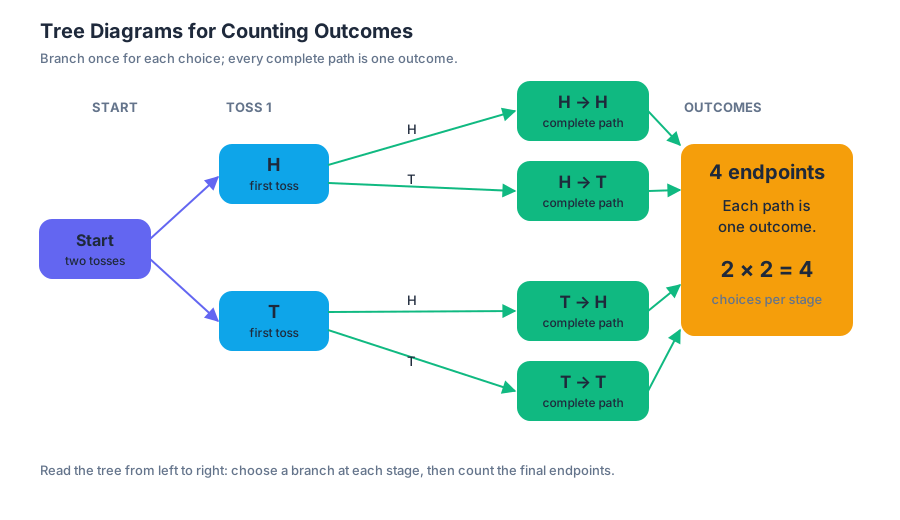
A tree diagram displays this multiplication process by branching once for each choice. For example, choosing one of $3$ shirts and one of $2$ pairs of pants gives
$$ 3\cdot 2=6 $$
outfits. The same principle counts ordered dice outcomes: $6$ choices for the first die multiplied by $6$ choices for the second gives $6\cdot 6=36$ outcomes.
When objects are selected without regard to order, use combinations. The number of combinations of $n$ objects taken $r$ at a time is written
$$ \binom{n}{r} $$
and is calculated by
$$ \binom{n}{r}=\frac{n!}{r!(n-r)!}, $$
where the factorial symbol means
$$ n!=n(n-1)(n-2)\cdots 2\cdot 1 $$
and
$$ 0!=1. $$
The quantity $\binom{n}{r}$ is also called a binomial coefficient. Since choosing $r$ objects is equivalent to leaving out $n-r$ objects,
$$ \binom{n}{r}=\binom{n}{n-r}. $$
A calculator may evaluate combinations with the $\operatorname{nCr}$ function. Enter $n$, select $\operatorname{nCr}$, enter $r$, and evaluate. The result must be a whole number because it counts selections.
Example. A fast-food restaurant offers $5$ side dishes, and a meal comes with $2$ different side dishes. How many selections are possible?
Because the order of the side dishes does not matter, this is a combination rather than a permutation. We choose $r=2$ side dishes from $n=5$ options:
$$ \binom{5}{2}=\frac{5!}{2!(5-2)!}. $$
Simplify the expression step by step:
$$ \begin{aligned} \binom{5}{2} &=\frac{5!}{2!3!}\ &=\frac{5\cdot4\cdot3\cdot2\cdot1}{(2\cdot1)(3\cdot2\cdot1)}\ &=\frac{120}{2\cdot6}\ &=\frac{120}{12}\ &=10. \end{aligned} $$
Therefore, there are
$$ \boxed{10} $$
possible selections of two side dishes.
For a probability application, suppose $2$ students are selected at random from a group of $5$ students, and exactly $2$ of the $5$ students are seniors. The total number of selections is
$$ \binom{5}{2}=10. $$
The number of selections containing two seniors is
$$ \binom{2}{2}=1. $$
Therefore, the probability of selecting two seniors is
$$ \begin{aligned} P(\text{two seniors}) &=\frac{\binom{2}{2}}{\binom{5}{2}}\ &=\frac{1}{10}. \end{aligned} $$
The combinations count each group once because the order in which the students are selected does not matter.
For an exam check, ask one decisive question: Does order matter? If different orders represent different outcomes, use the fundamental counting principle or permutations. If the same group is counted only once regardless of order, use combinations.
Practice Problems
- Two fair dice are rolled. What is the probability of rolling a pair?
Answer: The $6$ pair outcomes are $(1,1),(2,2),(3,3),(4,4),(5,5),(6,6)$, out of $36$ total outcomes:
$$ P(\text{pair})=\frac{6}{36}=\boxed{\frac{1}{6}}. $$
- A bag contains $4$ red marbles and $6$ blue marbles. If one marble is selected, what is the probability that it is red or blue?
Answer: These events are mutually exclusive and include every marble:
$$ P(\text{red or blue}) =\frac{4}{10}+\frac{6}{10} =\frac{10}{10} =\boxed{1}. $$
- A committee of $3$ people is selected from $8$ people. How many committees are possible?
Answer: Order does not matter, so use combinations:
$$ \begin{aligned} \binom{8}{3} &=\frac{8!}{3!(8-3)!}\ &=\frac{8!}{3!5!}\ &=\frac{8\cdot7\cdot6\cdot5!}{(3\cdot2\cdot1)5!}\ &=\frac{8\cdot7\cdot6}{6}\ &=56. \end{aligned} $$
Thus, there are $\boxed{56}$ possible committees.
Content adapted from OpenStax College Algebra 2e by Jay Abramson et al., licensed CC BY 4.0.
Source Materials
Study College Algebra on Lykke
This course page is free to open: signed out, you can read its first two sections, and signing in, on any plan, opens the rest. The free Lykke Chrome extension syncs your own Canvas courses, so ChatGPT, Claude and Muse can answer from your classes and deadlines. It only reads Canvas.
Add the free extensionSign in to open every section