From the free course College Algebra on Lykke
8.2 The Hyperbola
Key concepts: Cartesian coordinates: x-coordinate as horizontal displacement and y-coordinate as vertical displacement · Complex numbers and their real and imaginary parts · Rationalizing a denominator involving an imaginary number · Ellipses and their axes of symmetry · Major axis, minor axis, vertices, co-vertices, and foci of an ellipse · The relationship between an ellipse’s constant sum and the distance between its foci · Standard-form equations of ellipses centered at the origin · Horizontal versus vertical major axes and how they determine the equation’s form · Standard-form equations of ellipses centered at (h,k) · Writing and graphing an ellipse equation from given vertices and foci
By the end of this section the student can: Locate a hyperbola’s vertices and foci; Write equations of hyperbolas in standard form; Graph hyperbolas centered at the origin; Graph hyperbolas not centered at the origin; Solve applied problems involving hyperbolas
8.2 The Hyperbola
A hyperbola is the curve traced by a moving point whose distances from two fixed points differ by a constant amount. Unlike a circle or ellipse, a hyperbola has two separate branches that open in opposite directions. Its algebraic equation reveals whether those branches open horizontally or vertically, where they begin, and how they extend indefinitely.
In the Cartesian plane, the coordinate $x$ measures horizontal displacement and $y$ measures vertical displacement. A hyperbola uses these displacements in a difference of squared terms, producing equations with one positive fraction and one negative fraction. That minus sign is the visual signal that the graph is a hyperbola rather than an ellipse.
Locating the Vertices and Foci of a Hyperbola
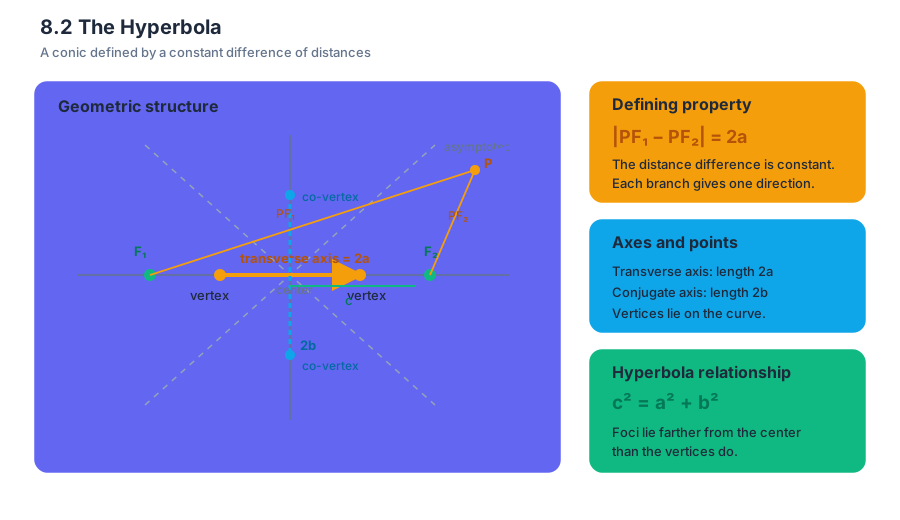
The foci of a hyperbola are two fixed points that determine the curve. For every point on the hyperbola, the absolute difference between its distances to the two foci is constant. If the foci are $F_1$ and $F_2$, then a point $P$ on the hyperbola satisfies
$$ \left|PF_1-PF_2\right|=2a. $$
The positive number $a$ determines the distance from the center to each vertex. The vertices are the points where the two branches come closest to the center. The number $c$ determines the distance from the center to each focus. For a hyperbola, the relationship among $a$, $b$, and $c$ is
$$ c^2=a^2+b^2. $$
This relationship differs from the corresponding relationship for an ellipse. For a hyperbola, the foci lie farther from the center than the vertices because $c^2$ is the sum of $a^2$ and $b^2$, so $c>a$.
For a hyperbola centered at the origin, the standard forms and principal features are as follows:
-
If the transverse axis is horizontal,
$$ \frac{x^2}{a^2}-\frac{y^2}{b^2}=1, $$
the vertices are $(\pm a,0)$, the foci are $(\pm c,0)$, and the branches open left and right.
-
If the transverse axis is vertical,
$$ \frac{y^2}{a^2}-\frac{x^2}{b^2}=1, $$
the vertices are $(0,\pm a)$, the foci are $(0,\pm c)$, and the branches open up and down.
The transverse axis passes through the vertices and the foci. Its length is $2a$. The conjugate axis is perpendicular to the transverse axis and has length $2b$. The values $a$ and $b$ are read from the denominators after the equation has been written in standard form.
Worked example: locating vertices and foci
Find the vertices and foci of the hyperbola
$$ 9x^2-16y^2=144. $$
First divide every term by $144$:
$$ \frac{9x^2}{144}-\frac{16y^2}{144}=\frac{144}{144}. $$
Simplify each fraction:
$$ \frac{x^2}{16}-\frac{y^2}{9}=1. $$
Compare this equation with the horizontal standard form:
Therefore,
$$ a^2=16,\qquad b^2=9. $$
Taking positive square roots gives
$$ a=4,\qquad b=3. $$
Find $c$ using the hyperbola relationship:
$$ c^2=a^2+b^2. $$
Substitute $a^2=16$ and $b^2=9$:
$$ c^2=16+9. $$
Thus,
$$ c^2=25, $$
so
$$ c=5. $$
Because the hyperbola is horizontal, its vertices are $(\pm a,0)$:
$$ \text{vertices: }(4,0)\text{ and }(-4,0). $$
Its foci are $(\pm c,0)$:
$$ \text{foci: }(5,0)\text{ and }(-5,0). $$
The branches therefore open to the left and right.
Writing Equations of Hyperbolas in Standard Form
The standard form of a hyperbola makes its center, direction, vertices, foci, and asymptotes visible. For a hyperbola centered at the origin, use
when the branches open horizontally, and use
when the branches open vertically.
To write an equation from geometric information:
-
Determine whether the transverse axis is horizontal or vertical.
-
Find the center, if it is not already given.
-
Find $a$ from the distance between the center and a vertex.
-
Find $c$ from the distance between the center and a focus.
-
Use
$$ c^2=a^2+b^2 $$
to solve for $b^2$.
-
Substitute $a^2$ and $b^2$ into the appropriate standard form.
Worked example: writing a horizontal hyperbola
Write the equation of the hyperbola with vertices $(6,0)$ and $(-6,0)$ and foci $(10,0)$ and $(-10,0)$.
The vertices and foci lie on the $x$-axis, so the transverse axis is horizontal. The center is the midpoint of the vertices:
$$ \left(\frac{6+(-6)}{2},\frac{0+0}{2}\right)
\left(\frac{0}{2},\frac{0}{2}\right)
(0,0). $$
The distance from the center to either vertex is $a$:
$$ a=6, $$
so
$$ a^2=36. $$
The distance from the center to either focus is $c$:
$$ c=10, $$
so
$$ c^2=100. $$
Use the relationship $c^2=a^2+b^2$:
$$ 100=36+b^2. $$
Subtract $36$ from both sides:
$$ 100-36=b^2. $$
Therefore,
$$ b^2=64. $$
Because the hyperbola is horizontal and centered at the origin, use
Substitute $a^2=36$ and $b^2=64$:
$$ \boxed{\frac{x^2}{36}-\frac{y^2}{64}=1}. $$
Graphing Hyperbolas Centered at the Origin
To graph a hyperbola centered at the origin, first identify the positive fraction. The variable in the positive fraction determines the direction in which the branches open. Then locate the vertices, construct the central rectangle using $a$ and $b$, draw the asymptotes through the rectangle's corners, and sketch the branches approaching those asymptotes.
For a horizontal hyperbola,
the vertices are $(\pm a,0)$, the foci are $(\pm c,0)$, and the asymptotes are
$$ y=\pm\frac{b}{a}x. $$
For a vertical hyperbola,
$$ y=\pm\frac{a}{b}x. $$
The central rectangle is not part of the hyperbola. It is a graphing guide: its horizontal and vertical side lengths are $2a$ and $2b$, and its diagonals lie on the asymptotes.
Worked example: graphing an origin-centered hyperbola
Graph
$$ \frac{y^2}{9}-\frac{x^2}{16}=1. $$
The $y^2$ term is positive, so the hyperbola is vertical. Compare with
Thus,
$$ a^2=9,\qquad b^2=16. $$
$$ a=3,\qquad b=4. $$
The vertices are on the $y$-axis:
$$ (0,a)=(0,3), $$
and
$$ (0,-a)=(0,-3). $$
Therefore, the vertices are
$$ (0,3)\quad\text{and}\quad(0,-3). $$
The asymptotes for a vertical hyperbola are
$$ y=\pm\frac{a}{b}x. $$
Substitute $a=3$ and $b=4$:
$$ y=\pm\frac{3}{4}x. $$
The central rectangle has horizontal corners $(\pm b,0)$ and vertical corners $(0,\pm a)$:
$$ (4,0),\quad(-4,0),\quad(0,3),\quad(0,-3). $$
To complete the graph, draw the two asymptotes $y=\frac{3}{4}x$ and $y=-\frac{3}{4}x$, mark the vertices $(0,3)$ and $(0,-3)$, and sketch two branches opening upward and downward. The branches approach the asymptotes but never cross them.
Graphing Hyperbolas Not Centered at the Origin
A hyperbola whose center is $(h,k)$ is obtained by shifting the origin-centered graph horizontally by $h$ units and vertically by $k$ units. The standard forms become
$$ \frac{(x-h)^2}{a^2}-\frac{(y-k)^2}{b^2}=1 $$
for a horizontal hyperbola, and
$$ \frac{(y-k)^2}{a^2}-\frac{(x-h)^2}{b^2}=1 $$
For a horizontal hyperbola centered at $(h,k)$:
-
The vertices are $(h\pm a,k)$.
-
The foci are $(h\pm c,k)$.
-
The asymptotes are
$$ y-k=\pm\frac{b}{a}(x-h). $$
For a vertical hyperbola centered at $(h,k)$:
-
The vertices are $(h,k\pm a)$.
-
The foci are $(h,k\pm c)$.
-
The asymptotes are
$$ y-k=\pm\frac{a}{b}(x-h). $$
Worked example: graphing a translated hyperbola
Graph
$$ \frac{(x-2)^2}{25}-\frac{(y+1)^2}{9}=1. $$
The equation has the horizontal form
Since $y+1=y-(-1)$, the center is
$$ (h,k)=(2,-1). $$
Also,
$$ a^2=25,\qquad b^2=9, $$
so
$$ a=5,\qquad b=3. $$
The vertices are
$$ (h\pm a,k). $$
Substitute $h=2$, $a=5$, and $k=-1$:
$$ (2+5,-1)=(7,-1), $$
and
$$ (2-5,-1)=(-3,-1). $$
Thus, the vertices are $(7,-1)$ and $(-3,-1)$.
Find the foci:
$$ c^2=a^2+b^2. $$
Substitute the known values:
$$ c^2=25+9. $$
Therefore,
$$ c^2=34, $$
so
$$ c=\sqrt{34}. $$
The foci are
$$ (h\pm c,k)
(2\pm\sqrt{34},-1). $$
The asymptotes are
$$ y-k=\pm\frac{b}{a}(x-h). $$
Substitute $h=2$, $k=-1$, $a=5$, and $b=3$:
$$ y-(-1)=\pm\frac{3}{5}(x-2). $$
Thus,
$$ \boxed{y+1=\pm\frac{3}{5}(x-2)}. $$
To sketch the graph, plot the center $(2,-1)$, mark the vertices $(-3,-1)$ and $(7,-1)$, draw the asymptotes through the center, and draw two horizontal branches opening left and right.
Solving Applied Problems Involving Hyperbolas
Hyperbolas model situations in which a point has a constant difference in distances from two fixed locations. Examples include navigation using signals from two transmitters, locating the source of a sound, and the paths of objects moving under certain gravitational conditions.
The defining application rule is
$$ \left|d_1-d_2\right|=2a, $$
where $d_1$ and $d_2$ are the distances from a point to the two fixed locations. If the fixed locations lie on a horizontal or vertical line, the resulting equation can be written in standard hyperbola form.
Worked example: a navigation model
Two radio transmitters are located at $F_1=(-5,0)$ and $F_2=(5,0)$, where distances are measured in kilometers. A receiver is known to be at a location whose distances from the two transmitters differ by $6$ kilometers. Find the equation describing all possible receiver locations.
The foci are $(-5,0)$ and $(5,0)$, so the center is $(0,0)$. The distance from the center to either focus is
$$ c=5. $$
The constant difference in distances is $6$, and the definition of a hyperbola says this difference equals $2a$:
$$ 2a=6. $$
Divide both sides by $2$:
$$ a=3. $$
Therefore,
$$ a^2=9. $$
Because the foci lie on the $x$-axis, the hyperbola is horizontal. Use
$$ c^2=a^2+b^2. $$
Substitute $c=5$ and $a=3$:
$$ 5^2=3^2+b^2. $$
Evaluate the squares:
$$ 25=9+b^2. $$
Subtract $9$ from both sides:
$$ 25-9=b^2. $$
Thus,
$$ b^2=16. $$
Substitute $a^2=9$ and $b^2=16$ into the horizontal standard form:
$$ \boxed{\frac{x^2}{9}-\frac{y^2}{16}=1}. $$
This equation describes every possible receiver location whose distances from the two transmitters differ by $6$ kilometers. Since the absolute value was used in the definition, both branches are included: one branch corresponds to locations closer to $F_1$, and the other corresponds to locations closer to $F_2$.
Practice Problems
-
Find the vertices and foci of
$$ \frac{x^2}{25}-\frac{y^2}{144}=1. $$
-
Write the equation of the hyperbola centered at $(1,-2)$ with vertices $(6,-2)$ and $(-4,-2)$ and foci $(7,-2)$ and $(-5,-2)$.
-
Graph the hyperbola
$$ \frac{(y-3)^2}{16}-\frac{(x+2)^2}{9}=1 $$
by identifying its center, vertices, and asymptotes.
Answers
-
Here, $a^2=25$, $b^2=144$, and
$$ c^2=a^2+b^2=25+144=169, $$
so $c=13$. The vertices are $(5,0)$ and $(-5,0)$; the foci are $(13,0)$ and $(-13,0)$.
-
The center is $(1,-2)$, $a=5$, and $c=6$. Therefore,
$$ c^2=a^2+b^2 $$
gives
$$ 36=25+b^2, $$
so $b^2=11$. The equation is
$$ \boxed{\frac{(x-1)^2}{25}-\frac{(y+2)^2}{11}=1}. $$
-
The hyperbola is vertical with center $(-2,3)$, $a=4$, and $b=3$. Its vertices are
$$ (-2,7)\quad\text{and}\quad(-2,-1), $$
and its asymptotes are
$$ \boxed{y-3=\pm\frac{4}{3}(x+2)}. $$
Content adapted from OpenStax College Algebra 2e by Jay Abramson et al., licensed CC BY 4.0.
Source Materials
Study College Algebra on Lykke
This course page is free to open: signed out, you can read its first two sections, and signing in, on any plan, opens the rest. The free Lykke Chrome extension syncs your own Canvas courses, so ChatGPT, Claude and Muse can answer from your classes and deadlines. It only reads Canvas.
Add the free extensionSign in to open every section